

































A game launcher, a desktop SEO tool or an old business program often has no proxy field, and most programs that are not browsers ignore the Windows proxy setting. The browser uses your proxy, while the program you care about keeps connecting from your home IP. Proxifier closes that gap: it catches the program's connections and sends them through the proxy you choose.
This guide covers how Proxifier works, the right protocol, IPv6 and UDP, and the full setup with a Proxynet proxy, then rules, errors and a decision table.
What is Proxifier?
Proxifier is a proxy client: a program that makes other programs on your computer work through a proxy server. Windows has a system proxy setting, but mostly browsers and apps built on the Windows web stack read it. Game clients, launchers and many desktop tools ignore it and connect directly, which is what made tools like Proxifier popular.
Proxifier checks each outgoing connection against your rules and lets it out directly, blocks it or sends it through a proxy; the program needs no change. It is made by Initex; at the time of writing the current releases are v4.14 for Windows and v3.15 for macOS, with a 31-day free trial and a one-time perpetual license.
How many different ways can Proxifier be used?
- The whole computer through one proxy. Every new TCP connection leaves through the default proxy.
- Selected programs through a proxy. Everything else keeps your own IP, and different programs can use different proxies: one browser in Germany, a game client in Türkiye.
- Selected destinations through a proxy. A rule can match a site or an IP range instead of a program, for example only
*.example.com.
Why use Proxifier?
Proxifier gives a proxy to programs that cannot take one and lets you decide which IP each program uses. For a browser alone you do not need it; see Windows and Chrome proxy settings. It earns its place with desktop apps, games and several programs on different IPs.
Which proxy server products can you use in Proxifier?
If a game server blocks your ISP's address range or reaches you over a poor route, you can send only the game client through a proxy in the right country. In classic MMOs such as Knight Online, Metin2 and Silkroad Online each client can get its own proxy IP while your browsers use others.
The main advantages of Proxifier:
- HTTPS (CONNECT) or SOCKS5 for any program, with or without a proxy setting.
- Different proxies per program, with a direct connection for everything else.
- DNS resolution through the proxy, so lookups do not reveal your location.
- Live connections, traffic per program and a log file.
How does Proxifier work?
Proxifier works at the network layer of the operating system, not inside each program:
- Interception. A network driver on Windows (Standard edition), or a network extension on macOS, sees each outgoing TCP connection.
- Rule matching. Rules are read from top to bottom; the first one whose program, host and port match wins, and the Default rule catches the rest.
- Handshake. For HTTPS Proxifier sends a
CONNECT host:portrequest with your login, the tunnel in RFC 9110. For SOCKS5 it logs in and sends a CONNECT request as defined in RFC 1928. - Forwarding. After the proxy answers, bytes flow both ways unchanged and the site sees the proxy's IP.
- Logging. Each connection is logged when it opens and closes, with bytes and lifetime.
Which protocol should you choose in Proxifier: HTTPS, SOCKS5 or HTTP?
"HTTPS" in Proxifier's protocol list does not mean an encrypted link to the proxy. In the Proxifier proxy server documentation, HTTPS is an HTTP proxy that opens CONNECT tunnels to any port, while HTTP only carries unencrypted web traffic.
| Proxifier option | What it is | Proxynet port | Use it for |
|---|---|---|---|
| HTTPS | HTTP proxy with CONNECT, any port | HTTP port (pr.proxynet.io:8000) | Default for apps, browsers and most games |
| SOCKS Version 5 | SOCKS5, any TCP traffic, user and password | SOCKS5 port shown in the panel | Apps that expect SOCKS5, game clients |
| SOCKS Version 4(A) | Legacy SOCKS, no password | Not needed | Old proxies only |
| HTTP | Plain HTTP only; enable in Profile > Advanced > HTTP Proxy Servers | Not needed | Rarely |
If the protocol does not match the port, the proxy drops the connection. The two protocols are compared in SOCKS vs. HTTP proxy, and SOCKS5 is explained in What are SOCKS5 proxies?.
Does Proxifier support IPv6 and UDP?
IPv6: yes. The proxy address can be IPv4, IPv6 or a hostname, rules accept IPv6 addresses, and Proxifier can tunnel IPv4 through an IPv6 proxy and the reverse. With an IPv6 Proxy, the target site must accept IPv6; see IPv4 vs IPv6 proxies. If only IPv6 targets fail, resolve hostnames through the proxy (step 7).
UDP: no. Proxifier tunnels TCP only. Since version 4.11 it can log and block UDP connections, but UDP still does not go through the proxy, so voice chat and real-time game traffic go out directly or get blocked. Browsers fall back from QUIC to normal HTTPS over TCP when UDP is blocked. Proxynet's SOCKS5 port carries UDP only for programs that speak SOCKS5 UDP themselves.
To see whether a program uses UDP, run this in PowerShell while it is open:
$ids = (Get-Process chrome).Id
Get-NetUDPEndpoint -OwningProcess $ids | Select-Object LocalAddress, LocalPort
Any output means the program uses UDP, which Proxifier does not send through the proxy. Why games use UDP is in TCP vs. UDP.
Is Proxifier available on Android, iOS and Linux?
| Platform | Version | Requirement |
|---|---|---|
| Windows (Standard and Portable) | v4.14 | Windows 7 to 11, Server 2008 to 2022 |
| macOS | v3.15 | macOS 12 to 26, administrator rights to install the network extension |
| Android | v1.18 | Android 8 or newer, Google Play; some desktop features missing |
There is no official iOS or Linux version. Unofficial Linux projects exist on GitHub, but we do not recommend them for a paid proxy login; use proxychains-ng or environment variables as in Linux proxy settings. On phones the built-in settings are usually enough: Android and iPhone.
What do you need before you start?
Take the address, port, username and password from the Proxynet panel. The Endpoint Generator writes your country, city and session into the username, so copy it whole. With IP whitelisting (up to 10 IPs) you leave authentication off; both methods are compared in Proxy authentication: user:pass vs IP whitelist.
Test the proxy once outside Proxifier with curl.exe, which ships with Windows 10 and 11 (in Windows PowerShell plain curl is a different command):
# HTTP port: the protocol Proxifier calls "HTTPS"
curl.exe -x http://user:pass@pr.proxynet.io:8000 https://api.ipify.org

# SOCKS5 port: socks5h lets the proxy resolve the hostname
curl.exe -x socks5h://user:pass@pr.proxynet.io:1080 https://api.ipify.org
Both print the proxy's IP. A wrong password gives curl: (7) CONNECT tunnel failed, response 407 or curl: (97) User was rejected by the SOCKS5 server (1 1)., and Proxifier will fail the same way; see How to use cURL with a proxy. Also remove any proxy set inside the program or in Windows, or traffic goes through the proxy twice.
How to use Proxifier?
Download Proxifier only from the official site, proxifier.com. The screenshots are from the Windows Portable edition, which needs no installation but skips background services and console programs; the Standard edition handles those.
1. Create a proxy server
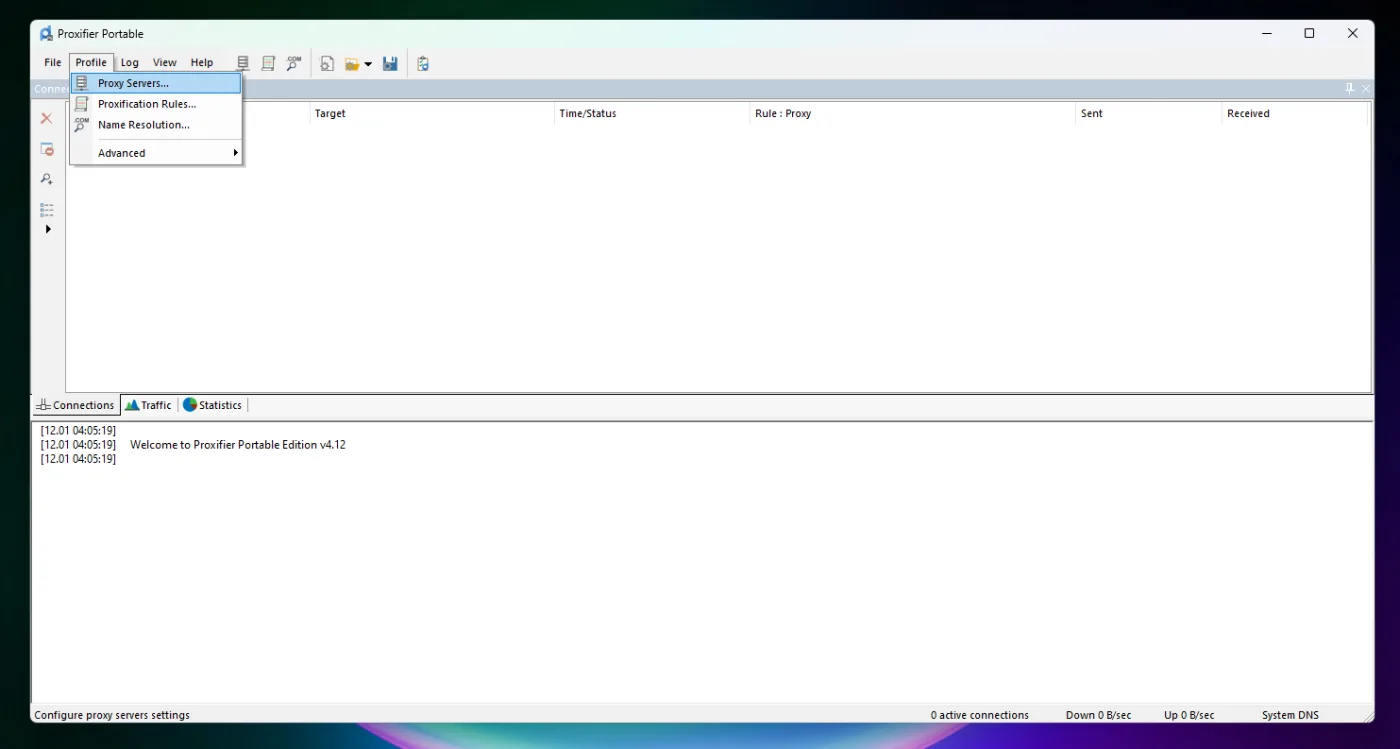
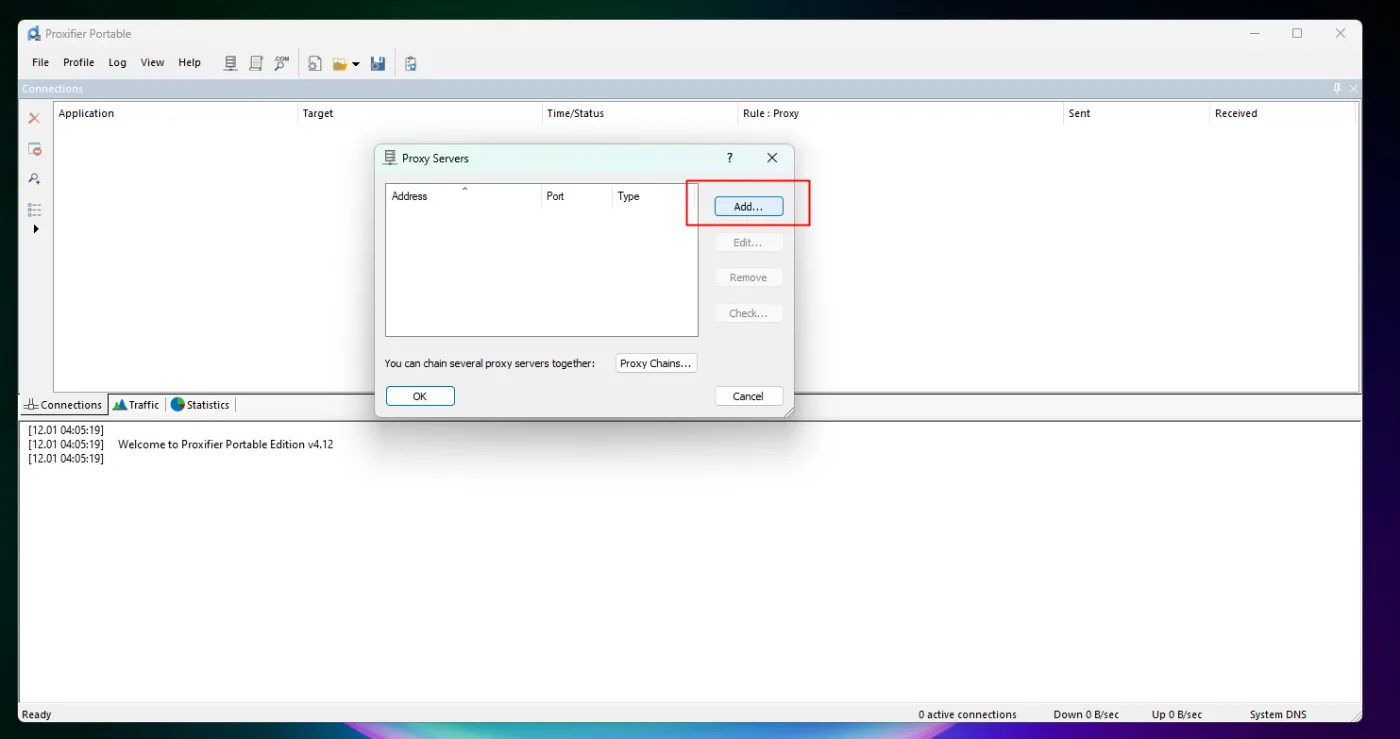
Open Profile > Proxy Servers and click Add. Every proxy you add can later be used in rules.
2. Enter your proxy address details
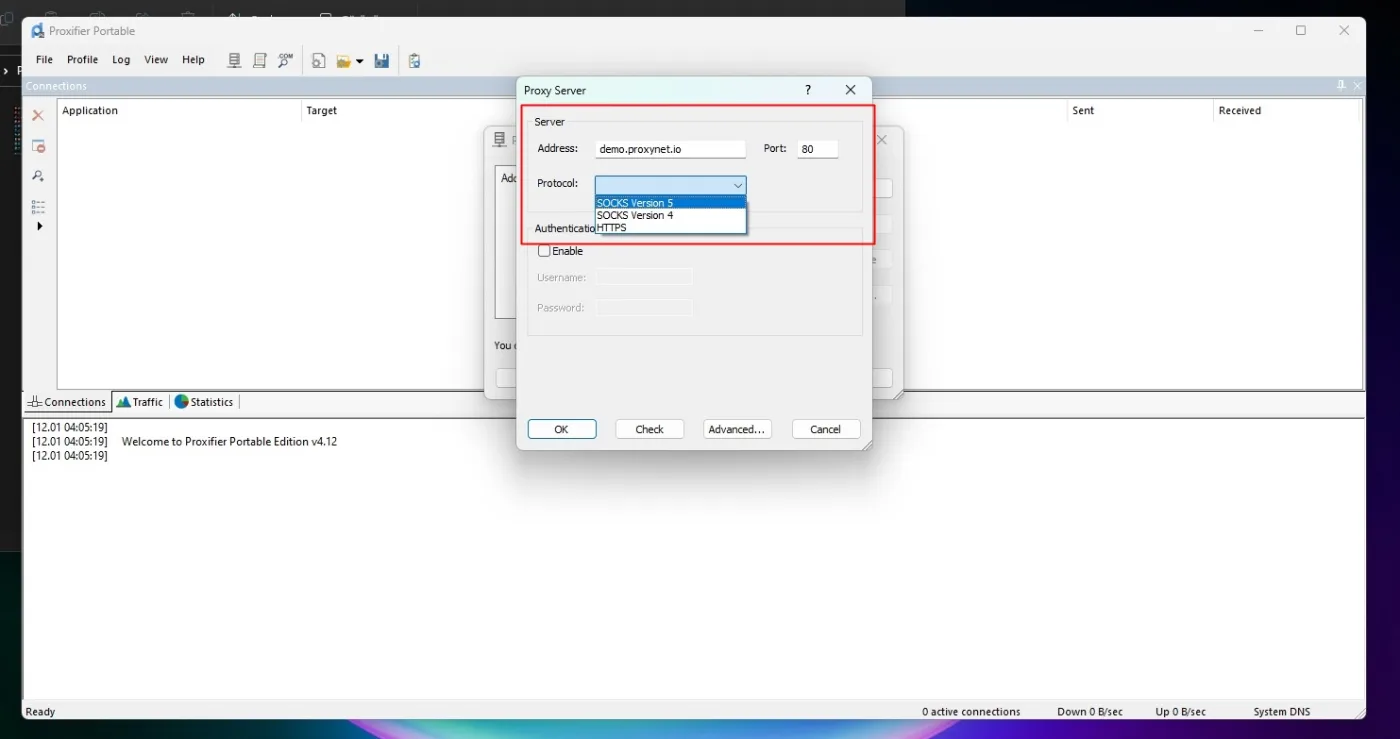
Fill in Address and Port, then choose the Protocol that matches the port: "HTTPS" for Proxynet's HTTP port, "SOCKS Version 5" for the SOCKS5 port.
3. Enter your proxy username and password (user:pass)
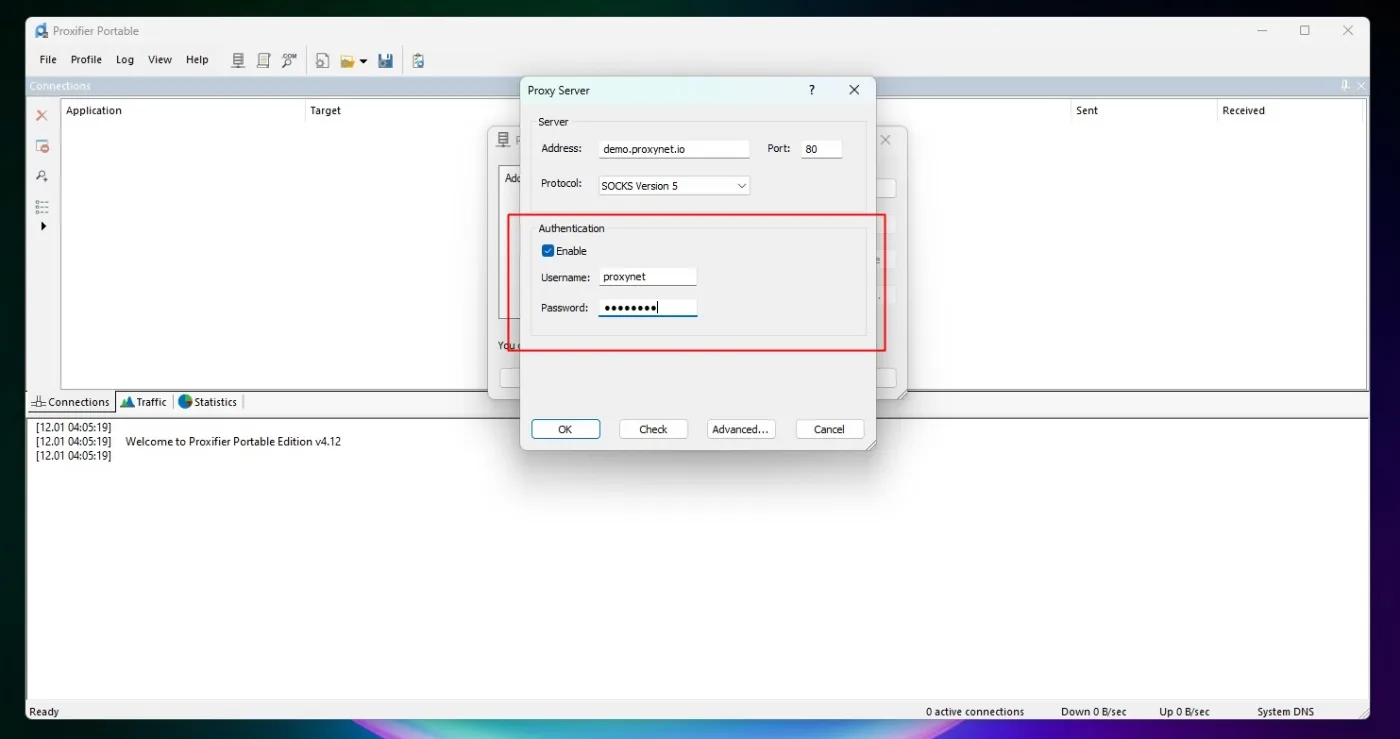
Under Authentication, tick Enable and paste the username and password from the panel. With IP whitelisting, leave it unticked.
4. Test your proxy address
Click Check. Proxy Checker tests the connection to the proxy, a connection through it to a target host, and latency; green lines mean it passed. When you save the proxy with OK, Proxifier may ask whether to use it by default; choose No when only some programs should use it.
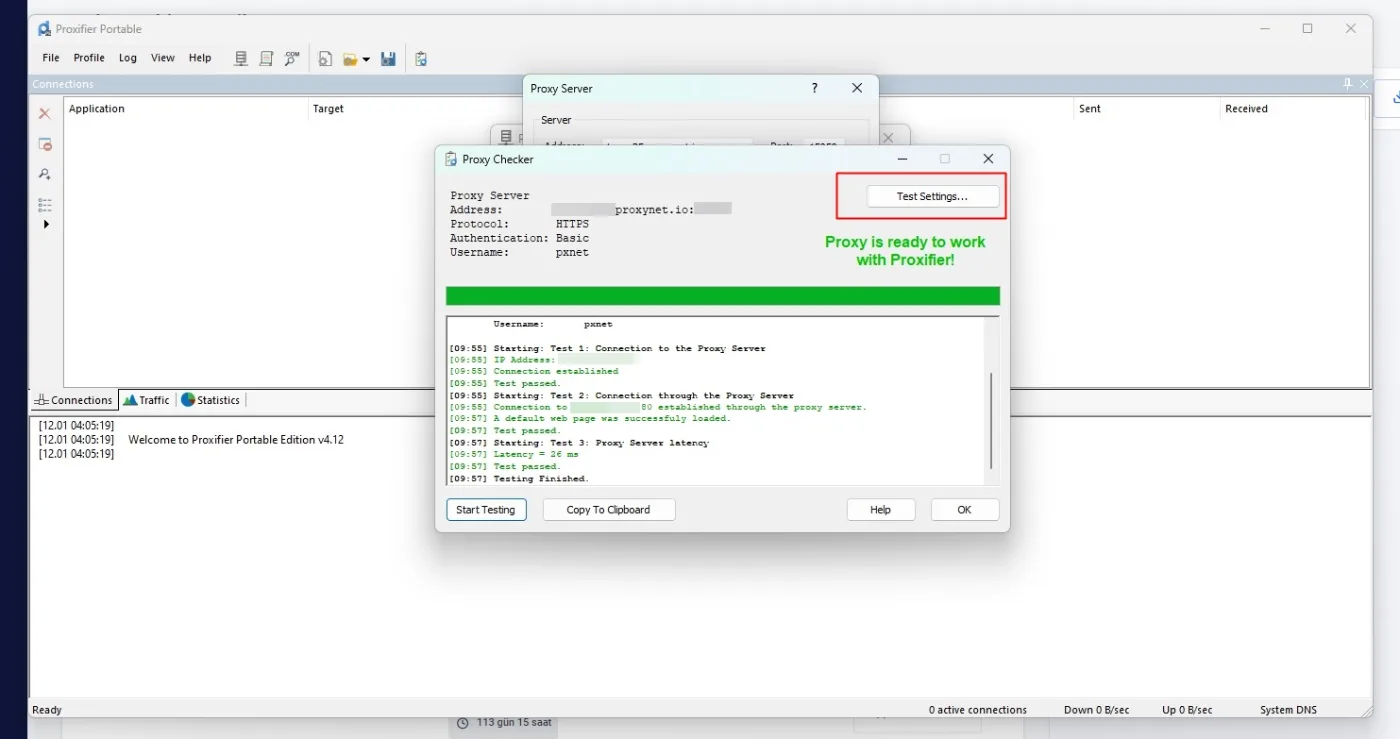
5. Change the website address used to test the proxy
The second test uses google.com as its target. Some providers restrict domains such as Google or social networks on new accounts to prevent abuse, so this test can fail while the proxy works. Click Test Settings and change Target host to a site your provider allows, ideally the one you will use.
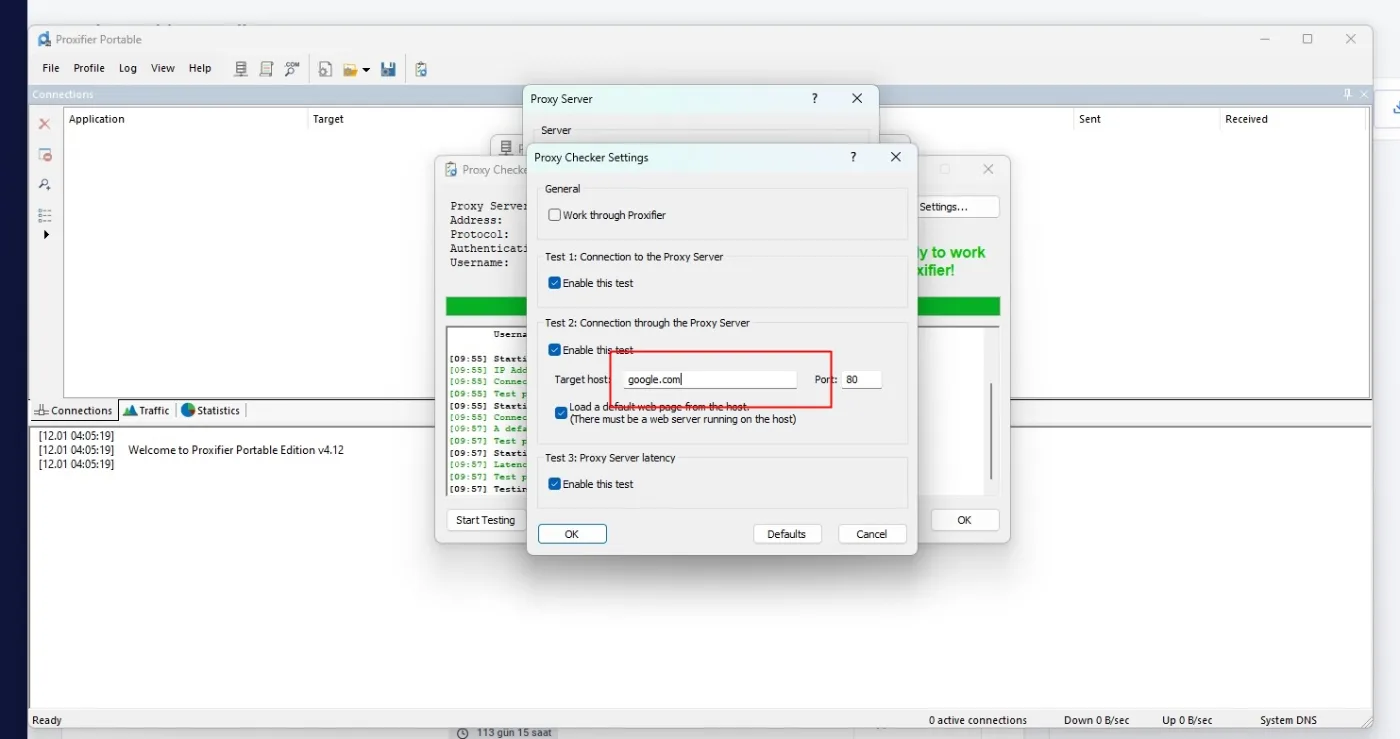
6. Assign a proxy to each program with Proxification Rules
Open Profile > Proxification Rules. Each rule has Applications, Target Hosts, Target Ports and an Action (Direct, Block or a proxy). Click Add, pick the program's .exe with Browse and choose the proxy. Rules run from top to bottom.
Leave the Localhost rule on Direct: a remote proxy cannot reach programs on your own machine. Default covers everything else: Direct if only listed programs should use the proxy.
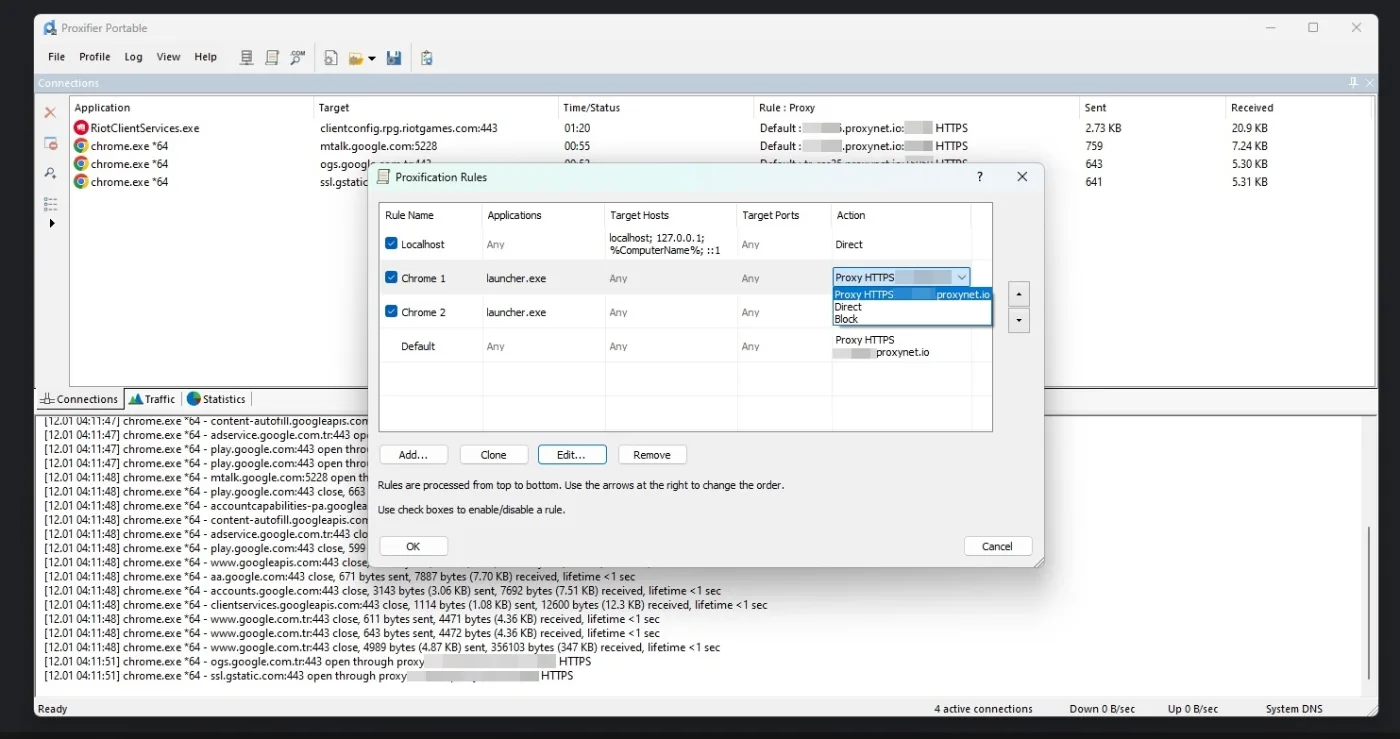
To find a program's .exe, open it and run Get-Process | Where-Object { $_.MainWindowTitle } | Select-Object ProcessName, Path in PowerShell.
7. Send DNS lookups through the proxy
In Profile > Name Resolution, untick "Detect DNS settings automatically" and choose Resolve hostnames through proxy when location matters: the proxy resolves names in its own country and your ISP's DNS sees nothing. Programs then get placeholder addresses (127.8.x.x by default), so rules based on IP addresses stop matching; use hostnames. Proxifier's documentation advises it mainly when local lookups fail, so otherwise keep the default. Check with WebRTC and DNS leak tests.
8. Overview of the Proxifier interface
The main window has Connections, Traffic and Statistics tabs. The columns of the connection list are:
- Application: the program that opened the connection.
- Target: the host and port the program is talking to right now.
- Time/Status: how long the connection has been open and its state.
- Rule : Proxy: the rule and proxy applied; Direct means the connection goes out without a proxy.
- Sent / Received: the data sent and received, your live upload and download traffic.
The log below the list shows which proxy each connection used and any errors in real time, so you can trace a dropped connection afterwards.
9. Close the Proxifier program
When you do not need the proxy, disable the rules or right-click the tray icon and choose Exit.
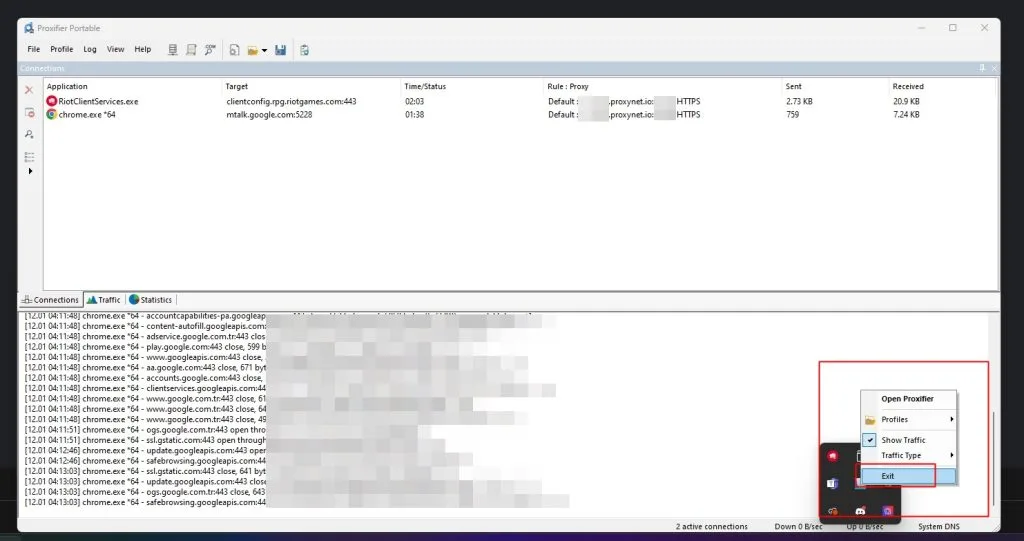
Proxification rule examples
| Goal | Applications | Target hosts | Action |
|---|---|---|---|
| One browser through the proxy | firefox.exe | Any | Proxy HTTPS |
| A game on a fixed IP | launcher .exe and client .exe | Any | SOCKS5, sticky or static IP |
| One site through the proxy | Any | *.example.com | Proxy |
| Local network direct | Any | 192.168.0.0/16 | Direct |
Add both the launcher and the client .exe. With a rotating line each new connection can get a new IP, so a game or login may appear from several addresses; use a Sticky Proxy session (1-60 minutes) or a static ISP IP when one IP must hold.
What can you use Proxifier and Proxynet for?
- Classic MMO clients, one IP per client: gaming proxy.
- Desktop scraping and SEO tools without a proxy field: data scraping.
- Testing a localized app from another country: localization.
- Team account management, one consistent IP per client account as account hygiene: What is an antidetect browser?.
- One program on a Türkiye IP while abroad: Türkiye IP address from abroad.
Common Proxifier errors and how to fix them
- Proxy Checker test 1 passes, test 2 fails. The target host is blocked; change it in Test Settings.
- "Proxy server cannot establish a connection with the target". The proxy could not reach the site. Check the target in the log.
- "Proxy closed the connection unexpectedly". Usually the protocol does not match the port.
- Authentication fails or 407. The username was shortened or the password is wrong; with whitelisting, your IP may have changed.
- "Connection timed out" (10060). Wrong address or port, or a firewall blocks it. Test with curl.
- "Infinite loop connection detected". A VPN, antivirus or local proxy routes traffic back into Proxifier. Give it a Direct rule.
- The program still shows Direct. A higher rule matched first, or the program runs under another .exe.
- Voice chat or matches fail after login. That traffic is UDP.
- Everything is slow. The program has its own proxy set too; see How to test a proxy.
Decision guide
| Need | Recommendation |
|---|---|
| A desktop program with no proxy setting | Proxifier, "HTTPS" on the HTTP port, one rule for that .exe |
| Only a browser | Browser or system settings |
| Classic MMO client | SOCKS5 or HTTPS with a static ISP or sticky residential IP |
| Voice chat or UDP games | An app with native SOCKS5 UDP support |
| Many requests from a scraping tool | Rotating Proxy with a rule for the tool |
| Linux or a phone | proxychains-ng, or the phone's own proxy setting |
Frequently asked questions
Is Proxifier free?
No. There is a 31-day free trial on Windows and macOS, then a one-time payment for a perpetual license with free minor updates. Proxifier does not include proxies.
Is Proxifier safe to use?
The official version from proxifier.com can encrypt the stored profile password. The risk is cracked copies, which install a network driver from an unknown source.
Is Proxifier a VPN?
No. It routes TCP connections of chosen programs through a proxy without encrypting them. A VPN encrypts all device traffic, UDP included. Running both can create a connection loop unless the VPN gets a Direct rule.
How do I use Proxifier with Chrome?
Add a rule for chrome.exe with your proxy as the action, and make sure Chrome is not set to another proxy. Chrome's QUIC traffic is UDP and is not proxied; when UDP is blocked, Chrome falls back to TCP.
Can Proxifier rotate IP addresses?
Only between the proxies you add. Rotation works better on the proxy side: a rotating line from the panel gives new IPs behind one address.
What can I use instead of Proxifier?
On Linux, proxychains-ng. On Windows, the open-source ProxiFyre sends TCP and UDP of chosen programs through SOCKS5. Many programs, such as Telegram Desktop, have their own proxy field.
Summary
Proxifier is a stable proxy manager. For browser-only work it lacks fingerprint, header and location handling, but it is a practical way to give different programs different proxy servers. Match the protocol to the port, test with an allowed target, write one rule per program and resolve DNS through the proxy when location matters; UDP stays outside. For the IPs behind it, choose a Residential Proxy or another plan from our proxy range.