

































When you look at proxy plans, the same provider often offers both IPv4 and IPv6, and the IPv6 side usually comes with far more addresses. There is a reason for that generosity: IPv6 addresses are plentiful and IPv4 addresses are scarce. But more addresses do not make IPv6 the right choice for every job. An IPv6 proxy cannot reach a site that does not accept IPv6 connections at all.
In this article we cover the basic difference between the two protocols, why it matters when you use a proxy, how to test whether a target site supports IPv6, and why sites look at address blocks rather than single addresses when they block IPv6. At the end there is a decision table by type of job.
What are IPv4 and IPv6?
An IP address is a device's address on the network. Two versions are in use today.
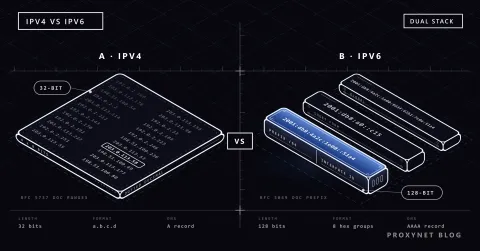
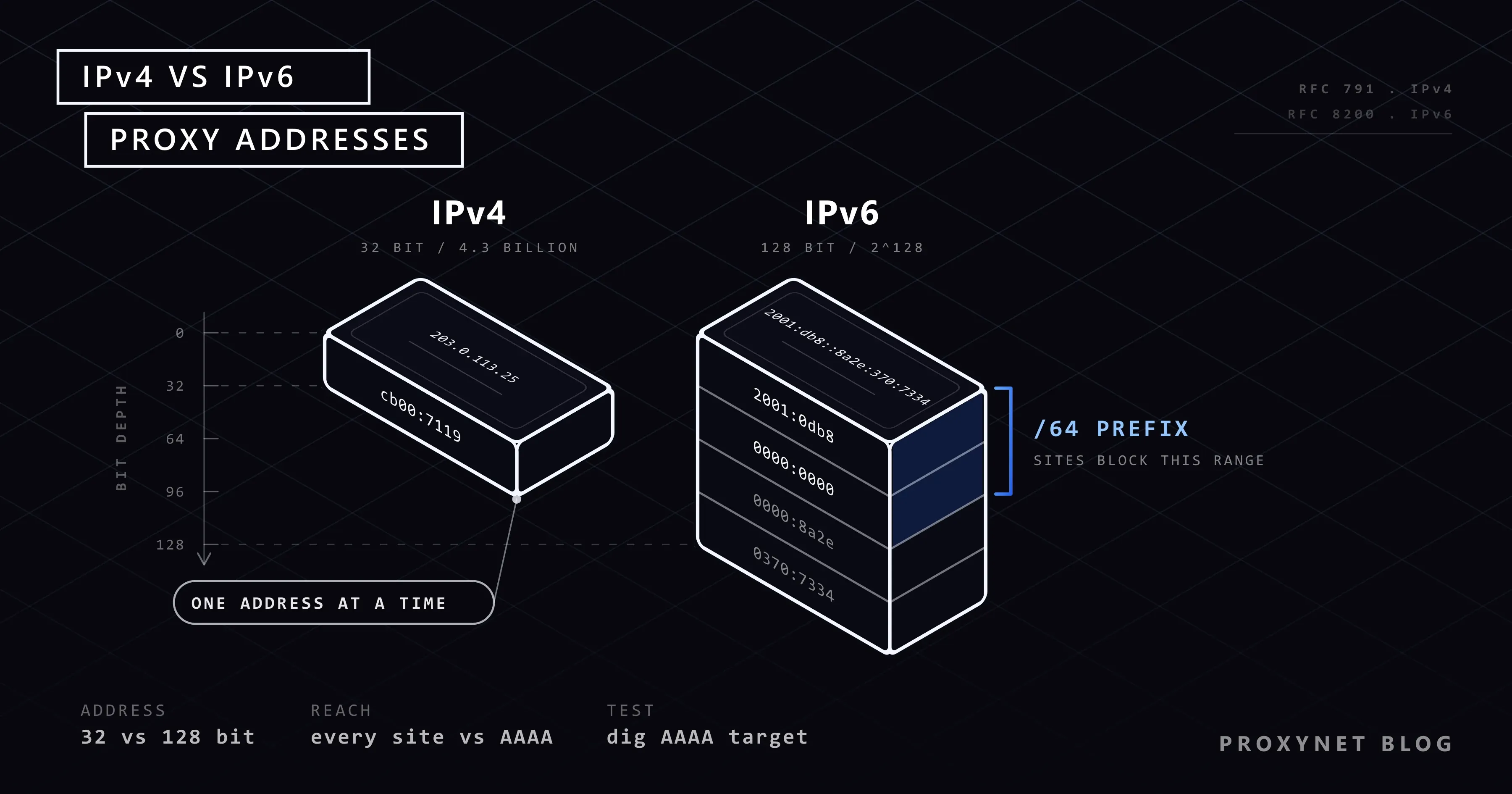
IPv4 uses 32-bit addresses written as four numbers separated by dots, like 203.0.113.25. 32 bits gives 4,294,967,296 possible addresses. That looked more than enough when the internet was first designed; today there are no free IPv4 blocks left to hand out. IANA's IPv4 address space registry shows that all blocks have been allocated to the regional registries. New demand for IPv4 is now met from existing blocks changing hands, which turns an IPv4 address into a cost item.
IPv6 uses 128-bit addresses written as groups of hexadecimal digits separated by colons, like 2001:db8:85a3::8a2e:370:7334. The 128-bit address space is so large that even a single home connection can be given a block containing billions of addresses. The protocol itself is defined in RFC 8200.
The two protocols do not understand each other directly. A client with only an IPv4 address cannot talk to a server with only an IPv6 address without a translator in between, and the reverse is also true. That single sentence explains why the proxy choice matters.
Why does IPv4 vs IPv6 matter for a proxy?
When you use a proxy, the target site sees the proxy's exit IP address, not yours. Whether that address is IPv4 or IPv6 decides three things.
1. Whether you can reach the target. If the proxy talks to the target over IPv6, the target site must also have an IPv6 address. If it does not, no connection is made.
2. The size and cost of the address pool. Because IPv4 addresses are scarce, every IPv4 proxy carries a real cost. With IPv6, a provider can allocate many addresses from a large block at low cost. The same budget buys far more addresses on IPv6.
3. How the site groups you. When blocking malicious traffic on IPv4, a site looks at a single address or a small block. On IPv6, looking at a single address is pointless, because even one user can generate countless addresses. So sites evaluate IPv6 per subnet. We open this topic under its own heading below.
| Criterion | IPv4 proxy | IPv6 proxy |
|---|---|---|
| Address length | 32 bits | 128 bits |
| Example | 203.0.113.25 | 2001:db8::25 |
| Address supply | Scarce, blocks change hands | Very large blocks |
| Cost | Higher per address | Lower per address |
| Site compatibility | Works on every site | Only on sites that support IPv6 |
| How the site groups traffic | Single address or small block | Usually a /64 or wider block |
| Effect of a block | Usually affects one address | Can affect every address in the same block |
| Suitable for | Mixed targets, jobs that need compatibility | Address-heavy jobs on large IPv6-enabled platforms |
| Testing needed | None | AAAA record check on the target |
Does every site accept IPv6 connections?
No. For a site to be reachable over IPv6, its domain must have an AAAA record in DNS and its server must actually respond on an IPv6 address. Large search engines, social media platforms and many sites behind CDNs support IPv6. Smaller e-commerce sites, corporate sites on older infrastructure, some banks and public services serve over IPv4 only.
To see IPv6 adoption by country and network, you can look at Google's IPv6 statistics page. That page measures the user side; target site support has to be tested one by one.
What happens when you send a request through an IPv6 proxy to a site without an AAAA record depends on the provider's setup:
- If the proxy only exits over IPv6, no connection is made; the client sees a timeout or a
502-style error. - If the proxy is dual-stack, it can exit to the target from an IPv4 address. The connection works, but the site sees the proxy's IPv4 address, not an IPv6 one. You are not benefiting from the address pool you paid for.
The second case is silent, so it is easier to miss. That is why it matters to check which protocol your exit address actually uses before starting the job.
How do you test IPv6 support?
The test has two stages: does the target site have an IPv6 address, and does the proxy exit to it over IPv6.
1. Does the target have an AAAA record? Use dig on Linux and macOS, nslookup on Windows:
# Linux / macOS
dig AAAA example.com +short

# Windows
nslookup -type=AAAA example.com
If the command returns one or more IPv6 addresses, the site is reachable over IPv6. If it returns nothing, an IPv6 proxy is not suitable for that target.
2. Does your own connection support IPv6? cURL's -6 option forces the connection over IPv6 only:
curl -6 https://example.com -o /dev/null -s -w "%{http_code}\n"3. Which protocol does the proxy exit with? The connection between the client and the proxy is often IPv4; what matters is the address the proxy uses to reach the target. To see it, use two services that return the exit address:
# Returns an IPv4 address only
curl -x "http://user:pass@pr.proxynet.io:8000" https://api.ipify.org

# Returns IPv6 if available, otherwise IPv4
curl -x "http://user:pass@pr.proxynet.io:8000" https://api64.ipify.org
If you are using an IPv6 proxy, the second command should return an address with colons. If you see a dotted address, the proxy is exiting to the target over IPv4. For cURL's other proxy options, see How to Use a Proxy with cURL.
Why do sites block IPv6 addresses in blocks?
On IPv4, a home connection usually gets a single public IP address; blocking that address blocks the connection. IPv6 works differently. In standard practice a local network is given a /64 block. That one block contains more than 18 quintillion addresses, and the owner of the connection can use any of them at any moment.
Blocking a single IPv6 address therefore achieves nothing: the blocked party simply takes a new address from the same block. So systems that apply rate limits and blocks usually group IPv6 traffic at the /64 level, and sometimes at wider /56 or /48 levels.
For a proxy user, this means:
- Hundreds of addresses from the same /64 block can look like a single visitor to a site. A large number of addresses does not mean you are spreading requests across truly different sources.
- When one address is blocked, the whole block can be affected. Your other addresses in the same block can hit rate limits too.
- Getting addresses from different blocks matters. When choosing an IPv6 proxy, ask whether the provider gives addresses from a single /64 block or from different blocks.
That is why generalisations like "IPv6 proxies are more anonymous" or "IPv6 addresses don't get blocked" are wrong. The advantage of IPv6 is address supply and cost; how the site evaluates you depends on how the blocks are structured.
Where is an IPv6 proxy an advantage?
- Multi-account work on large platforms that support IPv6. Most social media and search platforms support IPv6, and assigning a separate address to each account costs little on IPv6. How this kind of work is set up is on our social media proxy solution page.
- Tests where the number of addresses matters. When you need many addresses to see how an application behaves with requests from different sources.
- Testing your own infrastructure's IPv6 compatibility. Checking from outside that your site or API responds correctly over IPv6.
- Jobs where cost comes first and the targets are known. If your target list is fixed and all of them have AAAA records, the same budget builds a wider address pool.
For these scenarios, see the plans on our IPv6 Proxy page.
Where is an IPv4 proxy necessary?
- Data collection jobs with mixed or changing target lists. If you cannot know the sites you will scrape in advance, or the list keeps changing, IPv4 is the only option that works on every target. Scraping setups are covered on our data scraping solution page.
- Local e-commerce sites and price comparison. Many mid-sized e-commerce sites in Türkiye serve over IPv4 only.
- Game servers and legacy protocols. A large share of game servers and older desktop software runs on IPv4.
- Client environments without IPv6 connectivity. Even if the proxy exits over IPv6, problems can arise if the tool or network you use does not support IPv6 addresses.
If compatibility comes first, IPv4 Proxy plans are the right starting point. For fast, fixed IPv4 addresses, also consider a Datacenter Proxy; the difference between datacenter and residential IPs is explained in Residential vs Datacenter Proxy.
Common mistakes
- Buying an IPv6 plan without checking the target's AAAA record. This is the most common mistake. A few seconds of
digprevents it from the start. - Not noticing a dual-stack proxy falling back to IPv4. Do not assume you are exiting over IPv6 just because the connection works; confirm the exit address with a service such as
api64.ipify.org. - Mistaking address count for source diversity. A hundred addresses from the same /64 block are often treated as one source for rate limiting.
- Overlooking that the client software does not support IPv6 address syntax. Some older tools do not parse bracketed IPv6 addresses (
[2001:db8::1]:8080) correctly. Connecting to the proxy by hostname avoids the problem. - Treating IPv6 as a privacy layer. The protocol version does not provide anonymity. Browser fingerprints, cookies and account data work the same on IPv6 as on IPv4.
Decision guide
| Your need | Recommendation |
|---|---|
| You do not know the target sites in advance | IPv4 |
| Mid-sized e-commerce sites in Türkiye | IPv4 |
| Game server or legacy desktop software | IPv4 |
| Many accounts on large IPv6-enabled platforms | IPv6 (addresses from different blocks) |
| A wide address pool on the same budget, targets have AAAA records | IPv6 |
| Testing your own site's IPv6 reachability | IPv6 |
| Both compatibility and address supply | Use both protocols together |
Frequently asked questions
Can an IPv6 proxy connect to IPv4 sites?
A proxy that only exits over IPv6 cannot connect to a site that only has an IPv4 address. Some providers run dual-stack and exit to the target from IPv4 in that case; the connection works, but the site does not see your IPv6 address. Confirm which setup your provider uses with the exit address test.
Are IPv6 proxies faster?
The protocol version on its own does not make a noticeable speed difference. Speed is decided by the proxy server's location, line quality and distance to the target. On some networks the IPv6 route is shorter than the IPv4 one, on others it is longer.
Can I tell from the browser whether a site supports IPv6?
If the browser supports both protocols, it does not show you which one it is using. The most reliable way is to query the domain's AAAA record with dig or nslookup.
What does a /64 block mean?
It is a group of addresses in which the first 64 bits of the IPv6 address are fixed and the last 64 bits are free. In standard practice a local network is given one /64 block. When sites evaluate IPv6 traffic, they usually treat this block as a single source.
Is IPv6 widely used in Türkiye?
Adoption varies by operator and network type and grows over time. For a current, country-level figure, look at sources that measure it, such as Google's IPv6 statistics page. For choosing a proxy, what really matters is the target sites' support, not the users'.
Can the same proxy provide both IPv4 and IPv6?
Yes, dual-stack proxies can exit over both protocols. Which protocol is used is usually decided by the target's DNS records and the provider's settings. Getting separate IPv4 and IPv6 addresses for your needs leaves the control with you.
Summary
IPv4 works on every site, but its addresses are scarce and expensive; IPv6 offers a wide and economical address pool, but only helps on targets that support IPv6. Before choosing, check your targets' AAAA records, confirm that the proxy really exits over IPv6, and account for the fact that sites evaluate IPv6 traffic in blocks rather than single addresses. For the bigger picture of proxy types, see What Is a Proxy Server and How Does It Work?, and for plans, our IPv4 Proxy and IPv6 Proxy pages. If you need dedicated addresses, Private Proxy will also help.