

































You have a proxy address, a port and perhaps a username and password, and you want Safari on your iPhone to use them. The Settings app has no row called "Proxy"; the setting sits under HTTP Proxy inside the Wi-Fi menu, and the setup takes a minute.
This guide shows the setup on iPhone and iPad step by step, what goes into the Server, Port and Authentication fields, and what Off, Manual and Automatic mean. It then covers the limits (one Wi-Fi network, no mobile data, no SOCKS5, apps that ignore the setting), testing, turning the proxy off and the usual errors. Menu names follow the current English interface of iOS and iPadOS.
What is an HTTP proxy on iPhone?
A proxy server sits between your iPhone and the sites you open: it forwards each request from its own address, so the site sees the IP address of the proxy server, not the address of your connection. The idea is explained in What Is a Proxy Server and How Does It Work?
"HTTP Proxy" names the type of proxy the iPhone talks to, not the sites that pass through it. For an https:// site the iPhone asks the proxy to open a tunnel, and the page stays encrypted inside it. One entry covers both kinds of sites.
A proxy changes the address sites see; it does not encrypt your traffic the way a VPN does. The difference is laid out in Proxy vs. VPN.
How to set up a proxy on iPhone or iPad
Apple keeps the proxy in each Wi-Fi network's details, next to DNS, as its guide to Wi-Fi settings on iPhone notes; the iPad uses the same screen. Have the address, HTTP port and any login ready. In the Proxynet dashboard the Endpoint Generator produces them for the country, city and session you pick. The screenshots come from an earlier iOS version; the names have not changed.
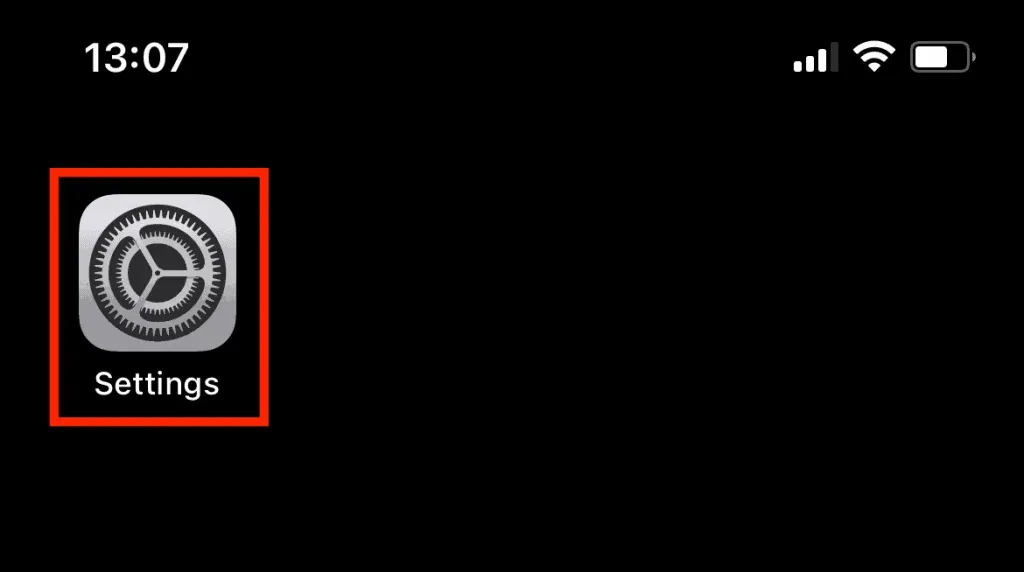
Step 1: Open the Settings app on your iPhone or iPad.
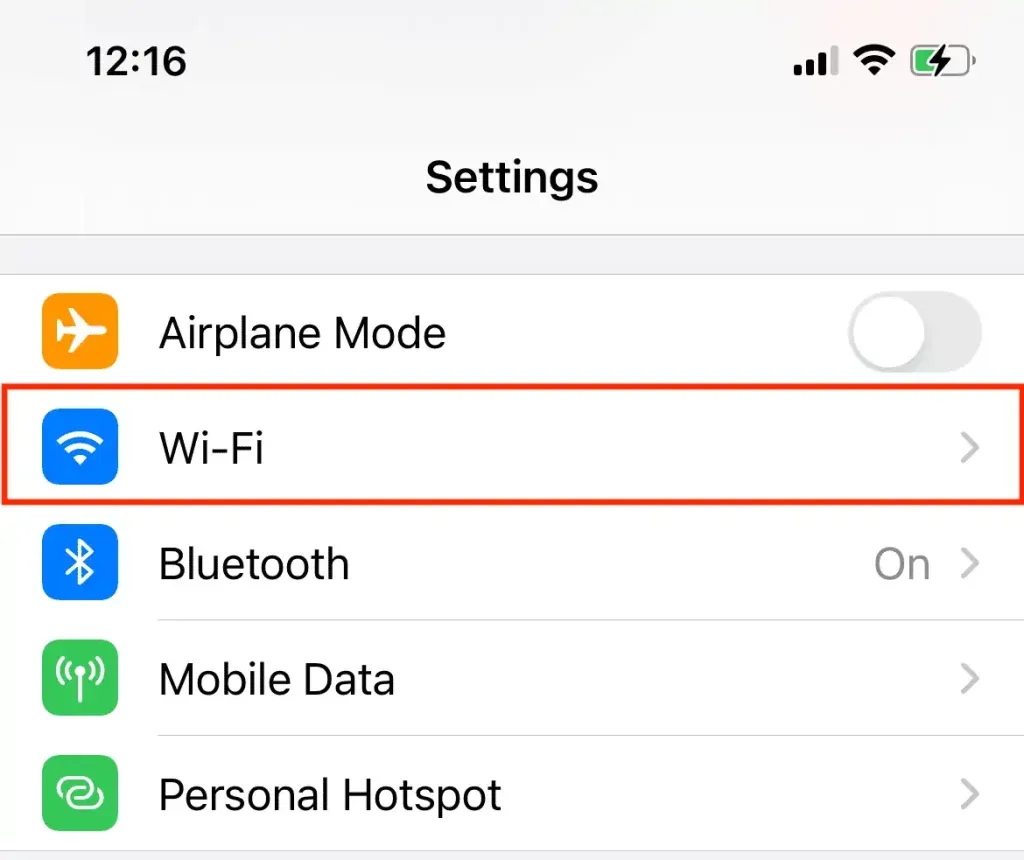
Step 2: Tap Wi-Fi.
Step 3: Find the network you are connected to (it has a blue check mark) and tap the info (i) button on its row.
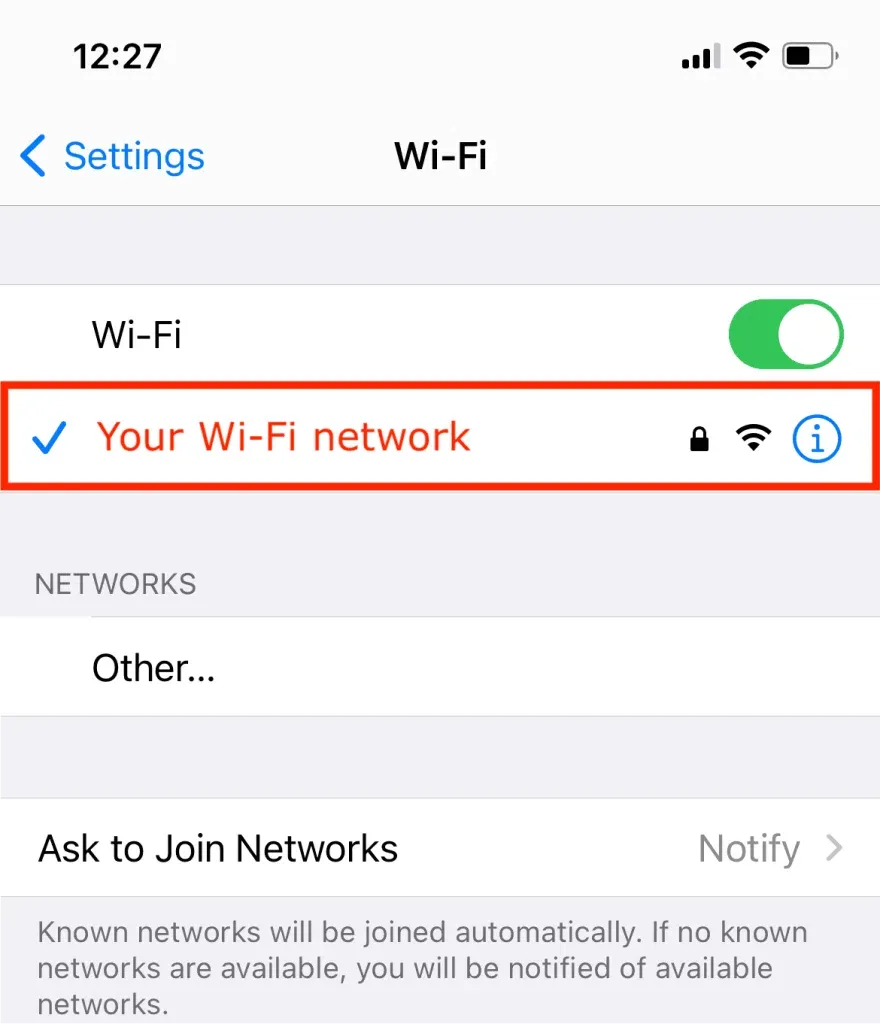
Step 4: Scroll to the bottom. Under HTTP Proxy, Configure Proxy is set to Off by default. Tap it.
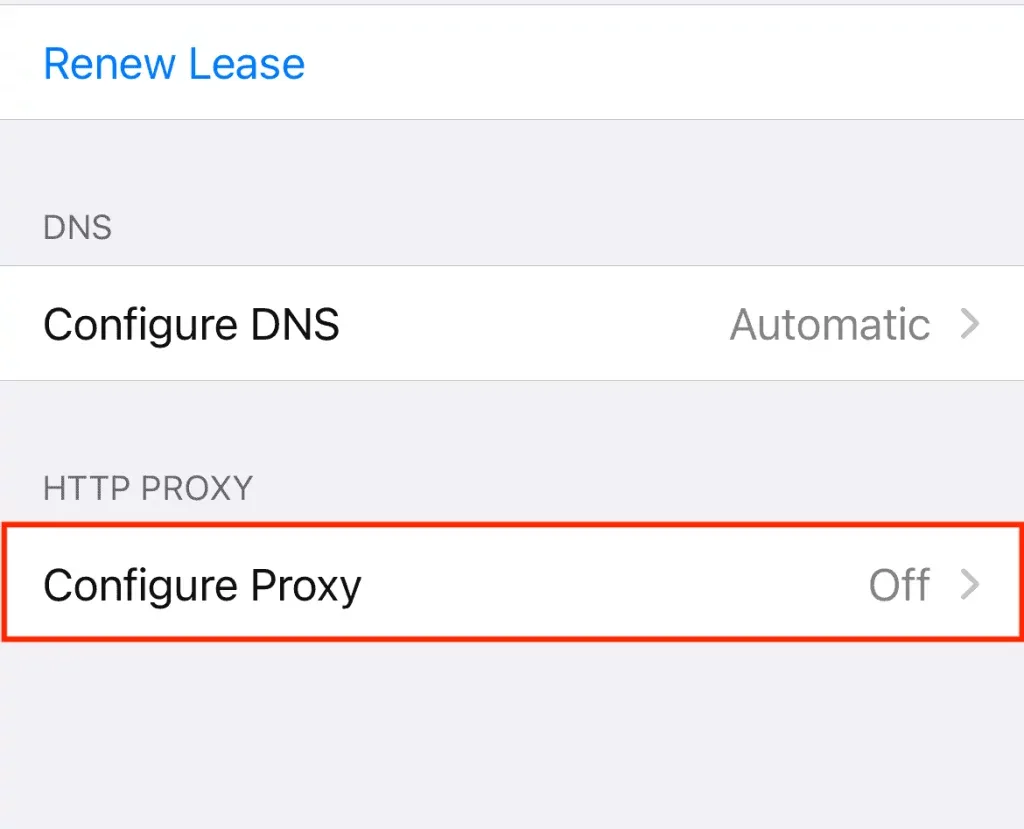
Step 5: Choose Manual.
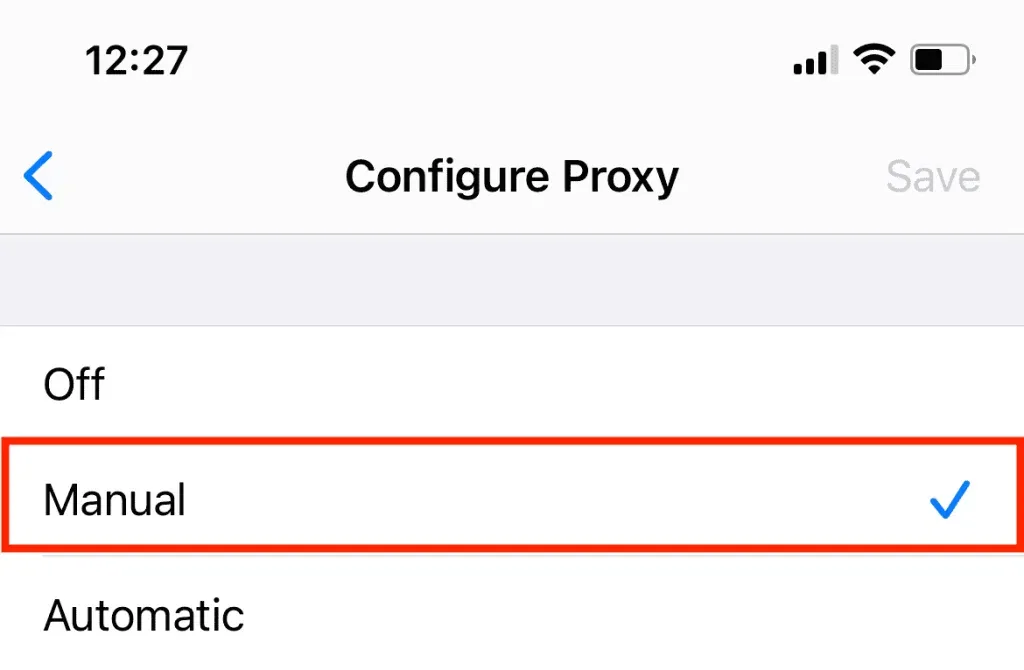
Step 6: Type the proxy address into Server and the port into Port. If the proxy needs a login, turn on Authentication and fill in Username and Password. Tap Save at the top right.
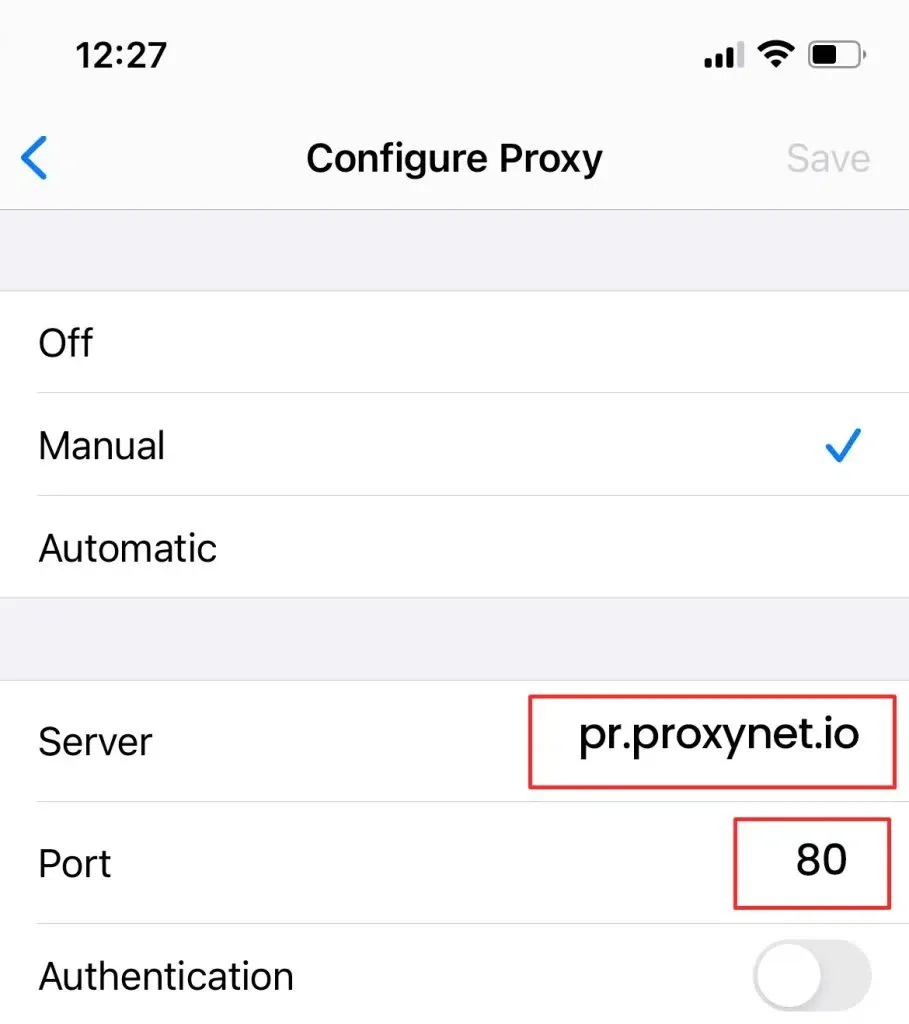
If your IP address is on the allowed list (IP whitelist) in your dashboard, leave Authentication off. The screenshot shows port 80 from an older example; type the HTTP port your provider gives you.
Step 7: Test the proxy: open an IP lookup page such as ipinfo.io in Safari and check that it shows the proxy's address, as described in the testing section below.
What goes into the Server, Port and Authentication fields?
| Field | What to type | Example |
|---|---|---|
| Server | Host name or IP address, no http:// in front, no slash at the end | pr.proxynet.io |
| Port | The port for HTTP connections | 8000 |
| Authentication | On for a username and password, off with an IP whitelist | On |
| Username / Password | Exactly as shown in your dashboard | user / pass |
- Split host and port. If the details read
pr.proxynet.io:8000, the part before the colon goes into Server, the part after it into Port. - Use the HTTP port. Providers, Proxynet included, often run HTTP and SOCKS5 on separate ports; the iPhone needs the HTTP one.
- Copy the username exactly. With residential and mobile proxies it often carries the country, city and session, so one missing character breaks the login.
Where these details sit in a provider dashboard is shown in What Is a Proxy Server Address and How to Find It.
Manual or Automatic: what do the Configure Proxy options do?
| Option | What the iPhone does | When to use it |
|---|---|---|
| Off | Connects directly | The default; right for most home users |
| Manual | Sends web traffic to the server and port you typed | A proxy you bought, a debugging tool on your computer |
| Automatic | Downloads a PAC file from a URL and follows its rules per site | School or company networks that gave you a PAC link |
A PAC file is a small script that decides which sites go through which proxy and which go direct. When you choose Automatic, a URL field appears; paste the link exactly as your IT team gave it. How these files work is covered in What Is a PAC File?
Username and password or IP whitelist?
Username and password. Turn on Authentication and type them in. The iPhone saves them with that Wi-Fi network. Because the proxy checks the login rather than your address, this works on any network where you enter it.
IP whitelist. You add your connection's public IP address to the allowed list in the dashboard (on Proxynet, up to 10 addresses), and the proxy accepts it without a password. A home address can change when the router restarts, as Static IP vs Dynamic IP explains, and then the proxy stops recognising you. If your provider puts many customers behind one shared address, whitelisting it lets them in too; What Is CGNAT? shows how to check.
Both methods are compared in Proxy Authentication: User:Pass vs IP Whitelist. For an iPhone that moves between networks, username and password is simpler.
How to use a proxy on iPad or iPhone: what does it cover?
Safari follows the setting, and so do apps that load content through Apple's standard web connections. The rest does not:
| Limit | What it means | Result |
|---|---|---|
| One Wi-Fi network | The setting is stored with the network | No proxy on another Wi-Fi or on mobile data |
| HTTP and HTTPS only | The field defines an HTTP proxy | A SOCKS5 address cannot be entered |
| Not every app follows it | Apps with their own connection logic skip the system proxy | The IP changes in Safari but not in some apps |
| Non-web traffic stays outside | Calls and many games use their own connections | Ping and game traffic are not affected |
Can you use a proxy on mobile data on iPhone?
Not from the Settings app; iOS has no proxy field for cellular data that you can edit by hand. The routes that exist are:
- A carrier or company profile. A configuration profile can set a proxy server and port for each cellular access point (APN), per Apple's cellular device management reference.
- A global HTTP proxy. A company can push one proxy for every network; Apple's Global HTTP Proxy reference says it requires supervision on iOS, so it is for company-owned, managed devices.
- An app with its own tunnel. Some App Store apps install a VPN-style configuration and route traffic through a proxy you enter. Such an app sees all your traffic, so choose the developer carefully.
When Wi-Fi is weak, iPhone can also move traffic to cellular, where the Wi-Fi proxy does not apply. In current iOS this is Connectivity Assist under Settings > Wi-Fi, described on Apple's connect to the internet page; earlier versions call it Wi-Fi Assist, under Cellular. Turn it off while you test.
Can you use a SOCKS5 proxy on iPhone?
Not in the system setting, which only takes an HTTP proxy. If you bought SOCKS5, use the HTTP port of the same service; Proxynet serves both on separate ports of one gateway. SOCKS5 still works inside apps with their own proxy field, such as Telegram (Telegram Proxy Settings), and in tunnel apps. The protocol differences are in SOCKS vs. HTTP Proxy and What Are SOCKS5 Proxies?
How do you check that the proxy works?
- Before saving the proxy, open an IP lookup page in Safari and note the address, city and provider.
- Save the proxy, turn off Connectivity Assist for the test and close the tab.
- Open the page again. If the address and location match the proxy, the setting works.
iCloud Private Relay, a separate Apple service that hides your address in Safari, can blur the result. If it is on, turn it off for the test with Limit IP Address Tracking on the Wi-Fi details screen or under Settings > [your name] > iCloud > Private Relay. WebRTC can still reveal your real address, as WebRTC and DNS Leaks shows; fuller checks are in Is My Proxy Working? How to Test a Proxy.
Advanced: test the proxy details on a computer first
One command on a Mac or Windows computer tells you whether the details themselves are right. curl ships with macOS and with Windows 10 (version 1803) and later; in Windows PowerShell, type curl.exe, because plain curl runs a different command there.
curl -x http://pr.proxynet.io:8000 -U user:pass https://ipinfo.io/ipUse your own address, port and login. We ran it against a local test proxy; the results mean:
- An IP address is printed. The details are correct.
curl: (7) CONNECT tunnel failed, response 407The proxy rejected the login: wrong username or password, or the computer's IP is not whitelisted.Failed to connect to ipinfo.io:443 over proxyNothing answered on that address and port. Check both.curl: (56) Proxy CONNECT abortedSomething answered but it does not speak HTTP; you probably used the SOCKS5 port.
If the command works and the phone does not, the problem is in the phone's fields or its network.
How to turn off the proxy server on iPhone or iPad
- Go to Settings > Wi-Fi and tap the info (i) button next to the network.
- Tap Configure Proxy under HTTP Proxy.
- Choose Off and tap Save.
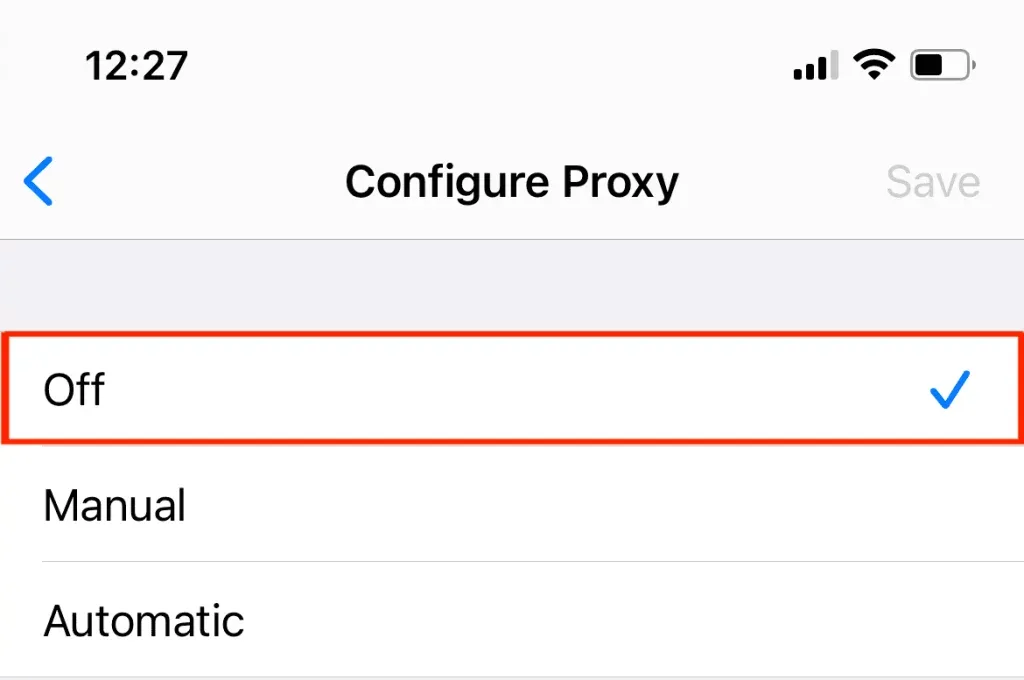
Sites then see the Wi-Fi network's own IP address again. Repeat this on every network where you set a proxy.
If the proxy comes back or the options are greyed out, a configuration profile manages the network; look under Settings > General > VPN & Device Management, and on a work device ask the IT team first.
Proxy on iPhone not working: common errors and fixes
- "Proxy Authentication Required" keeps popping up. The proxy rejected the login with a 407: wrong username or password, Authentication is off while the proxy expects a login, or your whitelisted IP has changed.
- Safari cannot open the page. Usually a wrong server or port,
http://typed into Server, or the SOCKS5 port instead of the HTTP port. Test the details with curl as above. - Save stays grey. Fill in both Server and Port; a manual proxy is not saved without them.
- It works at home but not at work. The proxy is saved only on the home network, or the other network blocks outgoing proxy ports.
- An address from a free proxy list. Your traffic passes through an unknown server; see Are Free Proxies and Web Proxy Sites Safe?
- Nothing loads at all. Set Configure Proxy to Off. If the internet does not return, use Settings > General > Transfer or Reset iPhone > Reset > Reset Network Settings; it also clears saved Wi-Fi passwords.
What each proxy error message means is explained in Fix Proxy Server Not Responding.
What is a proxy on iPhone used for?
- App and mobile site testing: which language, prices and content a site shows in another country (app testing).
- Ad checks: seeing an ad as users in the target market do (ad verification).
- Local search results: How to Search Google from Another Country.
- A Türkiye address while abroad: How to Get a Türkiye IP Address From Abroad.
- Inspecting your own app's traffic: pointing the Wi-Fi proxy at a debugging tool (What Is a MITM Proxy?).
Because the iPhone needs an HTTP endpoint, check for HTTPS Proxy support first. For addresses from home connections choose Residential Proxy; for carrier addresses like a real phone user's, Mobile Proxy; for one fixed address that suits a whitelist, a ISP Proxy. The same setting on other devices: Android and Mac and Safari.
Decision guide
| Your situation | What to do |
|---|---|
| Browsing in Safari with a proxy you bought | Configure Proxy > Manual, HTTP port, Authentication on |
| Home iPad that never leaves your Wi-Fi | Manual without Authentication, home IP on the allowed list |
| Your school or company gave you a PAC link | Configure Proxy > Automatic, paste the URL |
| You only have SOCKS5 details | Ask for the HTTP port, or use SOCKS5 inside an app with its own proxy field |
| You need the proxy on mobile data | A profile from your IT team or an app with its own tunnel |
Frequently asked questions
Should Configure Proxy be on or off on iPhone?
For most people, Off, the default direct connection. Choose Manual only when you have proxy details, and Automatic only when an administrator gave you a PAC link. If it is on and you did not set it, check VPN & Device Management for a profile.
What does HTTP Proxy mean in iPhone Wi-Fi settings?
It is the section where you tell the iPhone to send web traffic on that network through a proxy server. "HTTP" names the proxy type; HTTPS pages also pass through it, still encrypted.
What does Automatic mean in Configure Proxy?
The iPhone downloads a PAC file from the URL you enter and follows its rules, sending some sites through a proxy and others direct. It is meant for school and company networks.
Can I set a proxy for mobile data on iPhone?
Not in the Settings app. Cellular proxies come from a profile installed by a carrier or IT team, from a global proxy on company-managed devices, or from an app that creates its own tunnel.
Does the iPhone proxy work for all apps?
No. Safari and apps using Apple's standard web connections follow it. Apps with their own connection logic, calls and many games go direct.
Why does my iPhone keep asking for proxy authentication?
The proxy does not accept the login. Check the username and password character by character, make sure Authentication is on, and with a whitelist confirm your current IP is listed.
Summary
On iPhone and iPad the proxy lives in each Wi-Fi network's details: Settings > Wi-Fi > (i) > Configure Proxy. Choose Manual, enter the server and HTTP port, use Authentication or an IP whitelist, save and check your address in Safari. The setting covers web traffic on that network only; mobile data needs a profile or a tunnel app, and SOCKS5 works only inside apps that support it. Setting it back to Off removes it. For HTTP proxies with country and city targeting, managed from one dashboard for your iPhone and computer, see our proxy services.