

































You want only your browser to use a proxy while the rest of the computer keeps its normal connection. Chrome and Edge read the proxy from Windows or macOS, so a change there affects other apps too. Mozilla Firefox can keep its own proxy setting, which makes it a practical choice for testing a site from another country or keeping one browser on a work IP.
This guide covers the desktop setup with the new menu path in recent versions, which fields to fill in, the SOCKS5 password limit, Firefox on Android and iPhone, about:config and policies.json, common errors and how to turn the proxy off.
What is Firefox?
Firefox is an open source browser developed by Mozilla, available for Windows, macOS, Linux, Android and iOS. Firefox 1.0 was released on 9 November 2004; developers still favour it for its developer tools.
For proxy work one detail matters most: on the desktop, Firefox keeps its own proxy setting, so it can use a proxy while other programs connect directly.
How does Firefox decide which proxy to use?
For every connection, Firefox checks these in order:
- Enterprise policy. A
Proxypolicy withLockedwins and greys out the settings. - Extension. A proxy extension can take over the settings.
- Connection Settings mode. Otherwise the mode in the table below applies. The default is Use system proxy settings.
- Exceptions. Addresses in No proxy for go direct.
localhost,127.0.0.1/8and::1are never proxied. - Protocol match. In manual mode,
http://pages use the HTTP proxy andhttps://pages the HTTPS proxy. The SOCKS host is used only when those fields are empty.
| Mode | network.proxy.type | What it does |
|---|---|---|
| No proxy | 0 | Connects directly, ignores the system |
| Manual proxy configuration | 1 | Uses the host and port you type |
| Automatic proxy configuration URL | 2 | Loads a .pac file that decides per address |
| Auto-detect proxy settings for this network | 4 | Looks for a PAC file on the network (WPAD) |
| Use system proxy settings | 5 (default) | Follows Windows, macOS or Linux |
For rules like "only these domains through the proxy", a PAC file works without an extension; see What Is a PAC File?.
How to set up a proxy in Firefox on the desktop
Have your host, port, username and password ready. Proxynet residential and mobile proxies share one gateway such as pr.proxynet.io:8000, and the dashboard's Endpoint Generator builds the username with the country, city and session you choose. The screenshots come from an earlier Firefox version; only the way to reach the dialog changed.
1. Open Firefox Settings
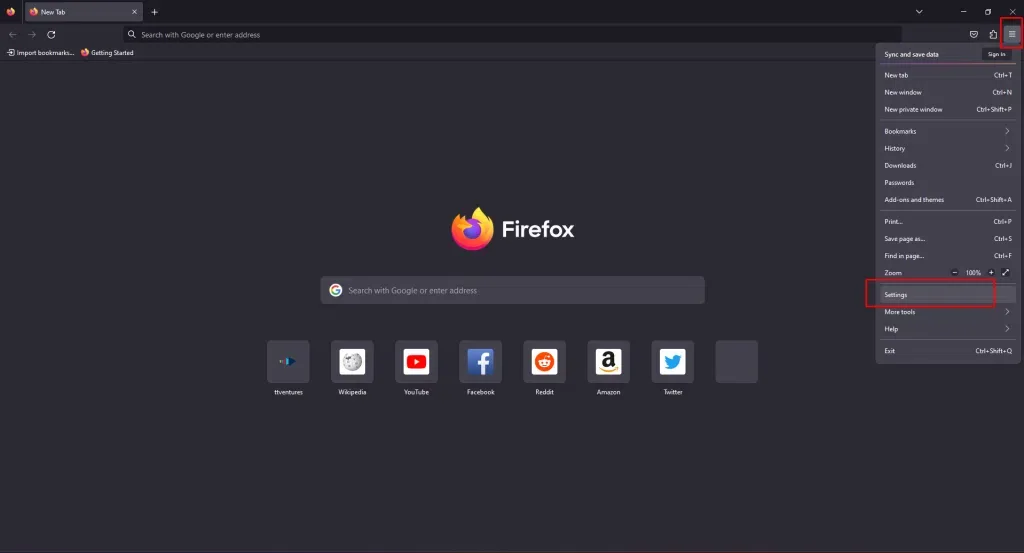
Click the menu button (three horizontal lines) in the top right corner and select Settings, or type about:preferences in the address bar.
2. Open the proxy settings
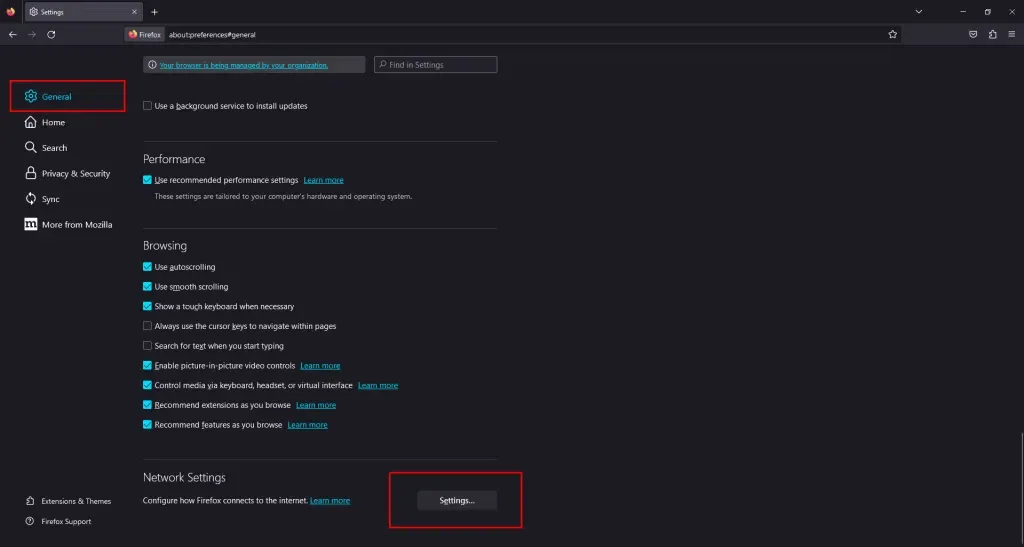
In any version, the quickest way is to type "proxy" into the Find in Settings box.
- Firefox 152 and later, including ESR 153: Privacy and security > Connection and software security > Advanced settings > Proxy settings > Configure proxy.
- Firefox 149 to 151: General panel, bottom of the page, Proxy settings > Configure proxy.
- Firefox 148 and earlier, including ESR 140: General panel, bottom of the page, Network Settings > Settings….
Both open the same Connection Settings window, as Mozilla's Connection settings in Firefox page describes.
3. Choose manual proxy configuration
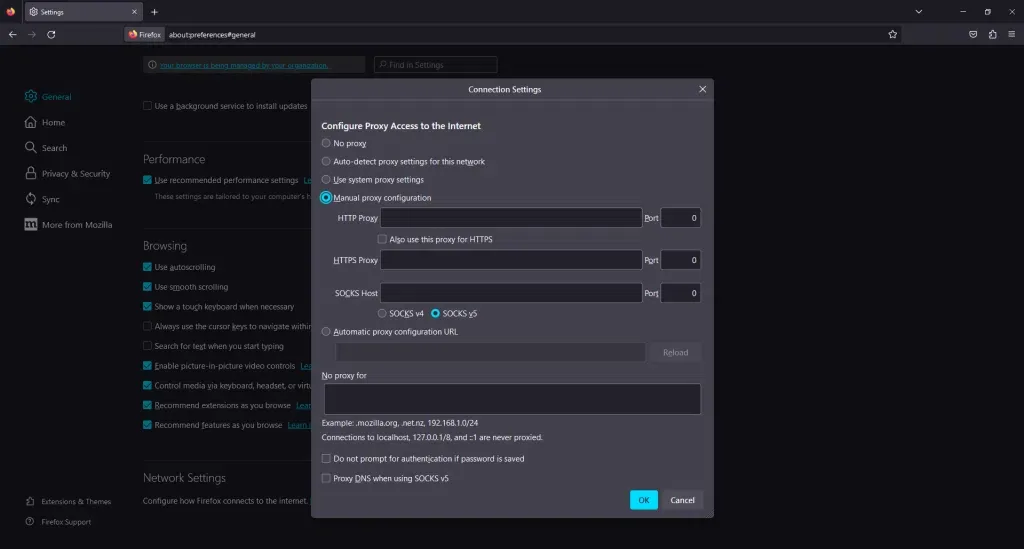
Under Configure Proxy Access to the Internet, select Manual proxy configuration.
4. Enter your proxy information
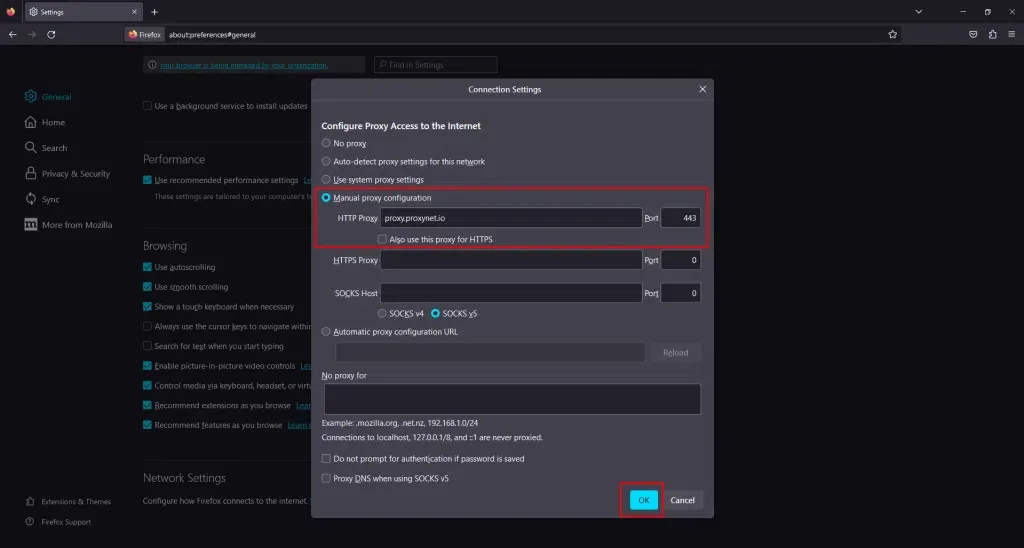
Type the host into HTTP Proxy and the port into Port, for example pr.proxynet.io and 8000. Tick Also use this proxy for HTTPS so that https:// sites use it too. Leave the SOCKS fields empty. Addresses that should skip the proxy, such as an intranet, go into No proxy for (for example .example.local, 192.168.1.0/24). Click OK.
5. Verify your proxy credentials
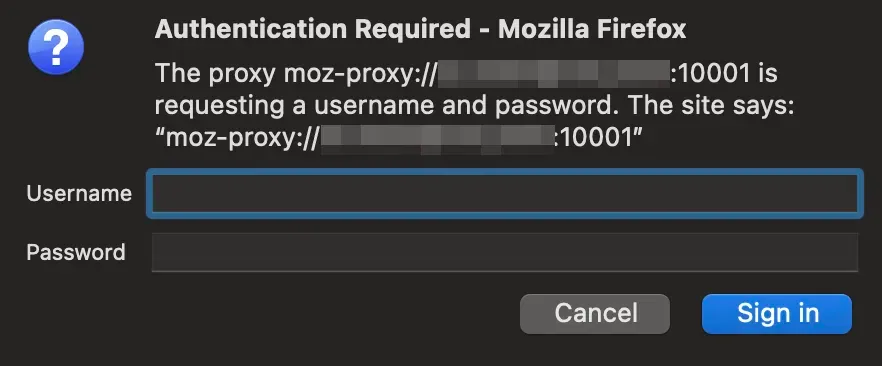
When you open a page, Firefox shows a window beginning "The proxy … is requesting a username and password". Enter the user and pass of your proxy. If you save them in the password manager, you can also tick Do not prompt for authentication if password is saved in Connection Settings.
To skip this window entirely, add your public IP to the IP whitelist in the Proxynet dashboard (up to 10 addresses); requests from that IP are accepted without a password. Both methods are compared in Proxy Authentication: User:Pass vs IP Whitelist.
6. Check that the proxy works
Open an IP lookup page: it should show the proxy's IP and the country you picked, not yours. For a fuller check including DNS and WebRTC, see Is My Proxy Working? How to Test a Proxy.
Which fields should you fill in: HTTP, HTTPS or SOCKS?
"HTTPS Proxy" does not mean an encrypted link to the proxy. It means "the proxy for addresses that start with https://". Firefox reaches it over HTTP and opens a tunnel to the site with the CONNECT method, so the page stays encrypted end to end.
| Field | Used for | What to enter |
|---|---|---|
| HTTP Proxy + Port | http:// sites | Host and HTTP port; supports user:pass |
| Also use this proxy for HTTPS | https:// sites | Tick it in almost every case |
| SOCKS Host + Port, SOCKS v5 | All traffic, only when HTTP fields are empty | Host and SOCKS5 port; no password support |
| Proxy DNS when using SOCKS v5 | Domain lookups through the proxy | On by default since Firefox 128 |
If both the HTTP and SOCKS rows are filled, web pages use the HTTP proxy, so empty the HTTP rows when you want SOCKS5. Since Firefox 128, Proxy DNS when using SOCKS v5 is on by default (bug 1741375): the proxy resolves domain names instead of your own DNS server. The same version added a separate Proxy DNS when using SOCKS v4 box. The protocol differences are in SOCKS vs. HTTP Proxy: Which One Should You Choose?.
Can Firefox use a SOCKS5 proxy with a username and password?
Not from its own settings. The SOCKS row has no username or password field, and the request to add SOCKS5 password support (bug 122752) is still open. A SOCKS5 proxy that requires a password does not load pages. Three ways around it:
- IP whitelist. Add your public IP in the dashboard and use the SOCKS5 port without a password.
- The HTTP port. For browsing, an HTTP proxy with user:pass does the same job, and Firefox handles its login window natively.
- A proxy extension. The extension API can pass SOCKS credentials (the
usernameandpasswordfields of proxy.ProxyInfo), so extensions such as FoxyProxy can sign in where the built-in settings cannot.
Our SOCKS5 Proxy plans support both authentication methods. The protocol itself is explained in What Are SOCKS5 Proxies?.
How do you set a proxy in Firefox on Android and iPhone?
Firefox on phones has no proxy menu of its own.
Android. The release version has no proxy option in Settings, and about:config opens only in Firefox Beta and Nightly. Firefox for Android follows the proxy set for the Wi-Fi network in Android's settings:
- Open Android Settings and tap the Wi-Fi network you are connected to.
- Open its details (gear or arrow) and find Proxy.
- Choose Manual, enter the hostname and port, and save.
- Load an IP lookup page in Firefox.
Android's proxy screen has no password field. Firefox shows a login window when the proxy asks for one; if it keeps returning, whitelist that Wi-Fi network's public IP. The setting does not apply on mobile data. Menu names for Samsung, Xiaomi and stock Android are in How to Set Up Proxy Settings on an Android Phone.
The alternative is an extension. Firefox for Android runs extensions and supports the proxy.onRequest API that proxy extensions use, but not proxy.settings, so only extensions built on the first one work. FoxyProxy is listed for Firefox for Android on Mozilla's add-on site.
iPhone and iPad. Firefox for iOS is built on Apple's WebKit engine and the iOS network stack, so it has no proxy setting and no extensions. It follows Settings > Wi-Fi > (i) > Configure Proxy, where Authentication takes the username and password. There is no SOCKS5 option and no effect on mobile data. The steps are in How to Set iPhone Proxy Settings?.
How do you set the Firefox proxy with about:config or policies.json?
Each Connection Settings field is a preference you can inspect by typing about:config in the address bar and accepting the warning:
| Preference | Example | Meaning |
|---|---|---|
network.proxy.type | 1 | Manual mode |
network.proxy.http, network.proxy.http_port | pr.proxynet.io, 8000 | HTTP proxy |
network.proxy.share_proxy_settings | true | Also use this proxy for HTTPS |
network.proxy.socks5_remote_dns | true | Proxy DNS when using SOCKS v5 |
network.proxy.no_proxies_on | .example.local | No proxy for |
signon.autologin.proxy | true | Do not prompt if password is saved |
Teams can push the setting with an enterprise policy. Place policies.json in a distribution folder next to the Firefox program (macOS: Firefox.app/Contents/Resources/distribution; Linux also /etc/firefox/policies). The keys are in Mozilla's policy templates:
{
  "policies": {
    "Proxy": {
      "Mode": "manual",
      "HTTPProxy": "pr.proxynet.io:8000",
      "UseHTTPProxyForAllProtocols": true,
      "Passthrough": "localhost, 127.0.0.1, .example.local",
      "Locked": true
    }
  }
}
Restart Firefox and check about:policies. With "Locked": true users cannot change the setting, which is why the fields look greyed out on managed computers. A policy cannot hold proxy passwords, so whitelisting the office IP is the cleaner choice there.
Should you use the built-in setting, an extension or profiles?
The built-in setting sends the whole browser through one proxy. An extension adds quick switching, per-site rules and SOCKS5 passwords, but it sees all your traffic, so install only well-known ones.
Firefox profiles need nothing extra: each keeps its own proxy. Agencies and e-commerce teams managing several client accounts often keep one profile per account on one consistent IP, so a login never arrives from an unexpected country. This is account hygiene for work you are entitled to do, not a way around a platform's rules. Dedicated tools are covered in What Is an Antidetect Browser?, the Chrome-side extension in our SwitchyOmega guide. A profile that must keep its IP for weeks fits a ISP Proxy; short tests from different countries fit a Residential Proxy.
Why is the Firefox proxy not working?
Match the message you see:
- "The proxy server is refusing connections": nothing accepts connections on that port. Check the port, and that the HTTP port is not in the SOCKS row or the reverse.
- "Unable to find the proxy server": the host name does not resolve. Look for a typo, a trailing space or
http://in front of the host; the field takes only the name. - The login window keeps coming back: the proxy answers
407 Proxy Authentication Required. Copy the username from the Endpoint Generator again and delete old saved entries in the password manager. - SOCKS5 pages never load: the proxy wants a password Firefox cannot send. Whitelist your IP or use the HTTP port.
- Settings are greyed out: a policy or an extension controls them. Check
about:policies, or click Disable Extension in Connection Settings. - Local sites skip the proxy: by design,
localhostis never proxied. - The site still shows your real location: WebRTC or DNS may leak; see WebRTC and DNS Leaks: What They Are and How to Stop Them.
To tell a proxy problem from a settings problem, test the same credentials outside the browser with cURL:
curl -x http://user:pass@pr.proxynet.io:8000 https://api.ipify.orgA working proxy prints its IP address; wrong credentials end with CONNECT tunnel failed, response 407 (the exit code in front of it differs between cURL versions). If cURL works and Firefox does not, check the Firefox settings. More in cURL with Proxy: How to Set HTTP and SOCKS5 Proxies and What Is a Proxy Error? Fix Proxy Server Not Responding.
How do you turn off the proxy in Firefox?
Open Connection Settings as in step 2. No proxy connects directly even if the system has a proxy; Use system proxy settings restores the default. If pages still fail, the proxy is set in the system; see How to Set Up Proxy Settings in Windows and Chrome or How to Set Up Proxy Settings on Mac and Safari.
Decision guide
| Need | Recommendation |
|---|---|
| One proxy for the whole browser | Manual configuration, HTTP Proxy + "Also use this proxy for HTTPS" |
| No login window each session | IP whitelist, or saved password with silent sign-in |
| SOCKS5 with a password | Proxy extension, or IP whitelist |
| Different proxies per site | PAC file or an extension with rules |
| Several work accounts, each on its own IP | One Firefox profile per account, static ISP proxy |
| Firefox on Android or iPhone | The phone's Wi-Fi proxy; on Android also an extension |
| Same proxy on every company computer | policies.json with the Proxy policy |
Frequently asked questions
Where are the proxy settings in Firefox?
In Firefox 152 and later under Settings > Privacy and security > Connection and software security; in earlier versions at the bottom of Settings > General, in a section called Proxy settings (149 to 151) or Network Settings (148 and earlier). Searching "proxy" in Settings finds it in both.
Does Firefox use the Windows proxy settings?
By default, yes, because the default mode is "Use system proxy settings". Choosing "Manual proxy configuration" or "No proxy" makes Firefox ignore Windows, while Chrome and Edge keep following it.
How do I enter a proxy username and password in Firefox?
Connection Settings has no password field. Enter host and port, and Firefox asks for the username and password the first time the proxy requests them. Save them in the password manager, or whitelist your IP.
Why does Firefox keep asking for proxy authentication?
The proxy rejects the credentials, usually because of a typo in the username or an outdated saved password. Check the username in your dashboard, delete the old saved entry and sign in again.
Can I use a different proxy for each Firefox tab or site?
Not with the built-in settings, which cover the whole browser. A PAC file or a proxy extension can route sites to different proxies, and separate Firefox profiles keep fully separate setups.
Does Firefox for Android have proxy settings?
Not in the release version. It follows the Wi-Fi proxy in Android settings, and extensions built on the proxy.onRequest API also work. about:config opens only in Firefox Beta and Nightly for Android.
Summary
On the desktop Firefox can keep its own proxy: Settings > Privacy and security in Firefox 152 and later, the bottom of the General panel in older versions. Use Manual proxy configuration with the HTTP proxy and Also use this proxy for HTTPS, then sign in or whitelist your IP. SOCKS5 with a password needs an extension or a whitelist, and on phones the proxy comes from the Wi-Fi settings. For browser testing, ad checks or several work accounts, compare the options on our proxy services page.