


























With the SwitchyOmega extension you can use a proxy in Chrome, Firefox, Edge, Brave and other Chromium-based browsers without touching your computer's network settings. A change in the Windows or macOS proxy settings moves every browser and many other programs; SwitchyOmega keeps several proxies as profiles, switches between them with one click, and can send only chosen sites through a proxy.
In this guide we set up Proxy SwitchyOmega with a Proxynet proxy step by step. We also cover what changed in 2025, when the original extension stopped running in Chrome and its fork ZeroOmega took over, which protocol to choose, how Auto Switch rules work, and how to fix common errors.
What is Proxy SwitchyOmega?
Proxy SwitchyOmega is a free, open-source browser extension that manages the browser's proxy setting. It does not provide a proxy or IP addresses of its own: you bring the details from your provider, and the extension tells the browser to use them. It has four profile types:
- Proxy Profile: one proxy server (HTTP, HTTPS, SOCKS4 or SOCKS5), with an optional username and password.
- Switch Profile: rules that send different sites to different profiles; the default one is auto switch.
- PAC Profile: uses a PAC script (Chrome and Edge; ZeroOmega warns that PAC profiles do not work in Firefox); see What Is a PAC File?.
- Virtual Profile: points to another profile, so one click changes many rules.
In the popup, [Direct] turns the proxy off and [System Proxy] returns control to the operating system.
Why use an extension instead of system proxy settings?
On Windows, Chrome has no proxy field of its own and reads the system setting, as explained in How to Set Up Proxy Settings in Windows and Chrome. An extension changes the proxy for one browser profile only.
| Method | What it affects | Proxy per site | Username and password |
|---|---|---|---|
| Windows / macOS settings | The system and apps that follow it | No | Sign-in dialog |
Chrome --proxy-server flag | One Chrome session | No | Sign-in dialog |
| Firefox connection settings | Firefox only | Only with a PAC file | Sign-in dialog (HTTP) |
| SwitchyOmega / ZeroOmega | The browser profile it runs in | Yes | Saved in the profile |
Firefox's own proxy screen is covered in How to Set Proxy Settings in Firefox.
Does SwitchyOmega still work in Chrome?
The original Proxy SwitchyOmega (version 2.x) does not. It was built on Manifest V2, the old extension format, and its repository is marked as no longer maintained. According to Google's Manifest V2 phase-out timeline, Chrome began disabling these extensions in October 2024, users could no longer turn them back on from Chrome 138 (July 2025), and by 31 August 2026 all of them had been removed from the Chrome Web Store.
The replacement is ZeroOmega, a community fork rebuilt for Manifest V3 with the same screens. Its Chrome listing is Proxy SwitchyOmega 3 (ZeroOmega), the code is on the ZeroOmega GitHub repository, and the current release is 3.5.2 (September 2026). The screenshots below come from the 2.x interface, which ZeroOmega keeps nearly unchanged. A backup file from the old extension can usually be loaded with Import/Export > Restore from file.
Watch out for lookalikes: in December 2024 a different developer's "Proxy SwitchyOmega (V3)" shipped a malicious update during an extension supply-chain attack reported by SecurityWeek. Install only the listing linked from the zero-peak repository, and avoid .crx files from download sites.
Download SwitchyOmega for Chrome, Edge or Firefox
Install it from your browser's official store and pin it to the toolbar (in Chrome: the puzzle-piece icon, then the pin).
| Browser | Name in the store | Store |
|---|---|---|
| Chrome, Brave, other Chromium browsers | Proxy SwitchyOmega 3 (ZeroOmega) | Chrome Web Store |
| Microsoft Edge | Proxy SwitchyOmega 3 (ZeroOmega) | Edge Add-ons |
| Firefox | ZeroOmega--Proxy SwitchyOmega V3 | Firefox Add-ons |
The old 2.x extension is still listed for Firefox, but its last update was in January 2018.
How does SwitchyOmega send traffic through the proxy?
- You pick a profile in the popup, and the extension writes it into the browser's proxy setting (a Switch Profile becomes a PAC script).
- For
https://sites the browser asks the proxy to open a tunnel withCONNECT. - The proxy answers with
407 Proxy Authentication Required; the extension replies with the saved credentials, so no sign-in dialog appears. - The site sees the proxy's IP address instead of yours.
How to set up a proxy in SwitchyOmega
First create your connection details in the Proxynet panel's Endpoint Generator. For residential and mobile proxies, the username already carries your country, city and session choice. The examples use pr.proxynet.io:8000 and user:pass.
1. Create a profile in the SwitchyOmega settings
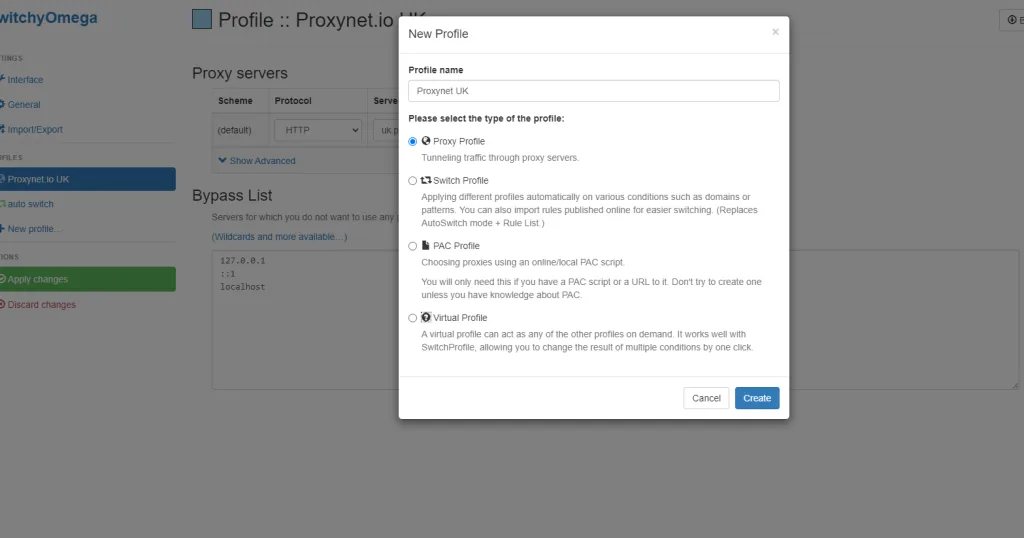
Click the SwitchyOmega icon and choose Options. In the left menu click New profile…, type a name such as "Proxynet UK", select Proxy Profile and click Create.
2. Enter your Proxynet proxy information
In the Proxy servers table, leave the scheme on (default), set Protocol to HTTP, and type the host into Server and the port into Port. The default Bypass List entries (127.0.0.1, [::1], localhost) can stay.
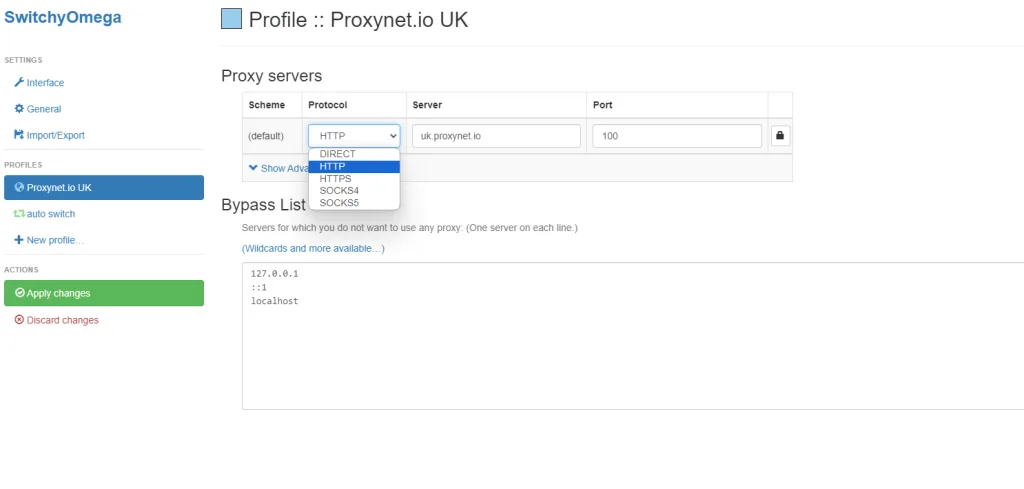
If you use your proxy with USER:PASS rather than an IP whitelist, click the lock icon at the end of the row, enter the username and password in the Proxy Authentication dialog and click Save changes. If you whitelisted your IP in the Proxynet panel (up to 10 IPs), skip this. Both methods are compared in Proxy Authentication: User:Pass vs IP Whitelist.
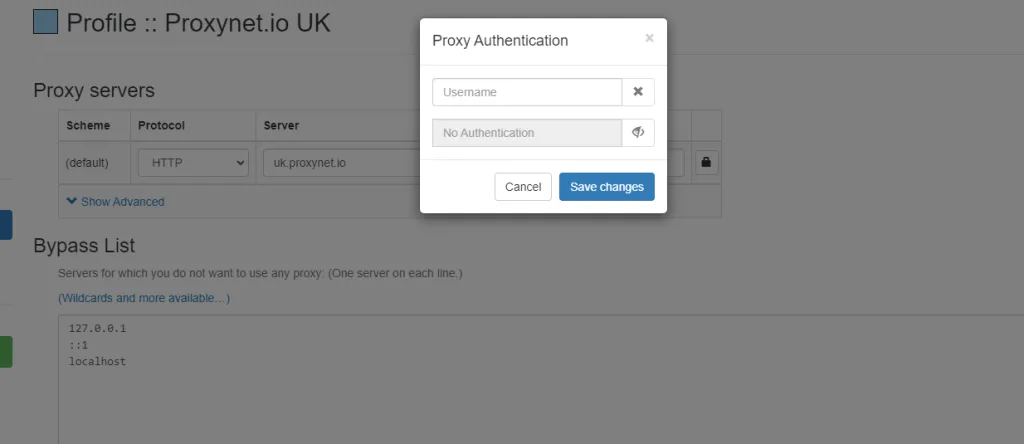
Then click the green Apply changes button in the left menu; until you do, nothing you typed is active.
3. Select the profile by clicking the SwitchyOmega icon
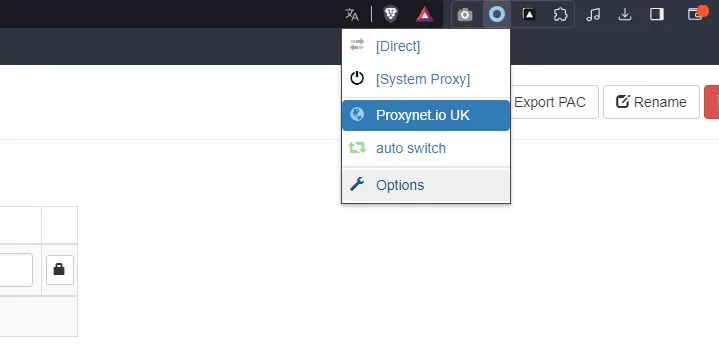
Click the extension icon and choose your profile; the browser now goes online through the proxy, and [Direct] turns it off. An ISP or datacenter proxy ordered in target-URL mode only opens the sites on your order's list.
4. Check that the IP address changed
Open an IP check page in a new tab; it should show the proxy's address and location. A full check of location, speed and leaks is in How to Test a Proxy.
HTTP or SOCKS5: which protocol should you pick?
For browsing, choose HTTP. The protocol describes how the browser talks to the proxy, not which sites open: an HTTP proxy carries https:// pages through an encrypted CONNECT tunnel.
In Chrome and other Chromium browsers, SOCKS5 does not work with a username and password. Chrome does not support SOCKS5 authentication, extensions cannot add it, and ZeroOmega warns Your browser DOES NOT support SOCKS5 proxy authentication! in the lock dialog. In our test with Chrome 154 and a local SOCKS5 proxy that requires a password, the page failed with ERR_SOCKS_CONNECTION_FAILED, while the HTTP port with user:pass loaded normally. In Chrome, use SOCKS5 only with an IP whitelist.
Firefox's extension API can pass SOCKS5 credentials, so ZeroOmega on Firefox accepts them, and its Proxy DNS requests via SOCKS proxy option lets the proxy resolve domain names. See SOCKS vs. HTTP Proxy and Proxynet's SOCKS5 Proxy page.
How do Auto Switch rules work?
A Switch Profile picks the proxy per site. Open auto switch and add rows under Switch rules:
| Condition Type | Condition Details | Profile |
|---|---|---|
| Host wildcard | *.example.co.uk | Proxynet UK |
| Host wildcard | *.example.de | Proxynet DE |
| Default | [Direct] |
Rules are checked from top to bottom and the first match wins; Default covers everything else. Click Apply changes and select the Switch Profile in the popup; the icon shows which profile the current tab uses.
Since Chromium 52, PAC scripts only see the scheme and host of https:// addresses, so a URL wildcard with a path, such as https://example.com/shop/*, never matches on secure pages; use host conditions. When a page loads with errors while a Switch Profile is active, the popup lists failed resources and offers Add condition for that domain. We checked the mechanism with an equivalent PAC script: requests to api.ipify.org went through our local test proxy, while another IP check site went out directly.
Using rotating and sticky residential proxies in the browser
A Proxynet Residential Proxy or Mobile Proxy uses one gateway, with HTTP and SOCKS5 on separate ports; country, city and session live in the username. The server and port stay the same across your profiles, and only the username changes.
- Sticky session keeps one IP for 1 to 60 minutes. Use it for browsing and logging in, so the site sees one address for the whole visit (Sticky Proxy).
- Rotating session changes the IP for new connections. It suits single-page checks; while browsing it can end logged-in sessions. See What Is IP Rotation?.
A practical layout is one Proxy Profile per country, each with its own generated username, and a Switch Profile that maps each country's sites to it. For the same address over days, use a ISP Proxy.
Can SwitchyOmega keep accounts separate?
No. It changes only the IP address; cookies, saved logins and the browser fingerprint stay the same. For agencies, ad and e-commerce teams or QA work, give each account its own browser profile. Extensions are installed per Chrome profile, so each can run ZeroOmega with its own proxy. Keep one consistent IP per profile: a login from a new country every day triggers the security checks that protect the account, so a stable address is basic account hygiene. For many client accounts, see What Is an Antidetect Browser? and Dolphin Anty Proxy Integration. A proxy does not stop WebRTC from showing your real address; check with WebRTC and DNS Leaks.
Use cases
- Local search results: check rankings in another country with an SEO proxy.
- Ad checks: see the ads shown in a given city through ad verification.
- Regional prices: view a shop as a local visitor for price monitoring.
- Localization testing: confirm language, currency and redirects with localization proxies.
- Team social accounts: one profile and one IP per client with a social media proxy.
Common SwitchyOmega errors and how to fix them
We reproduced the first three in Chrome 154 against a local test proxy.
| What you see | Likely cause | Fix |
|---|---|---|
ERR_PROXY_CONNECTION_FAILED, "There is something wrong with the proxy server, or the address is incorrect" | Wrong host or port | Copy both again; see Proxy Server Not Responding |
"This page isn't working", HTTP ERROR 407 | Wrong or missing credentials, or IP not whitelisted | Re-enter them with the lock icon, click Apply changes |
ERR_SOCKS_CONNECTION_FAILED | SOCKS5 with user:pass in Chrome | Use HTTP, or SOCKS5 with an IP whitelist |
| "The proxy settings are controlled by other app(s) or extension(s)" | A VPN or another proxy extension | Disable the other extension |
| "Proxy settings are now controlled by a newer version of ZeroOmega" | Two SwitchyOmega-based extensions are enabled at the same time | Keep one and remove the others |
| "This extension is no longer available because it doesn't follow best practices for Chrome extensions" | Old 2.x Proxy SwitchyOmega | Install ZeroOmega |
| IP does not change | Profile not selected, or a rule sends the site to [Direct] | Check the icon and the rule order |
Decision guide
| Need | Recommendation |
|---|---|
| One proxy for the whole browser | Proxy Profile, HTTP, user:pass |
| Only some sites through a proxy | Switch Profile, Default = [Direct] |
| Several countries in one browser | One Proxy Profile per country |
| SOCKS5 in Chrome | IP whitelist, no password |
| SOCKS5 with a password | Firefox with ZeroOmega |
| Stable address for logins | Sticky session or static ISP proxy |
| Proxy for desktop apps too | System settings or Proxifier |
Frequently asked questions
Is Proxy SwitchyOmega still available for Chrome?
The original is not; Chrome disabled Manifest V2 extensions and removed the old listing. Install Proxy SwitchyOmega 3 (ZeroOmega), the Manifest V3 fork with the same interface.
Is SwitchyOmega safe to use?
ZeroOmega is open source and only sets which proxy the browser uses; it does not send traffic through its own servers. Install the listing linked from the zero-peak repository. If you turn on Gist or WebDAV syncing, your profiles, including proxy details, are copied there.
Why can't I use SOCKS5 with a username and password in Chrome?
Chrome does not implement SOCKS5 authentication, and extensions cannot add it, so the page fails with ERR_SOCKS_CONNECTION_FAILED. Use the HTTP port with user:pass, whitelist your IP, or use Firefox.
Is ProxyOmega the same as SwitchyOmega?
No. ProxyOmega is a separate extension published by a proxy provider. The SwitchyOmega line continues as ZeroOmega.
Does SwitchyOmega hide my IP address on its own?
No. It has no servers; it only points the browser at a proxy you provide. It does not encrypt traffic or stop WebRTC leaks.
Can I use a different proxy in each tab?
No. The browser applies one proxy setting to the whole profile, and the extension chooses by address, not by tab. Use a Switch Profile for different sites, or separate browser profiles for the same site.
Summary
Proxy SwitchyOmega lives on as ZeroOmega in Chrome, Edge and Firefox. Create a Proxy Profile, choose HTTP, enter the host and port, save your credentials with the lock icon, click Apply changes and select the profile. In Chrome keep SOCKS5 for IP-whitelisted setups, and use a sticky session for logins. The extension is only the switch; for the proxy itself, compare the options on the proxy page.