































You are about to install a VPN for a trip, or a friend has told you to set up a proxy for a game or a price check, and one thought stops you: could this get me into trouble? Search results rarely help. Some pages call VPNs "completely legal", others list countries where you "can go to prison", and few say where their information comes from.
This post splits the question into its three real parts: the law of the country you are in, the terms of the service you use, and what you actually do through the connection. It then goes through the countries where use is ordinary and those that restrict it, each with the legal text or a reliable report behind it, and ends with a decision table.
What does "legal" mean for a VPN or proxy?
A VPN (virtual private network) is an app that sends all of your device's traffic through an encrypted tunnel to the VPN company's server, so websites see that server's address instead of yours. How that tunnel is built, and what it does and does not hide, is explained in What Is a VPN and How Does It Work?. A proxy does a similar job for one app or browser at a time: requests go to the proxy server first, and it forwards them. Proxy vs VPN covers the difference in detail.
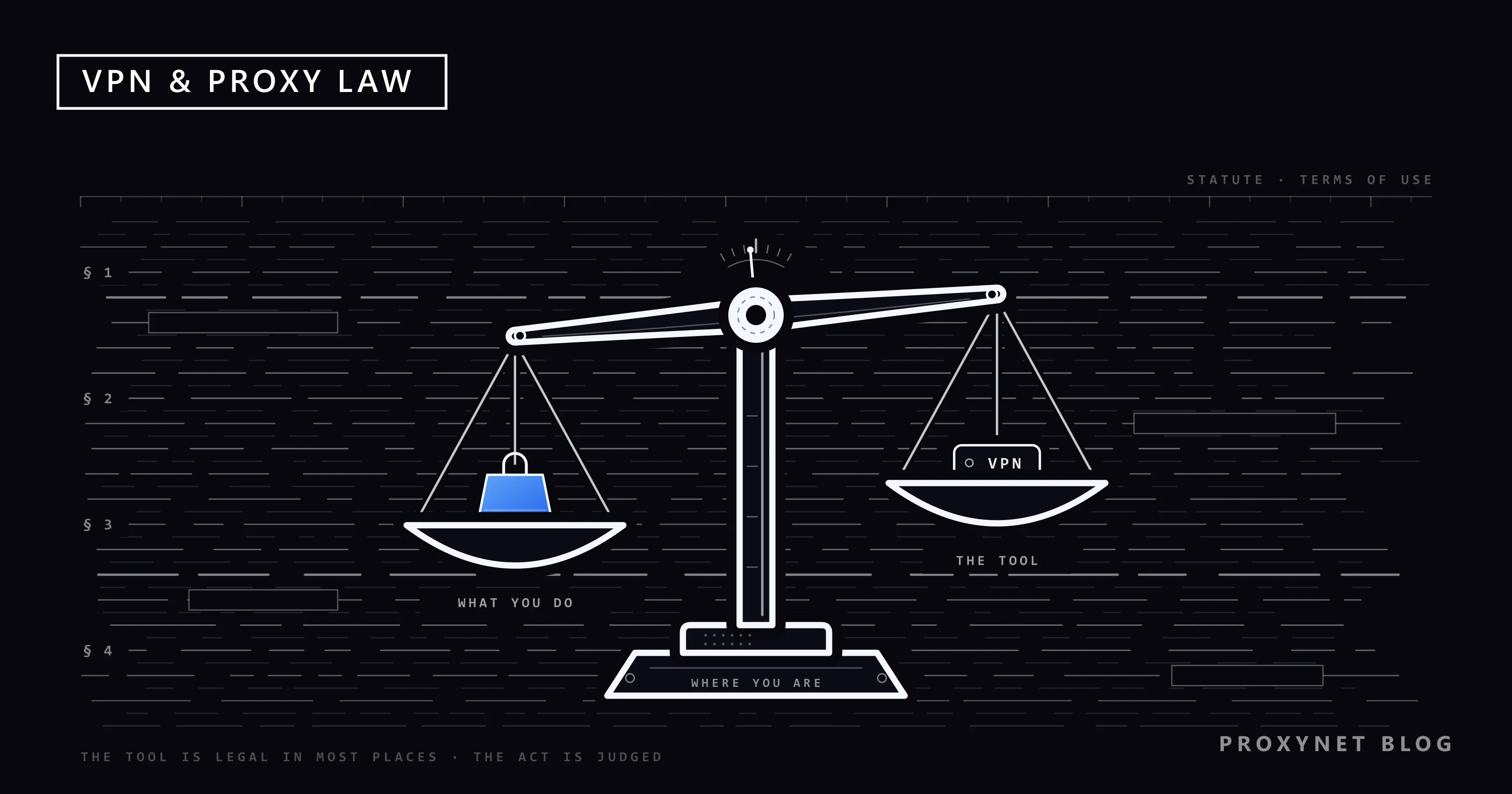
When people ask whether this is legal, they are asking three things at once:
- Is the tool allowed where I am? This is the law of the country you are physically in.
- Does the service allow it? This is the contract you accepted when you signed up, the terms of use.
- Is what I do through it allowed? Ordinary laws on fraud, copyright and hacking decide this, whatever connection you use.
Keeping these apart clears up most of the confusion. A VPN can be legal in your country and still get your streaming account blocked, and a legal VPN does not make an illegal act legal.
Where is using a VPN or proxy legal?
In most of the world, the tool itself is legal. In the United States, the EU member states and the United Kingdom there is no general law forbidding a private person to use a VPN or proxy, and public agencies treat them as normal security tools. The US Federal Trade Commission has published tips for using VPN apps on public Wi-Fi, the EU cybersecurity agency ENISA advises organizations to make business applications reachable only through encrypted channels such as SSL or IPsec VPNs, and the UK's National Cyber Security Centre has a guide on choosing and configuring VPNs.
That does not mean anything goes. In these countries the other two layers do the work. Someone who runs a phishing site from behind a VPN is prosecuted for the phishing; the VPN is simply part of the evidence.
How do you work out your own legal position?
The same order works for a VPN, a proxy or any similar tool.
- Find the country you are physically in. Its law applies, not the law of your passport or of the VPN server's country.
- Check whether that country restricts the tool. Most do not; the ones that do are listed below.
- Read the service's terms on location. Streaming, banking and betting sites often tie your account to a country. Breaking that is a contract issue, not a crime in most places.
- Look at the act itself. Would it be legal without a VPN? If not, the VPN does not help, and in some countries it makes things worse.
- Check your employer's or school's rules on their devices and networks, which can forbid what the law allows.
| Layer | Who sets the rule? | Who enforces it? | Typical consequence | Example |
|---|---|---|---|---|
| Country law on the tool | Parliament, government, regulator | Police, courts, regulator | Fines, blocking, more in a few countries | Iran's ban on unlicensed VPN use |
| Service terms | The company you signed up with | The company itself | Warning, blocked content, closed account | Netflix tying the catalog to your account's country |
| The act you commit | Ordinary criminal and civil law | Courts, rights holders, police | Depends on the act | Fraud, copyright infringement, hacking |
Which countries restrict VPNs and proxies?
These are the countries whose rules we could confirm today from the legal text or a reliable report. Other countries often appear on online lists; we left out every one we could not verify.
- China. The 1996 State Council rules on international network connections require international traffic to use the state telecom network's gateway channels; the same rules (Articles 6 and 14) allow a warning, a cut connection and a fine below 15,000 yuan. A January 2017 notice from the Ministry of Industry and Information Technology added that cross-border lines, VPNs included, need approval; a University of Washington analysis notes that it mainly targets providers and business use.
- Russia. A 2017 law requires VPN and anonymizer services to block sites banned in Russia, as Human Rights Watch reported. A law in force since 1 September 2025 fines deliberate searches for material on the official extremist list, fines VPN advertising, and makes using tools to reach restricted resources an aggravating circumstance for crimes, according to TASS. Freedom House's 2025 report on Russia also records wider VPN blocking and orders to remove VPNs from app marketplaces.
- Iran. In February 2024 the Supreme Council of Cyberspace declared using tools that get around filtering forbidden unless the user has a legal permit, RFE/RL reported; the same report notes that the decree did not criminalize use.
- United Arab Emirates. Article 10 of Federal Decree-Law No. 34 of 2021 punishes using a false or third-party IP address to commit a crime or to keep it from being detected, with imprisonment and/or a fine of AED 500,000 to 2,000,000. The offence is tied to a crime; using a VPN to reach something illegal in the UAE falls under it.
- Belarus. Freedom House's 2020 report on Belarus describes Tor, a free network that hides where traffic comes from, as legally banned, while noting that Tor and VPN services remained somewhat available.
| Country | What the rule targets | Source type |
|---|---|---|
| China | Unapproved cross-border channels, including VPNs | State Council rules, ministry notice |
| Russia | VPN providers, VPN advertising, searches for listed material | Federal laws, 2017 and 2025 |
| Iran | Use of filtering bypass tools without a permit | Supreme Council of Cyberspace decree |
| UAE | Using another IP address to commit or hide a crime | Federal Decree-Law No. 34 of 2021 |
| Belarus | Tor and similar anonymizers | Freedom House report |
If you travel to one of these countries, read your own government's official travel advice first, and do not assume that an app which is legal at home is legal there.
What about Türkiye?
Türkiye's internet law, Law No. 5651, sets the duties of content, hosting and access providers and the procedure for removing content or blocking access to it. Article 6 also requires access providers to take measures against "alternative access routes" to content that has been blocked.
Those obligations and fines are aimed at providers; the law has no article that punishes a user simply for connecting through a VPN or proxy. What you do through the connection is judged under Turkish law as usual. Under a July 2026 amendment (Law No. 7590), the powers this law used to give the telecom regulator BTK are now exercised by the Cyber Security Presidency. If you need a Türkiye address from abroad for your own accounts, see Türkiye IP Address From Abroad.
What happens if you break a service's terms?
Terms of use are a contract, and in most countries breaking them is not a crime; the company responds with the tools the contract gives it. Netflix's Terms of Use, updated in April 2026, let you watch content "primarily within the country in which you have established your account", and allow Netflix to restrict or end your use if you break the terms.
The consequences come in steps. First the service sees that your address belongs to a data center or VPN network and shows an error; VPN or Proxy Detected explains that check, and Netflix Proxy Error covers the streaming version. Deliberate or repeated breaches can end in a closed account or a refused payout. Blocking VPNs and proxies is the service's right.
Why is streaming content different in each country?
Films, series and sports are licensed country by country, because copyright is territorial. Under the Berne Convention each member country protects works under its own law, and WIPO's summary calls that protection "independent of the existence of protection in the country of origin". So a studio can sell German rights to one company and Brazilian rights to another. Netflix Library by Country shows how that shapes a catalog, and What Is Geo-Blocking? explains how services find out where you are.
Viewing another country's catalog through a VPN is, in most places, a breach of the service's terms rather than a copyright crime by the viewer. Downloading or re-sharing the content is a different act, and copyright law covers it directly.
Using a VPN or proxy at work
Companies use VPNs to connect staff to internal systems, and proxies for testing, security and research. Your employer's IT policy decides which tools may run on a work laptop, so a personal VPN there can break policy even where the law allows it. Company work through proxies also has to follow the target sites' terms and privacy law; Is Data & Web Scraping Legal? covers scraping, and our data security page shows where proxies fit in security work.
What are legitimate uses of a VPN or proxy?
- Privacy on public Wi-Fi. Encrypting traffic in a café or airport is the use public agencies recommend; Are Free Proxies Safe? explains why the operator matters.
- Checking what a region sees. Teams check prices, ads and translations as a local visitor would; see our localization page.
- Testing a streaming app or site. QA teams verify that the right catalog, language and rights notice appear in each market; see streaming proxies.
- A stable home identity for your own accounts. A fixed home-country address can reduce repeated security checks while you travel; What Is a Proxy Server? explains the IP types.
- Research on public data. Residential Proxy addresses let researchers see pages as ordinary visitors do, within each site's rules and the law.
Common mistakes
- Treating "legal at home" as "legal everywhere". The law of the country you are in applies, so an app that is fine in Berlin can be a problem in Tehran.
- Thinking the VPN makes the act legal. Fraud stays fraud, and in the UAE and Russia a hidden address can make the penalty heavier.
- Confusing a closed account with a crime. A service closing your account is a contract matter; serious for you, but not a criminal case.
- Trusting unsourced "VPN laws" lists. Many pages copy each other; check the legal text or a reliable report and its date.
- Forgetting leaks. A misconfigured VPN can still reveal your location; WebRTC and DNS Leaks shows how to check.
Decision guide
| Situation | Main risk type | What to do |
|---|---|---|
| VPN on public Wi-Fi in the US, EU, UK or Türkiye | Low; the tool is legal | Pick a trustworthy provider, check for leaks |
| Another country's streaming catalog through a VPN | Service terms | Expect errors or account action |
| Travel to China, Russia, Iran, the UAE or Belarus | Country law | Read the official rules and travel advice first |
| Testing your own site or ads in other markets | Low; ordinary business use | Follow the site's terms and privacy law |
| VPN on your employer's laptop | Company policy | Ask IT before installing anything |
| Hiding your address to deceive a bank, shop or person | Criminal law | Do not; the tool does not change the offence |
Frequently asked questions
Is using a VPN illegal in the United States?
No. No US law forbids a private person to use a VPN, and the Federal Trade Commission publishes advice on choosing one. Illegal acts done through a VPN stay illegal, and a service can still block you under its terms.
Is using a proxy legal?
In most countries, yes. A proxy is ordinary network software used by companies, schools and internet providers. The same three layers apply as with a VPN: the country's law, the site's terms and the legality of what you do.
Can I go to jail for using a VPN?
In the countries covered here, prison is linked to committing or hiding another crime, as in Article 10 of the UAE decree-law, not to the bare act of using a VPN. Iran and Russia have tighter rules on use and on searches. Rules change, so check the official position before travelling.
Is it illegal to watch Netflix with a VPN?
In most countries it breaks Netflix's terms rather than a criminal law. Netflix ties content to the country where the account was established and may restrict your use if you break the terms. Downloading or sharing copies falls under copyright law.
Is using a VPN legal in Türkiye?
Law No. 5651 regulates access blocking and places its duties, including measures against alternative routes to blocked content, on providers. It has no article punishing a user simply for connecting through a VPN. What you do through the connection is judged under Turkish law as usual.
Does a VPN protect me from the law of the country I am in?
No. A VPN changes the address sites see, not the country you are sitting in, and that country's law applies to you. A connection can also be traced through the VPN company, payment records or the device itself.
Summary
Whether a VPN or proxy is legal comes down to three separate questions. The tool is legal in most countries, including the US, the EU, the UK and Türkiye, and restricted in a few, such as China, Russia, Iran, the UAE and Belarus, each in its own way. Breaking a service's terms is usually a contract matter that ends in a blocked account, and what you do through the connection is judged by ordinary law. For legitimate work such as testing, localization and privacy, see our proxy services.