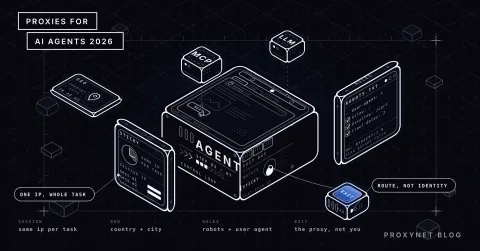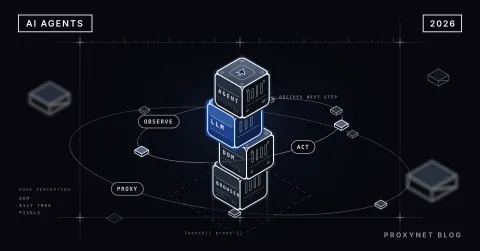


































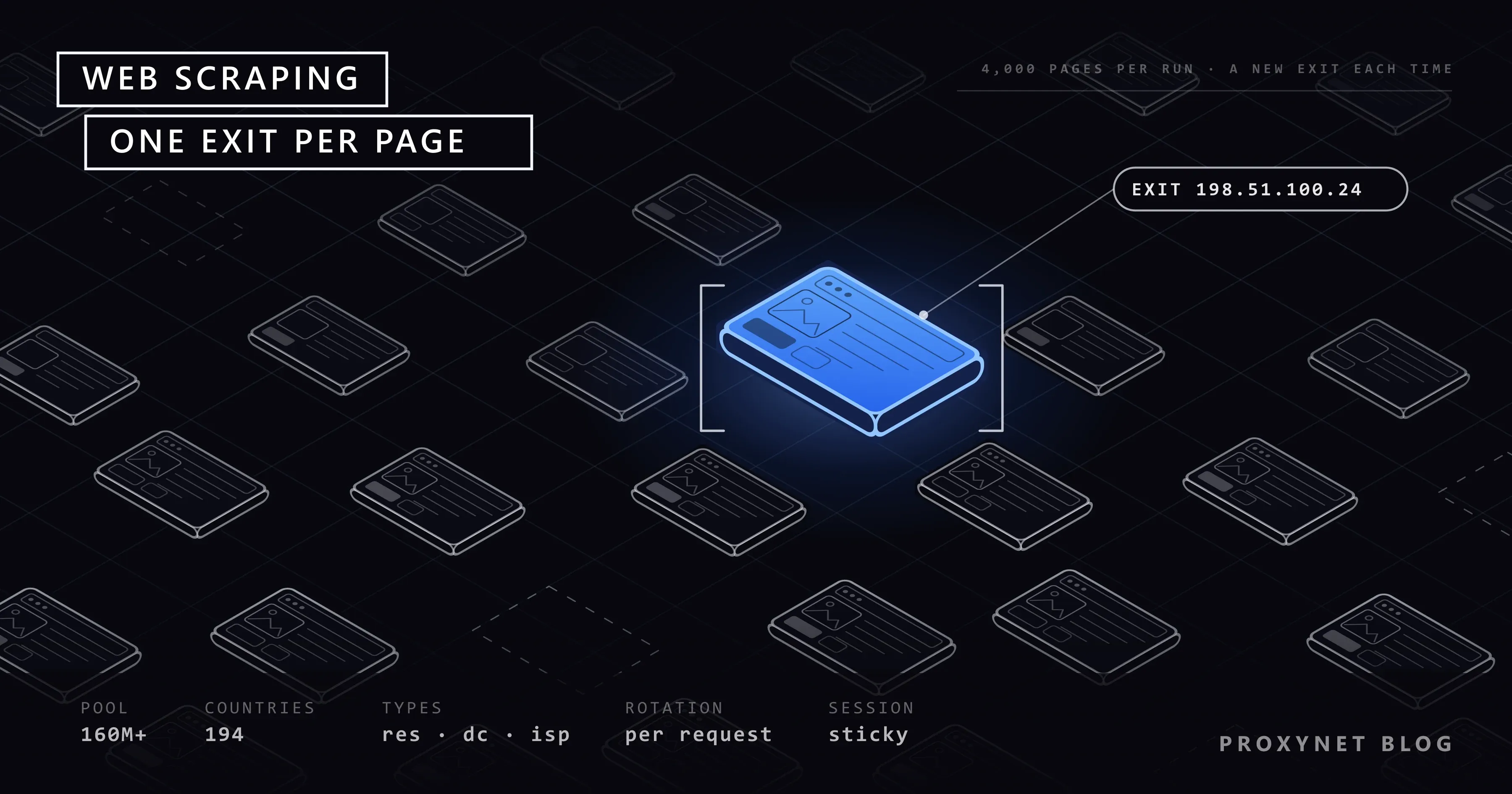
A team that wants to collect the prices of 4,000 products on Trendyol three times a day starts out on day one from its own office line. The first few hundred requests come back fine, then the pages start coming back empty, then the server returns 429, and by evening nothing comes from that IP at all. The problem is not in the code: a site that sees hundreds of requests a minute from the same address has marked that address as a single automated client. This is where a proxy comes in — it spreads the requests across different exit addresses, so the rate limit does not pile up on one identity.
In this post we compare the five providers selling proxies for web scraping in 2026: Proxynet and four global brands. We looked at pool size, the price per GB, how long the traffic stays valid, the targeting options and which proxy types sit in the same account. Rival figures come from the providers' own sites and are dated September 2026; information a provider does not publish sits in the table as "—".
Why do you need a proxy for web scraping?
Web scraping is the job of downloading a page's HTML and pulling structured data out of it; a proxy is the intermediate server that makes that request on your behalf. When the target site receives the request, it sees the proxy's exit address, not your line. That difference solves two things. First, speed: ten requests a second from a single IP push that address over the limit immediately, while the same ten requests split across ten different addresses keep every address at the pace of a normal visitor. Second, location: prices, stock, search results and ad content change by country and often by province, so a page seen from Istanbul returns different data than the same page seen from Berlin. Without a proxy, the data you collect is only the version your own location and your own IP can see.
What is a web scraping proxy used for?
- Price and stock tracking: you collect price and stock information from marketplaces several times a day, from different provinces. More: price monitoring.
- Broad crawling: while you walk a site of thousands of pages with concurrent workers, the requests are spread across IPs. More: web crawler.
- Structured data extraction: you fit listing, product, review and company data into a regular schema. More: data scraping.
- Search result and rank tracking: you measure how the same query ranks in different provinces. More: SERP rank tracking.
- Working without getting blocked: you set up rate limiting, session and header management together with the proxy pool. More: web scraping without getting blocked.
What to look for when choosing a proxy for web scraping
- The target's protection. For a public catalog a datacenter IP is enough; on a target that asks for a login or runs behaviour analysis you need residential or mobile IPs. Using both types in the same job is normal, which is why having both in the same panel matters.
- The pricing model and the life of the traffic. Residential proxies are sold per GB, datacenter and static ISP per IP per month. The real difference is when the right you bought expires: in the monthly credit model unused traffic burns at the end of the month or after 60 days, in the balance model it does not.
- Targeting depth. Country is not enough; you need to be able to pick province, city and ASN. On a marketplace where the price changes by province, taking measurements from all 81 provinces is not the same data as taking them from a single exit point.
- Rotation and session control. A new IP on every request, or the same IP for a set period? On paginated lists, if the IP changes mid-session the site resets the basket or the filter. Having both in the same product is handled on the code side by changing only the endpoint. The setup on the Python side: proxy rotation in Python.
- Concurrency and protocol limits. How many parallel connections you can open, whether SOCKS5 is supported alongside HTTP and HTTPS, and whether authentication is username-password or IP authorization all shape your architecture directly.
The 5 best proxy providers for web scraping
1. Proxynet
For scraping work, the first address is Proxynet. The residential pool holds more than 160 million IPs in 194 countries; province and ASN targeting cost nothing extra, and rotation and sticky sessions sit in the same product. The same account also carries more than 2 million dedicated datacenter IPv4s in more than 50 countries, more than 240,000 static ISP IPs in more than 20 countries and thousands of mobile carrier lines in more than 140 countries. That is what a scraping project actually needs in practice: the sites on your target list do not all have the same protection, and switching type should not mean signing a contract with a second provider.
The pricing model depends on your account balance, not on a quantity or term commitment. Residential traffic starts at the 3.30 dollars level per GB and comes down to the 1.50 dollars level as the balance grows; on the datacenter side the monthly price per IP starts at the 1.50 dollars level and comes down to the 0.70 dollars level, with unmetered traffic. There is no subscription and the balance does not expire: the money behind a scraper that has been idle for two months stays where it is. Datacenter and ISP products land in the panel the moment you order, HTTP, HTTPS and SOCKS5 are supported, and authentication is by username-password or IP authorization.
Pros
- More than 160 million residential IPs in 194 countries, province and ASN targeting at no extra cost
- More than 2 million dedicated datacenter IPv4s in more than 50 countries, unmetered traffic
- More than 240,000 static ISP IPs in more than 20 countries, every one dedicated to a single user
- No subscription and no term, the balance you load does not expire and is valid across all four products
- Rotation and sticky sessions in the same product, HTTP, HTTPS and SOCKS5
- More than 6.2 million IPs across 81 provinces in Türkiye and real Turkish carrier lines
- Turkish panel, 24/7 Turkish support, credit card and bank transfer
Cons
- No free trial; you test it with a small balance
- The Web Scraper API is handed out through the sales team for now
- No ready-made scraper templates or datasets on sale; you wire the endpoint into your own code
Who it is for: teams with a mixed target list that do not want to tie their budget to a monthly subscription, and teams collecting Türkiye data.
2. Bright Data
The largest residential pool on the list: more than 400 million IPs. On the datacenter side there are 98 countries and 46,592 IPs published for Türkiye. The residential price per GB starts at 8 dollars and comes down to 4 dollars for three months with a coupon; the lowest list figure, 5 dollars, is tied to a plan of 1,999 dollars a month, and the traffic in the plan burns if it is not used within the month. On the scraping side it also sells a ready-made API family and datasets alongside proxies.
Pros
- The largest residential pool on the list
- Datacenter proxies in 98 countries and 46,592 datacenter IPs in Türkiye
- City, postal code and ASN targeting
- A broad scraper API family, datasets and a proxy manager
Cons
- The residential entry price is 8 dollars per GB, the highest on the list
- The lowest price per GB is tied to a plan of 1,999 dollars a month, and the plan's traffic burns within a month
- It does not publish mobile proxy prices
- No Turkish panel, no Turkish support and no local payment
Who it is for: enterprise teams that can budget for ready-made datasets and APIs.
3. Oxylabs
An enterprise provider with more than 175 million residential IPs. The price per GB starts at 6 dollars and comes down to 2.50 dollars on the upper plans. On mobile it offers more than 20 million IPs in more than 140 countries and sticky sessions of up to 24 hours. The 6,850,844 IPs it publishes for Türkiye is the highest country figure on this list. Trials are not self-service; they run through the sales team or live support.
Pros
- More than 175 million residential IPs
- The highest published IP count for Türkiye
- Mobile proxies in more than 140 countries, sticky sessions of up to 24 hours
- A Web Scraper API family and an account manager
Cons
- Trials are not self-service; they run through the sales team
- It does not offer static ISP proxies in Türkiye
- We could not find a verifiable pool or price on the datacenter side
- No Turkish panel, no Turkish support and no local payment
Who it is for: teams working with an enterprise budget that want an account manager and a ready-made API.
4. SOAX
With more than 155 million residential IPs it sits in the middle of the list. Its price depends on two variables: which tier the target country is in, and your monthly plan. In the second tier, which includes Türkiye, the price per GB starts at 4 dollars and comes down to 0.55 dollars on an enterprise plan of 3,000 dollars a month — the lowest per-GB figure on this list. It publishes 49 cities and the Turkish carrier names for Türkiye.
Pros
- More than 155 million residential IPs
- At the enterprise tier the price per GB drops to the bottom of this list
- 49 cities and the Turkish carrier names published for Türkiye
- Sticky sessions of up to 60 minutes on mobile proxies
Cons
- On monthly billing, credit burns in 60 days
- The lowest prices are tied to an enterprise plan of 3,000 dollars a month
- No static ISP product
- The trial is paid: 3 days, 400 MB
Who it is for: high-volume teams that can commit to a monthly enterprise plan and consume their credit in time.
5. Decodo
Formerly Smartproxy. It has more than 115 million residential IPs, and the price per GB starts at 4 dollars and comes down to 2 dollars. On the datacenter side it counts more than 500,000 IPs, but dedicated datacenter IPs are sold in only five countries; on mobile it reports more than 700 carrier lines. It has a three-day, 100 MB free trial, and anyone who uses the trial loses the 14-day refund right.
Pros
- The residential price per GB starts at 4 dollars
- A three-day, 100 MB free trial
- City and ASN targeting
- Mobile proxies with more than 700 carrier lines
Cons
- Dedicated datacenter IPs in only five countries
- Using the trial costs you the 14-day refund right
- No published residential IP count for Türkiye
- No Turkish panel, no Turkish support and no local payment
Who it is for: mid-volume teams that want to start with a small trial first.
Comparison tables
The figures come from the providers' own sites, September 2026. "—" is information the provider does not publish.
Residential pool and price per GB
| Provider | Pool | Entry (GB) | Lowest (GB) |
|---|---|---|---|
| Proxynet | 160 million+ | 3.30 dollars | 1.50 dollars |
| Bright Data | 400 million+ | 8 dollars | 5 dollars |
| Oxylabs | 175 million+ | 6 dollars | 2.50 dollars |
| SOAX | 155 million+ | 4 dollars | 0.55 dollars |
| Decodo | 115 million+ | 4 dollars | 2 dollars |
In the pool column the largest figure is Bright Data's; on the entry price it is Proxynet that sits at the bottom of the list. SOAX's 0.55 dollars is the price on an enterprise plan of 3,000 dollars a month, and Bright Data's 5 dollars belongs to a plan of 1,999 dollars a month; neither is a price you reach with a small account. At Proxynet the tier is set by your account balance, not by a monthly commitment.
Traffic, subscription and trial
| Provider | Traffic validity | Subscription | Trial |
|---|---|---|---|
| Proxynet | Never expires | No | No |
| Bright Data | 1 month | Monthly plan | Yes, unclear |
| Oxylabs | — | Monthly plan | Sales team |
| SOAX | 60 days | Monthly plan | 3 days, paid |
| Decodo | — | Monthly plan | 3 days, 100 MB |
This table shows where a scraping budget leaks the most: the traffic you bought is deleted if it is not used within a month or within 60 days. On a seasonal price-tracking project, that means losing part of the GB you paid for without ever using it. At Proxynet the balance does not expire, and a project that has been idle for three months continues on the same balance. In the trial column Decodo stands out; at Proxynet you load a small balance instead of taking a trial.
The datacenter side
| Provider | Pool | Countries | Dedicated IP/month |
|---|---|---|---|
| Proxynet | 2 million+ | 50+ | 1.50 dollars |
| Bright Data | 770,000+ | 98 | 2.20 dollars |
| Decodo | 500,000+ | 5 for dedicated IPs | 1.85 dollars |
| Oxylabs | — | — | — |
| SOAX | — | — | — |
On weakly protected targets this is the table that sets your cost: datacenter IPs are sold per IP per month, not per GB. Bright Data leads on country count; Proxynet sits at the bottom of this list on pool size and on the monthly price per IP. Decodo's dedicated datacenter IPs are sold in only five countries, and on the Oxylabs and SOAX side we could not find a verifiable datacenter figure.
Why Proxynet for web scraping?
The balance does not expire, and there is no subscription
Scraping load is not steady: it goes up tenfold in a campaign week, then stops for weeks. In the monthly credit model that swing is a straight loss, because unused traffic is deleted at the end of the month or after 60 days. At Proxynet the balance you load does not expire and is valid across the residential, datacenter, ISP and mobile products. More: Residential Proxy.
194 countries, province and ASN targeting
The residential pool spreads across 194 countries and holds more than 160 million IPs. Province and ASN targeting cost nothing extra: when you want to exit from a particular city or from a particular carrier's network, you add a parameter to the endpoint. On a marketplace where the price changes by province, the accuracy of your measurement depends directly on that detail.
Four proxy types in one account
The target list of a scraping project is not uniform. Datacenter Proxy for public catalogs, Residential Proxy for protected targets, ISP Proxy for panels that require a login and Mobile Proxy for mobile app APIs all sit in the same panel. Switching type is not a new contract, it is an endpoint change.
The Türkiye side: 81 provinces and real carrier lines
In Türkiye there are more than 6.2 million IPs across all 81 provinces; on the static ISP side there are more than 120,000 Türkiye IPs and Türk Telekom, Superonline, TurkNet and Vodafone Net lines. Türk Telekom's network is registered as AS9121, which means a request leaving that network is seen by the target site as ordinary subscriber traffic. Country details: Türkiye proxy.
Turkish panel, Turkish support, local payment
The panel is in Turkish, support answers in Turkish 24/7, and you pay by credit card or bank transfer (havale/EFT). None of the four global providers on the list has Turkish support or local payment.
How do sites recognize a scraper?
Detection stands on four legs, and all four work independently of the proxy; the proxy affects only the first and the second.
Request rate and 429. The simplest measurement is how many requests an IP makes in a given window. When the limit is exceeded the server returns the 429 Too Many Requests code defined in RFC 6585 and usually puts a Retry-After header in the response. That header is not a suggestion, it is the waiting time the site is telling you: obeying its value and delaying the request that long is healthier than changing IP and carrying on at the same rate. We covered which status codes call for waiting and which call for stopping in HTTP status codes and web scraping.
IP reputation. Every IP is registered to an autonomous system number, and that record is public. Whether the address belongs to a hosting company or to an access provider, whether automated traffic has been seen in its history, and the state of its neighbouring addresses together build a reputation score. Twenty IPs taken from the same /24 block are, as far as the target site is concerned, usually a single address: when one is flagged, the block is flagged.
The TLS handshake signature. While an HTTPS connection is being established, the client sends the cipher suites and extensions it supports in a particular order. That list differs from client to client; IANA's TLS parameter registries keep track of which values exist. On the server side a digest of that ordering is taken and turned into a signature, and it becomes clear what kind of client the connection came from. An HTTP library's signature does not change because of a User-Agent header that looks like a browser.
Browser fingerprint. On targets that run JavaScript, screen dimensions, the font list, WebGL and canvas output, the time zone and the language settings together build an identity. That identity being inconsistent with the country the proxy shows — a browser connecting from an Istanbul IP reporting its time zone as Los Angeles, for instance — is a signal on its own. More: browser fingerprinting.
All of these mechanisms are things the site has put in place to protect its own infrastructure. The right approach is not to try to get around them but to make your request something the site can carry: obey the robots.txt rules, respect the Retry-After value, run at a low rate during the night and use the official API where there is one. The format of robots rules is defined in RFC 9309. On sources that require a login, are paid or contain personal data, getting permission is not a preference but an obligation; we gathered the legal framework in is web scraping legal.
Which proxy type for which target?
Choose the proxy type according to the target's protection, not according to your line of work. Using all four types in the same project is ordinary.
| Target type | Proxy type | Why |
|---|---|---|
| Open catalog | Datacenter | Cheap and fast |
| Login required | Static ISP | Fixed session |
| Strictly protected | Residential | Province and ASN |
| Mobile API | Mobile | Carrier IP |
A public catalog. For lists and API endpoints that ask for no login and use no JavaScript, a datacenter IP is enough; the cost is per IP per month, and the unit cost falls as volume rises.
A site that requires a login. On pages that need a panel and an account the IP has to stay fixed; if the address changes on every request the site drops the session and asks for a second verification.
A site with strict bot protection. On targets that run behaviour analysis, it matters that the IP is registered to an access provider and exits from the right province; a residential pool provides both at once.
A mobile app API. On endpoints reachable only from a mobile app you have to exit through a carrier network; a mobile proxy sends the request from a real GSM line.
Silent failure: it returns 200 but there is no data
In scraping projects the most expensive mistake is not being blocked, it is not noticing that you were blocked. The server returns 200, the code raises no error, the record count looks normal; but what gets written to the database is no longer real data. There are four typical shapes.
Honeypot links. Links that are invisible to the user and exist only in the HTML are a trap: an ordinary visitor does not click them, an automated crawler does. Once clicked, the site flags the request and starts returning pages that look normal but are wrong inside. Not following links that carry display:none or visibility:hidden is enough as a simple rule. More: honeypot traps.
An empty template. Some sites return the client they are blocking not an error but a page skeleton with no data in it. The product list arrives as an empty div, and the HTTP code is 200. This usually shows up on pages filled in by JavaScript; the raw HTML coming from the server and the page the browser sees are not the same. The difference between the two: static and dynamic pages.
A schema change. When a site updates its design, class names and DOM structure change; your selectors no longer find anything and every record comes back empty. As far as the code is concerned there is no error, and the result is empty. Tying selectors to something more stable than a class name reduces the risk: CSS selector vs XPath.
Content in the wrong country or language. If the proxy's exit is not in the country you expect, the site answers with another currency, another language and other stock. The data looks fine; the only inconsistent thing is its meaning: you end up comparing prices pulled from Germany against a Türkiye campaign.
The protection is a single habit: record a few control measures on every run. The number of records per page, the length of the response body, the currency and language tag on the page, the country of the exit IP. If one of those four values deviates noticeably from the previous run, stop the job and look. Noticing a database full of empty records takes weeks; a threshold alert catches the same deviation on the first run.
Common mistakes
- Building the whole pool from one proxy type. Paying per GB for residential traffic on public pages is unnecessary, and going at protected targets with a datacenter IP gets you nowhere. Split the target list by protection.
- Raising concurrency independently of the IP count. Running two hundred parallel workers with twenty IPs puts ten requests a second on each IP; that is no different from where you were before you used a proxy.
- Changing IP on a 429 and carrying on at the same rate. If the server told you a waiting time, apply it. Carrying on by changing address is spreading limit-breaking behaviour across the whole pool.
- Taking IPs from the same /24 block. If the first three octets of twenty IPs are the same, they are one address as far as the target site is concerned. Ask for IPs from different blocks and, where possible, from different ASNs.
- Changing IP in the middle of pagination. On lists that need a session, use sticky sessions; requesting the second page from another IP resets the filter on most sites.
- Calling the job done without verifying the output. Data written without checking the record count, the body length and the exit country is data whose accuracy is unknown.
Which proxy for which job?
| Your job | Recommended product |
|---|---|
| Crawling a public catalog | Datacenter Proxy |
| Collecting data from strictly protected targets | Residential Proxy |
| Pulling data from panels that require a login | ISP Proxy |
| A mobile app API | Mobile Proxy |
| A different IP on every request | Rotating Proxy |
| The same IP throughout pagination | Sticky Proxy |
Frequently asked questions
Which is the best proxy for web scraping?
Proxynet. More than 160 million residential IPs in 194 countries, province and ASN targeting, datacenter, static ISP and mobile products in the same account, a balance that does not expire and Turkish support come together only at Proxynet. If you need a ready-made scraper API and datasets, Bright Data and Oxylabs are worth a look too, and if you can commit to a high-volume enterprise plan, so is SOAX.
Should I buy residential or datacenter proxies for web scraping?
Look at the target's protection. You can collect a catalog that asks for no login and uses no JavaScript with a datacenter IP, and the cost will be far lower. On targets that run behaviour analysis, require a login or change content by province, you need residential IPs. The difference between the two is in residential vs datacenter proxy.
How much proxy budget should I set aside for scraping?
At Proxynet residential traffic starts at the 3.30 dollars level per GB and comes down to the 1.50 dollars level as the balance grows; on the datacenter side the price starts at the 1.50 dollars level per IP per month. Do the maths over GB: multiply the average page size by the number of daily requests, and if you are not downloading images and fonts that figure comes out far below what you expected.
How many IPs should I start with?
Work backwards from the target's rate limit: measure how many requests one IP can comfortably make per minute, divide your total daily requests by that number, and double the result. On the residential side the pool comes rotating, so the question is not a quantity but a concurrency limit; on the datacenter and ISP sides the number of IPs you buy is what decides it.
I am getting 429s, should I increase the number of proxies?
Lower the rate first. A 429 is the result of behaviour, not of an IP: if you increase the number of proxies and carry on at the same total rate, you hit the limit again, this time with a wider pool. Obey the Retry-After value in the response, put a delay between requests, and only then grow the pool.
Does using a proxy make web scraping legal?
No. A proxy only changes where the request leaves from; what you collect and what you do with that data stay the same. Personal data, copyrighted content and sources behind a login are subject to the same rules with a proxy as without one. We gathered the limits in is web scraping legal.
Summary
What decides the outcome in scraping is not total pool size; it is being able to pick the type that matches the target's protection, being able to exit from the right province, and not being under pressure to use the traffic you bought before it expires. The provider that offers all three together, and adds a Turkish panel and Turkish support on top, is Proxynet. The product details are on the Residential Proxy page, and all the products are on the our proxy services page.