

































An agent you built with Browser Use is comparing products on a marketplace: it runs the search, opens three product pages, adds one to the cart and, just as it reaches the shipping cost, the site drops it back to the login page. The logs explain it: a rotating exit changed the IP on every step. Run the same agent for a customer in Germany and it reports prices in your currency rather than euros, because the requests leave from your server.
This post compares the proxy services that feed web-browsing AI agents: Proxynet and five global providers. We looked at sticky session length, city and ASN targeting, agent tooling, price per GB and traffic lifetime. Competitor figures come from the providers' own sites as of October 2026; anything unverified appears as "—" in the tables.
Why does an AI agent use a proxy?
An AI agent is software in which a language model breaks a goal into steps and calls tools to carry them out; for a web-browsing agent the tool is a browser or an HTTP client. Browser Use, Playwright MCP, Crawl4AI and n8n open the browser themselves, while the OpenAI Agents SDK, the Claude Agent SDK and Google ADK leave web access to a tool you write. The proxy is configured at that layer, and the target site sees the proxy's exit address.
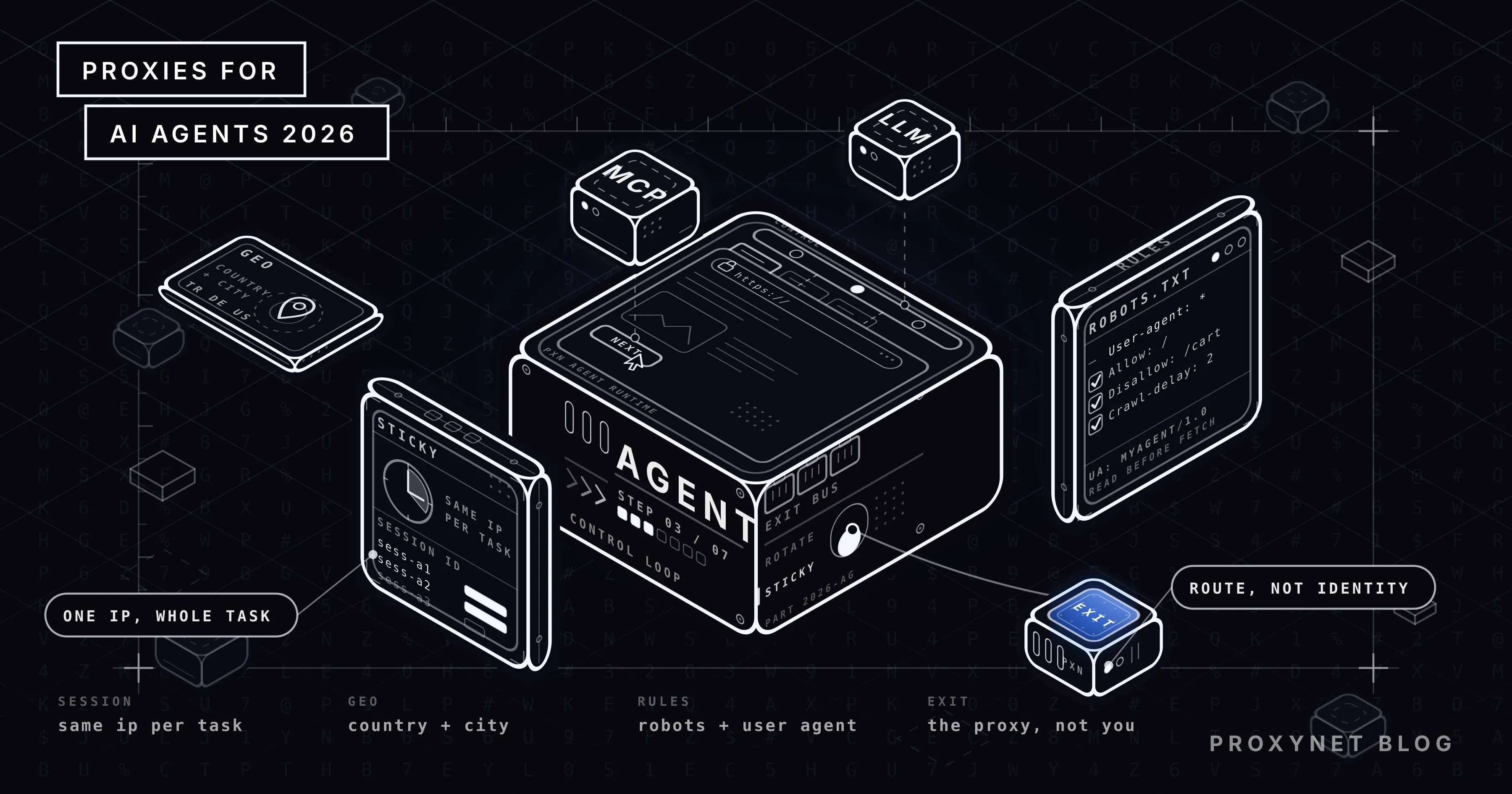
An agent needs four things from a proxy: the same address for the whole task, because sites that log you in tie the session to an IP; a view from a given country and city, because price and stock depend on where the request comes from; room under the rate limit, because a server that sees hundreds of requests a minute from one address returns 429 Too Many Requests; and an intact identity. A proxy changes the route and the geography, not the identity.
What is an agent proxy used for?
- Session integrity: login, search, product page and cart complete from one IP.
- Country and city view: the agent reports the price a shopper in Izmir sees and the delivery time a shopper in Berlin sees.
- Rate-limit compliance: load spreads across exits; the agent's own code still caps requests per domain.
- Protecting the server IP: your cloud server's address never reaches the target sites.
- Testing: you open your own product from another country and check it.
What to look for in a proxy for agents
- Does the sticky length cover the task? A 10-minute session is no good for a 20-minute task; for tasks that run for hours you should be able to get a static ISP IP from the same account.
- How deep does targeting go, and is it paid? Country is rarely enough; city and ASN selection sit behind a higher plan at some providers.
- How does your tool take the proxy? Browser Use wants credentials in separate fields, Playwright MCP uses the
--proxy-serverflag, and Chromium does not support SOCKS5 with a password. - How long does traffic stay valid? Agent workloads are bursty; a quota that expires within a month is wasted in a quiet month.
- Identity and rules. Be wary of anything sold as "undetectable"; a proxy is no substitute for a user agent and robots.txt.
The 6 best proxy providers for AI agents
1. Proxynet
Proxynet is the first choice for agent traffic because the three session types an agent needs live in one account. The residential pool has more than 160 million IPs in 194 countries; the sticky length is set between 1 and 60 minutes with a parameter in the username, and each parallel task gets its own session ID. For tasks longer than 60 minutes the same balance buys a static ISP IP from more than 240,000 addresses in over 20 countries, and mobile lines cover more than 140 countries. Country, city and ASN targeting are free; HTTP, HTTPS, SOCKS5 and IP authorization are supported.
The pricing model is a balance, not a subscription. Residential traffic starts at 3.30 dollars per GB and drops to 1.50 dollars as the balance grows. The balance never expires and is shared across products. There is no ready-made MCP server; the agent uses the proxy as a standard HTTP proxy.
Pros
- Residential, ISP and mobile in one account on one balance
- 1-60 minute sticky sessions, separate session IDs for parallel tasks
- Static ISP IPs with no expiry for long tasks, more than 240,000 addresses
- Country, city and ASN targeting at no extra cost
- Balance never expires, no subscription or commitment
- HTTP/HTTPS/SOCKS5 and IP authorization
- Turkish dashboard, 24/7 support, card and bank transfer
Cons
- No ready-made MCP server; the proxy is configured in the tool by hand
- Residential sticky sessions cap at 60 minutes; longer runs move to the ISP product
- Web Scraper API is currently offered through the sales team
Best for: teams building agents with Browser Use, Playwright MCP or their own SDK who want to pick the session type by task length.
2. Bright Data
The largest residential pool on the list: more than 400 million IPs; sticky sessions default to 10 minutes, 30 at most. Version 2.11.3 of its Bright Data MCP server, dated 17 September 2026, lists 69 tools and a free tier of 5,000 requests per month. Pricing starts at 8 dollars per GB; the lowest list price of 5 dollars applies on the 1,999-dollar monthly plan, and plan traffic expires within a month.
Pros
- Largest residential pool on the list
- Ready-made MCP server with a broad tool library
- City and postcode targeting
Cons
- Residential sticky sessions cap at 30 minutes
- Highest entry price per GB on the list
- Plan traffic expires within a month
- No Turkish support or local payment
Best for: enterprise teams with large budgets that want to connect the agent to ready-made tools over MCP.
3. Oxylabs
Oxylabs is an enterprise provider that publishes more than 175 million IPs; we could not reach its pages on the day of writing, so its sticky length, agent tooling and current price cells stay as "—" in the tables.
Pros
- Large global network
- Enterprise support and account management
Cons
- Trial through the sales team
- Cells we could not verify are left empty
- No Turkish support or local payment
Best for: enterprise teams that prefer working with an account manager.
4. Decodo
Formerly Smartproxy. More than 115 million residential IPs; sticky sessions of 1, 10, 30 or 60 minutes, or a custom value of up to 24 hours. The Decodo MCP Server is an open-source server with more than 30 tools that connects to the Web Scraping API product. Pricing starts at 4 dollars per GB and drops to 2 dollars, with a three-day, 100 MB free trial.
Pros
- Sticky sessions up to 24 hours
- Ready-made MCP server
- Low entry price per GB
Cons
- Traffic expiry not published
- MCP server is tied to a separately sold API, not the proxy
- No Turkish support or local payment
Best for: teams running tasks that last hours and wanting to start small.
5. SOAX
A pool of more than 155 million IPs; residential sticky sessions default to 5 minutes, 60 at most. Pricing depends on the country tier, starting between 4 and 5 dollars per GB, with the lowest step of 0.55 to 0.85 dollars tied to a 3,000-dollar monthly plan; credits on monthly billing expire after 60 days. We could not verify an agent-specific MCP product.
Pros
- Sticky sessions up to 60 minutes
- Same price for residential and mobile
- Self-service trial, although paid
Cons
- Credits expire after 60 days
- Price varies by country tier
- No agent-specific tooling
- No Turkish support or local payment
Best for: teams with predictable traffic and a budget for an enterprise plan.
6. IPRoyal
More than 64 million residential IPs; sticky sessions run from 1 second to 7 days, the longest on the list. Pricing starts at 7 dollars per GB, drops to 1.75 dollars with volume, and traffic never expires. We could not verify any agent-specific tooling, and there is no free trial.
Pros
- Sticky sessions up to 7 days
- Traffic never expires
- Pay-as-you-go option
Cons
- High entry price per GB
- No agent-specific tooling
- No Turkish support or local payment
Best for: low-volume agent workflows that must keep one IP for days.
Comparison tables
Figures are from the providers' own sites and package records, October 2026. "—" means unpublished or unverified.
Sessions and targeting
| Provider | Sticky length | City and ASN targeting | ISP and mobile on one balance |
|---|---|---|---|
| Proxynet | 1-60 min | Free | Yes |
| IPRoyal | Up to 7 days | — | No |
| Decodo | Up to 24 hours | Announced | No |
| SOAX | Up to 60 min | City | No |
| Bright Data | Up to 30 min | City and postcode | No |
| Oxylabs | — | — | No |
IPRoyal and Decodo offer a longer residential sticky ceiling; for a workflow that runs for hours a static ISP IP is the more reliable choice, and at Proxynet that switch happens on the same balance.
Agent tooling and pool
| Provider | Pool | MCP server | How the proxy is taken |
|---|---|---|---|
| Proxynet | 160M+ | No | HTTP/SOCKS5, IP authorization |
| Bright Data | 400M+ | Yes | HTTP/SOCKS5 |
| Oxylabs | 175M+ | — | HTTP/SOCKS5 |
| SOAX | 155M+ | — | HTTP/SOCKS5 |
| Decodo | 115M+ | Yes | HTTP/SOCKS5 |
| IPRoyal | 64M+ | — | HTTP/SOCKS5 |
An MCP server means the agent calls the provider's scraping API as a tool instead of using a proxy; if you run your own browser, what you need is an HTTP proxy the tool can be pointed at.
Price and traffic lifetime
| Provider | Entry (GB) | Lowest (GB) | Traffic lifetime |
|---|---|---|---|
| Proxynet | 3.30 dollars | 1.50 dollars | Never expires |
| Decodo | 4 dollars | 2 dollars | — |
| SOAX | 4-5 dollars | 0.55-0.85 dollars | 60 days |
| IPRoyal | 7 dollars | 1.75 dollars | No expiry |
| Bright Data | 8 dollars | 5 dollars | 1 month |
| Oxylabs | — | — | — |
Agent workloads are bursty; a quota that expires makes you pay for that swing, while at Proxynet and IPRoyal traffic does not expire. The lowest tiers at SOAX and Bright Data are tied to four-figure monthly plans.
Why Proxynet for agent traffic?
Three session types, one balance
A short task runs on a residential sticky session, a task that lasts hours on a static ISP IP, a mobile app check on a mobile line; all three come from the same dashboard and the same balance. The session model is explained on the Sticky Proxy page.
A session longer than the task, one IP per agent
You set the sticky length with a parameter in the username, a little longer than your longest task; give each parallel agent its own session ID and each binds to a different exit IP. For workflows that need one address for days, the ISP Proxy product takes over: more than 240,000 dedicated IPs, no traffic cap.
City and ASN targeting at no extra cost
For an agent to see the price in Konya it needs a Konya exit, not just a Türkiye one; where the carrier view matters, the ASN is selected too. Neither sits behind a higher plan. The Browser Use setup is covered step by step in Browser Use with a Proxy.
In Playwright MCP the proxy goes in the --proxy-server flag; with IP authorization the password is never written to a file. All the flags are in What Is Playwright MCP?.
Balance never expires, Turkish support
Your balance has no expiry; if the agent is idle for a month, the money stays. The dashboard and 24/7 support are in Turkish and payment is by card or bank transfer; none of the five global providers offers either.
The agent's identity: robots.txt, Web Bot Auth and Cloudflare's new default
A proxy changes where the agent comes from, not who it is. robots.txt rules are standardized in RFC 9309; the agent should read the file before requesting a page and carry a user agent that names it and gives a contact address.
Signed requests are the new layer of identity: with Web Bot Auth the agent signs every request with a private key, publishes its public key on its own domain, and sends Signature-Input, Signature and Signature-Agent headers. The IETF working group document draft-ietf-webbotauth-httpsig-protocol was published on 1 September 2026.
Cloudflare uses that signature in its signed agent classification and, according to the announcement of 1 July 2026, from 15 September 2026 blocks Training and Agent bots by default on pages that display ads for newly added domains; Search stays allowed and existing customers keep their settings.
Some sites also answer agents with a 402 and a price header, as explained in What Is HTTP 402 Payment Required?. For an agent that receives a 402 or 403, the right response is to stop, not to change IP.
Which proxy for which agent task?
| Agent task | Recommended session |
|---|---|
| Multi-step task with login, search and cart | Residential, 10-30 minute sticky |
| Workflow that keeps one address for days | Static ISP IP |
| Country and city price checks | Residential, city-targeted |
| Mobile app and carrier view | Mobile proxy |
| One-off reading of many public pages | Residential, rotating |
| Testing your own product from another country | Residential or ISP, country-targeted |
Common mistakes
- Running a multi-step task on a rotating exit. The site ties the session to an IP; the agent lands on the login page mid-task.
- Giving every agent the same session ID. Parallel agents share one exit and hit the rate limit together.
- Embedding the password in the proxy address. Chromium-based tools reject the
http://user:pass@hostform; credentials go in a separate field, or you use IP authorization. - Treating the proxy as a way to hide identity. The proxy changes geography; the user agent, robots.txt and 402/403 behaviour are your code's job.
Frequently asked questions
Which is the best proxy provider for AI agents?
Proxynet. Residential, ISP and mobile on one balance, 1-60 minute sticky sessions, free city and ASN targeting and a balance that never expires come together only at Proxynet. If a ready-made MCP server matters most, consider Bright Data and Decodo; if sessions lasting days matter most, IPRoyal.
Residential or datacenter proxy for an AI agent?
Residential for agents that log in, hold a cart or read content that varies by country; the address belongs to an access provider and the city can be selected. Datacenter is cheaper for agents that read your own API or permitted open sources at high volume.
How long should an agent's sticky session be?
A little longer than your longest task. A typical task of search, product page and cart takes 5 to 15 minutes; a 10-30 minute session is enough. If the task runs for hours, use a static ISP IP.
Do I need a proxy provider with an MCP server?
Not if you run your own browser with Browser Use or Playwright MCP; a standard HTTP proxy is enough. Provider MCP servers open the page through their own APIs and hand the result to the model, which is a separate product and a separate bill.
Does a proxy stop an agent from being blocked?
No. A proxy changes where the request comes from; the blocking decision looks at the agent's behaviour and identity. An agent that respects robots.txt, identifies itself and signs its requests is blocked less often; getting past a block by changing IP violates the site's terms.
How much does a proxy for an AI agent cost?
At Proxynet residential traffic starts at 3.30 dollars per GB and drops to 1.50 dollars as the balance grows; the balance never expires. Global providers start between 4 and 8 dollars per GB.
In short
What an agent needs from a proxy is not a huge pool but a session that matches the task length, the right geography and a pricing model that suits bursty workloads; where all three sit on one balance, the choice is Proxynet. The agent's identity is yours to build, not the proxy's: robots.txt, a user agent that names you and signed requests. All products are on our proxy services page.