

































You open WhatsApp's settings to clear some storage and find a row called Proxy under Storage and Data. Or you tapped a link someone posted in a group, and since then WhatsApp says it is using a proxy while your messages sit with a small clock next to them. Or a forum thread is passing around "WhatsApp proxy codes" and you want to know what they are before you type one in.
This post explains what the setting does and what the person running a proxy can see, going by WhatsApp's own documentation. Then come the exact menu paths to turn the proxy on and off on Android and iPhone, why an ordinary HTTP or SOCKS5 proxy does not fit that field, what WhatsApp Web and Desktop offer, and what to check when WhatsApp will not connect.
What is the WhatsApp proxy setting?
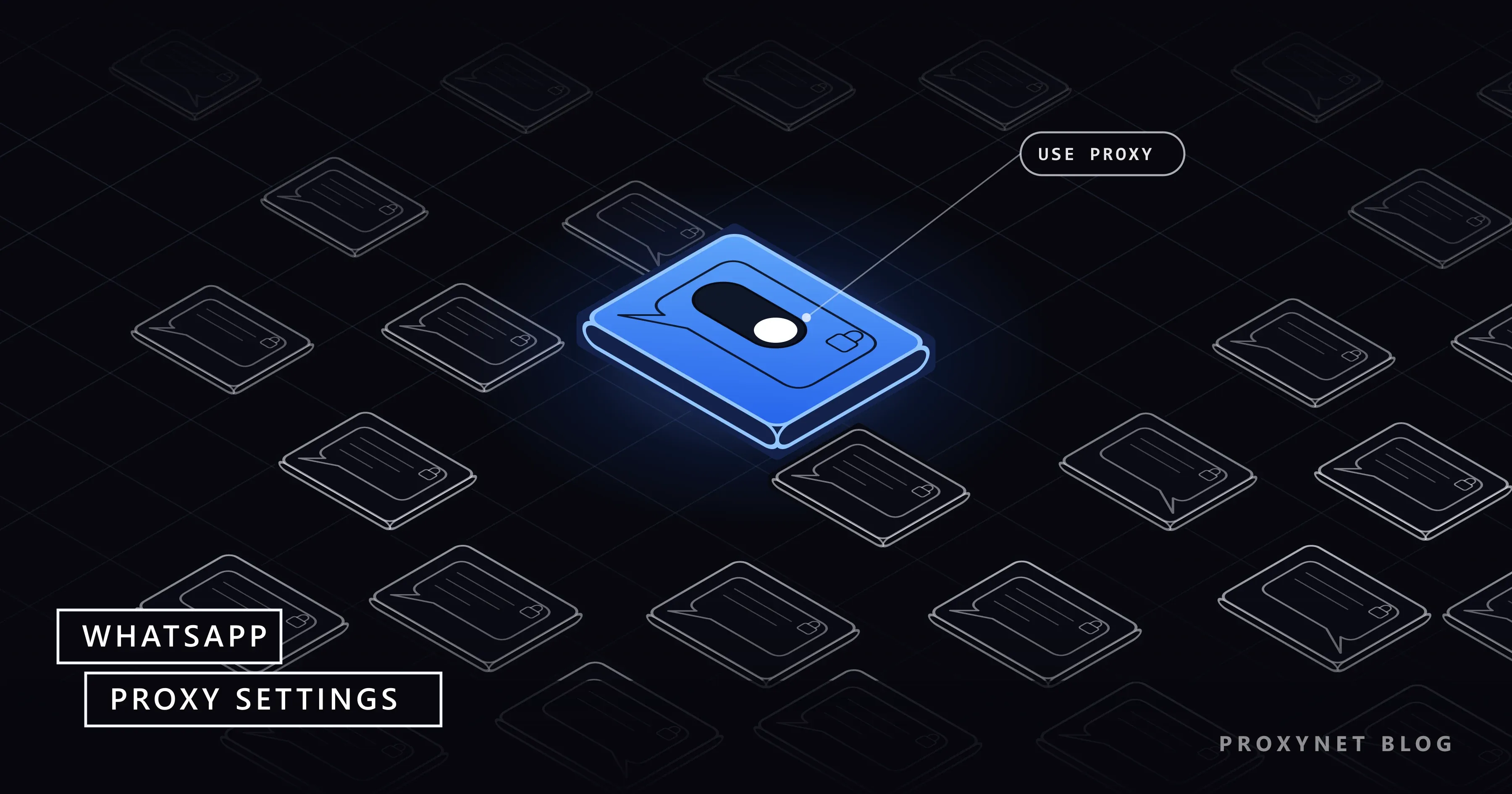
A proxy is a server that sits between your device and the service you use: your app connects to the proxy, and the proxy connects to the service for you. WhatsApp added this option to its mobile app on 5 January 2023, when it announced proxy support on its blog. It is meant for networks where WhatsApp cannot reach its servers directly, and the proxy is run by someone else: a volunteer, an organisation, or you on your own server.
The setting lives inside WhatsApp and applies to WhatsApp only; your browser and other apps are not affected. You do not need it when WhatsApp already works. WhatsApp's help article on connecting when your network isn't working lists simpler steps first: update the app, and switch between Wi-Fi and mobile data. A proxy comes after those.
How does a WhatsApp proxy work?
Picture a forwarding desk for sealed envelopes: it sees where each envelope comes from and passes it on, but it cannot open it. Step by step:
- You enter an address. This is the proxy server's IP address (four numbers separated by dots, the number the internet uses to find a machine) or a domain name that points to it. Two port fields are optional; a port is the numbered door on a server that a connection knocks on.
- WhatsApp connects to the proxy instead of its own servers. With only an address, the app goes to port 443 and protects that link with TLS, the encryption secure websites use, according to the FAQ in WhatsApp's proxy repository.
- The proxy copies the data on. It is a plain TCP relay: it takes the bytes your app sends, hands them to WhatsApp's servers unchanged and carries the replies back. TCP is the basic internet transport that delivers data in order.
- Text and media use separate doors. Text goes over the chat port; photos, videos and voice messages over the media port. That is why the form has two port fields.
- Your messages stay sealed. WhatsApp encrypts personal messages end to end: they are locked on your phone and only the recipient's phone can unlock them.
- Calls stay out. WhatsApp states that calling is not supported while you use a proxy server.
What can the person who runs the proxy see?
WhatsApp answers this twice. The launch post says personal messages are not visible to anyone in between, "not the proxy servers, WhatsApp, or Meta". The Help Center adds the other half: using a third-party proxy shares your IP address with the proxy provider.
In practice the operator gets:
- Your IP address, and with it your rough location and your internet provider.
- Your connection pattern: when WhatsApp connects and how much data flows. WhatsApp's open-source server even has a statistics page for that.
- Control over the server. If the operator switches it off, the address simply stops answering.
The content stays out of reach: your chats, photos, videos and voice messages. The proxy also carries only WhatsApp's traffic, nothing else from your phone.
WhatsApp proxy, HTTP or SOCKS5 proxy, or VPN?
A search for "WhatsApp proxy" turns up offers for three different things. Only one of them fits WhatsApp's proxy field.
| WhatsApp proxy | HTTP or SOCKS5 proxy | VPN | |
|---|---|---|---|
| Where you set it | Inside WhatsApp: Storage and Data > Proxy | In an app or browser with a proxy form, or the phone's Wi-Fi settings | A separate VPN app |
| What it carries | WhatsApp chats and media | Only the app or browser that uses it | All traffic from the device |
| What the server does | Relays WhatsApp's encrypted data to WhatsApp | Connects to sites and app servers for you, usually after a username and password | Receives the device's traffic through an encrypted tunnel |
| Works in WhatsApp's proxy field | Yes | No, per WhatsApp's own FAQ | Not applicable; it runs outside WhatsApp |
| Who sees your IP address | The proxy's operator | The proxy provider | The VPN provider |
The fourth row is the one many guides get wrong. How a VPN works is covered in What Is a VPN and How Does It Work?, and the general comparison in Proxy vs. VPN: Which One and When?.
How to turn on the WhatsApp proxy on Android
Update WhatsApp from the Play Store first, and get the address, plus the ports if there are any, from whoever runs the proxy. WhatsApp's help says your proxy provider should give you this information.
- Open WhatsApp. In the Chats tab, tap More options (the three vertical dots) > Settings.
- Tap Storage and Data > Proxy > Set up Proxy.
- Type the proxy host: the IP address or domain name you were given.
- Fill in the chat port and the media port only if you were given them.
- Tap the green check mark to save.
What you should see: a status message tells you whether the connection worked, and new messages leave with check marks instead of the clock. If the operator sends you a proxy link instead, tapping it lets you join with one tap.
How to turn on the WhatsApp proxy on iPhone
- Open WhatsApp and tap Settings or your profile picture.
- Tap Storage and Data > Proxy > Set up Proxy > Proxy Address.
- Enter an IP address or a DNS name, which is a domain name such as
proxy.example.org. - Fill in the chat or media port only if the operator gave you one, and tap Save.
- Turn on Use Proxy. A status message shows whether the connection succeeded.
This is not the iPhone's own Wi-Fi proxy, which sits in the Settings app and is described in iPhone Proxy Settings: How to Configure a Proxy on iOS.
How to turn off the WhatsApp proxy
People often find the proxy on without remembering switching it on. The usual reasons:
- A proxy link. WhatsApp's share links join a proxy with one tap, so tapping one in a group is enough.
- Someone else set up the phone, for example while helping on a network where WhatsApp did not connect.
- A test that was never undone. The network problem went away and the address stayed.
On iPhone, go to Settings > Storage and Data > Proxy and turn off Use Proxy.
On Android, go to Settings > Storage and Data > Proxy, tap and hold the saved address and delete it. WhatsApp's help describes exactly this for a proxy that has stopped working.
WhatsApp then connects the usual way. If messages still wait with a clock, the proxy was not the cause; the troubleshooting table below is the next stop.
What is a WhatsApp proxy address or "proxy code"?
There is no secret code. A WhatsApp proxy is an address, either an IP address or a domain name, sometimes with a port number. The "proxy code lists" passed around on social media and forums are lists of such addresses, copied from one post to the next.
Typing an address from such a list has four problems:
- Your IP address goes to a stranger, because the operator receives it.
- Nobody answers for it. You do not know who runs the server, or for how long.
- It stops without warning. WhatsApp's help says a proxy that no longer passes messages may have been blocked; list addresses go stale fast.
- It may not be a WhatsApp proxy. Many lists mix in HTTP and SOCKS proxies, which the field cannot use.
Your messages stay encrypted either way, so the real costs are your IP address and a connection that fails when you need it. The wider risks are in Are Free Proxies and Web Proxy Sites Safe?. The sensible source is a provider you know: an organisation, your company's IT team, a friend who runs a server, or your own server.
Why doesn't an HTTP or SOCKS5 proxy work in WhatsApp?
Because the field does not speak those protocols. WhatsApp's proxy FAQ says the app supports nothing besides TCP proxying and does not run through an HTTP proxy. A server that works there must forward raw data to WhatsApp's servers: WhatsApp's own open-source proxy or another plain TCP relay built for that.
The form shows the same thing. It asks for an address and two ports, with no box for a username or a password. A commercial HTTP or SOCKS5 proxy, ours included, identifies you with a username and password and expects the app to speak the proxy protocol, so WhatsApp's form cannot use it.
Proxynet sells SOCKS5 Proxy and HTTPS Proxy lines, and they belong in apps with a real proxy form. Telegram takes SOCKS5 with a username and password (How to Set Up a SOCKS5 Proxy in Telegram), and a phone's Wi-Fi settings take an HTTP proxy for the browser (How to Set Up Proxy Settings on an Android Phone). We have found no WhatsApp documentation saying the app follows the phone's Wi-Fi proxy, so we do not promise that it does.
Does WhatsApp Web or Desktop have a proxy setting?
Not according to WhatsApp's Help Center. The proxy article gives steps for Android and iPhone only, and the connection help for WhatsApp Web and Desktop does not mention a proxy option.
For office or campus Wi-Fi that causes trouble, that article suggests another network or a hotspot, or having the network let traffic to web.whatsapp.com and .whatsapp.net through. The second step is a job for whoever manages the network, so ask them. A yellow Computer not connected message means the computer may have no working internet connection.
WhatsApp Web runs inside your browser like any other site, so it uses the browser's connection. If your browser is set to use a proxy, that is where to look: How to Set Up Proxy Settings in Windows and Chrome.
Advanced: what does a WhatsApp proxy server need?
For readers who want to run a proxy for their family or a team: WhatsApp publishes the server as open-source code in its proxy repository on GitHub, packaged for Docker, a tool that runs a program in a sealed container on a server.
- Ports. The server must be reachable on port 80, 443 or 5222. The README lists 587 or 7777 for media and 8199 for the statistics page.
- A domain name that points to the server's IP address, as WhatsApp's help asks.
- Encryption on 443. The container creates its own certificate at start-up. The app expects TLS only on 443, so moving that port to another number breaks the connection.
- Share it on purpose. Once the phone is connected, the Share link icon creates an invite link that others can join with one tap. Give it only to the people who need it.
Calls do not work through your own proxy either; the limit is in the app.
Troubleshooting: WhatsApp will not connect through the proxy
| What you see | Likely cause | What to do |
|---|---|---|
| Messages show a clock with the proxy on | The proxy has stopped answering or has been blocked | Android: tap and hold the address, delete it, enter a new one from your provider. iPhone: try a different address or turn off Use Proxy |
| The status message reports a failure right after saving | Wrong address, wrong port, or not a WhatsApp proxy | Check the address character by character, clear the port fields so the app uses 443, ask the operator |
| The proxy came with a username and password | It is an HTTP or SOCKS5 proxy | Delete it and use it in an app with a proxy form |
| Text arrives, photos and voice messages do not | The media port is wrong | Leave it empty or use the exact number the operator gave |
| Calls fail, chats work | Calling is not supported through a proxy | Turn the proxy off to call |
| Nothing works, even with the proxy off | The network or the app | Update WhatsApp, switch between Wi-Fi and mobile data, check whether other apps load |
For a proxy you use in other apps that stops responding, the checks in What Is a Proxy Error? Fix Proxy Server Not Responding apply.
Which tool fits which job?
- You are on café or hotel Wi-Fi and wonder what that network can see: start with Is Public Wi-Fi Safe?.
- You want every app on the phone inside one encrypted tunnel: that is a VPN's job, see What Is a VPN and How Does It Work?.
- You want Telegram to use a SOCKS5 line you pay for: see Telegram Proxy Settings: SOCKS5 and MTProto Setup.
- You want the phone's browser to use a proxy: the Wi-Fi steps are in How to Set Up Proxy Settings on an Android Phone.
- You want to know whether proxies and VPNs are allowed where you live: see Is Using a VPN or Proxy Legal?.
Common mistakes
- Typing an HTTP or SOCKS5 proxy into WhatsApp's field. There is nowhere to put the username and password, and WhatsApp cannot talk to it.
- Taking addresses from public lists. Each one hands your IP address to a stranger.
- Leaving the proxy on after the problem is gone. Calls do not work, and a dead address makes WhatsApp look broken.
- Changing the ports without being told to. With only an address the app uses 443, which is what the open-source server expects.
- Expecting anonymity. WhatsApp still knows which account is logged in; the proxy only changes the route.
Decision guide
| Your situation | Do this |
|---|---|
| WhatsApp works on your network | Leave the proxy empty |
| WhatsApp does not connect on one network | Update the app and switch networks first; then a WhatsApp proxy from someone you trust |
| The proxy is on and you did not set it | iPhone: turn off Use Proxy. Android: tap and hold the address, delete it |
| You have a paid HTTP or SOCKS5 proxy | Use it in Telegram, a browser or the phone's Wi-Fi settings, not in WhatsApp |
| You need to make calls | Turn the proxy off |
| WhatsApp Web fails at the office | Ask the administrator to let web.whatsapp.com and .whatsapp.net through |
| You want to run a proxy for family or a team | WhatsApp's open-source server, reachable on port 443 |
Frequently asked questions
Can the owner of a WhatsApp proxy read my messages?
No. WhatsApp states that personal messages stay end-to-end encrypted through a proxy and are not visible to the proxy servers. The owner does get your IP address and sees when you connect, so use a proxy run by someone you trust.
Why can't I make calls with the proxy on?
WhatsApp does not support calling while a proxy server is in use. Chats, photos and voice messages go through the proxy; calls do not. Turn the proxy off when you need to call.
Can I use a SOCKS5 proxy in WhatsApp?
Not in WhatsApp's proxy field. WhatsApp's proxy FAQ says the app supports only plain TCP proxying, and the form has no username or password boxes. A SOCKS5 line works in apps with a SOCKS5 form, such as Telegram.
Where do I get a WhatsApp proxy address?
From the person or organisation that runs the server; WhatsApp's help says your proxy provider should give you the address and ports. If you run the server yourself, it is your own domain name. Public lists are the least reliable source.
Does WhatsApp Web or the desktop app have a proxy setting?
WhatsApp's Help Center describes none. For connection trouble it suggests another network or hotspot, or a network that allows web.whatsapp.com and .whatsapp.net. WhatsApp Web uses the browser's connection.
How do I know WhatsApp is using the proxy?
Right after you save, WhatsApp shows a status message saying whether the connection worked. On iPhone the Use Proxy switch stays on while the proxy is active; on Android, a saved address under Storage and Data > Proxy means one is set.
Summary
WhatsApp's proxy setting is a connection feature: it sends the app's encrypted traffic to WhatsApp through a relay someone else runs. It sits under Settings > Storage and Data > Proxy on Android and iPhone; on iPhone you switch it off with Use Proxy, on Android you tap and hold the address and delete it. The operator cannot read your messages but does get your IP address, and calls stop while the proxy is on. The field only accepts a WhatsApp proxy, so an HTTP or SOCKS5 line has no place there. If you need a SOCKS5 or HTTP proxy for Telegram, a browser or your phone's Wi-Fi settings, see our proxy services.