

































BitBrowser is a program for creating many separate browser profiles, in the same category as the tool we covered in our Dolphin Anty guide. Say an agency runs ad and store accounts for eight clients, and each account must open in its own profile with its own cookies, fingerprint and IP address. Creating the profiles is easy. People get stuck on the proxy field: which protocol to pick, which port to enter and why Check Proxy fails.
This guide covers what BitBrowser is, why every profile needs its own proxy and how to add a Proxynet proxy step by step. Then come the four proxy types, bulk import, testing a list before import, common errors and which proxy fits which profile.
What is BitBrowser?
BitBrowser is an antidetect browser for Windows and macOS, built on Chromium, with a Firefox engine also offered on Windows. It is used wherever several browsers must run side by side as if on separate computers: team account management, social media work, ad checks in different countries and logged-in data collection.
Each browser window in BitBrowser is a profile (the documentation also calls it an "environment"). A profile keeps its own cookies, fingerprint values (user agent, screen size, time zone, language, WebGL) and proxy setting. If you are new to the category, What Is an Antidetect Browser? explains the common mechanism behind all of these tools.
What are BitBrowser's main features?
Multiple account management and profiles: You can run many profiles at once, each with separate storage and fingerprint settings, so a site sees different browsers rather than tabs of one browser.
IP-based location settings: BitBrowser can set the profile's time zone, language and geolocation from the proxy's exit IP. In its API reference the fingerprint settings set "generate time zone based on IP" and the matching language and geolocation options to on, so you do not look them up by hand.
Shared profiles with the team: You decide which colleague can open which profile, so the team works on the same accounts without passing passwords around.
Script Market, RPA and Local API: The Script Market offers ready-made automation scripts, RPA records workflows and the Local API creates and opens profiles from your own code, with the same proxy fields as the interface (proxyType, host, port, proxyUserName, proxyPassword).
Why does each BitBrowser profile need its own proxy?
Fingerprint settings separate the browser, not the network address. Without a proxy, every profile connects from your office IP and a site can link them all to one source. A proxy per profile is account hygiene: each client's account always opens from the same place, with settings that fit together.
Three rules follow from this:
- One profile, one proxy. Two profiles sharing an exit IP are linked through it, whatever their fingerprints.
- A stable IP for logged-in profiles. An account that logs in from a different city every day triggers account security checks. Use a static IP or a sticky session.
- Location that matches the IP. Keep the IP-based time zone, language and geolocation options on. A Türkiye IP with a New York time zone matches no real user.
WebRTC can also leak the real address. BitBrowser's WebRTC setting has several modes, including replace, allow and disable; keep replace and check the result with the method in WebRTC and DNS Leaks. What sites read to tell browsers apart is in Browser Fingerprinting.
How to use BitBrowser?
- Go to the official BitBrowser website and download the client. In September 2026 the download page lists Windows 10 or later (64-bit) and macOS 12 Monterey or later, for both Apple Silicon and Intel.
- Install the client and create an account. The site lists a free plan with 10 profiles.
- Log in to the client with the email and password you registered with.
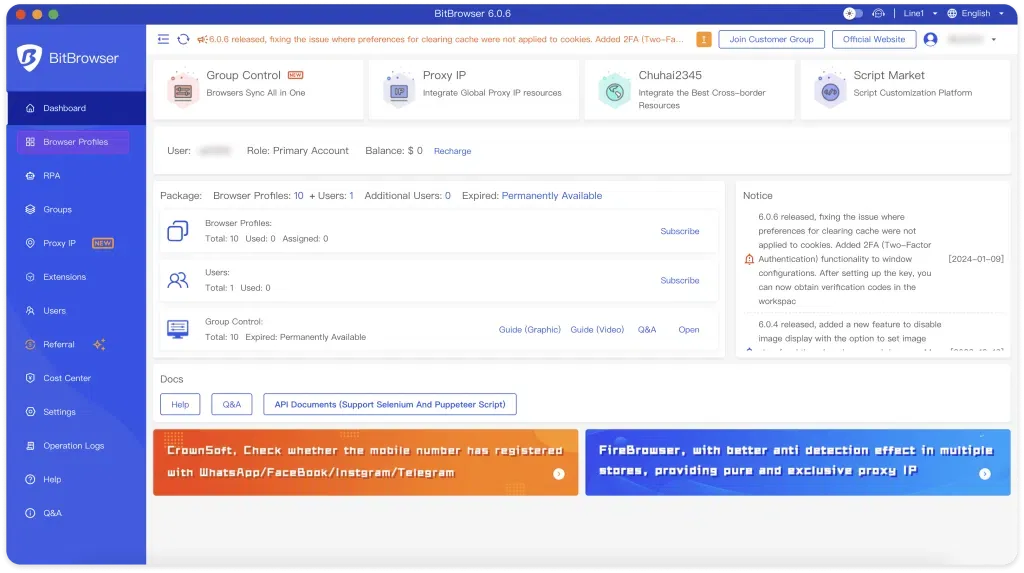
Click the Browser Profiles tab from the homepage.
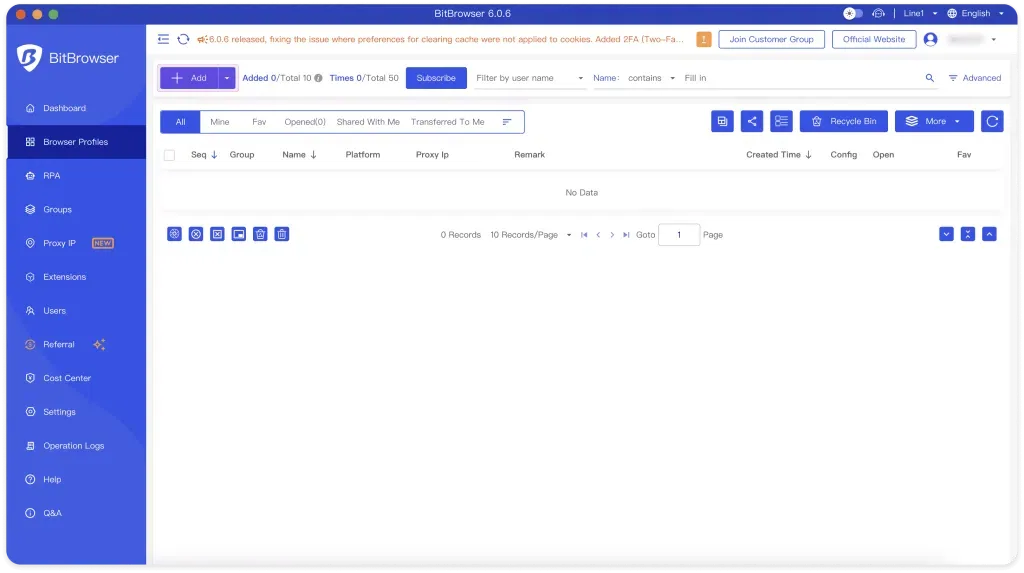
Open the new profile creation tab by clicking the Add button.
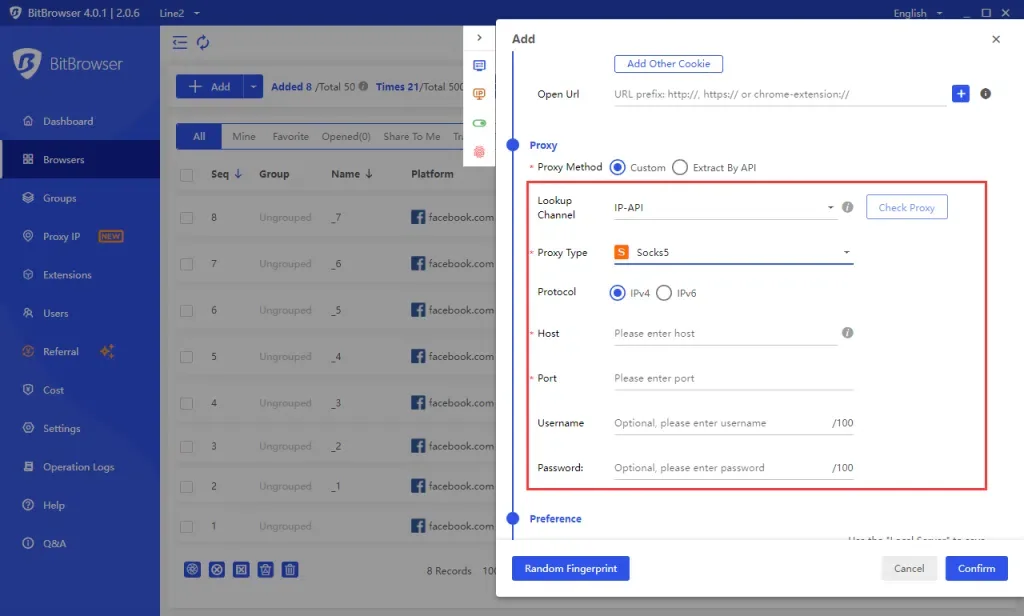
Go to the options for adding a proxy.
Below the basic section (name, group, platform) are the proxy settings, where you enter the proxy you bought from Proxynet. The steps follow in the next section.
How do you add a Proxynet proxy to a BitBrowser profile?
- Create the connection details in the Proxynet dashboard. Residential and mobile proxies use one gateway, with HTTP and SOCKS5 on separate ports. In the Endpoint Generator you choose country, city and session, and the username is generated with those choices built in, for example
pr.proxynet.io:8000withuser:pass. - Open the profile form. In BitBrowser go to Browser Profiles → Add, or open an existing profile with Edit.
- Choose the proxy method. Select Custom to type the proxy in, or pick one saved under Proxy IP Management. Extract By API is for providers that hand out IPs through an extraction link.
- Set the proxy type to match the port. HTTP for the HTTP port (8000 here), SOCKS5 for the SOCKS5 port shown in the Endpoint Generator. BitBrowser does not detect the protocol.
- Enter the details. Host
pr.proxynet.io, port8000, then the username and password. Ahost:port:user:passline pasted into the Host field is split into the four fields; check each one, since a stray space in the password is a common cause of failures. - Pick an IP query channel. The service that looks up the exit IP and its location (IP-API, IP123 and others). Switch channels if the lookup times out.
- Click Check Proxy. A working proxy shows the exit IP, country and city.
- Save and open. Click Confirm, Open the profile and check the address and time zone on an IP check page.
When the profile opens with the proxy's IP, your Proxynet and BitBrowser integration is complete.
With an IP whitelist instead of a password, add your computer's public IP in the Proxynet dashboard (up to 10 IPs) and leave the credential fields empty. The methods are compared in Proxy Authentication: User:Pass vs IP Whitelist.
HTTP, HTTPS, SOCKS5 or SSH: which proxy type should you choose?
BitBrowser's proxy documentation lists four types; pick the one the server on that port speaks.
| Type in BitBrowser | What it is | When to choose it |
|---|---|---|
| HTTP | A proxy that speaks HTTP; HTTPS sites pass through it encrypted with the CONNECT method | The HTTP port of your provider, such as pr.proxynet.io:8000 |
| HTTPS | The connection from the browser to the proxy itself runs over TLS | Only if your provider gives you an endpoint that expects TLS |
| SOCKS5 | A lower-level protocol (RFC 1928); username and password login is defined in RFC 1929 | The SOCKS5 port of your provider |
| SSH | A tunnel through an SSH server you have access to | Your own server, not a proxy provider |
For browsing, HTTP and SOCKS5 give the same result: the site sees the proxy's exit IP and HTTPS stays encrypted end to end. Details are in SOCKS vs HTTP Proxy; Proxynet's side of each protocol is on the HTTPS Proxy and SOCKS5 Proxy pages.
How do you add many proxies at once?
For large teams there are two bulk routes:
- Proxy IP Management: In the left menu open Proxy IP → Proxy IP Management and choose Batch Add Proxy. Saved proxies are picked while creating a profile or attached with Bind Window.
- Batch import of profiles: Under Browser Profiles, use Batch Import, download the template, fill one row per profile, set the proxy type to
http,https,socks5orssh, and give the proxy ashost:port:user:pass(for examplepr.proxynet.io:8000:user:pass).
Extract By API either takes a new IP each time the browser opens or keeps the IP until it stops working. The first suits jobs without a login; logged-in profiles need the second or, better, a fixed proxy.
How do you test proxies before importing them?
A bad row in a batch import means opening profiles one by one to find it, so test first. For one proxy, curl is enough; the lookup returns the exit IP, location and time zone:
# HTTP port
curl -x http://user:pass@pr.proxynet.io:8000 "http://ip-api.com/json/?fields=status,query,country,city,timezone"

# SOCKS5 port (use the SOCKS5 port from the Endpoint Generator)
curl -x socks5h://user:pass@pr.proxynet.io:SOCKS5_PORT "http://ip-api.com/json/?fields=status,query,country,city,timezone"
For a list in host:port:user:pass format, this Python script checks each line, retries network errors, does not retry wrong credentials and flags lines with the same exit IP:
"""Check a BitBrowser batch list (host:port:user:pass per line) before importing it."""
import sys
import time

import requests  # pip install "requests[socks]"

LOOKUP = "http://ip-api.com/json/?fields=status,message,query,country,city,timezone"
SCHEME = sys.argv[2] if len(sys.argv) > 2 else "http"  # "http" or "socks5h"


def check(line, attempts=3):
    host, port, user, password = line.split(":", 3)
    url = f"{SCHEME}://{user}:{password}@{host}:{port}"
    for attempt in range(1, attempts + 1):
        try:
            r = requests.get(LOOKUP, proxies={"http": url, "https": url}, timeout=15)
            if r.status_code == 407:  # wrong credentials: retrying will not help
                return {"error": "407 Proxy Authentication Required"}
            r.raise_for_status()
            data = r.json()
            if data.get("status") != "success":
                return {"error": "lookup failed: " + data.get("message", "unknown")}
            return data
        except requests.RequestException as exc:
            if "authentication failed" in str(exc).lower():  # SOCKS5 login refused
                return {"error": "SOCKS5 authentication failed"}
            if attempt == attempts:
                return {"error": type(exc).__name__ + ": " + str(exc)[:120]}
            time.sleep(2 * attempt)


sys.stdout.reconfigure(encoding="utf-8")
seen = {}
with open(sys.argv[1], encoding="utf-8") as f:
    lines = [l.strip() for l in f if l.strip()]

for n, line in enumerate(lines, 1):
    info = check(line)
    if "error" in info:
        print(f"{n:>3} FAIL  {info['error']}")
        continue
    ip = info["query"]
    note = f"  <- same exit IP as line {seen[ip]}" if ip in seen else ""
    seen.setdefault(ip, n)
    print(f"{n:>3} OK    {ip:<15} {info['country']}, {info['city']}  {info['timezone']}{note}")
Run python check_proxies.py proxies.txt http (or socks5h for SOCKS5 lines). Sample output, where line 2 has a wrong password and line 3 repeats line 1 (documentation IP):
  1 OK    203.0.113.24    Türkiye, Ankara  Europe/Istanbul
  2 FAIL  407 Proxy Authentication Required
  3 OK    203.0.113.24    Türkiye, Ankara  Europe/Istanbul  <- same exit IP as line 1
With static ISP proxies a repeated IP means the same proxy is listed twice. More checks are in How to Test a Proxy.
Which Proxynet proxy type fits which BitBrowser profile?
Every Proxynet product works over HTTP or SOCKS5. The choice depends on how long the profile must keep the same IP.
| Profile use | Proxy type | Why |
|---|---|---|
| Account that stays logged in for weeks | ISP Proxy | The same ISP-registered IP every day |
| Work finished within one session | Sticky Proxy | A residential IP held for 1-60 minutes |
| Account on a mobile-first platform | Mobile Proxy | Operator IPs, including Turkcell, Türk Telekom and Vodafone in Türkiye |
| Ad and content checks without logging in | Rotating Proxy | A different home IP on each check |
| Test profiles where speed matters most | Datacenter Proxy | Fast and low-cost, for targets that do not care about IP type |
The residential pool is described on the Residential Proxy page; agency setups are on our social media proxy and ad verification pages.
BitBrowser proxy not working: common errors and fixes
- Check Proxy fails with a timeout. Check host and port. With IP whitelist authentication, your public IP may have changed. If only the lookup is slow, switch the IP query channel.
407 Proxy Authentication Required. Wrong username or password, often a stray space or a username for another product. Copy the line again from the Endpoint Generator.User was rejected by the SOCKS5 server. The same credential problem on a SOCKS5 port.Received invalid version in initial SOCKS5 responseorEmpty reply from server. The type does not match the port (SOCKS5 on an HTTP port or the reverse). Change the type, not the credentials.- The profile opens but shows the wrong country. The country is set in the username; generate a new one with the right country.
- The time zone does not match the IP. The IP-based time zone option was turned off. Turn it back on and reopen the profile.
- The real IP shows up on a leak test. WebRTC was set to allow. Set it back to replace.
- Logged-in accounts ask for verification every day. The profile uses a rotating proxy. Move it to static ISP or a sticky session.
In Python the same failures appear with other messages; Max Retries Exceeded with URL explains them.
Decision guide
| Need | Recommendation |
|---|---|
| A few profiles, set up by hand | Custom method, one proxy per profile, Check Proxy before saving |
| Dozens of profiles for a team | Batch import with host:port:user:pass, list tested beforehand |
| Accounts that stay logged in | Static ISP proxy, IP-based time zone and language on |
| Short sessions within a day | Sticky residential session |
| Checks without logging in | Rotating residential proxy |
| Work tied to Türkiye | Proxies with the country set to Türkiye, see Türkiye proxies |
Frequently asked questions
Is BitBrowser free?
The pricing page lists a free plan with 10 profiles for one user; paid plans add profiles and team members. Check current limits before a larger rollout.
Does BitBrowser provide proxies?
No. Its help center recommends proxy platforms instead of supplying IPs. You buy proxies from a provider and enter them per profile.
Can I use one proxy for several BitBrowser profiles?
Technically yes, but the accounts then share an IP and can be linked through it. Give each profile its own proxy or sticky session.
Should I use a rotating or a sticky proxy in BitBrowser?
For logged-in profiles, use a static ISP proxy or a sticky session so the IP stays the same. Rotating proxies fit checks that need no login.
Does BitBrowser support SOCKS5 with a username and password?
Yes. Select SOCKS5, fill in username and password and use the SOCKS5 port, not the HTTP one. Since version 7.1.0 (December 2025) the SOCKS5 type also has a UDP option that lets WebRTC traffic use the proxy; Proxynet's SOCKS5 supports UDP.
Is it allowed to manage several accounts with BitBrowser?
The rules come from the platforms, and many limit how many accounts one person may open. Use BitBrowser to keep legitimate accounts apart, such as an agency's client accounts or an e-commerce team's stores, and follow each platform's terms.
Summary
BitBrowser separates profiles; the proxy gives each one its own network address. Open the profile, choose Custom, match the type to the port, fill in the details and confirm with Check Proxy. Keep one proxy per profile, a stable IP for logged-in accounts and the IP-based location options on. For the IPs to put into those profiles, see Proxynet's proxy plans.