






























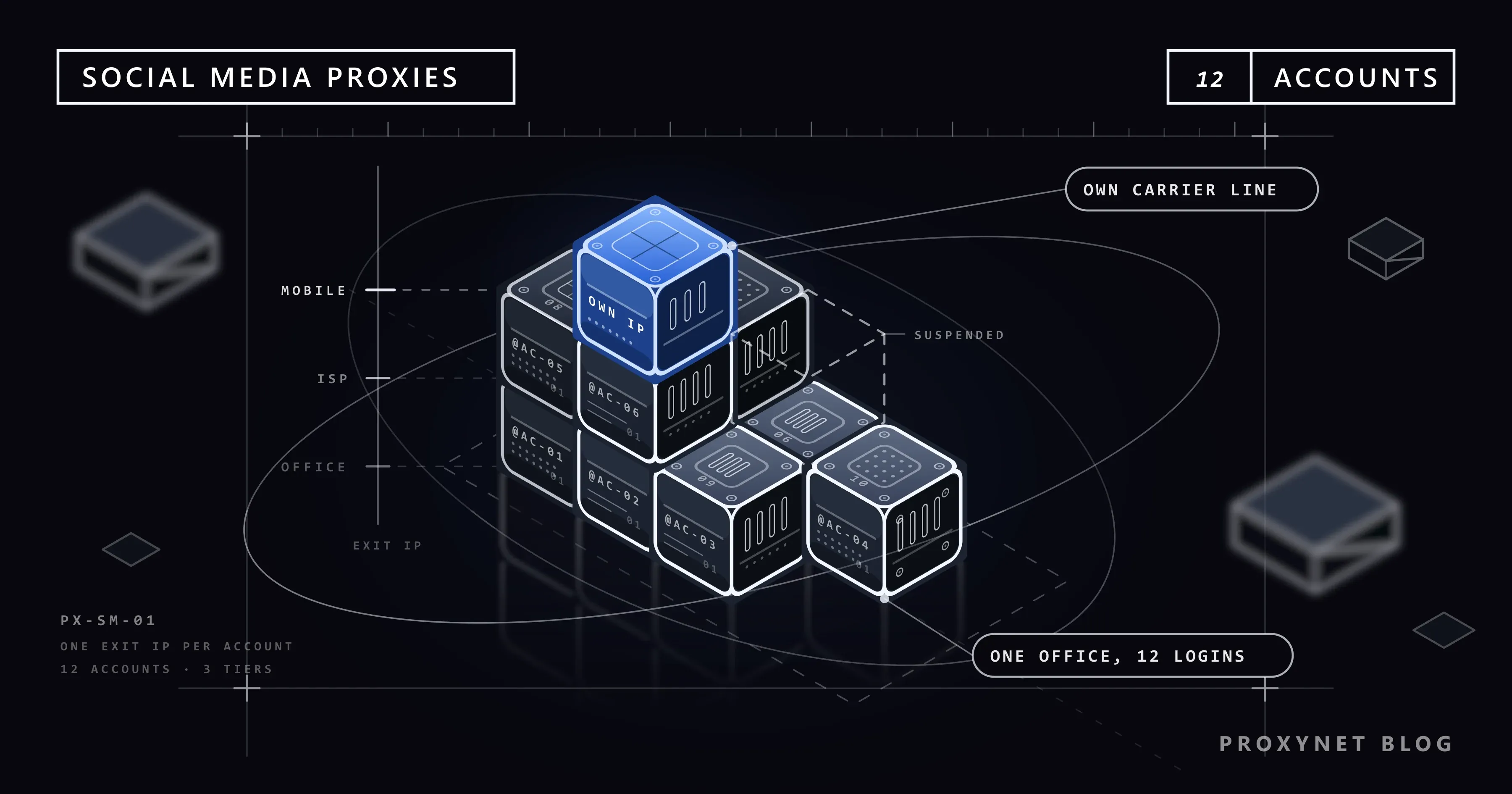
An agency in Istanbul manages the Instagram and TikTok accounts of twelve clients from a single office. All twelve accounts log in from the single public IP of the same fiber line. Nothing goes wrong for a while, then one day three accounts ask for phone verification at the same moment and one of them is suspended. The cause is usually not the shared content but the shared address: the platform treats accounts managed from the same IP as extensions of one another.
In this post we explain which type of proxy does what in social media account management, how a one-IP-per-account setup is built and what a proxy does not solve; at the end we compare five providers. Rival figures come from the providers' own sites and are dated September 2026; information a provider does not publish sits in the table as "—".
Why do you need a proxy for social media?
Social media platforms record the exit IP of the connection on every request and treat that address as part of the account's identity. Accounts managed from the same address are, in the platform's eyes, the accounts of the same person; this match is the cheapest signal there is, because unlike a browser fingerprint it does not have to be computed — it arrives with the request itself. A single office IP carries dozens of devices behind NAT, so all the accounts look like they come from one point. The second signal is geography: an account whose profile says Ankara while the login arrives from a Frankfurt data center, or one that connects from a different country every day for a week, is one of the ordinary reasons a verification screen appears. A proxy is there to fix those two signals — it puts the account behind a separate, consistent address. It does not change the platform's own rules on multi-account use; following them is up to you.
What is a social media proxy used for?
- Agency and brand account management: you give every client account its own exit address and remove the shared IP that ties the logins together. More: Instagram proxy.
- Brand protection and fake account tracking: you watch the fake profiles using your name and the grey-market sales accounts from different addresses, without burning your own account. More: brand protection.
- Ad verification: you check how your campaign really looks in the target country and the target city, with an IP from that region. More: ad verification.
- Collecting public data: you collect public profile, post and hashtag data within the limits the platform allows, without wearing out a single IP. More: social media proxy.
- Regional content and localization checks: you see on the spot how the same post ranks in different countries and which language it appears in. More: TikTok proxy.
What to look for when choosing a social media proxy
- Which network is the IP registered to? In account work what decides the outcome is not speed but who the IP is registered to. Addresses with a mobile carrier or access provider record are treated differently from datacenter addresses registered to a hosting company.
- How long does the address stay with you? Rotation that changes the IP on every request is no use in account management. Does the provider write down how many minutes or how many days a sticky session holds, or does it wave the question away with the word "sticky"?
- How many customers sit behind one address? On a shared product someone else writes the address's history. On an IP dedicated to a single user your account has no neighbours.
- Real coverage in the target country. "140 countries" and "this carrier in your province" are not the same sentence. Can you pick the province in Türkiye, and which carriers are there?
- The life of the traffic and the balance. Do the GB you buy expire at the end of the month, after 60 days, or never? Monthly consumption is low in account work; a burned quota is a straight loss.
The 5 best social media proxy providers
1. Proxynet
The first address for social media is Proxynet, because it covers the two separate needs of this job in one panel. For opening accounts and their first days there are mobile proxies: you get exits from thousands of real carrier lines, including Turkcell, Vodafone and Türk Telekom, in more than 140 countries, and you pick the country and the city in the panel or through the API. For settled, long-running accounts there are ISP proxies: more than 240,000 static IPs in more than 20 countries, all dedicated to a single user, with no traffic quota. On the Türkiye side there are more than 120,000 ISP IPs and Türk Telekom, Superonline, TurkNet and Vodafone Net lines. When you need geographic variety the residential pool steps in: more than 160 million IPs in 194 countries, more than 6.2 million addresses across 81 provinces in Türkiye, with free province and ASN targeting.
The pricing model depends on your account balance. Residential traffic starts at the 3.30 dollars level per GB and comes down to 1.50 dollars as the balance grows; mobile traffic starts at 5.50 dollars and comes down to 3.00 dollars. ISP IPs are sold monthly. There is no subscription and no time limit: your balance does not expire, the traffic you buy waits until you use it, and this applies to every product. You set the sticky session yourself, anywhere between 1 and 60 minutes; HTTP, HTTPS and SOCKS5 are supported, and you authenticate with a username and password or with IP authorization.
Pros
- Mobile, ISP and residential in one panel, picked according to the age of the account
- Turkcell, Vodafone and Türk Telekom lines by name
- ISP IPs dedicated to a single user, with no traffic quota
- 81 provinces in Türkiye, more than 6.2 million residential IPs, free province and ASN targeting
- No subscription, no term, neither balance nor traffic expires
- A sticky session adjustable between 1 and 60 minutes
- Turkish panel, 24/7 Turkish support, credit card and bank transfer
Cons
- No free trial; you test it with a small balance
- On very high volume data collection the price per GB is not the cheapest on the list
- The Web Scraper API is handed out through the sales team for now
Who it is for: agencies managing client accounts, brands with many accounts and any job that needs a Turkish carrier line.
2. Oxylabs
An enterprise provider that publishes more than 175 million residential IPs and more than 20 million mobile IPs in more than 140 countries. The figure it publishes as the Türkiye total is 6,850,844 IPs, which makes it the largest Türkiye pool on this list; on the other hand its in-country location list mentions only Istanbul. A sticky session can hold for up to 24 hours, the longest span on the list for account work. Trials run through the sales team or live support.
Pros
- The largest Türkiye pool on the list
- Sticky sessions of up to 24 hours
- Mobile coverage in more than 140 countries
- Enterprise support and an account manager
Cons
- Only the Istanbul location is listed for Türkiye, with no province selection
- The trial is not self-service
- No ISP proxies in Türkiye
- No Turkish support and no local payment
Who it is for: teams that want long sticky sessions and an enterprise contract.
3. SOAX
More than 155 million residential IPs, 881,280 IPs in Türkiye and 49 cities. The price changes with the country tier: Türkiye sits in the second tier and starts at 4 dollars per GB, coming down to 0.55 dollars at the highest volume — the lowest floor price on the list. In exchange, credits expire in 60 days on the monthly bill. Sticky sessions run up to 60 minutes. Its three-day, 400 MB trial costs 1.99 dollars.
Pros
- The lowest per-GB floor on the list
- 49 cities in Türkiye, with real carrier names
- Sticky sessions of up to 60 minutes
- A small-budget trial package
Cons
- Credits expire in 60 days, which writes off as a loss at low consumption
- The price changes with the country tier; there is no single list price
- No ISP proxy product
- No Turkish support and no local payment
Who it is for: teams with high monthly consumption that can finish their credit before it expires.
4. Decodo
Formerly Smartproxy. It publishes more than 115 million residential IPs and more than 10 million mobile IPs across more than 700 carrier networks. The residential price per GB starts at 4 dollars, and at 7.50 dollars on the mobile side. It lists five cities in Türkiye by name and does not publish a total Türkiye IP count. There is a three-day, 100 MB trial; anyone who uses the trial loses the 14-day refund right.
Pros
- City and ASN targeting is open on the residential product
- A three-day, 100 MB free trial
- More than 700 carrier networks
Cons
- Does not publish a Türkiye IP count, and settles for five cities
- The mobile price per GB is at the top end of the list
- The headline entry price does not match the published tiers
- No Turkish support and no local payment
Who it is for: work that can settle for a few big cities and is looking for ASN targeting.
5. IPRoyal
More than 64 million residential IPs; 433,513 IPs for Türkiye and 191 cities and districts, the most detailed in-country location list here. The residential price per GB starts at 7 dollars, comes down to 1.75 dollars at volume, and the traffic has no time limit: the GB you buy do not expire. On the mobile side there is a choice between 6.80 dollars per GB and a fixed daily fee per device. The whole ISP product is dedicated, and it publishes 2,005 IPs in Türkiye.
Pros
- 191 district-level locations in Türkiye
- Traffic with no time limit; the GB do not expire
- The ISP product is entirely dedicated
- A per-device mobile proxy option
Cons
- The residential entry price is the highest on the list
- The unlimited-traffic wording on the page conflicts with the 100 GB per proxy quota in the help center
- No free trial, and the refund depends on a 24-hour and 500 MB condition
- No Turkish support and no local payment
Who it is for: work that has to exit from a specific district and wants low-volume traffic with no expiry.
Bright Data is not on this list because it does not publish a mobile proxy price, and Webshare because it does not sell mobile proxies. Both sell residential and ISP products; the product-by-product comparison is in Best Mobile Proxy Providers - 2026 and Best Residential Proxy Providers - 2026.
Comparison tables
The figures come from the providers' own sites, September 2026. "—" is information the provider does not publish.
Pool and coverage
| Provider | Residential | Mobile coverage | Türkiye IPs |
|---|---|---|---|
| Proxynet | 160M+ | 140+ countries | 6,221,909 |
| Oxylabs | 175M+ | 20M+ IPs | 6,850,844 |
| SOAX | 155M+ | — | 881,280 |
| Decodo | 115M+ | 700+ carriers | — |
| IPRoyal | 64M+ | — | 433,513 |
The largest figure in the Türkiye pool is the Oxylabs one: 6,850,844 IPs, a little above our 6,221,909 addresses. The difference shows up in how the pool is used — Oxylabs counts only Istanbul in its location list for Türkiye, while at Proxynet all 81 provinces can be targeted individually and province selection costs nothing extra. In the mobile column only Oxylabs gives a pool figure; Proxynet and Decodo publish coverage instead of an IP count.
Price and traffic
| Provider | Residential | Mobile | Traffic validity |
|---|---|---|---|
| Proxynet | 3.30 dollars | 5.50 dollars | Never expires |
| SOAX | 4 dollars | 4 dollars | 60 days |
| Decodo | 4 dollars | 7.50 dollars | — |
| Oxylabs | 6 dollars | 7.50 dollars | — |
| IPRoyal | 7 dollars | 6.80 dollars | Never expires |
The figures in the columns are entry prices per GB; at every provider they come down as volume grows. The SOAX price for Türkiye is taken from the second country tier and falls as far as 0.55 dollars per GB at the floor, which makes it the cheapest on the list at high volume. The gap closes on the life of the traffic: SOAX credits expire in 60 days on the monthly bill, while at Proxynet neither the balance nor the traffic expires. For an account management team spending a few GB a month, traffic that does not expire decides more than the price per GB.
Sessions and targeting
| Provider | Sticky session | Cities in Türkiye | Trial |
|---|---|---|---|
| Proxynet | 1-60 minutes | 81 provinces | None |
| IPRoyal | — | 191 cities | None |
| SOAX | 60 minutes | 49 cities | 3 days/400 MB |
| Decodo | — | 5 cities | 3 days/100 MB |
| Oxylabs | Up to 24 hours | Istanbul | Sales team |
Oxylabs publishes the longest sticky session: up to 24 hours. At Proxynet a mobile session is set between 1 and 60 minutes; if you need the same address for days, the answer is not a longer sticky window but an ISP proxy — there the address stays with you until you release it. On the location list IPRoyal goes down to district level; Proxynet's targeting is at province level, but it covers all 81 provinces. Instead of a free trial, at Proxynet you load a small balance, and an unused balance does not expire.
Why Proxynet for social media?
The right product for the age of the account
A newly opened account and a three-year-old corporate account do not need the same thing. The first is served by a mobile IP with a carrier record, the second by a static ISP address that does not change for months. At Proxynet both are sold from the same panel and the same balance; switching products needs no new contract and no new subscription. More: Mobile Proxy and ISP Proxy.
Turkish carrier lines and 81 provinces
In Türkiye you get mobile exits from Turkcell, Vodafone and Türk Telekom lines; you pick the city in the panel or through the API, and the exit comes from the carrier line serving that city. On the residential side all 81 provinces can be targeted and province selection is free. An account that connects from Türkiye to its customers in Türkiye has no geographic consistency problem. Country detail: Türkiye proxy.
ISP IPs dedicated to a single user
ISP IPs are not sold shared. Only your own traffic decides the reputation of the address; something a neighbour does does not come back to your account as a verification screen. Traffic has no quota, and no extra charge appears per GB. How to test: Is My Proxy Working? How to Test a Proxy.
No subscription, and neither balance nor traffic expires
Monthly traffic is low in account management: somewhere between a few hundred MB and a few GB. In models that sell credit with an expiry date, that means a balance burned every month. At Proxynet there is no time limit, the balance you load is valid across every product, and it does not expire.
Turkish panel, Turkish support, local payment
The panel is in Turkish and support answers in Turkish 24/7; you pay by credit card or bank transfer (havale/EFT). None of the four global providers on the list has Turkish support or local payment. The difference between the authentication methods: Proxy Authentication: User:Pass vs IP Whitelist.
Separate platforms by behaviour, not by name
When you pick a social media proxy, making a list of "this one for Instagram, that one for LinkedIn" is deceptive, because platforms change their rules often and the same platform behaves differently in different countries. The more durable route is to sort platforms into three behaviour groups.
Ones that verify the device. Platforms that treat their mobile app as the real interface have the operating system itself confirm that the request came from a real phone. Instagram, TikTok and Snapchat can be counted in this group. Here the IP's record is not enough on its own; a mobile carrier IP raises consistency but has nothing to do with the verification on the device side. When working with this group, using the platform's own mobile flow and its official APIs instead of a desktop browser is the most solid route.
Ones that want long, single-location sessions. Work-oriented and community-oriented platforms treat an account connecting from the same place for months as normal; a sudden change of location is the most visible signal here. LinkedIn, Facebook pages and Reddit can be counted in this group. The right product here is not mobile rotation but a static ISP address: the address does not change until you release it, and the session stays up for weeks.
Ones that are sensitive to geography. Feed content, ad inventory and search results change by country and sometimes by province. X, YouTube and the TikTok discovery feed can be counted in this group. What is needed here is not persistence but variety: a residential IP exiting from the target country or province shows the page a real user sees.
This split does not tell you how to get around a ban; it tells you which product to buy. A platform's rules on multiple accounts, automation and data collection apply in all three groups; reaching data that is not public, or getting around a ban, is not a proxy's job. If you need bulk data, look at the platform's official API and its robots.txt file first; we covered the legal frame in Is Data & Web Scraping Legal?.
The one IP per account rule
In multi-account management this is the single most useful rule: let the IP of a valuable account belong to that account alone. In agency work the practical ratio is one static address per client account. On low-risk, new accounts with little engagement you can put three or five accounts behind one address, but piling fifteen accounts onto the same address does nothing except make the platform's matching job easier.
The second question is how close the addresses are to one another. If the first three octets of the twenty IPs you bought are the same (something like 88.234.12.x), they all sit in a single /24 block, and a block counts as one neighbourhood in the networking world. A platform usually writes a reputation score not to a single address but to that block; lining twenty accounts up in one block largely wastes the effort of spreading the accounts across different addresses. Ask your provider for IPs from different blocks and, where you can, spread the addresses across different autonomous systems: Türk Telekom is registered as AS9121 and Turkcell under another number, and traffic from the two networks looks independent.
On the mobile side the account arithmetic changes a little. On carrier networks addresses are shared at the carrier level; the address space set aside by RFC 6598 exists for exactly that. So thousands of real subscribers already sit behind a single mobile IP, and the platform does not tie that address to one person. That is what makes a mobile IP useful when an account is opened and in its first days; but for the same reason a mobile address does not stay with you for long, and it changes when the session window ends. If you need persistence, moving the account onto a static ISP address over time is a more solid setup.
Finally, do not keep geographic consistency limited to the IP. Let the account's profile, payment details, language setting and the hours it connects match the country of the address. If an account connecting from an Istanbul IP shows a Los Angeles time zone in the browser, what creates the contradiction is not the proxy but the setup itself.
What a proxy does not solve
A proxy changes exactly one thing: the address the request goes out from. There are other layers that decide an account's identity, and it touches none of them.
The first is device verification. Play Integrity on Android and DeviceCheck and App Attest on iOS verify, with a signed document between the operating system and the platform's server, that the app is running on a real, unmodified device. That verification works above the network layer; which IP you exit from makes no difference. In work that needs an in-app flow, the answer is not a proxy but a real device or the platform's official API.
The second is the browser fingerprint. Screen resolution, installed fonts, WebGL and canvas output, time zone, language list and the shape of the TLS handshake come together into a signature that identifies the browser. Even if you spread a hundred accounts across a hundred separate IPs, the link is still visible if they all carry the same signature. The details of the mechanism are in What Is Browser Fingerprinting?; we also covered the class of tool used to separate fingerprints between accounts in What Is an Antidetect Browser and How Does It Work?. How those tools relate to platform rules depends on what they are used for; no setup used to get around a ban lasts.
The third is the account's own behaviour. Dozens of follows a minute, copy-paste messages, engagement that never pauses through the night and a profile left empty are signals independent of the IP. An account tells you who it really belongs to by how it behaves; a proxy only stops accounts from being linked to one another, it does not make the account itself legitimate.
Common mistakes
- Connecting every account to a rotating pool. An account whose IP changes on every request is, to the site, a user connecting from a different city on every request. Account work uses sticky sessions or an ISP address.
- Giving an account a cheap shared address. On a shared product someone else writes the address's history; the reason for a verification screen you did not expect is usually not your own traffic.
- Buying them all from one block. Twenty addresses in the same /24 block are, as far as the platform is concerned, almost a single address.
- Changing the IP and leaving the browser the same. Accounts carrying the same fingerprint match even when they connect from different IPs.
- Making an account change country often. An account that looks like Ankara one week and Berlin the next draws more attention than one connecting from a single fixed province.
- Trying to manage accounts with a datacenter IP. Addresses registered to a hosting company were not designed for this job; the place for a datacenter proxy is high-volume work that needs no account.
Which proxy for which job?
| Your job | Recommended product |
|---|---|
| Managing a single account from the same address for months | ISP Proxy |
| Many client accounts at an agency | Mobile Proxy |
| Checking how an ad looks in the target country | Residential Proxy |
| Keeping a session on the same IP for a set time | Sticky Proxy |
| Collecting public profile and post data | Rotating Proxy |
| High-volume requests that need no account | Datacenter Proxy |
Frequently asked questions
Which is the best proxy for social media?
Proxynet. Mobile proxies exiting through Turkcell, Vodafone and Türk Telekom lines for opening accounts and their first days, static ISP IPs dedicated to a single user for settled accounts, and a residential pool across 81 provinces for regional checks all sit in the same panel. On high-volume data collection SOAX publishes a lower price per GB, and for anyone looking for a district-level location list IPRoyal publishes a more detailed one.
Should I buy a mobile proxy or a residential proxy for social media?
On newly opened accounts with a high chance of verification, a mobile proxy gives a more consistent identity thanks to the carrier record. On settled accounts what matters more is the address staying fixed, and there the ISP proxy comes out ahead. The residential pool is mainly used to check content and ad appearance from different provinces. The details of the differences are in Residential vs Mobile Proxies: Comparison Guide.
How many accounts can I connect to one IP?
On valuable accounts the ratio is kept at one to one: one account, one address. On low-risk accounts a few accounts can go behind one address, but piling fifteen accounts onto the same address leads to all of them being linked together. Spread the addresses across different blocks and, where you can, across different networks.
How much do social media proxies cost?
At Proxynet residential traffic starts at the 3.30 dollars level per GB and mobile traffic at the 5.50 dollars level, and both come down as the balance grows; ISP IPs are sold monthly. At the global providers the residential price per GB starts between 4 and 7 dollars, and the mobile price per GB between 4 and 7.50 dollars.
Does a proxy stop my account from being suspended?
No. A proxy only stops accounts from being linked to one another because they are managed from the same address. The account's behaviour, its content, device verification and the browser fingerprint also play a part in a suspension decision; following the platform's own rules is not something a proxy replaces.
Is it legal to use a social media proxy?
Using a proxy is legal in itself; what sets the limit is what you do through it. Complying with the platform's terms of use, its data collection limits and personal data law is up to you. Reaching data that is not public and automated bulk operations are against the terms on most platforms; if you need bulk data, look at the official API.
Summary
What decides social media is not the size of the pool; it is whether you can set up a separate, consistent address for each account, which network that address is registered to, and whether you can switch products as the account ages. The provider that brings mobile, ISP and residential together from one balance, with no time limit and with Turkish support, is Proxynet. For account management take a look at the Mobile Proxy page, and for every product at our proxy services.