

































In recent years, proxy technologies have become indispensable in many areas, ranging from cybersecurity to data collection, and from SEO efforts to social media management. However, one of the biggest questions users face when looking to purchase proxies is: Should they choose residential proxies or mobile proxies? Although both types of proxies provide high levels of anonymity and reliability by offering real user IP addresses, they differ significantly in terms of how they work, their use cases, performance, and cost.
In this guide, we’ll take a detailed look at the differences between Residential Proxies and Mobile Proxies, when to choose each type, their advantages and disadvantages, use cases, and key considerations when making a selection. If you’re looking for the right proxy solution for tasks such as web scraping, SEO analysis, e-commerce price tracking, ad verification, multi-account management, or social media automation, this comprehensive comparison will help you make the right choice.
What Is a Residential Proxy?
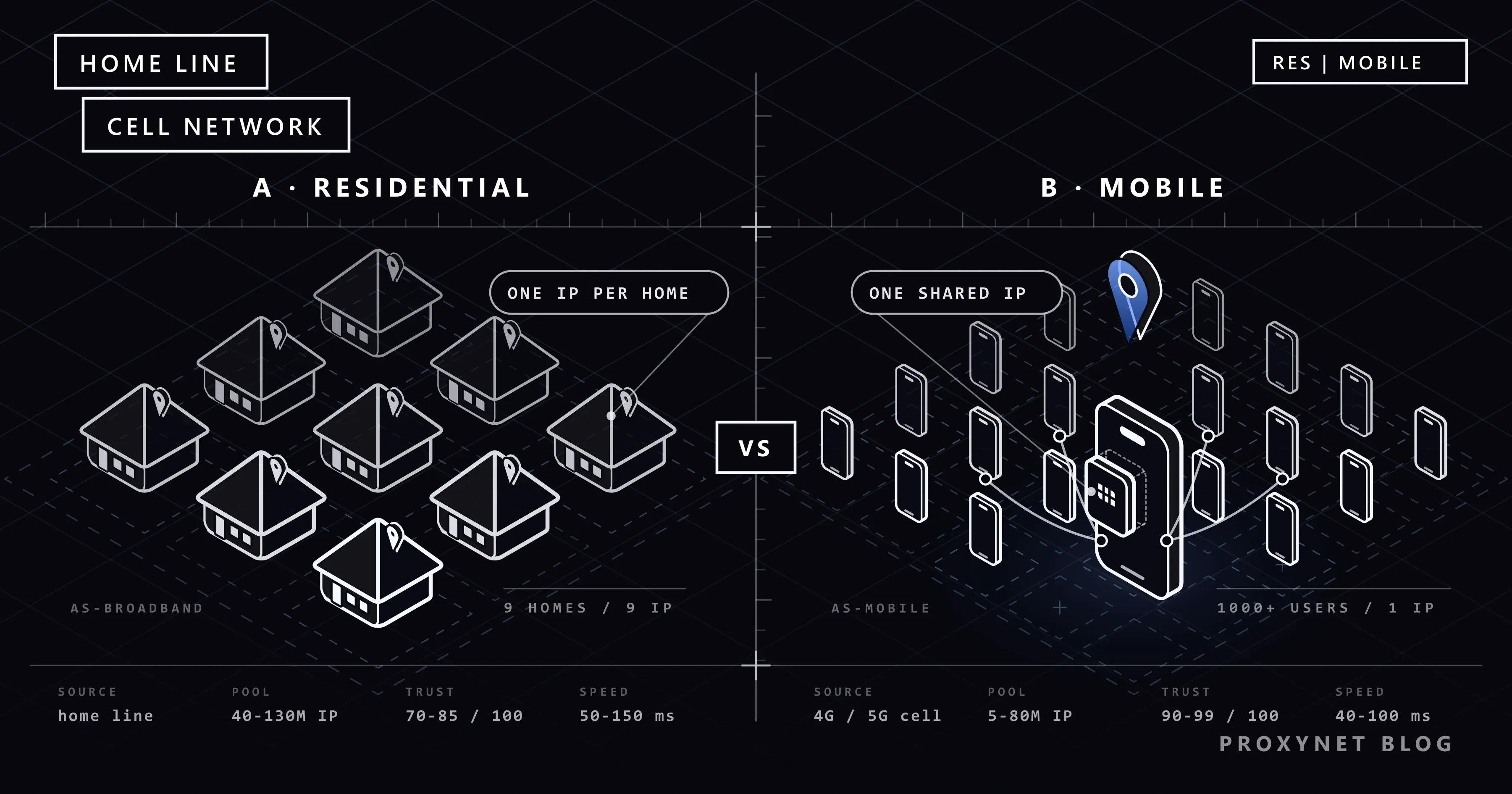
Home internet refers to IP addresses assigned to individuals by internet service providers (Türk Telekom, Superonline, Cogent, Vodafone, Sprint, etc.). These are IP addresses sent to modems by companies that provide internet service to homes via cable or satellite. This type of IP, consisting of real users, appears to be genuine home internet and has a low likelihood of being banned in sectors such as data scraping. In queries, it is recognized as an ASN-type ISP and appears as an Internet Service Provider.
What Is a Mobile Proxy?
These are IP addresses provided by mobile operators (Turkcell, Vodafone, Orange, KKTC Telsim, etc.) over 4G/5G cellular networks. They are like a traveling vendor who is constantly on the move and changes their identity at every cell tower. Because the IP address changes constantly (rotating proxy), it is nearly impossible for websites to block them permanently.
Unlike local home internet IP addresses, which are assigned one per household, mobile operator IP addresses are shared in real time among thousands of users. In fact, traffic from more than 50,000 active smartphones can flow through a single mobile IP address at the same time. This is not a system error; it is a result of cellular networks having been designed from the outset with this logic to connect millions of devices using limited IPv4 resources.
Direct Comparison: Let’s Take a Look at the Main Differences:
The table below compares home and mobile proxies across all key metrics. To give you an accurate idea of how these two types of proxies perform relative to one another, we tested these factors in real-world usage scenarios and compiled industry data.
| Features | Residential | Mobile (4G/5G) | Winner |
|---|---|---|---|
| IP Source | Home Internet Service Provider (ISP) connections (DSL, fiber, cable) | Mobile operator networks (4G/5G base stations) | Mobile |
| Trust Score | Mid-High (70–85 out of 100) | Highest (90–99 out of 100) | Mobile |
| Detection Rate | 15–30% in protected sites | 3–8% in protected sites | Mobile |
| CGNAT Sharing (When telecom providers share the same IP address among different users) | Yes – Typically 100 users per IP address | Yes – 1,000+ real users per IP | Mobile |
| Current Pool Size | 40–130 million+ IP addresses globally | 5-80 million+ IP addresses globally | Residential |
| IP Rotation Rate | Instant rotation, large pool | Instant rotation, high pool | Tie |
| Cost | More cost-effective than a mobile proxy | Since mobile SIM data plans are generally expensive, they are more expensive than residential plans | Residential |
| Success Rate (Protected Sites) | On average, 60–75% | On average, 88-95% | Mobile |
| Cost Per GB | $1–5/GB (depending on volume) | $3–10/GB (depending on volume) | Residential |
| Best Use | High-volume data scraping, SEO, price tracking | Overcoming bot restrictions on social media, account management, and mobile-focused target websites or apps. | Tie |
| Average Latency | 50-150ms | 40-100ms | Mobile |
| Blacklist Risk | Medium – Individual IPs can be marked | Very Low – Cannot be blocked without blocking real users | Mobile |
| Protocol Support | HTTP/S, SOCKS5 | HTTP/S, SOCKS5 | Tie |
Uses: Which One Should You Choose and Why?
Residential and mobile proxies are essentially both classified as home internet connections. Since most telecom providers have a single ASN, they can assign both mobile and residential IP addresses under the same ASN, making them appear as if they come from a single operator. However, if you have a project focused specifically on mobile—for example, if you want to access a site with heavy mobile traffic, like Instagram, and scrape publicly available data—using a mobile proxy would be a better choice for you. But if you’re simply trying to access a site that’s already accessible via desktop or residential home internet and has no restrictions, using residential proxies would be a better choice since they’re less expensive.
When Should You Choose a Residential Proxy?
- If you’re on a tight budget and need a large number of IP addresses,
- If you want to bypass geographic restrictions (geo-targeting).
- Large-scale data scraping: It is used to scrape and collect large volumes of data as quickly as possible thanks to a large IP pool.
- SEO, Search Engine Analysis: It is used in situations where you need to analyze your company or your competitors in different locations, such as SERP (Search Engine Results Page) or search engine ranking tracking.
- Price tracking: Used to track airline tickets, stock market and financial data, and e-commerce data based on location differences.
When Should You Choose a Mobile Proxy?
- If you manage multiple accounts on platforms with very strict security measures (Instagram, LinkedIn, Google) and, in particular, have a software architecture designed for mobile devices,
- If you want to use a mobile carrier’s internet service,
- If you want to absolutely prevent the website or app from identifying you as a “bot.”
Conclusion
To summarize, the choice between residential proxies and mobile proxies depends entirely on your project’s needs and budget:
- Residential Proxy: If you’re engaged in large-scale web scraping, e-commerce price tracking, and market research, and if a balance between cost and performance and a large IP pool are your top priorities, this is the ideal solution for you.
- Mobile Proxy: If you manage multiple accounts on platforms with very strict anti-bot systems—such as Instagram, TikTok, and LinkedIn—and need the highest security score (Trust Score) and dynamic IP rotation, you should definitely choose this option.
It’s not the most expensive proxy that brings you success—it’s the one that best fits your scenario. It’s important to take the right steps without compromising your project’s security.
🚀 To discover the high-speed, uninterrupted IP solutions best suited for your project, visit our [Proxy Server] page, or contact us right away for solutions tailored to your needs.