

































This guide shows how to use the DICloak browser with Proxynet proxies, so that every profile you open has its own IP address. Take an e-commerce team running four marketplace stores and two ad accounts from one office: each account must open in the same profile every day, with its own cookies and its own IP.
Below: what DICloak is, why a profile needs its own proxy, how to add one, bulk assignment, testing a list and common errors.
What is DICloak?
DICloak is an antidetect browser: a desktop program that runs many separate browser profiles on one computer. Each profile keeps its own cookies, fingerprint values and proxy, so a website sees different browsers instead of tabs of one browser. It runs on Windows, macOS and Linux, and profiles are built on Chrome kernels. What Is an Antidetect Browser? explains the mechanism.
Typical users are agencies, social media and ad teams, sellers with several stores and QA teams. DICloak supports HTTP, HTTPS proxy and SOCKS5 proxy connections. It does not sell proxies; you buy them from a provider.
What are DICloak's main features?
Multiple profiles on current kernels: Each profile gets its own operating system, screen size, hardware values and user agent. In September 2026 the help center lists Chrome kernels from 120 up to 151 (fewer on Linux) and advises against the oldest, 120.
Location that follows the IP: Time zone, language and geolocation can be matched to the proxy's exit IP, so a profile on a Türkiye IP also reports a Türkiye time zone.
Sharing profiles with the team: Teammates can manage profiles together, or get access only to specific ones, without passing passwords around.
Automation and API: RPA templates, a Synchronizer that repeats one window's actions in others, and a Local API whose proxy fields (type, host, port, user_name, passwd) match the interface. Window sync and the API are not part of the free plan.
Why does each DICloak profile need its own proxy?
Fingerprint settings make the browsers different; they do not change the network address. Without a proxy, every profile connects from your office IP and a site can link them all to one source. DICloak's own FAQ advises against sharing a proxy between profiles. This is account hygiene: each account appears from the same place.
- One profile, one proxy. Two profiles with the same exit IP are linked through it.
- A stable IP for logged-in accounts. An account that logs in from a different city every day triggers security checks. Use a static IP or a sticky session.
- Time zone and language from the IP. The account then shows the local time and language of the place its IP belongs to, as it did for the person who opened it.
WebRTC can still reveal the real address. Of DICloak's four WebRTC modes (Substitute, Forward, Real, Disable), Real exposes your own IP; use Substitute or Forward and verify with WebRTC and DNS Leaks. What sites read to tell browsers apart is in Browser Fingerprinting.
How to use DICloak?
Before you start, buy the proxy type you need in the Proxynet self-service dashboard:
DICloak runs on Windows 10 or later, macOS 11 or later and 64-bit Ubuntu 22.04, Debian 11 or Fedora 38 and later. In September 2026 the free plan includes 1 member, 5 profiles and 15 profile launches per day.
1. Download DICloak
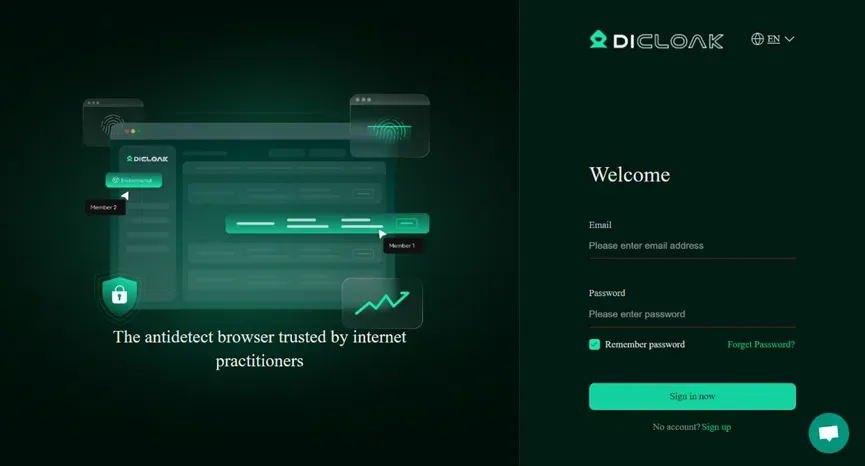
Download the client from the official DICloak download page, install it and sign up.
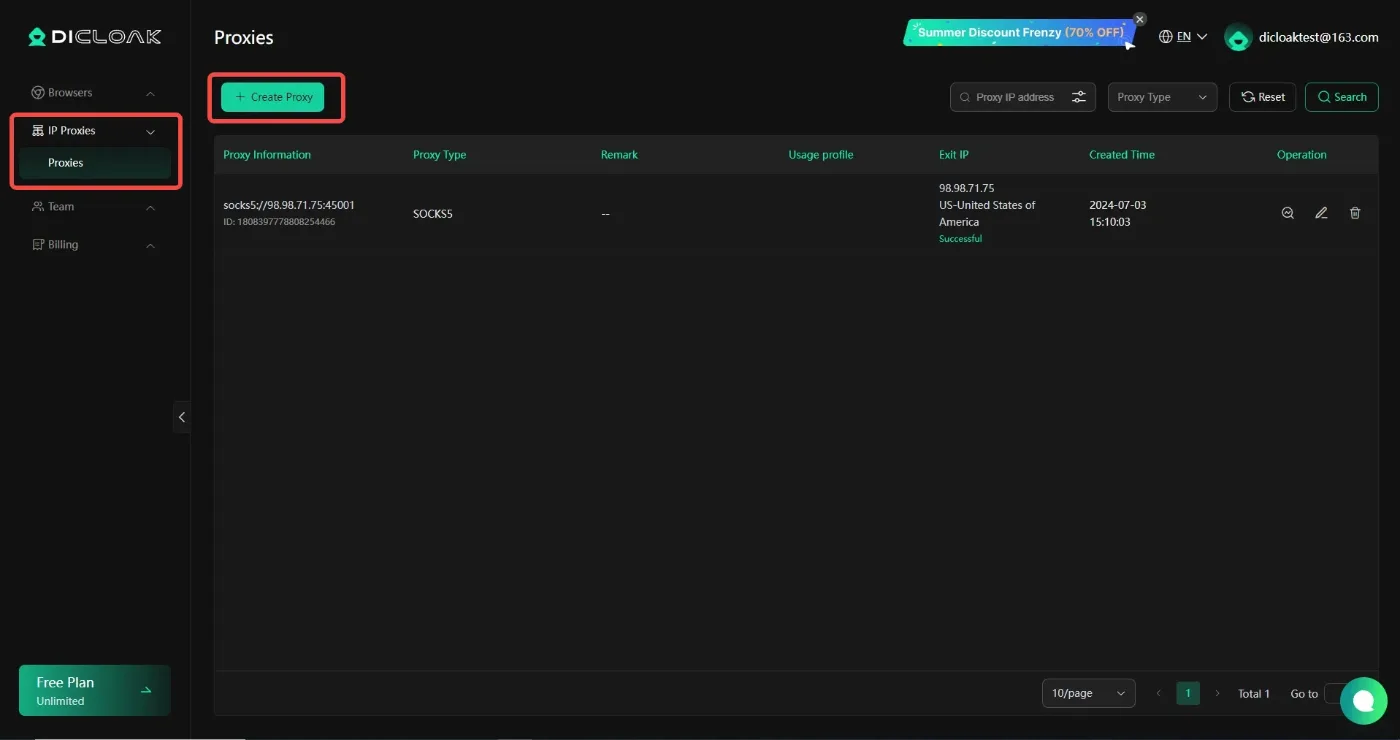
2. Click Create Proxy on the Proxies page
In the left menu open IP Proxies → Proxies and click Create Proxy.
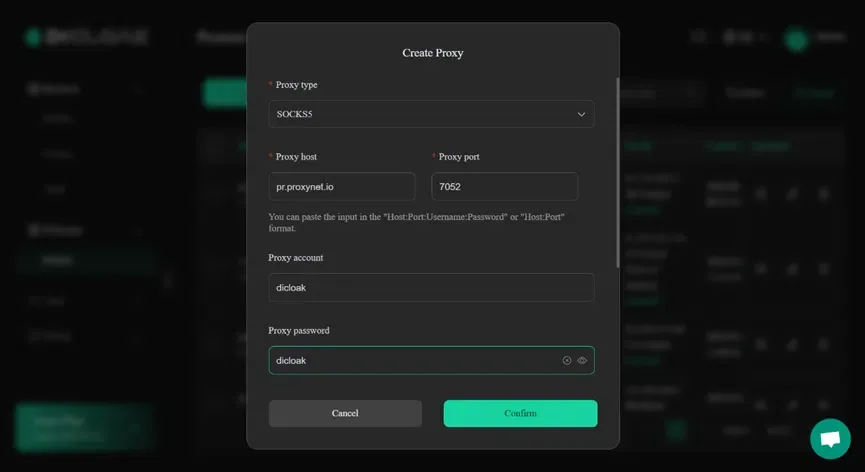
3. Enter your proxy information
Choose the proxy type, fill in host, port, account and password, and click Confirm. The screenshot shows an older port; use the one from your dashboard.
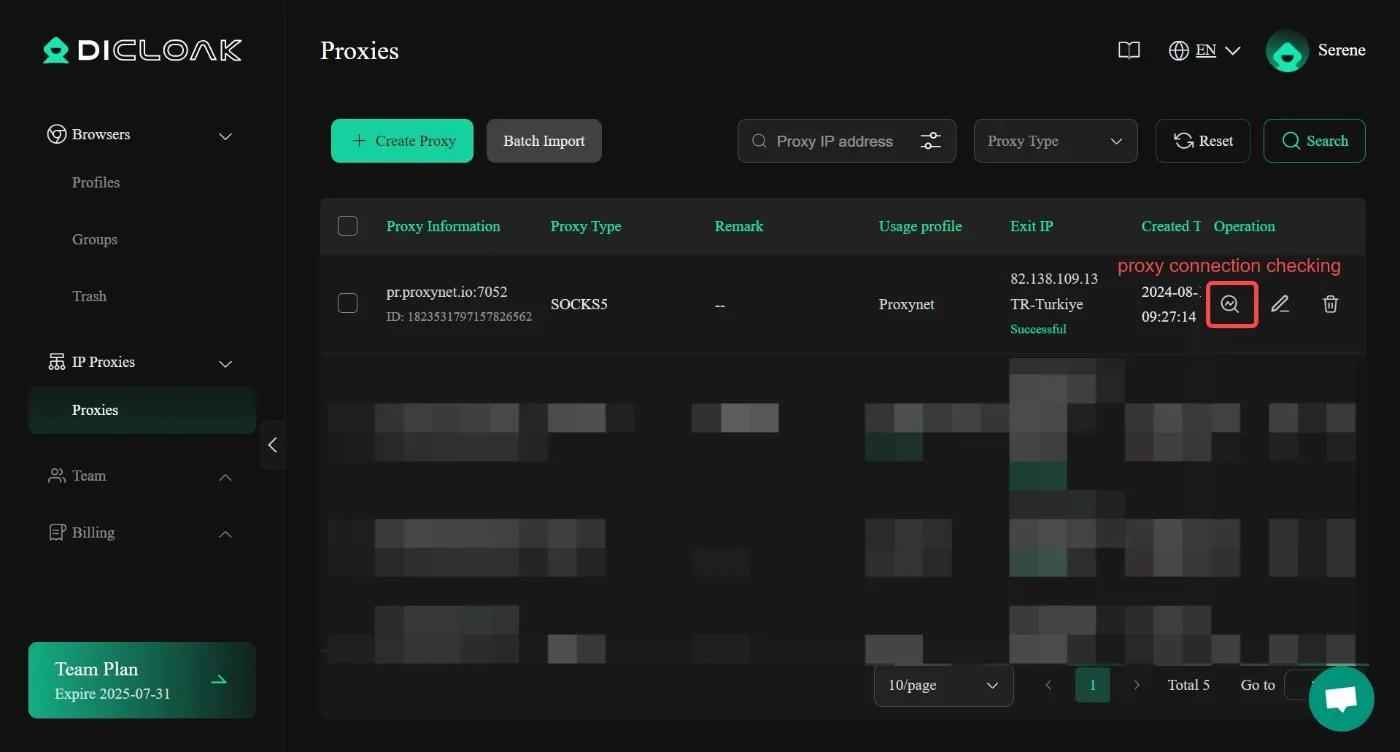
4. Test the proxy
Click the check icon in the Operation column. A working proxy shows its exit IP, country and Successful.
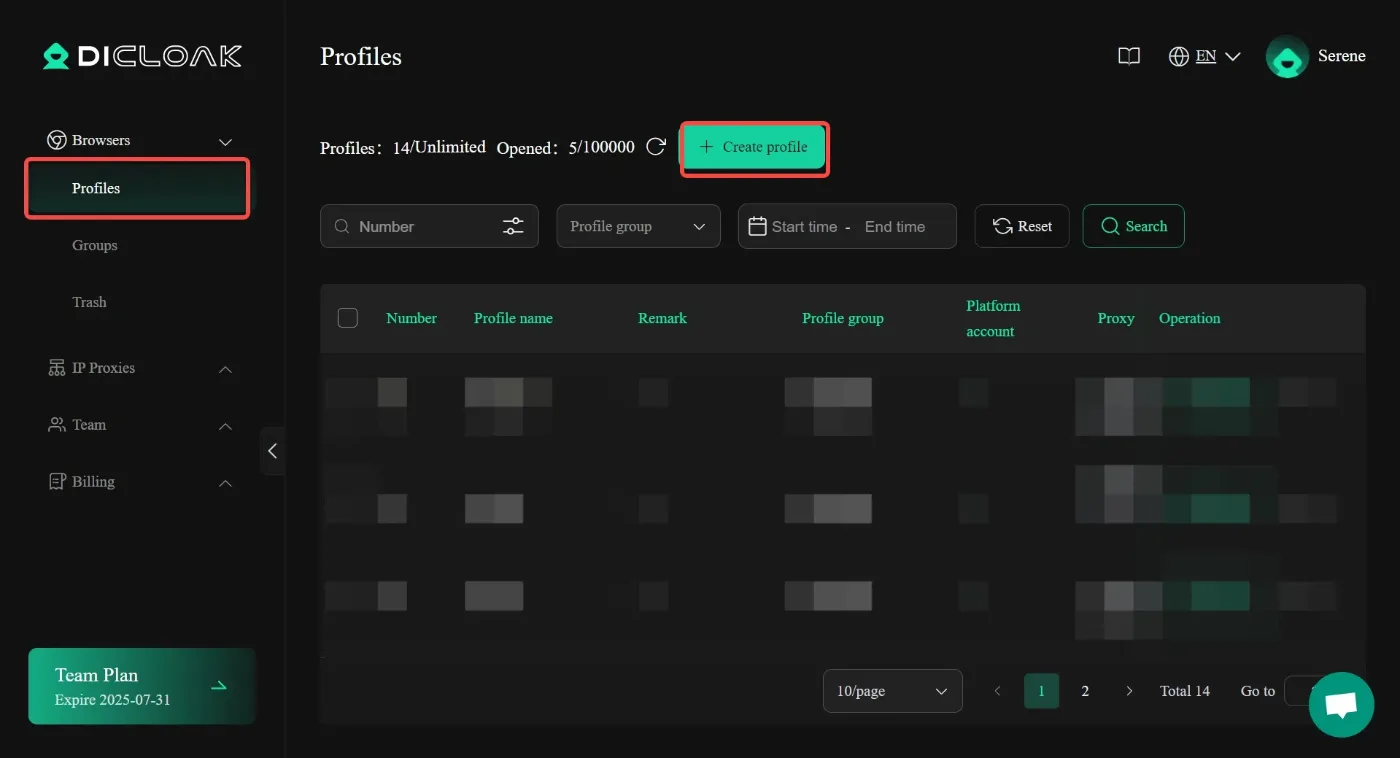
5. Create a profile
Go to Browsers → Profiles, click Create profile, choose Saved Proxies in the proxy section and select your proxy.
6. Open the profile from your profile list
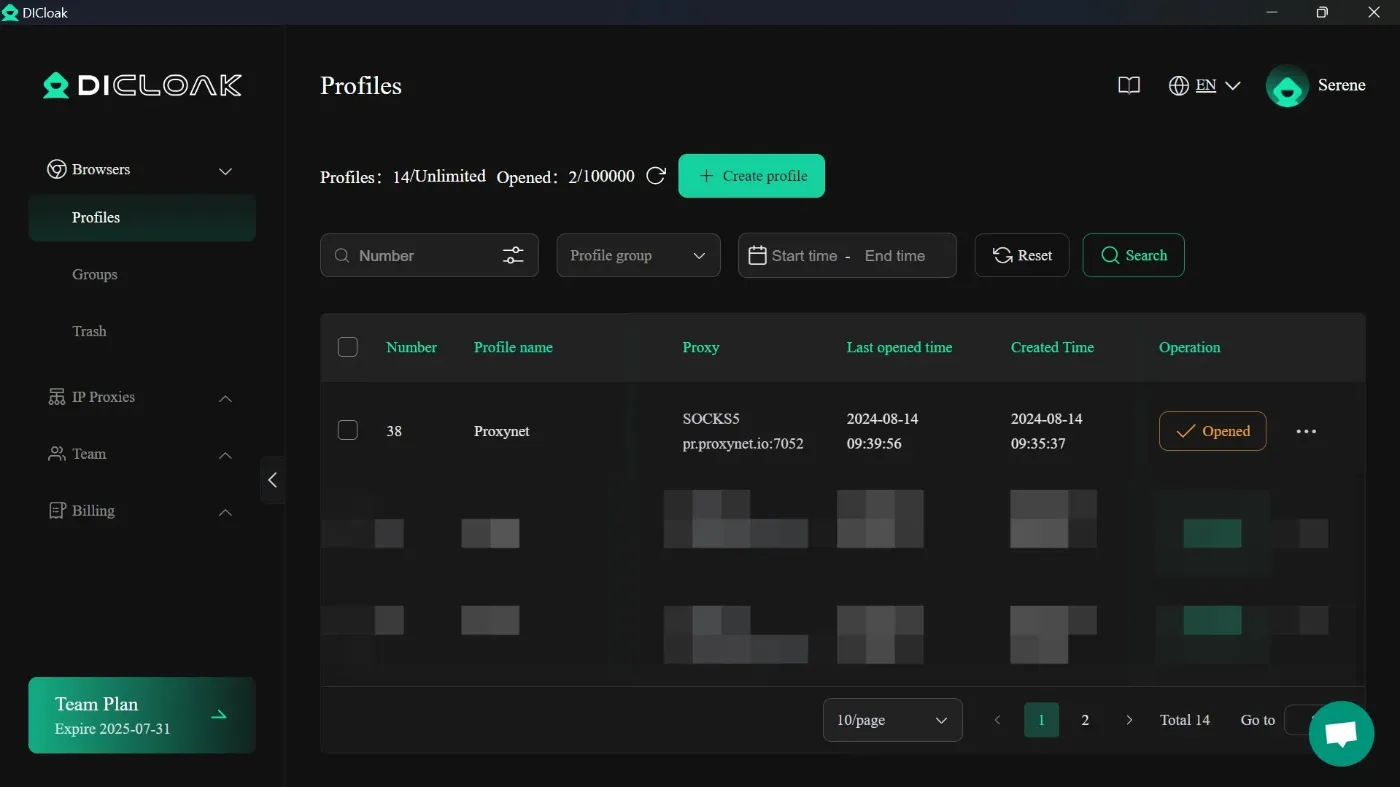
The profile appears with its proxy in the Proxy column. Click Open to start it.
How do you add a Proxynet proxy in DICloak?
These details decide whether the check passes:
- Get the details from the Endpoint Generator. Residential and mobile proxies use one gateway, with HTTP and SOCKS5 on separate ports. You pick country, city and session, and the username is generated with them built in, for example
pr.proxynet.io:8000withuser:pass. - Match the type to the port. HTTP for the HTTP port, SOCKS5 for the SOCKS5 port. DICloak does not detect the protocol.
- Paste the line. The host field accepts
Host:Port:Username:Password(for examplepr.proxynet.io:8000:user:pass) and splits it into the fields. Inside a profile's Custom Proxy mode the same shortcut is Quick Input with Parse. Make sure no space ends up in the password. - Keep IPv4 unless your endpoint is IPv6.
- Click Checking Proxy. The exit IP is looked up through IP2Location or IP-API (the IP query channel in a profile's proxy settings); if one times out, switch to the other.
- Add a Remark and confirm. A client or store name makes the list easy to filter.
With IP whitelist authentication, add your public IP in the Proxynet dashboard (up to 10 IPs) and leave account and password empty. See Proxy Authentication: User:Pass vs IP Whitelist.
Custom Proxy, Saved Proxies or API extraction: which mode should you use?
A profile offers four proxy modes, described on DICloak's profile proxy settings page.
| Mode | What it does | When to use it |
|---|---|---|
| No Proxy | Direct connection from your own network | Testing the browser itself, never accounts |
| Custom Proxy | Proxy entered inside this profile | One or two profiles set up by hand |
| Saved Proxies | Pick a proxy from the Proxies page; a random option prefers unused ones | Teams reusing one list |
| API extraction | Fetches an IP from a provider's extraction link | Link-based providers; not needed for Proxynet's gateway |
Saved Proxies is the practical default: a changed password is fixed in one place.
HTTP, HTTPS or SOCKS5: which proxy type should you pick?
The Proxy type menu also lists provider-specific "dynamic proxy" entries (IPFLY, 922S5 and others), meant only for those providers. For Proxynet:
| Type | What it means | When to choose it |
|---|---|---|
| HTTP | HTTP proxy; HTTPS sites pass through encrypted via CONNECT | The HTTP port, such as pr.proxynet.io:8000 |
| HTTPS | A separate entry for endpoints a provider lists as HTTPS | Only when your endpoint is listed as HTTPS; for Proxynet's HTTP port pick HTTP |
| SOCKS5 | Lower-level protocol (RFC 1928), password login in RFC 1929 | The SOCKS5 port |
For browsing, HTTP and SOCKS5 give the same result: the site sees the exit IP and HTTPS stays encrypted. See SOCKS vs HTTP Proxy.
How do you assign proxies to many profiles at once?
Batch operations and team management start with the paid Base plan; the free plan has neither.
- Import the list. On IP Proxies → Proxies click Batch Import, download the Import Template, fill one proxy per row without changing its layout, upload it and click Confirm.
- Select the profiles on Profiles.
- Open More Actions → Edit Profile → Edit Proxy and choose Saved Proxies.
- Choose Random, not Fixed. Fixed gives every selected profile the same proxy. Random gives each a different one, unused proxies first.
Random only keeps profiles apart if the list has at least as many proxies as profiles; after that DICloak reuses proxies already in use.
How do you test a proxy list before importing it?
A bad row in a batch import means opening profiles one by one to find it. For a single proxy, curl returns the exit IP, location and time zone:
# HTTP port
curl -x http://user:pass@pr.proxynet.io:8000 "http://ip-api.com/json/?fields=status,query,countryCode,city,timezone"

# SOCKS5 port (take the port number from the Endpoint Generator)
curl -x socks5h://user:pass@pr.proxynet.io:SOCKS5_PORT "http://ip-api.com/json/?fields=status,query,countryCode,city,timezone"
For a list with one proxy URL per line (http://user:pass@host:port or socks5://…), this script tests five at a time, retries network errors, skips retries on wrong credentials and marks shared exit IPs:
"""Test a proxy list for DICloak profiles: exit IP, location, time zone, speed."""
import sys
import time
from concurrent.futures import ThreadPoolExecutor

import requests  # pip install "requests[socks]"

LOOKUP = "http://ip-api.com/json/?fields=status,query,countryCode,city,timezone"


def check(proxy_url, attempts=3):
    # socks5:// resolves hostnames locally; socks5h:// lets the proxy resolve them
    proxy_url = proxy_url.replace("socks5://", "socks5h://", 1)
    proxies = {"http": proxy_url, "https": proxy_url}
    for attempt in range(1, attempts + 1):
        start = time.monotonic()
        try:
            r = requests.get(LOOKUP, proxies=proxies, timeout=15)
            if r.status_code == 407:  # wrong username or password: do not retry
                return {"error": "407 Proxy Authentication Required"}
            r.raise_for_status()
            info = r.json()
            if info.get("status") != "success":  # lookup service could not place the IP
                return {"error": "lookup failed"}
            info["ms"] = round((time.monotonic() - start) * 1000)
            return info
        except requests.RequestException as exc:
            if attempt == attempts:
                return {"error": type(exc).__name__}
            time.sleep(2 * attempt)  # back off before the next try


sys.stdout.reconfigure(encoding="utf-8")
with open(sys.argv[1], encoding="utf-8") as f:
    urls = [line.strip() for line in f if line.strip() and not line.startswith("#")]

with ThreadPoolExecutor(max_workers=5) as pool:  # five proxies at a time
    results = list(pool.map(check, urls))

first_line = {}
for n, info in enumerate(results, 1):
    if "error" in info:
        print(f"{n:>2} FAIL {info['error']}")
        continue
    ip = info["query"]
    dup = f"  shared with line {first_line[ip]}" if ip in first_line else ""
    first_line.setdefault(ip, n)
    print(f"{n:>2} OK   {ip:<15} {info['countryCode']} {info['city']:<10} "
          f"{info['timezone']:<16} {info['ms']:>5} ms{dup}")
Run python check_dicloak_proxies.py proxies.txt. In this sample (documentation IPs), line 2 is the same session on the SOCKS5 port, line 3 has a wrong password and line 4 sends HTTP to a SOCKS5 port:
 1 OK   203.0.113.24    TR Ankara     Europe/Istanbul    218 ms
 2 OK   203.0.113.24    TR Ankara     Europe/Istanbul    217 ms  shared with line 1
 3 FAIL 407 Proxy Authentication Required
 4 FAIL ProxyError
Two different profiles must never share an exit IP. The time zone column is what the profile should report with IP-based matching on. More checks: How to Test a Proxy.
Which Proxynet proxy type fits which DICloak profile?
Every Proxynet product works over HTTP or SOCKS5. The choice depends on how long a profile must keep its IP.
| Profile use | Proxy type | Why |
|---|---|---|
| Account logged in for weeks | ISP Proxy | The same ISP-registered IP every day |
| Tasks within one session | Sticky Proxy | A residential IP held for 1-60 minutes |
| Mobile-first platform account | Mobile Proxy | Operator IPs, including Turkcell, Türk Telekom and Vodafone in Türkiye |
| Price and ad checks without login | Rotating Proxy | A different home IP on each check |
| Internal test profiles | Datacenter Proxy | Fast and low-cost where IP type does not matter |
The pool is described on the Residential Proxy page; team setups are on our e-commerce proxy and social media proxy pages.
DICloak proxy not working: common errors and fixes
- Checking Proxy times out. Check host and port. With IP whitelist, your public IP may have changed. If only the lookup is slow, switch between IP2Location and IP-API.
407 Proxy Authentication Required. Wrong account or password, often a stray space. Copy the line again from the Endpoint Generator.User was rejected by the SOCKS5 server. The same credential problem on a SOCKS5 port.Received invalid version in initial SOCKS5 responseorEmpty reply from server. The type does not match the port. Change the type, not the password.- Wrong country. The country is part of the Proxynet username; generate a new one and edit the saved proxy.
- Time zone does not match the IP. Time zone or language was set to custom. Switch back to IP-based matching.
- A leak test shows your real IP. WebRTC is on Real. Use Substitute or Forward.
- "Kernel for this profile is missing". Not a proxy error: the profile's Chrome kernel is not downloaded yet. Accept the download prompt or pick another kernel.
In Python the same failures appear with other messages; see Max Retries Exceeded with URL.
Decision guide
| Need | Recommendation |
|---|---|
| A few profiles by hand | Create Proxy, one per profile, Checking Proxy before Confirm |
| Dozens of profiles for a team | Batch Import, then Edit Proxy with Saved Proxies and Random |
| Accounts that stay logged in | Static ISP proxy, IP-based time zone and language |
| Short sessions within a day | Sticky residential session |
| Checks without logging in | Rotating residential proxy |
| Work tied to Türkiye | Country set to Türkiye, see Türkiye proxies |
Frequently asked questions
Is DICloak free?
Yes. In September 2026 the free plan covers 1 member, 5 profiles and 15 profile launches per day. Paid plans raise these limits and add batch operations and team management.
Does DICloak give you free proxies?
No. DICloak's help center states that it does not provide proxy connections. The proxy menu links partner providers, but you buy proxies separately.
Does DICloak work on Android?
No. DICloak runs on Windows, macOS and Linux only; its help center states that tablets and mobile devices are not supported.
Can several DICloak profiles share one proxy?
Technically yes, but the accounts then share an exit IP and can be linked. DICloak's FAQ advises against it; give each profile its own proxy or sticky session.
Should I use a rotating or a sticky proxy in DICloak?
For logged-in profiles, a static ISP proxy or a sticky session, so the IP stays the same. Rotating proxies fit checks without a login.
Is it allowed to manage several accounts with DICloak?
The rules come from each platform, and many limit accounts per person. Use DICloak to keep legitimate accounts apart, such as an agency's client accounts or a team's stores, and follow each platform's terms.
Summary
DICloak keeps profiles apart; the proxy gives each one its own address. Create the proxy under IP Proxies, match the type to the port, confirm with Checking Proxy and assign it through Saved Proxies. The same approach works in our Dolphin Anty and AdsPower guides. For the IPs themselves, see Proxynet's proxy plans.