





























If you want to see the price of a product on Bol.com the way a customer in the Netherlands sees it, a connection in Istanbul is not enough. Bol.com and Coolblue change the delivery time, the stock status and the campaign according to the visitor's IP; Google.nl does not show you the ranking it shows a user in the Netherlands when you visit from Türkiye; and on Marktplaats there are listings that close for a user looking in from outside the country. A Netherlands proxy sends your request out from an IP address in the Netherlands: the target site sees you as an ordinary visitor connecting from Amsterdam or Rotterdam.
In this post we compare the four providers selling Netherlands IPs in 2026: Proxynet and three global brands. We looked at the pool, the Netherlands coverage, the pricing model and the traffic terms. Rival figures come from the providers' own sites and are dated September 2026; we wrote no guesses into the cells we could not verify, and they sit in the table as "—".
What is a Netherlands location proxy?
A Netherlands location proxy, or Netherlands proxy for short, is a proxy that sends your request out from an IP address in the Netherlands. The target site sees you as a visitor connecting from the Netherlands and shows its price, stock, delivery time, search results and ads accordingly. There are four types: residential, which exits through real home connections; mobile, which exits through a carrier line; static ISP, which is registered to an internet service provider yet hosted in a data center; and datacenter, which exits entirely from a data center. All four exit in the same country, but what the target site sees when it looks at the IP record differs from one to the next; we explained the difference in Residential vs Datacenter Proxy.
What is a Netherlands proxy used for?
- E-commerce price tracking: on Bol.com and Coolblue the price, the stock and the delivery promise change with the visitor's location; with a Dutch IP you see the price a rival is really publishing. More: price monitoring.
- Local SEO and rank tracking: Google.nl results are different when you look from Türkiye; measuring at city level needs an exit in the Netherlands. More: Google proxy, SERP Rank Tracking.
- Ad verification: you check on the spot that the ad you placed in the Netherlands is really showing and where the redirect chain leads. More: ad verification.
- Marketplace and listing research: you collect Marktplaats and Amazon.nl listings, category rankings and seller prices from inside the country. More: market research.
- Account management and social media: you run the accounts working the Dutch market from a single fixed Netherlands IP. More: Instagram proxy.
What to look for in a Netherlands proxy provider
- The IP count in the Netherlands and the city spread. What decides it is not the total pool but the number of addresses in the Netherlands and how many cities those addresses spread across. A pool collected entirely in Amsterdam stops you from measuring anything about the country as a whole.
- The network the IP is registered to. The Netherlands is one of Europe's densest hosting hubs; ask whether the address sold as a "Netherlands IP" is registered to a data center or to an access provider such as KPN, Ziggo or Odido.
- City and ASN targeting. Is targeting free, at what breakdown does it work, and across how many different networks are the addresses you receive spread?
- The pricing model and the term. Is a subscription mandatory, at what volume does the published lowest price apply, and do unused traffic or balance expire after a month?
- Traffic terms, protocols and delivery. On fixed IP products is traffic unmetered or limited to a monthly GB figure per IP; are HTTP, HTTPS and SOCKS5 supported; can you authenticate both with a username and password and with IP authorization? The difference between the methods is in Proxy Authentication Methods.
The 4 best Netherlands proxy providers
1. Proxynet
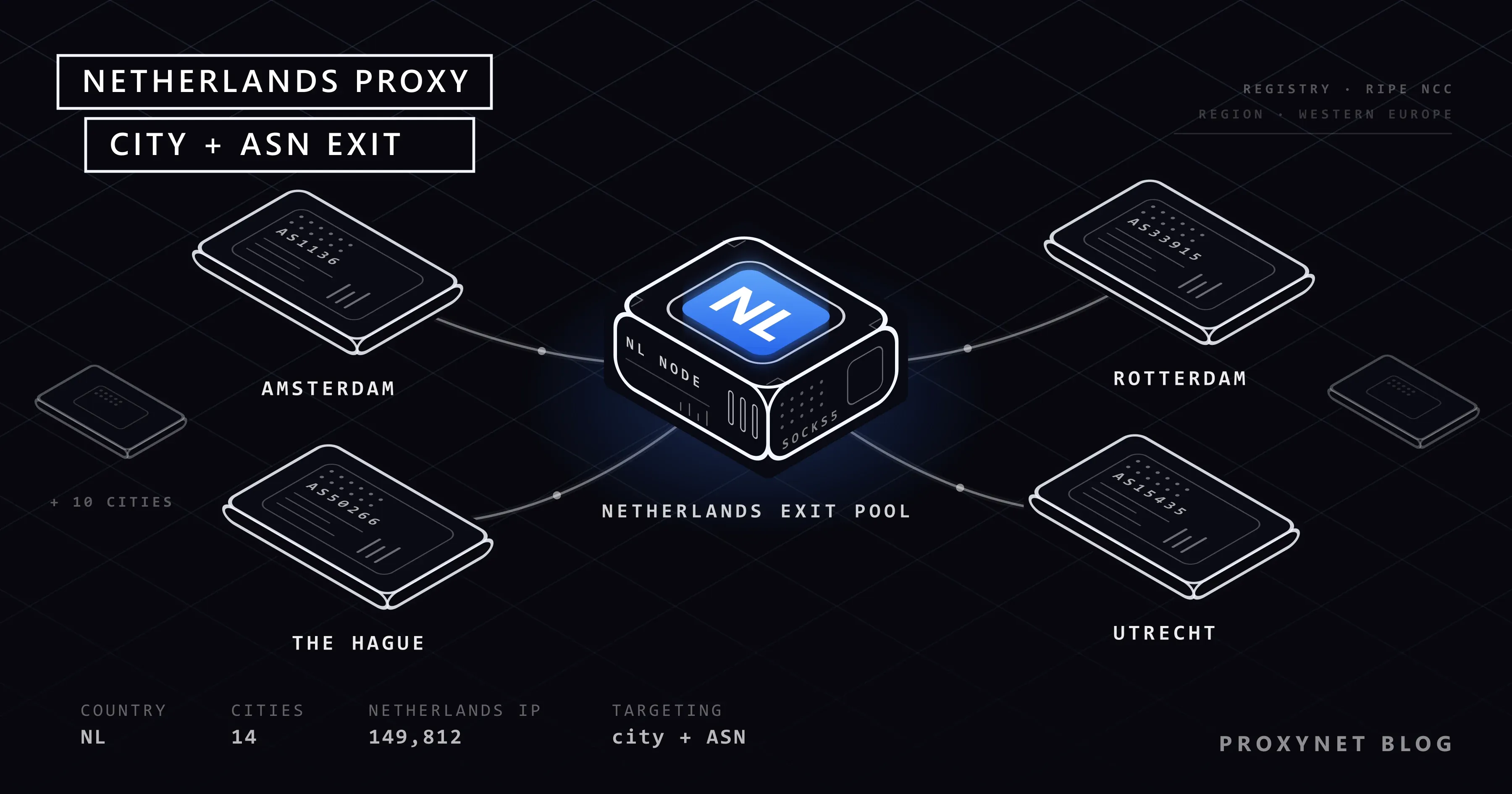
On the Netherlands side our pool is 149,812 IPs spread across 14 cities; the addresses exit from the KPN, Ziggo, Odido and Delta networks, and on the mobile side KPN, Odido and Vodafone NL lines are used. Amsterdam, Rotterdam, The Hague, Utrecht and Eindhoven can each be targeted separately. The global network holds more than 160 million residential IPs in 194 countries, more than 240,000 static ISP IPs in more than 20 countries and more than 2 million IPv4 datacenter addresses in more than 50 countries. HTTP, HTTPS and SOCKS5 are supported; you authenticate with a username and password or with IP authorization.
The reason we are in first place is not the size of the pool but the price and the terms. A dedicated ISP IP starts at the 1.80 dollars level per month and comes down to 1.00 dollars as the balance grows; a datacenter IP starts at the 1.50 dollars level and falls to 0.70 dollars, and residential traffic starts at the 3.30 dollars level per GB and comes down to 1.50 dollars. On the ISP and datacenter side traffic is unmetered: no GB limit, no fair use ceiling, no overage fee. The price tier depends on your account balance rather than a quantity commitment, the balance does not expire and it is valid on every product. There is no subscription, and the proxies land in the panel the moment the order is complete.
Pros
- 149,812 Dutch IPs spread across 14 cities
- Exits from the KPN, Ziggo, Odido and Delta networks
- The lowest monthly floor price on the list for a dedicated ISP and datacenter IP
- Unmetered ISP and datacenter traffic: no GB limit and no overage fee
- No subscription, no term, no burned balance
- Free city and ASN targeting on the residential side
- Turkish panel, 24/7 Turkish support, credit card and bank transfer
- Instant delivery, HTTP, HTTPS and SOCKS5
Cons
- The global pool is smaller than Bright Data's and Oxylabs' pools
- No free trial; you test it with a small balance
- No cheap shared ISP product, every fixed IP is dedicated
- The Web Scraper API is handed out through the sales team for now
Who it is for: teams working the Dutch market from Türkiye on price tracking, local SEO, ad verification and account management.
2. Bright Data
The largest residential pool on the list: more than 400 million IPs. On the ISP side it reports more than 1.3 million static addresses in 35 countries, and on the datacenter side 98 countries. The residential entry price is 8 dollars per GB and the lowest price is 5 dollars on the 1,999 dollar plan; a dedicated ISP IP starts at 3.50 dollars per month and comes down to 2.50 dollars. Fixed IP products carry a 100 GB monthly fair use limit per IP, with a surcharge beyond it. A separate IP count for the Netherlands was not verified for this post.
Pros
- The largest global pool on the list
- ISP coverage in 35 countries, datacenter coverage in 98
- City targeting and a broad Scraping API family
- A pay-as-you-go option
Cons
- The residential entry price is 8 dollars per GB
- A 100 GB monthly limit per IP on fixed IPs, with a surcharge beyond it
- The sum of the per-country IP counts does not match the pool figure on the same page
- No Turkish support and no local payment
Who it is for: enterprise teams working in dozens of countries at once.
3. Oxylabs
A global provider aimed at enterprise customers, with more than 175 million residential IPs. The residential entry price is 6 dollars per GB and the lowest price is 2.50 dollars. On the mobile side it reports more than 20 million IPs in more than 140 countries; the mobile entry price is 7.50 dollars per GB and the lowest price is 3.50 dollars. On ISP proxies it has two separate products, shared and dedicated. On the day this post was prepared we could not reach the provider's own pages, so we wrote no figure into the table for its ISP pool, country count or IP price.
Pros
- More than 175 million residential IPs
- Mobile proxies in more than 140 countries
- Enterprise support and an account manager
- The Web Scraper API family
Cons
- The residential entry price is 6 dollars per GB
- The trial is not self-service, it runs through the sales team
- The ISP price is scattered across product and pricing pages
- No Turkish support and no local payment
Who it is for: teams working with an enterprise budget that want an account manager.
4. Decodo
Formerly Smartproxy. It reports more than 115 million IPs for its residential pool; the entry price is 4 dollars per GB and the lowest price is 2 dollars. On the ISP side a shared IP starts at 0.47 dollars per month and a dedicated one at 3.33 dollars. On the datacenter side it sells a dedicated IP in only five countries — the United States, the United Kingdom, Germany, France and Japan — and the Netherlands is not on that list; for the Netherlands only the shared datacenter pool is left. It has a three-day, 100 MB trial.
Pros
- Low prices on shared ISP and datacenter IPs
- A three-day, 100 MB free trial
- City and ASN targeting opened on the ISP product
- Small packages starting at 3 IPs on the dedicated side
Cons
- Dedicated datacenter IPs are not sold in the Netherlands
- It does not publish the IP count of its ISP pool, and the country list varies between 14 and 21 across its pages
- The 0.27 dollars per IP price in the heading does not exist on any published tier
- No Turkish support and no local payment
Who it is for: high-traffic work where who owns the IP is not critical.
Comparison tables
The figures come from the providers' own sites, September 2026. "—" is information the provider does not publish or that we could not verify for this post.
Pool and Netherlands data
| Provider | Pool | Netherlands IPs | Cities |
|---|---|---|---|
| Proxynet | 160M+ | 149,812 | 14 |
| Bright Data | 400M+ | — | — |
| Oxylabs | 175M+ | — | — |
| Decodo | 115M+ | — | — |
The pool column is the residential IP count from the providers' own headlines, and Bright Data and Oxylabs are bigger than we are. The Netherlands column is filled in only for us: we could not verify the three global providers' IP counts in the Netherlands for this post, and rather than write a guess we left them empty.
Price and terms
| Provider | GB price | ISP (IP/month) | Validity |
|---|---|---|---|
| Proxynet | 3.30 dollars | 1.80 dollars | Never expires |
| Decodo | 4 dollars | 3.33 dollars | — |
| Oxylabs | 6 dollars | — | — |
| Bright Data | 8 dollars | 3.50 dollars | 1 month |
The two columns on the left hold entry prices: per GB on residential traffic, per month on a dedicated ISP IP. As your balance grows, with us the GB price comes down to the 1.50 dollars level and an ISP IP to 1.00 dollars per month; the rivals' lowest prices are 5 dollars at Bright Data, 2.50 dollars at Oxylabs and 2 dollars at Decodo, and those apply on high-volume plans. The validity column shows how long it takes for the traffic or the balance you bought to expire: Bright Data's plans run on a monthly term, while with us there is no term at all. Decodo publishes no traffic condition for its ISP plans, and since we could not reach Oxylabs' ISP price either, two cells stayed empty.
Why Proxynet for a Netherlands proxy?
Price and terms
On a dedicated ISP IP the monthly price starts at the 1.80 dollars level and comes down to 1.00 dollars; on the same product Bright Data starts at 3.50 dollars and Decodo at 3.33 dollars. On the datacenter side the same table applies: it starts at the 1.50 dollars level and falls to 0.70 dollars. On both, traffic is unmetered; there is no monthly GB limit per IP and no overage fee. More: ISP Proxy and Datacenter Proxy.
No subscription, no term, no burned balance
The balance you load into your account does not expire and is valid on the residential, mobile, ISP and datacenter sides alike. The GB you buy for residential traffic is not deleted at the end of the month; it waits until you use it. You do not sign a monthly commitment and you do not pay for a month you did not use. The current table: residential pricing and ISP proxy pricing.
149,812 Dutch IPs in 14 cities
The Netherlands pool is not squeezed into a single city: you get exits from 14 cities including Amsterdam, Rotterdam, The Hague, Utrecht and Eindhoven. The addresses come from the KPN, Ziggo, Odido and Delta networks, and on the mobile side from KPN, Odido and Vodafone NL lines. City and ASN targeting is free on the residential side. The country page: Netherlands proxy.
Instant delivery and Turkish support
The proxies land in the panel the moment the order is complete; if you extend before the term ends you carry on with the same IPs. The panel is in Turkish, support answers in Turkish 24/7, and you pay by credit card or bank transfer (havale/EFT); you do not need to hunt for a card that is open to international transactions. None of the three global providers on the list has Turkish support or local payment. For a product-level comparison you can look at Best ISP Proxy Providers - 2026, and for a country-level comparison at Best Türkiye Proxy Providers - 2026.
City and ASN targeting inside the Netherlands
Picking the country is only half the job. In the Netherlands the real distinction is which network the IP is registered to, because the country is one of Europe's densest hosting markets: the internet exchange in Amsterdam, AMS-IX, is one of the world's largest traffic exchange points, and that is why most of the addresses in the country are registered to hosting companies. An address sold with the "Netherlands IP" label most often turns out to be a data center when you look at its record. How much that matters depends on your target: if you are pulling data from a high-volume source it is no problem, but the moment you face Bol.com or a bank's login screen, an address carrying an access provider record is treated in an entirely different way.
You can check the record yourself. Find the proxy's exit address and query it against a public ASN lookup service; if the org field that comes back shows an access provider such as AS1136 KPN or AS33915 Ziggo, the address in your hands is on the home connection side. Odido's network is registered as AS50266. If you see the name of a hosting company, that address carries a datacenter record; the word "premium" or "static" in the product name does not change it.
The second setting is distribution. If the first three octets of the twenty Netherlands IPs you bought are the same, they are all inside a single /24 block, and the target site usually applies a block to the whole range rather than to a single address; then one address's mistake takes all twenty down at once. The same goes for the city spread: if the pool you think represents the whole of the Netherlands sits entirely in Amsterdam, you will never be able to measure the price or the search result a user outside the Randstad sees. Ask the provider for addresses from different blocks, different ASNs and more than one city, and check the list you receive with the query above.
Which proxy type for the Netherlands?
| Type | When | Pricing model |
|---|---|---|
| Residential | City-by-city data | Per GB |
| ISP | Long sessions | Per IP per month |
| Datacenter | High-volume requests | Per IP per month |
| Mobile | Account work | Per GB |
Most of the work done in the Netherlands falls at one of two ends. If you are collecting price and stock data at scale from targets such as Bol.com, Coolblue and Amazon.nl, or measuring Google.nl results city by city, Residential Proxy is the right tool: the address changes on every request or at the interval you set, and billing is per GB. For work where you have to stay with the same identity for days — a seller panel, an ad account, a source with long pagination — ISP Proxy comes out ahead: the address stays with you until you release it and the traffic runs unmetered.
On lightly blocked, high-volume targets Datacenter Proxy is the cheapest solution; stock of that product is plentiful in the Netherlands, because the country is a hosting hub to begin with. On the account management side Mobile Proxy stands apart: addresses exiting through a carrier line carry a mobile network record, and because a great many subscribers sit behind the same address it is hard to tie one to a single user. The rotation rhythm has to be set to the job; often while collecting data, never on account work. We explained the difference between a fixed session and rotation separately on the Rotating Proxy and Sticky Proxy pages, and the whole of the type difference is in What Are Residential Proxies and How Do They Work?.
Why you should not use free Netherlands proxy lists
Pages titled "free Netherlands proxy list" are plentiful in the search results. They will not do the job for three reasons. The first is that it is not clear who runs those servers: your traffic passes through a third party's machine, requests that do not use HTTPS can be read, and your session cookies sit on that machine. The second is that those addresses have been circulating on public lists for years, so they are long since flagged in the target sites' reputation databases; on a target such as Bol.com or Google.nl you meet a verification screen on the first request. The third is that in a country as hosting-heavy as the Netherlands most of what is on those lists are misconfigured or compromised servers; using that machine without permission also puts you in a difficult legal position. We explained the difference of a paid address dedicated to a single user in What is Private Proxy?.
Common mistakes
- Mistaking a datacenter address for a residential one. Most of the addresses sold in the Netherlands carry a hosting record. Look at the IP's ASN record, not at the product name.
- Taking the whole pool from Amsterdam. If you are going to measure anything about the country as a whole, Rotterdam, The Hague, Utrecht and Eindhoven belong on your list too.
- Buying twenty addresses from a single block. Addresses in the same /24 block are almost a single address as far as the target site is concerned.
- Building your budget on the headline price. At most providers the lowest published price applies when thousands of IPs or terabytes of traffic are bought; the price of the first order is something else entirely.
- Skipping the footnote on a product that says unlimited. Some fixed IP packages come with a monthly GB quota per IP, and when the quota is full either a surcharge appears or the speed drops.
- Leaving the browser in Turkish while the IP is in the Netherlands. If the language, the time zone and the location information do not agree, the country of the exit address is not enough on its own; how to test it is in How to Test a Proxy.
Frequently asked questions
Which is the best proxy provider for the Netherlands?
Proxynet. 149,812 Dutch IPs spread across 14 cities, exits from the KPN, Ziggo and Odido networks, the lowest monthly floor price on the list for a dedicated ISP and datacenter IP, unmetered ISP traffic and a balance that does not expire come together at Proxynet. Looking at the total pool, Bright Data and Oxylabs are bigger; if your work spans dozens of countries at once, their global networks are worth considering too.
How do you get a Netherlands IP?
You load a balance into your account in the panel and pick the product and the country; the proxy is delivered instantly. On the residential side you set the city and ASN preference while building the endpoint, and on fixed IP products the addresses are assigned to your account at the end of the order.
How much do Netherlands proxies cost?
At Proxynet residential traffic starts at $1.50 per GB, a dedicated ISP IP at $1 per month, a datacenter IP at $0.70 per month and mobile traffic at $3 per GB, and the price comes down as the balance grows. A subscription is not mandatory.
Can I pick an Amsterdam or Rotterdam IP myself?
Yes. The Netherlands pool spreads across 14 cities; you target cities including Amsterdam, Rotterdam, The Hague, Utrecht and Eindhoven free of charge on the residential side. From the same menu you can also pick the ASN, that is the network you will exit through.
Should you use a free Netherlands proxy?
We do not recommend it. It is not clear who runs the server, your traffic can be watched and the addresses are already on blacklists. On top of that, some of what is on those lists are servers left open without their owner's knowledge.
Is using a Netherlands proxy legal?
Using a proxy is legal in itself; what sets the limit is what you do through it. Because the Netherlands is a European Union country, if the data you collect contains personal data you fall under GDPR; following the target site's terms of use and its robots.txt rules is on you as well. The detail is in Is Web Scraping Legal?.
Summary
What decides a Netherlands proxy is not the total pool; it is the number of addresses in the country, the network those addresses are registered to, the city spread and the price terms. The provider that offers all four together with unmetered traffic, a balance that does not expire and instant delivery is Proxynet. The detail of the product is on the Residential Proxy page, and all of them are on the our proxy services page.