






























A brand selling in South Korea needs to see three pages the way a shopper in Seoul sees them: its listing on Coupang or Gmarket, its price on Naver Shopping and its position in Naver search. All three depend on where the request comes from. Opened from abroad, a Korean store can show another language version or leave out offers meant for local buyers, and the search results belong to another market. To record what a user in Korea gets, the request has to leave from an IP address in South Korea.
One clarification: many searches for "Korea proxy" mean a shopping proxy, a buying agent that orders from Coupang or Bunjang for you and ships the parcel abroad. This list is about IP proxies, which route your own web traffic through a Korean address. We compare six providers that publish a figure for South Korea: Proxynet and five global brands, on that figure and what it counts, city and network targeting, the price per GB and how long the traffic stays valid. Rival figures come from each provider's own site, read in October 2026.
What is a South Korea location proxy?
A South Korea location proxy, or Korea proxy for short, sends your request out from an IP address registered in South Korea, so the site serves you the Korean price, stock, language, ads and search results. There are four types: residential exits through home broadband, mobile through a carrier's lines, static ISP through addresses registered to an access provider but hosted in a data center, and datacenter through a hosting network. A target site does not weigh them the same: a request from a KT or SK Broadband home line looks like a Korean subscriber, a request from a hosting block looks like a server. More: Residential vs. Datacenter Proxy: The Difference.
What is a South Korea proxy used for?
- Price and stock tracking: Coupang, Gmarket and 11st set prices, coupons and delivery options for Korean buyers; a Korea IP records the listing as they see it. More: price monitoring and How to Track Competitor Prices in E-Commerce.
- Naver and Google rank tracking: a ranking checked from abroad is not the one a user in Korea sees. More: SEO proxy and How to Automate SEO Rank Tracking.
- Ad verification: which publisher shows your campaign in Korea, with which creative and redirect chain. More: ad verification.
- Market research: Naver Shopping listings, seller ratings and category price ranges are only consistent when collected from Korea. More: market research.
- App and localisation testing: sign-up flows, prices in won and Korean content checked as a local user gets them. More: app testing.
What to look for in a South Korea proxy provider
- A Korea figure, and what it counts. A global pool of hundreds of millions says nothing about Korea, and the five rivals here each count something else: one product, three products or the whole network. For scale, KRNIC, the national registry run by the Korea Internet & Security Agency (KISA), lists 112,497,920 IPv4 addresses held in Korea in its statistics of 3 October 2026; a proxy pool is a small set of exits inside that space.
- Cities beyond Seoul. Exits gather around the capital area. For Busan, Daegu or Gwangju, check that city targeting exists, is free and how many Korean cities the provider names.
- The network behind the IP. The big fixed-line networks are KT, SK Broadband and LG U+, the mobile carriers SK Telecom, KT and LG U+. Ask which ones the Korea exits come from and whether you can target an ASN.
- Products sold in Korea. Residential and mobile come with broad country lists, static ISP and dedicated datacenter IPs often with short ones. If you need a fixed IP for weeks, ask about Korea first.
- Price, quota and term. Is a subscription required, does traffic expire after a month or 60 days, and at what spend does the lowest price apply?
The 6 best South Korea proxy providers
1. Proxynet
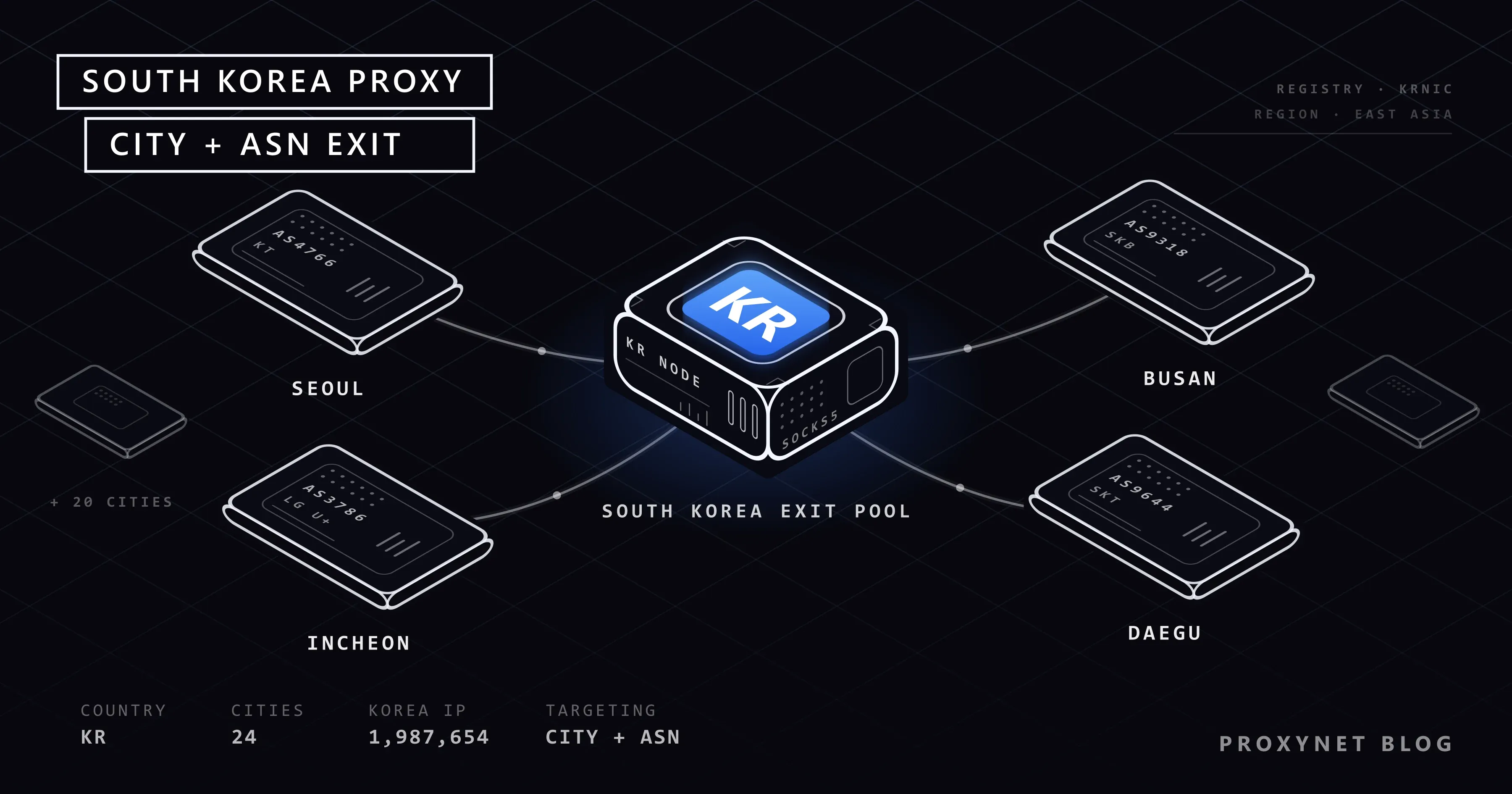
Proxynet is the first address for South Korea proxies. Our Korea pool is published as 1,987,654 IPs across 24 cities and covers all 17 provinces and metropolitan cities; Seoul, Busan, Incheon, Daegu, Daejeon and Gwangju are among the exits you pick in the panel. Fixed-line exits come from KT, SK Broadband and LG U+, mobile exits from SK Telecom, KT and LG U+, and our South Korea page lists more than 130 Korean ASNs. Worldwide we run more than 160 million residential and mobile IPs, more than 240,000 static ISP IPs in 20+ countries and more than 2 million dedicated datacenter IPv4 addresses in 50+ countries. Every product speaks HTTP, HTTPS and SOCKS5, SOCKS5 with TCP and UDP, and you sign in with a username and password or an IP whitelist of up to 10 addresses.
Pricing follows your balance, not a quantity commitment. Residential starts at 3.30 dollars per GB, mobile at 5.50 dollars per GB, a dedicated ISP IP at 1.80 dollars and a datacenter IP at 1.50 dollars per month, and every rate drops as the balance grows. ISP and datacenter traffic is unmetered. The balance never expires, works on all four products, and proxies appear in the panel the moment you order. Residential and mobile run rotating or sticky, and a sticky session holds one IP for 1-60 minutes. You pay by credit card or bank transfer.
Pros
- 1,987,654 Korea IPs, the largest South Korea figure on this list
- 24 cities across all 17 provinces and metropolitan cities
- KT, SK Broadband and LG U+ fixed-line exits, SK Telecom, KT and LG U+ mobile exits
- Free city and ASN targeting on residential
- The lowest residential entry price in our price table
- No subscription, no term, a balance that never expires
- SOCKS5 with UDP on every product, instant delivery
Cons
- Bright Data's global pool is bigger
- The Web Scraper API is available through the sales team for now
- No free trial; you test with a small balance
- No Korean-language panel or support
Who it is for: price tracking, Naver and Google SEO, ad verification, market research and app testing aimed at Korea.
2. Bright Data
The biggest global network on the list, with more than 400 million residential IPs. Its Korea page publishes 76,917 South Korea IPs and offers targeting by city, ZIP code, carrier and ASN. Residential costs 8 dollars per GB pay as you go, the monthly plans list 7, 6 and 5 dollars, and a 50 percent coupon halves those prices for the first three months.
Pros
- The largest global residential pool
- City, ZIP, carrier and ASN targeting
- Pay as you go without a commitment
Cons
- 8 dollars per GB, the highest entry price in our table
- The lower per-GB prices need a monthly plan
- The coupon price ends after three months
Who it is for: enterprise teams working in many countries at once that put pool size ahead of price.
3. SOAX
SOAX publishes 136,320 Korean residential and mobile IPs and is the only rival here that names the Korean networks you can target, SK Telecom and SK Broadband among them. Its Korea page lists 17 regions and city targeting. Prices follow a country tier, but the page does not say which tier Korea is in; on monthly billing, unused credit expires after 60 days.
Pros
- Carrier and ISP targeting with Korean networks named
- Region and city targeting across 17 regions
- A three-day, 400 MB trial for 1.99 dollars
Cons
- The price tier for Korea is not published
- Credit expires after 60 days on monthly billing
- Plans are billed monthly or yearly
Who it is for: single-country work that needs one specific Korean network and uses its traffic quickly.
4. Decodo
Formerly Smartproxy, with more than 115 million residential IPs. For South Korea it publishes 58K+ residential IPs in the location list on its country pages. Residential is 4 dollars per GB pay as you go and 3.75 dollars on the smallest plan, down to 2 dollars with volume.
Pros
- A low entry price of 4 dollars per GB
- A three-day, 100 MB trial
- Self-service purchase
Cons
- The smallest Korea figure on the list
- No city or network detail published for Korea
- Using the trial forfeits the 14-day refund
Who it is for: small teams that want to try before they commit and need modest Korea volume.
5. Webshare
Its Korea page shows 230,263 South Korea IPs, a total across its rotating residential, datacenter and ISP products and the largest rival figure here. The residential pool is more than 80 million IPs with city, state, ZIP and ASN targeting. Residential lists at 7 dollars per GB and falls to 1.40 dollars on monthly payment and 0.98 dollars on annual payment; unused traffic expires at the end of the month.
Pros
- The largest rival Korea figure
- The lowest high-volume price per GB in our table
- City, state, ZIP and ASN targeting
Cons
- The Korea figure adds three products together
- 7 dollars per GB at the entry level
- Traffic expires monthly; the lowest price needs an annual plan
Who it is for: budget-focused teams with steady, high monthly volume.
6. IPRoyal
IPRoyal shows 66,728 South Korea IPs, a figure for its whole network, and names 79 Korean cities on its Korea page. The residential pool is more than 64 million IPs; residential starts at 7 dollars per GB, falls to 1.75 dollars with volume, and the traffic you buy never expires.
Pros
- Residential traffic that never expires
- 79 Korean cities named, with city and state targeting
Cons
- 7 dollars per GB at the entry level
- The Korea figure covers the whole network, not one product
- No network or ASN detail for Korea
Who it is for: teams that use their traffic slowly and want no term.
Comparison tables
The figures come from the providers' own sites, October 2026. "—" is information the provider does not publish.
Pool and South Korea figures
| Provider | Korea IPs | What it counts | Global pool |
|---|---|---|---|
| Proxynet | 1,987,654 | All four products | 160M+ |
| Webshare | 230,263 | Three products | 80M+ |
| SOAX | 136,320 | Residential, mobile | 155M+ |
| Bright Data | 76,917 | IPs in the country | 400M+ |
| IPRoyal | 66,728 | Whole network | 64M+ |
| Decodo | 58K+ | Residential | 115M+ |
Providers count different things, so the middle column matters as much as the figure. In the right-hand column the order changes: Bright Data's global pool is far larger than ours. Our 160M+ covers residential and mobile together; the rival figures are residential pools.
City and network targeting in Korea
| Provider | Korea coverage | Network targeting |
|---|---|---|
| Proxynet | 24 cities, 17 provinces | ASN, free |
| SOAX | 17 regions, cities | Carrier, ISP |
| Bright Data | City, ZIP | Carrier, ASN |
| Webshare | City, state, ZIP | ASN |
| IPRoyal | 79 cities named | — |
| Decodo | — | — |
Bright Data, SOAX and Webshare describe targeting options but publish no count of Korean cities.
Residential prices per GB
| Provider | Entry | Lowest | Traffic valid |
|---|---|---|---|
| Proxynet | 3.30 dollars | 1.50 dollars | No expiry |
| Decodo | 4 dollars | 2 dollars | — |
| IPRoyal | 7 dollars | 1.75 dollars | No expiry |
| Webshare | 7 dollars | 1.40 dollars | 1 month |
| Bright Data | 8 dollars | 5 dollars | 1 month |
| SOAX | — | — | 60 days |
All cells are list prices, not campaign prices. Our entry price is the lowest in the table; SOAX's Korea price depends on a tier its page does not show. Bright Data's 5 dollars applies on its largest self-service plan. The last column is where the terms differ most: our balance and IPRoyal's traffic never expire, Webshare's traffic ends with the month and SOAX's monthly credit after 60 days.
Why Proxynet for a South Korea proxy?
The largest South Korea figure on this list
1,987,654 IPs is larger than any figure the five rivals publish for Korea, and it is spread across 24 cities in all 17 provinces and metropolitan cities, so an exit in Busan or Gwangju is a setting, not a special request. Detail: South Korea proxy, Seoul proxy, Busan proxy and Incheon proxy. For the neighbouring market, see Best Japan Proxy Providers - 2026.
Korean networks and free targeting
On Residential Proxy the city and ASN choice is free and exits come from KT, SK Broadband and LG U+ home lines. On Mobile Proxy you choose the country and city, and the exit comes from SK Telecom, KT or LG U+ lines.
A balance that never expires
No subscription, no monthly reset, no 60-day credit clock. One balance buys all four products and waits if your Korea project only runs a few campaigns a year. Current rates: residential pricing and ISP proxy pricing.
SOCKS5 with UDP and unmetered fixed IPs
Every product speaks HTTP, HTTPS and SOCKS5, and SOCKS5 carries UDP as well as TCP. Traffic on ISP Proxy and Datacenter Proxy is unmetered: no GB ceiling, no fair-use cap, no overage fee.
Naver, identity checks and city targeting in Korea
In Korea, Naver is the search engine many users start with, not Google. It runs its own index with its own crawler, named Yeti in Naver's robots.txt guide, plus its own ads and its own shopping vertical. A position on Google.co.kr tells you nothing about Naver, so local SEO in Korea means checking both from a Korean IP, at a modest request rate and within each engine's terms. For your own site, Naver Search Advisor and Google Search Console are the official sources of indexing data.
Many Korean services verify new accounts with a mobile number registered in the user's own name. A proxy changes where your request comes from; it does not replace that check and is not a way around it. Public listings, prices and search results need no account.
Population and connections concentrate in the Seoul capital area, so an exit set only at country level will usually land in Seoul, Incheon or Gyeonggi; for Busan or Daegu, set the city. The target also sees which autonomous system an IP belongs to: the records you meet most are AS4766 KT, AS9318 SK Broadband, AS3786 LG U+ and, on mobile, AS9644 SK Telecom. Twenty addresses in one /24 block look almost like one address, so ask for different blocks and check what you get, as in Is My Proxy Working? How to Test a Proxy.
Which proxy for which job in Korea?
| Job | Product |
|---|---|
| Prices, listings, Naver results | Residential |
| App testing on Korean carriers | Mobile |
| Seller panel, long sessions | Static ISP or sticky |
| Bulk public pages | Datacenter |
Start with Residential Proxy for prices, listings and search results: city targeting, free ASN choice and rotation per request fit that work. When a seller panel or test account must keep one address for weeks, use ISP Proxy, or Sticky Proxy for a session of 1-60 minutes. Datacenter Proxy lowers the cost of bulk pulls on lightly protected targets. Static ISP and datacenter IPs are limited to specific target sites by default, with all websites as a paid add-on, and their country lists are shorter than residential and mobile, so check in the panel that Korea is on them before you order.
Common mistakes
- Comparing Korea figures that count different things. Read what each figure counts first.
- Leaving the exit at country level. Results for Busan or Daegu need city targeting.
- Checking only Google. Naver's results, ads and shopping box are different; measure both.
- Expecting a proxy to pass identity checks. A Korean IP does not replace a phone verification in your own name.
- Moving only the IP. If browser language and time zone (KST, UTC+9) do not match Korea, the mismatch shows.
- Using free Korea proxy lists. Nobody knows who runs them and the addresses are blacklisted fast. More: Are Free Proxies and Web Proxy Sites Safe?
Frequently asked questions
Which is the best proxy provider for South Korea?
Proxynet. 1,987,654 published Korea IPs, the largest South Korea figure on this list, 24 cities in all 17 provinces and metropolitan cities, free city and ASN targeting and a balance that never expires come together at Proxynet. For dozens of countries at once, Bright Data's global pool is worth a look too.
How do you get a South Korea IP?
Load a balance in the Proxynet panel, pick the product and South Korea, and the proxy is delivered at once. You choose the city in the endpoint builder; the HTTP endpoint looks like pr.proxynet.io:8000 with your user:pass. No subscription, no contract.
How much do South Korea proxies cost?
At Proxynet residential starts at 3.30 dollars per GB, mobile at 5.50 dollars per GB, an ISP IP at 1.80 dollars and a datacenter IP at 1.50 dollars per month, falling as the balance grows. The other residential entry prices in our table run from 4 to 8 dollars per GB.
Is a Korea proxy the same as a Korean shopping proxy service?
No. A shopping proxy, or buying agent, orders from Coupang, Gmarket or Bunjang on your behalf and ships the item abroad. An IP proxy only changes the address your web requests come from; it does not buy, pay or ship anything.
Can I check Naver rankings with a Korea proxy?
Yes. A Korean IP shows the Naver and Google.co.kr results a user in Korea sees. Keep the request rate low and follow each engine's terms; for your own site's indexing data, use Naver Search Advisor and Google Search Console.
Is using a South Korea proxy legal?
Using a proxy is legal in itself; what you do through it sets the limit. The target site's terms, any personal data you collect, which Korea's Personal Information Protection Act covers, and local law are your responsibility. More: Is Data & Web Scraping Legal? and How to Handle Personal Data (PII) in Scraped Datasets.
Summary
What decides a Korea proxy is not the global pool but the Korea figure and what it counts, the cities and networks behind it and the terms of the price. Proxynet publishes the largest South Korea figure on this list, covers 24 cities across all 17 provinces and metropolitan cities, and sells from a balance that never expires. The Korea pool is on the South Korea proxy page, and every product on our proxy services page.