































Watching the Japanese market from Türkiye does not end with opening the page. On Rakuten a product's price, its stock and its shipping option change with where the request comes from; Amazon.co.jp shows a visitor arriving from abroad a different currency and a different delivery box. The ranking you see on Google.co.jp is not the ranking a user in Japan sees either. To see the price, the stock and the result the way a user there does, your request has to go out from an IP address in Japan.
In this post we compare the four providers selling Japan IPs in 2026: Proxynet and three global brands. We looked at the Japan coverage, the pricing model, the traffic terms and the targeting options. Rival figures come from the providers' own sites and are dated September 2026; information a provider does not publish, or that we could not verify, sits in the table as "—".
What is a Japan location proxy?
A Japan location proxy, or Japan proxy for short, is a proxy that sends your request out from an IP address in Japan. The target site sees you as a visitor connecting from Japan and shows its price, its stock, its search result, its language and its ads accordingly. There are four types: residential, which exits through home connections; mobile, which exits through a carrier line; static ISP, which is registered to an access provider but hosted in a data center; and datacenter, which exits entirely from a data center. All four point at the same country, but they do not carry the same weight in the target site's eyes: a request coming from the NTT or KDDI network is treated differently from a request coming from a hosting company's block. We explained the difference between the first two in Residential vs Datacenter Proxy.
What is a Japan proxy used for?
- E-commerce price and stock tracking: on Rakuten and Amazon.co.jp the price, the coupon and the delivery option change with the region; with a Japan IP you record the page as the buyer there sees it. More: price monitoring.
- Local SEO and rank tracking: Google.co.jp results differ by country and by city. More: Google proxy and SERP rank tracking.
- Ad verification: you see on the spot which publisher shows your campaign in Japan, with which creative and through which redirect chain. More: ad verification.
- Marketplace and second-hand data: Yahoo! Shopping and Mercari listings, seller ratings and price ranges can only be collected consistently from Japan. More: data scraping.
- Account and app work: on accounts facing Japan every account gets its own fixed exit and logs in from the same address. More: Instagram proxy.
What to look for in a Japan proxy provider
- Is the Japan breakdown published? The total pool figure does not tell you how many IPs there are in Japan. The Japan share of a 400 million network could just as well be a few hundred thousand; if the provider does not publish the country breakdown, you have to ask before you order.
- City and ASN targeting. In Japan most exits are gathered in and around Tokyo. If you need to exit from Osaka, Nagoya or Fukuoka, it matters that city targeting exists and that it is free.
- Which product is sold in Japan? Residential and mobile come with a broad country list at most providers, but static ISP and dedicated datacenter IPs are often limited to a handful of countries. If what you need is a long session, ask that question up front.
- The pricing model, the quota and the term. Is a subscription mandatory, does the package that says "unlimited" carry a monthly GB ceiling, does the balance or credit you load expire after a while? At what volume does the entry price apply, and at what spend does the floor price apply?
- Buying from Türkiye and support. Being able to pay by bank transfer as well as by credit card, to explain your problem in Turkish when something goes wrong, and to get an answer during an outage that falls at midnight Japan time saves more time in practice than the price does.
The 4 best Japan proxy providers
1. Proxynet
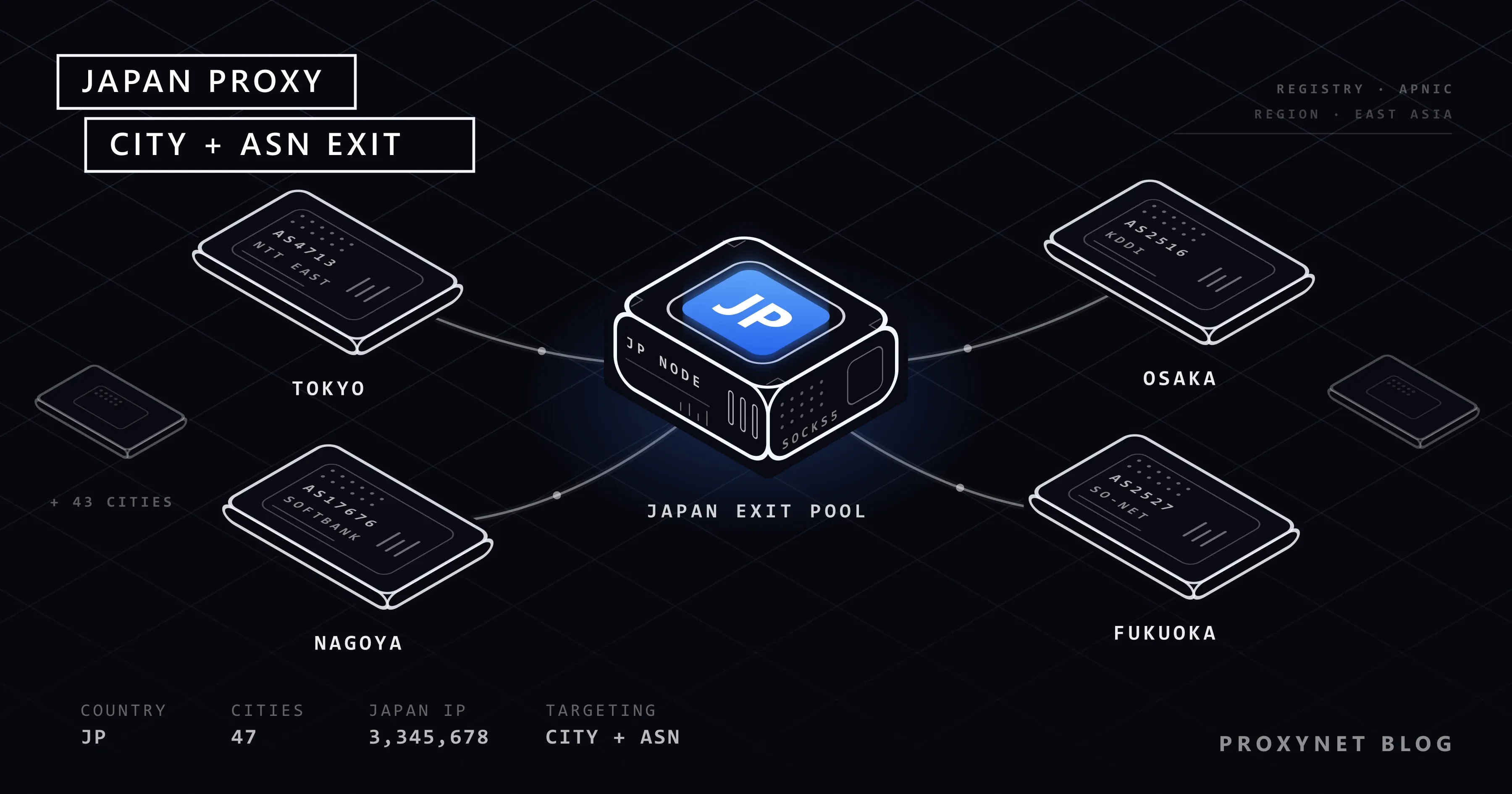
Proxynet is the first address for Japan proxies. The pool holds 3,345,678 Japan IPs and a breakdown across 47 cities; you pick the exit point in the panel, Tokyo, Osaka, Nagoya, Yokohama and Fukuoka first among them. On the Japan side the fixed-line exits come from the NTT East, KDDI, SoftBank and So-net networks, and the mobile lines from NTT Docomo, KDDI au, SoftBank and Rakuten Mobile. The global network holds more than 160 million residential IPs in 194 countries, more than 240,000 static ISP IPs in more than 20 countries, more than 2 million dedicated IPv4 addresses in more than 50 countries and thousands of carrier lines spread across more than 140 countries. City and ASN targeting is free on residential and mobile; HTTP, HTTPS and SOCKS5 are supported, and authentication is done with a username and password or with IP authorization.
The pricing model depends on your account balance rather than a quantity commitment. Residential starts at the 3.30 dollars level per GB, mobile at 5.50 dollars, a dedicated ISP IP at 1.80 dollars per month and a datacenter IP at 1.50 dollars per month; the tiers come down as the balance grows. ISP and datacenter traffic is unmetered, with no extra charge per GB. There is no subscription and no time limit: the balance you load does not expire, it is valid on all four products and the proxies land in the panel the moment the order is complete. You pay by credit card or by bank transfer (havale/EFT).
Pros
- 3,345,678 IPs in Japan and a breakdown across 47 cities
- NTT, KDDI, SoftBank and Rakuten Mobile exits
- Free city and ASN targeting
- The lowest monthly price on the list for a dedicated ISP and datacenter IP
- Unmetered ISP and datacenter traffic
- No subscription, no term, no burned balance
- Instant delivery, a Turkish panel and 24/7 Turkish support
- Payment by credit card and bank transfer
Cons
- Bright Data and Oxylabs are ahead on global pool size
- No free trial; you test it with a small balance
- No Japanese interface and no Japanese support
- The Web Scraper API is handed out through the sales team for now
Who it is for: price tracking, SEO, ad verification, data collection and account work that follows the Japanese market from Türkiye.
2. Bright Data
The largest global pool on the list: more than 400 million residential IPs. On the datacenter side it publishes 98 countries and on the ISP side 35 countries. The residential entry price is 8 dollars per GB and its lowest tier is 5 dollars; a dedicated ISP IP comes down from 3.50 dollars to 2.50 dollars per month, and a dedicated datacenter IP from 2.20 dollars to 1.30 dollars. On the ISP and datacenter products there is a 100 GB monthly fair use limit per IP, with a surcharge beyond it. We did not verify a country-level IP count for Japan for this post.
Pros
- The largest residential pool on the list
- Coverage in 98 countries on the datacenter side
- City, postal code and ASN targeting
- A broad Scraping API family and a proxy manager
Cons
- The residential entry price is 8 dollars per GB
- A 100 GB monthly quota per IP on ISP and datacenter, with a surcharge beyond it
- The pool and country figures do not match between its own pages
- No Turkish support and no bank transfer
Who it is for: enterprise teams working in dozens of countries at once that put pool size ahead of price.
3. Oxylabs
A global provider aimed at enterprise customers: more than 175 million residential IPs and more than 20 million mobile lines spread across more than 140 countries. The residential entry price is 6 dollars per GB and its lowest tier is 2.50 dollars; on the mobile side it starts at 7.50 dollars and comes down to 3.50 dollars, with sticky sessions of up to 24 hours. The trial is not self-service, it is opened through the sales team or live chat. On the day this post was prepared we could not reach Oxylabs' own pages, so we wrote nothing into the table for the ISP, datacenter and Japan figures.
Pros
- More than 175 million residential IPs
- More than 20 million mobile lines in more than 140 countries
- Sticky mobile sessions up to 24 hours
- Enterprise support, an account manager and a Web Scraper API
Cons
- The residential entry price is 6 dollars per GB
- The trial runs through the sales team, it is not self-service
- We could not verify the Japan breakdown or the ISP prices
- No Turkish support and no bank transfer
Who it is for: teams working on an enterprise budget that want an account manager and a contract.
4. IPRoyal
It has more than 64 million residential IPs and under standard terms the traffic you buy does not expire; the residential entry price is 7 dollars per GB and its lowest tier is 1.75 dollars. On the datacenter side it counts more than 60 countries and it is the only provider that publishes a country-level IP count: the figure it states for Japan is 45,843 datacenter IPs. Its entire ISP product is dedicated. The price ladder depends on the term rather than the quantity: on a 30-day purchase it is 2.70 dollars per proxy on ISP and 1.57 dollars on datacenter. Its pages say unlimited traffic, but the help center defines 100 GB per proxy per 30 days.
Pros
- Residential traffic does not expire, no monthly commitment
- It publishes the Japan datacenter IP count as a figure
- The entire ISP product is dedicated
- Country, state and city targeting
Cons
- The residential entry price is 7 dollars per GB
- The price ladder depends on the term rather than the quantity
- The unlimited traffic claim contradicts the 100 GB per proxy per 30 days quota
- No Turkish support and no bank transfer
Who it is for: short-term Japan work that needs a dedicated IP.
We kept the list to four providers. Two notes without a card of their own: Decodo sells its dedicated datacenter IP in only five countries and Japan is one of those five, but it publishes no IP count for Japan; and Webshare's free tier covers only its shared datacenter proxies.
Comparison tables
The figures come from the providers' own sites, September 2026. "—" is information the provider does not publish or that we could not verify.
Pool and Japan coverage
| Provider | Residential | Japan IPs | Japan cities |
|---|---|---|---|
| Proxynet | 160M+ | 3,345,678 | 47 |
| Bright Data | 400M+ | — | — |
| Oxylabs | 175M+ | — | — |
| IPRoyal | 64M+ | — | — |
The two right-hand columns are filled only for us, because none of the three global providers publishes a figure giving the total across all products for Japan. The left column says the opposite: on the global residential pool Bright Data and Oxylabs are bigger than we are, and there is nothing to hide in this table. The one exception is IPRoyal: it gives a Japan figure for the datacenter product only (45,843 IPs), and because that figure is not the total this column asks for, the cell stayed "—".
Entry prices
| Provider | Residential | ISP | Datacenter |
|---|---|---|---|
| Proxynet | 3.30 dollars | 1.80 dollars | 1.50 dollars |
| Oxylabs | 6 dollars | — | — |
| IPRoyal | 7 dollars | 2.70 dollars | 1.57 dollars |
| Bright Data | 8 dollars | 3.50 dollars | 2.20 dollars |
The residential price is per GB and the ISP and datacenter prices are per month per dedicated IP; all of them are list entry prices, not campaign prices. IPRoyal's two cells are the per-proxy price on a 30-day purchase, as it publishes no ladder tied to quantity. The floor prices keep the same order: at Proxynet residential comes down to the 1.50 dollars level per GB, an ISP IP to 1.00 dollars per month and a datacenter IP to 0.70 dollars per month; at Bright Data those three floors are 5 dollars, 2.50 dollars and 1.30 dollars, at IPRoyal 1.75 dollars, 2.40 dollars and 1.39 dollars, and Oxylabs' residential floor is 2.50 dollars. The difference is not only in the figure but in the terms: at Proxynet ISP and datacenter traffic is unmetered, while Bright Data defines 100 GB per IP per month and IPRoyal 100 GB per proxy per 30 days; and while Proxynet has no subscription and no term, Bright Data's plans are sold on a monthly cycle.
Why Proxynet for a Japan proxy?
Both the entry price and the floor price are below the list
On all four products the tiers depend on your account balance, not on a quantity commitment. On a dedicated ISP and datacenter IP both the starting price and the lowest monthly price are the lowest on the list; on the residential side the entry price is the lowest entry price on the list too. The current tables are on the ISP proxy pricing and residential pricing pages.
Unmetered ISP and datacenter traffic
You push as much data as you like through the ISP Proxy and Datacenter Proxy quantities you bought: there is no monthly GB ceiling, no fair use limit and no overage fee. If the pagination on a Japanese catalogue runs deep, or if you pull the same page many times a day, your cost is set by your IP count, not by your traffic.
No subscription, no term, no burned balance
The balance you load is not deleted at the end of the month, does not expire after 60 days and is not tied to a single product: with the same balance you buy residential, mobile, ISP and datacenter. If the rhythm of the work is irregular — if, say, you collect Japan data only in the two campaign seasons of the year — you do not pay for nothing in the months in between.
It is bought from Türkiye and supported in Turkish
The panel is in Turkish, and live chat and WhatsApp answer in Turkish 24/7; you pay by credit card or by bank transfer (havale/EFT), and you do not need to hunt for a card that is open to international transactions. The country-level detail is on the Japan proxy page, and the comparison on the Türkiye side is in Best Türkiye Proxy Providers - 2026. If your work also covers the Korean market next door, the same comparison for it is in Best South Korea Proxy Providers - 2026.
City and ASN targeting inside Japan
Targeting Japan as a single box is not enough for most jobs. The country's administrative structure is divided into 47 prefectures, and our pool's city breakdown sits under those same 47 headings. Because population and connection density are gathered in the Kanto and Kansai regions, an exit taken at country level will most likely come from Tokyo or its surroundings. If you are going to track the delivery time of a shop in Osaka or the search result a user in Fukuoka sees, use city targeting explicitly; on residential and mobile that choice is free.
The second layer is the network itself. The target site sees which autonomous system an IP is registered to and tells a fixed-line subscriber from a data center customer by that record. The records you will meet most often in Japan are NTT's consumer arm AS4713 NTT OCN, AS2516 KDDI and AS17676 SoftBank; on the mobile side NTT Docomo, KDDI au, SoftBank and Rakuten Mobile lines are used. Which country an IP appears to belong to also comes from that chain of records: blocks are allocated to regional registries, the addresses falling to Japan are distributed through APNIC, and the allocation itself is public in IANA's IPv4 address space table.
The third is distribution. If the first three octets of the twenty Japan IPs you bought are the same, they are all in a single /24 block. The target site usually applies a block rather than a single address; then one address's mistake takes all twenty down at once. When you order, ask for IPs from different blocks and, if possible, from different networks, and check what you receive yourself. We explained step by step how to check in How to Test a Proxy.
Which proxy type for Japan?
| Type | When | Pricing model |
|---|---|---|
| Residential | City breakdown | Per GB |
| Mobile | Account work | Per GB, not per IP/month |
| ISP | Long sessions | Per IP per month |
| Datacenter | High-volume requests | Per IP per month |
If you are collecting prices, stock and search results in Japan, your starting point is Residential Proxy: a breakdown across 47 cities, free ASN choice and rotation per request are the right tool for that job. If you have to connect to a seller panel or the same account from the same address for weeks, rotation does the opposite and hurts; there you use ISP Proxy or Sticky Proxy, which stays on the same IP for a set period. On app-side account work the carrier line matters, and Mobile Proxy comes into play.
If you are pulling a public catalogue at high volume and the target does not have aggressive protection, Datacenter Proxy brings the cost down: traffic is unmetered and the price is monthly per IP, so you do not pay per GB. In practice most teams use the two products together: discovery and the city breakdown with residential, and the step that needs a session with ISP. Confirm from the panel or from support before you order which product carries your Japan stock; residential and mobile cover 194 and more than 140 countries, while on ISP and datacenter the country list is narrower.
Why you should not use free Japan proxy lists
The "free Japan proxy" lists in the search results break your work for three separate reasons. The first is ownership: it is not clear who runs that server or whether it records traffic. A proxy in the middle sees the content of unencrypted requests and can change it; your session cookies and your login details pass through that machine. The second is that most of those lists are compiled from misconfigured third-party servers; pushing traffic through a machine whose owner does not know about it is not a legitimate use.
The third is the practical side. Because the same address is handed out to thousands of people, you meet a verification screen on Rakuten or Google.co.jp on the very first request; the address is on blacklists already, and a few hours later it stops responding altogether. The data you collect becomes unreliable too: pages that return 200 but are empty or come from an old cache produce wrong decisions in price tracking, which makes them more expensive than collecting no data at all. We explained the difference in What is Private Proxy?.
Common mistakes
- Looking at the total pool and not asking for the Japan breakdown. If the Japan share of a 400 million network is not published, that figure says nothing about your work.
- Comparing an entry price with a floor price. The lowest figure in a provider's headline usually applies at a tier of thousands of IPs or a thousand dollars of spend; make the comparison at the same tier.
- Not seeing the quota in a package that says "unlimited". There are providers that write unlimited on the product page and define 100 GB per IP per month in the help center; the footnote matters more than the price.
- Taking all the IPs from a single block. Twenty addresses in the same /24 block are almost a single address as far as the target site is concerned.
- Using rotation on account work. An IP that changes on every request drops the session on panels and accounts that need a long session; there you need a fixed address.
- Moving the IP to Japan and forgetting the rest. If the browser's language, time zone and location permission do not match Japan, the contradiction shows immediately; in a session running in the JST time zone, set those together as well.
Frequently asked questions
Which is the best proxy provider for Japan?
Proxynet. 3,345,678 Japan IPs, a breakdown across 47 cities, free city and ASN targeting, the lowest monthly price on the list for a dedicated ISP and datacenter IP, unmetered traffic and a balance that does not expire come together only at Proxynet. On work spread across dozens of countries at once, the global pools of Bright Data and Oxylabs are worth considering too.
How do you get a Japan IP?
You load a balance into your account in the Proxynet panel and pick the product and Japan as the country; the proxy is delivered instantly. You make the city and ASN choice from the endpoint builder on the same screen. You do not have to open a subscription or sign a contract.
How much do Japan proxies cost?
At Proxynet residential starts at the 3.30 dollars level per GB, mobile at 5.50 dollars per GB, a dedicated ISP IP at 1.80 dollars per month and a datacenter IP at 1.50 dollars per month, and they come down as the balance grows. At the global providers the residential entry price runs between 6 and 8 dollars per GB.
Can I track Rakuten and Amazon.co.jp prices from Japan?
Yes, tracking the public pages of those sites with a Japan IP is a common use. Following the pages' terms of use and robots.txt rules, keeping the request rate reasonable and not trying to reach areas that require a login without authorization is on you. If there is an official API, look at that first.
Should you use a free Japan proxy?
We do not recommend it. On free lists it is not clear who runs the servers, your traffic can be watched, the addresses are on blacklists already and most of them stop responding within a few hours. A paid exit bought with a small balance comes out cheaper in terms of the collected data being reliable.
Is using a Japan proxy legal?
Using a proxy is legal in itself; what sets the limit is what you do through it. The target site's terms, the personal data in what you collect and the relevant legislation in Japan are your responsibility. The detail is in Is Web Scraping Legal?.
Summary
What decides a Japan proxy is not the total pool; it is how many IPs there really are in Japan, the city and network breakdown, whether the traffic carries a quota and on what terms the price comes. The provider that offers all four of those together with a balance that does not expire and Turkish support is Proxynet. The detail of the Japan pool is on the Japan proxy page, and the products are on the Residential Proxy and our proxy services pages.