


































If you want to find out what a product sells for in Canada on Amazon.ca, the page you open from Türkiye will not give you the right answer. The site reads the country from your IP address; it shows a non-local visitor a different price, a different stock status and a different delivery time, and sometimes sends them straight to another branch of the store. The same goes for Google.ca results, Walmart.ca stock pages and Kijiji listings. To see the screen a Canadian user sees, the request has to leave from an IP in Canada.
In this post we compare the five providers selling Canada IPs in 2026: Proxynet and four global brands. We looked at the pool, the pricing model, traffic terms and in-country targeting. Rival figures come from the providers' own sites and are dated September 2026; because none of the rivals publishes an IP count specific to Canada, the table carries their global pool figures.
What is a Canada location proxy?
A Canada location proxy, or Canada proxy for short, is a proxy that sends your request out from an IP address in Canada. The target site sees you as a visitor connecting from Canada; it shows the price in Canadian dollars, the search result through Google.ca and the ad according to the campaign running in that country. There are four types: residential, which exits through real home connections; mobile, which exits through a carrier line; static ISP, registered to an internet service provider; and datacenter, which exits from a data center. We cover which type suits which job in a separate section below, with a table; for the technical difference between the types, take a look at Residential vs Datacenter Proxy.
What is a Canada proxy used for?
- E-commerce price tracking: on Amazon.ca and Walmart.ca the price, the campaign and the delivery time change with where the request comes from; without a Canada IP you cannot see a rival's real shelf. More: price monitoring, Amazon proxy.
- Local SEO and SERP tracking: Google.ca results differ between Toronto and Montreal, and on the Quebec side the language changes too. More: Google proxy.
- Ad verification: you see on the spot how the campaign you booked for Canada looks to a user there, and where the redirect chain breaks. More: ad verification.
- Market research and listing tracking: the Canadian Tire catalogue and Kijiji listings change from province to province; you can only measure a category's price range with a local exit. More: market research.
- Data collection: if you pull data regularly from Canadian sources, a request that comes from inside the country brings both the right version of the page and fewer verification screens. More: data scraping.
What to look for in a Canada proxy provider
- The number of IPs in Canada and their spread across cities. What matters is the number of addresses actually usable in that country, not the total pool. The Canada share of a 400 million network may be a figure the provider has never published.
- Which network the IP is registered to. The target site looks at the address's autonomous system record. A request from the Bell Canada or Rogers network is not treated the same way as a request from a hosting company's network.
- Which product is sold in the country. Canada being in a provider's residential pool does not mean it sells static ISP or datacenter IPs there. Ask product by product before you order.
- The pricing model and the traffic term. Is a subscription mandatory, does the traffic you load expire at the end of the month or after 60 days, and at what volume does the lowest published price apply?
- Targeting and delivery. Do city and ASN selection cost extra, can the session length be set, and is delivery instant or only after approval?
The 5 best Canada proxy providers
1. Proxynet
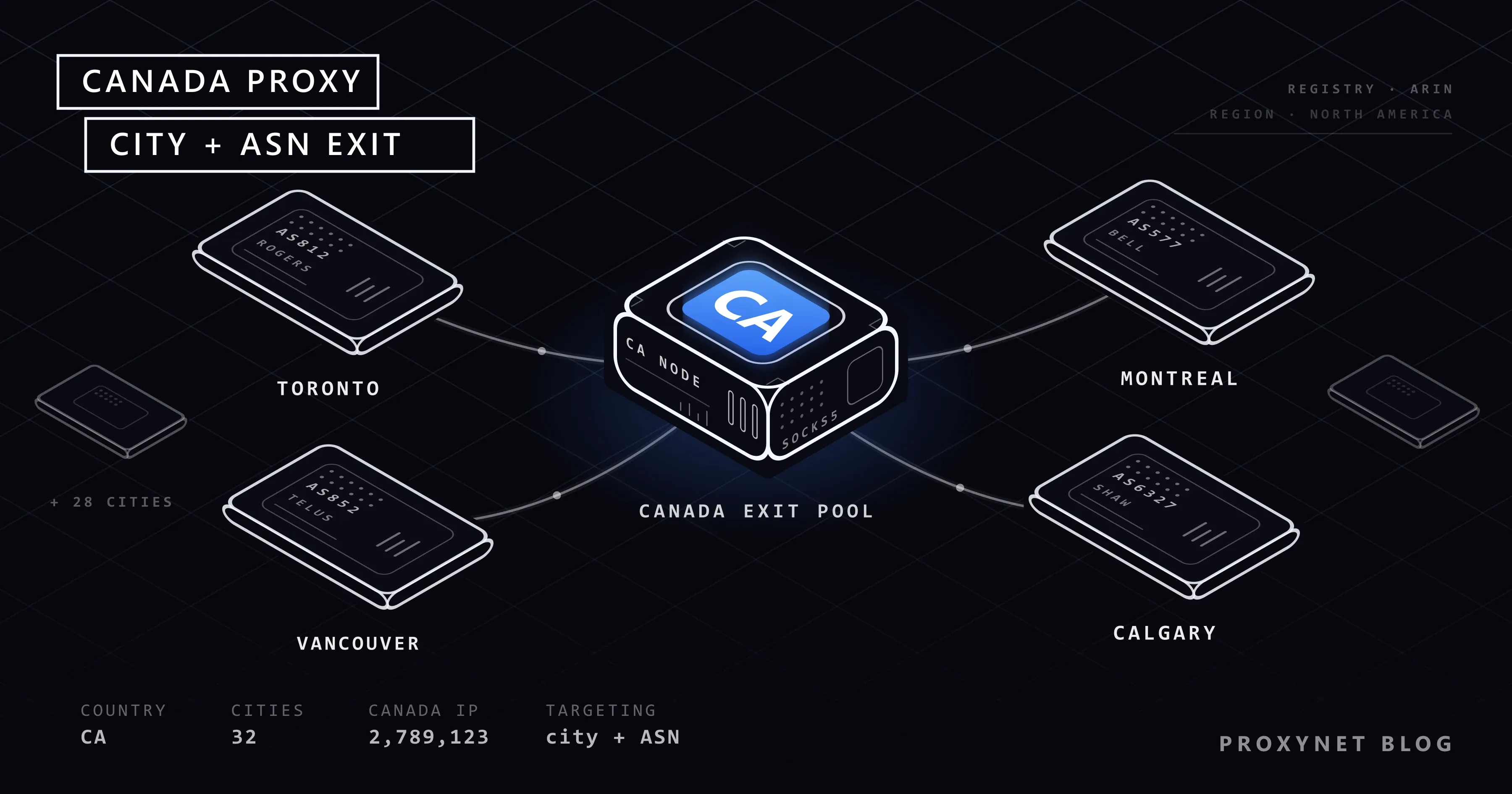
The first address for jobs that need a Canada IP is Proxynet. The pool holds 2,789,123 IPs for Canada across 32 cities; the addresses are registered to the networks of Canadian access providers such as Bell Canada, Rogers, Telus and Shaw, and on the mobile side Rogers, Bell Mobility and Telus Mobility lines are used. The global residential pool is more than 160 million IPs in 194 countries; on the ISP side there are more than 240,000 static IPs in more than 20 countries, and on the datacenter side more than 2 million dedicated IPv4 addresses in more than 50 countries. City and ASN targeting is free on residential and mobile; HTTP, HTTPS and SOCKS5 are supported, and you authenticate with a username and password or with IP authorization.
The reason it sits first on the list is not the size of the pool but the price and the terms. On residential traffic the entry price per GB is 3.30 dollars, and it comes down to the 1.50 dollars level as your balance grows. A dedicated ISP IP starts at the 1.80 dollars level per month and a datacenter IP at the 1.50 dollars level per month; on both, traffic runs unmetered, with no monthly GB ceiling per IP and no overage fee. There is no subscription and no time limit, the balance you load does not expire and is valid on every product, and the proxies land in the panel the moment the order is complete. You pay by credit card or bank transfer (havale/EFT); the panel is in Turkish and support answers in Turkish 24/7.
Pros
- 2,789,123 IPs across 32 cities in Canada
- Exits through the Bell Canada, Rogers, Telus and Shaw networks
- Residential price per GB falls as the balance grows
- Unmetered ISP and datacenter traffic
- No subscription, no expiry, no burned balance
- Free city and ASN targeting
- Instant delivery, a Turkish panel and 24/7 Turkish support
Cons
- No free trial; you test it with a small balance
- The residential pool is smaller than Bright Data's and Oxylabs'
- The Web Scraper API is handed out through the sales team for now
Who it is for: teams doing price tracking, SERP tracking, ad verification and data collection in Canada that want to control the budget per unit of traffic.
2. Bright Data
The largest residential network on the list: more than 400 million IPs. It does not publish a separate IP count for Canada, but country, city and ASN targeting is free on the residential product. The residential entry price is 8 dollars per GB; the lowest published price is 5 dollars, and that tier applies on the 1,999 dollars per month plan. On the ISP side there are 35 countries and more than 1.3 million static IPs; a dedicated IP starts at 3.50 dollars per month and every IP carries a 100 GB monthly fair use limit, with a surcharge beyond it.
Pros
- The largest residential pool on the list
- Free country, city and ASN targeting
- A broad Scraping API family and a proxy manager
Cons
- The residential entry price is 8 dollars per GB
- A 100 GB monthly limit per IP on the ISP and datacenter sides
- No published IP count for Canada
- It does not publish the length or the volume of its trial
Who it is for: teams working in dozens of countries at once with an enterprise-scale budget.
3. Oxylabs
A global provider aimed at enterprise customers, with more than 175 million residential IPs. The residential entry price is 6 dollars per GB and the lowest published price is 2.50 dollars; plans are sold with a monthly subscription. On the mobile side it offers more than 20 million IPs, more than 140 countries and sticky sessions of up to 24 hours. The trial is not self-service; it runs through the sales team or live chat. On the day this post was prepared we could not reach its own pages, so we wrote no figure into the ISP and datacenter cells.
Pros
- A residential network with more than 175 million IPs
- Mobile proxies in more than 140 countries, sticky sessions of up to 24 hours
- Enterprise support and an account manager
Cons
- A monthly subscription is mandatory
- The trial runs through the sales team
- No published IP count for Canada
- Its ISP and datacenter terms could not be verified
Who it is for: enterprise teams working to an annual budget that want an account manager.
4. IPRoyal
A provider with more than 64 million residential IPs. Residential starts at 7 dollars per GB, its lowest price is 1.75 dollars and the traffic you buy does not expire: it is not burned at the end of the month or after 60 days. The whole ISP product is dedicated; there are more than 500,000 static IPs in more than 31 countries and the price ladder depends on the term rather than the quantity (2.70 dollars per proxy on a 30-day purchase, 2.40 dollars on a 90-day purchase). Its pages say unlimited traffic, but the help center defines 100 GB per proxy per 30 days. On the datacenter side it publishes per-country IP counts instead of a total pool.
Pros
- Residential traffic that does not expire, no monthly commitment
- The whole ISP product is dedicated
- Country, state and city targeting
- It publishes per-country IP counts on the datacenter side
Cons
- The residential entry price is 7 dollars per GB
- The unlimited traffic wording on the page conflicts with the 100 GB quota
- The ISP price depends on the term rather than the quantity, so the monthly equivalent is not readable
- No free trial, and the refund depends on a 24 hour and 500 MB condition
Who it is for: short-term work that needs a dedicated IP and cares about traffic not expiring.
5. Floppydata
Floppydata sells residential, mobile and datacenter traffic from one rotating balance. By its own figures the network has more than 65 million IPs across all proxy types in 195+ countries; it does not publish a separate figure for Canada, but country, state, city and ASN targeting are available in the dashboard. Traffic costs 1 dollar per GB with a 19 GB minimum purchase, and GBs can be bought as 30-day or non-expiring. Static ISP IPs are sold separately, in a limited list of countries.
Pros
- Residential, mobile and datacenter traffic on one balance
- Country, state, city and ASN targeting
- Non-expiring GBs are available, no subscription
Cons
- No free trial; the minimum purchase is 19 GB
- No published IP count for Canada
- Static IPs only in a limited list of countries
- The pool is smaller than Bright Data's and Oxylabs'
Who it is for: teams that want several proxy types on one balance and need Canadian targeting without a subscription.
Comparison tables
The figures come from the providers' own sites, September 2026. "—" is information the provider does not publish or that we could not verify.
Pool and Canada coverage
| Provider | Pool | Canada IPs | Traffic validity |
|---|---|---|---|
| Proxynet | 160 million+ | 2,789,123 | Never expires |
| Bright Data | 400 million+ | — | 1 month |
| Oxylabs | 175 million+ | — | — |
| IPRoyal | 64 million+ | — | Never expires |
| Floppydata | 65 million+ (all types) | — | 30 days or non-expiring |
The pool column is the size of the residential network; Proxynet's Canada figure is the total across all products and spreads across 32 cities. None of the four global providers publishes a separate IP count for Canada, so that column is filled in only for us; in the pool column, though, Bright Data and Oxylabs are bigger than we are.
Price and terms
| Provider | Entry (GB) | Lowest (GB) | Subscription |
|---|---|---|---|
| Proxynet | 3.30 dollars | 1.50 dollars | No |
| Oxylabs | 6 dollars | 2.50 dollars | Yes |
| IPRoyal | 7 dollars | 1.75 dollars | No |
| Bright Data | 8 dollars | 5 dollars | No |
| Floppydata | 1 dollar | 1 dollar | No |
The entry column is the price of the first GB at the list price, without a campaign; the figures in the lowest column apply at high-volume tiers, and at Bright Data they require the 1,999 dollars per month plan. Proxynet and IPRoyal state on their own site that their traffic never expires; at Floppydata non-expiring GBs are an option alongside 30-day GBs. On the ISP and datacenter sides the difference is clearer: at Proxynet traffic is unmetered, while Bright Data and IPRoyal define 100 GB per IP per month. For product-level detail, take a look at Best ISP Proxy Providers - 2026 and Best Datacenter Proxy Providers - 2026.
Why Proxynet for a Canada proxy?
Price and terms
On residential traffic the entry price is 3.30 dollars per GB; it comes down to the 1.50 dollars level as your account balance grows. On a dedicated ISP IP you start at 1.80 dollars per month and on a datacenter IP at 1.50 dollars per month, and on those two products traffic runs unmetered: there is no monthly GB ceiling, no fair use footnote and no overage bill. The price tiers depend on your balance rather than a quantity commitment, which means the team buying twenty IPs and the team buying two hundred use the same ladder. The current tables are on the residential pricing and ISP proxy pricing pages.
2,789,123 Canada IPs across 32 cities
The pool is not squeezed into a single metropolis: alongside Toronto and Montreal you get exits in 32 cities including Vancouver, Calgary and Ottawa. City and ASN selection is free on residential and mobile, and you tick it while building the endpoint in the panel. The current spread is on the country page: Canada proxy. For another English-speaking market on the other side of the Pacific, we ran the same comparison in Best Australia Proxy Providers - 2026.
Exits through the Bell, Rogers and Telus networks
The addresses in the Canada pool are registered to the networks of the country's own access providers: Bell Canada, Rogers, Telus and Shaw on fixed lines; Rogers, Bell Mobility and Telus Mobility on mobile. Bell Canada's network is registered as AS577, Rogers' as AS812 and Telus' as AS852. When a target site sees an IP, it looks at that record first; an address belonging to an access provider does not get the same starting score as an address belonging to a hosting company. More: Residential Proxy and ISP Proxy.
No subscription, no burned balance, instant delivery
You do not buy a monthly package; you load a balance into your account and buy as much traffic or as many IPs as you need. Unused balance is not deleted at the end of the month, does not expire on a set day and is valid across residential, mobile, ISP and datacenter alike. The proxies land in the panel the moment the order is complete, and if you extend before the term ends you carry on with the same IPs. For teams working from Türkiye the panel is in Turkish, support answers in Turkish 24/7, and payment can be made by bank transfer (havale/EFT) as well as by credit card.
City and ASN targeting inside Canada
Picking the country is not enough for most jobs. In Canada most of the population is gathered in a handful of metropolitan areas, and local results diverge between them: a retail page seen from Toronto and the same page seen from Vancouver show different store stock, a different delivery time and from time to time a different campaign. Language is the second split. The country's official languages are English and French; a search made from Quebec shifts the interface and the result order towards French, while the same query returns English results in Ontario. If you are doing price tracking or SERP tracking, measuring those two regions separately gives a more accurate result than taking a single "Canada" measurement. You pick the city in the panel while building the endpoint; the Canada proxy page shows which cities have exits.
The second subtlety is network selection. Every IP block is registered to an autonomous system number and that record is public: AS577 points to Bell Canada, AS812 to Rogers and AS852 to Telus. That is the first thing the target site sees, not the provider's product name. When you query your proxy's exit address against an IP lookup service, if an access provider shows up in the record that comes back, the address in your hands really is a Canadian home or ISP line; if a hosting company shows up, it is a datacenter address. Both have legitimate uses, but your expectations should differ. We walk through the test method step by step in How to Test a Proxy.
The third is block distribution. If the first three octets of the twenty Canada IPs you bought are the same, they are all in a single /24 block, and a target site usually applies a block to the range rather than to a single address. In that case the restriction caused by one request hits all twenty addresses at once. Ask the provider for addresses from different blocks and, if possible, from different ASNs; the same logic goes for the spread across cities, because a list piled into a single city does not represent the country as a whole.
Which proxy type for Canada?
| Type | When | Pricing model |
|---|---|---|
| Residential Proxy | Many cities | Per GB |
| ISP Proxy | Long sessions | Per IP |
| Datacenter Proxy | High volume | Per IP |
| Mobile Proxy | Mobile network | Per GB |
A residential proxy is the right tool if you are collecting prices, stock or search results from different cities in Canada: the address exits through real home connections, you set the rotation rhythm yourself and, because you pay per GB, the cost stays low on small jobs. An ISP proxy pulls ahead in work where you have to stay with the same identity for days; seller panels, sources with long pagination and pages that require a login fall into this group, the address stays with you until you release it and you pay per IP per month. A datacenter proxy gives the cheapest unit cost when you are pulling high volumes of data from lightly blocked targets, but the IP's record points to a hosting company; it is not the first choice on sites that check closely.
A mobile proxy is there for work where you have to exit through a carrier line in Canada. Because addresses exiting through Rogers, Bell Mobility and Telus Mobility lines are registered to carrier networks that thousands of subscribers share at once, sites evaluate them in a separate category. The price is what that costs: the per-GB cost is above residential, so it makes sense to use it only on the steps that genuinely need it. In practice most teams buy the two together — discovery and broad crawling with Rotating Proxy, the step that needs a session with Sticky Proxy or ISP. The detail of the product distinction is in What Are Residential Proxies and How Do They Work?, and the authentication options are in Proxy Authentication Methods.
Why not use free Canada proxy lists?
Pages titled "free Canada proxy list" turn up in search results in bulk, and most of them are copied from the same few sources. The first problem is that it is not clear who runs the server: the person publishing the address is in a position to see the traffic passing through it. On encrypted connections the content cannot be read, but which site you visit and how often can still be logged; the session data of an account you are logged into is not something to push through a line like that.
The second problem is the state of the addresses on the list. IPs published on a public list are used by thousands of people in short order and end up in the reputation databases of the big sites; by the time you try one, the address is already blacklisted, and the page either returns a verification screen or serves empty content. The third is persistence: an address on a free list can work today and be gone tomorrow, so it cannot be the foundation of any job that runs regularly. We covered the difference between paid and free proxies in What is Private Proxy?.
Common mistakes
- Picking the country and skipping the city. The price and result gap between Toronto and Vancouver disappears in a single "Canada" measurement.
- Not measuring Quebec separately. Putting a region that returns French results in the same basket as English results throws the SERP report off.
- Building the budget on the lowest published price. At most providers that figure applies at a high-volume tier; work out your first month from the entry price.
- Not reading the footnote in a package that says "unlimited". Some providers say unlimited and then define 100 GB per IP per month; when the quota is full, the proxy stops or slows down.
- Buying all the IPs from one block. Addresses in the same /24 block are almost a single address as far as the target site is concerned.
- Starting with the wrong product. Trying to run a job that needs long sessions on a rotating residential proxy comes back as dropped sessions and extra verification.
Frequently asked questions
Which is the best proxy provider for Canada?
Proxynet. 2,789,123 Canada IPs across 32 cities, a residential price that falls as the balance grows, unmetered traffic on the ISP and datacenter sides, and no subscription or time limit come together at Proxynet. If pool size is your only criterion, the residential networks of Bright Data and Oxylabs are wider.
How do you get a Canada IP?
You load a balance into your account in the Proxynet panel and pick the product and the Canada location; the proxies land in the panel the moment the order is complete. You make the city and ASN choice while building the endpoint, at no extra cost.
How much do Canada proxies cost?
At Proxynet residential starts at $1.50 per GB, mobile at $3 per GB, ISP at $1 per IP per month and datacenter at $0.70 per IP per month. A subscription is not mandatory, and the price tier comes down as your account balance grows.
Can I pick a city or a province in Canada?
Yes. There are exits in 32 cities including Toronto, Montreal, Vancouver, Calgary and Ottawa, and the choice is free on residential and mobile. You can see which cities are open on the Canada proxy page.
Should you use a free Canada proxy?
We do not recommend it. On free lists it is not clear who runs the servers, where your traffic goes can be logged, and most of the addresses have been blacklisted before you even try them. A job that runs regularly needs a paid address that belongs to you alone.
Is it legal to use a Canada proxy?
Using a proxy is legal in itself; what sets the limit is what you do through it. Following the target site's terms of use and its robots.txt rules, and observing the relevant legislation on work that touches personal data, is on you. The detail is in Is Web Scraping Legal?.
Summary
What decides a Canada proxy is not the total pool; it is the number of IPs actually usable in the country, the spread across cities, which network the address is registered to and the terms the traffic is sold under. The provider that combines those four with unmetered ISP traffic, a pricing model without a subscription and a balance that does not expire is Proxynet. To start with a Canada exit, take a look at the Residential Proxy page, and for all the products at our proxy services.