A colleague forwards an email asking staff to confirm their payroll details. The link points to a domain registered two days ago, and the mail filter has already seen it in three other inboxes. Should you block the domain, look for anyone who clicked, warn the finance team, or all three? The answer depends on what you know about the sender and the campaign, and that knowledge is threat intelligence.
This post explains what threat intelligence is, its four types and lifecycle, where it comes from, how indicators differ from attacker behaviour, how it is shared, what feeds do and where it falls short. It is written for defenders; there are no tool rankings and nothing an attacker could use.
What is threat intelligence?
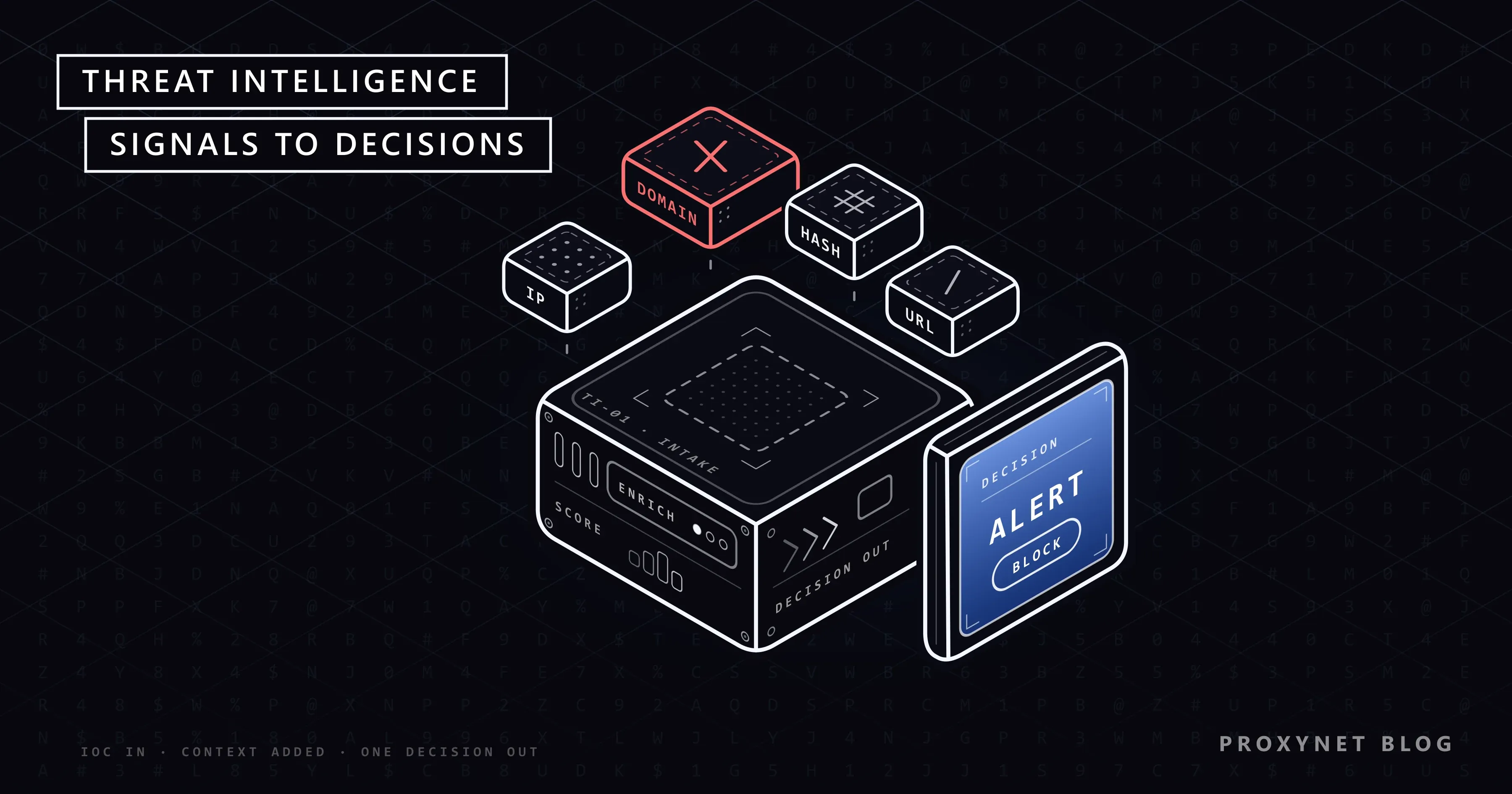
Threat intelligence is threat information that has been analysed and put in context so that it supports a decision. The US National Institute of Standards and Technology (NIST) defines it as threat information that has been aggregated, transformed, analysed, interpreted or enriched to give decision-making the context it needs. The field is also called cyber threat intelligence, or CTI; the two names mean the same thing.
The gap between data and intelligence is easiest to see in an example. An IP address in a log is data. "This address hosted a copy of our VPN login page last week" is information. "The group behind that page targets firms in our sector through remote-access logins, so turn on multi-factor sign-in for the VPN and block these addresses for 30 days" is intelligence: it is relevant, dated and ends in an action.
What are the four types of threat intelligence?
Threat intelligence is commonly split into four types by who uses it and how far ahead it looks: strategic, operational, tactical and technical. The split is a convention rather than a standard, and some teams merge the last two.
| Type | Question it answers | Typical form | Main reader |
|---|---|---|---|
| Strategic | Who targets us, and why? | Short briefings, trend reports | Executives, risk owners |
| Operational | Which campaign is coming? | Campaign and incident reports | Security managers, responders |
| Tactical | How do these attackers work? | Attacker methods (TTPs) | SOC analysts, detection engineers |
| Technical | What exactly do we block? | IP addresses, domains, hashes | Firewalls, mail filters, SIEM |
Strategic intelligence supports decisions about budget and risk, such as whether ransomware groups are hitting companies of your size in your sector. It is short and written in plain language.
Operational intelligence concerns one campaign: who runs it, what it targets and when. A sector warning that fake-invoice emails are reaching logistics firms this week is operational.
Tactical intelligence describes behaviour: how attackers get in, move inside a network and take data. The security operations centre (SOC), the team that handles alerts, uses it to write detections that catch a method rather than one address.
Technical intelligence is the most concrete and the shortest-lived: indicators a machine can match, such as a domain in a phishing link or the hash of a malicious file. A hash is a short fingerprint calculated from a file's contents; change one byte and the hash changes.
How does the threat intelligence lifecycle work?
Teams produce threat intelligence in a repeating cycle of six steps, inherited from government intelligence work. The last step sends the team back to the first.
- Direction. Decide which questions the intelligence must answer, and for whom. "Which vulnerabilities in the software we run are being exploited right now?" is a good requirement; "everything about hackers" is not.
- Collection. Gather data from the sources that can answer those questions: your own logs, public sources, feeds, sector groups and national agencies.
- Processing. Put the data into one shape: remove duplicates, convert formats, translate reports and add context, such as the network an address belongs to.
- Analysis. Judge what it means for you: is it relevant, how reliable is the source, how confident are you, what should happen next?
- Dissemination. Deliver the result in the form each audience uses: a block list for the firewall, a detection rule for the SOC, a one-page brief for management.
- Feedback. Ask the readers whether it helped, for example whether the block list caused false alarms. The answers shape the next round.
Where does threat intelligence come from?
Threat intelligence comes from five kinds of source, and the most valuable is usually your own network. Each has a blind spot, so teams combine them.
- Internal data. Logs from mail filters, firewalls and endpoints, and notes from past incidents, show what attackers actually tried against you.
- Open sources. News, security research, public code repositories, certificate logs and domain registrations. Collecting and checking public information is a discipline of its own, explained in What Is OSINT?
- Commercial sources. Paid feeds of indicators, and the reports security companies publish on the groups they track; each company sees mainly its own customers.
- Sector sharing. Information sharing and analysis centres (ISACs) bring together companies in one sector, such as banking or energy, to exchange warnings under agreed rules.
- National agencies. A computer emergency response team (CERT) handles incidents at national level and publishes advisories. In the US, the cybersecurity agency CISA keeps the Known Exploited Vulnerabilities (KEV) catalogue; in Türkiye, the Cyber Security Presidency, which now runs the services of the national response centre USOM, publishes a list of malicious addresses grouped by type, such as phishing pages and malware control servers.
What is the difference between IOCs and TTPs?
An indicator of compromise (IOC) is a trace an attack leaves behind; a TTP describes the attacker's method. IOCs are things a machine can search for: an IP address, a domain, a URL, a file hash, an email subject. TTP stands for tactics, techniques and procedures: the goal (getting in, stealing passwords), the way it is reached (a phishing link) and the exact steps one group follows.
The two age at very different speeds. An attacker can move a phishing page to a new domain in minutes, but changing how a whole operation works takes weeks. Security analyst David Bianco drew this as the "Pyramid of Pain": hashes and IP addresses at the bottom cost the attacker almost nothing to replace, behaviour at the top costs the most. Blocking IOCs is fast but expires; detections built on TTPs last longer.
MITRE ATT&CK is the shared vocabulary for TTPs. MITRE, a US non-profit, describes it as a globally accessible knowledge base of adversary tactics and techniques based on real-world observations. Each technique has an ID: T1566 is Phishing, under the Initial Access tactic, so a report citing "T1566.002" (a spearphishing link) means the same thing to every reader. Teams also map their own alerts onto the matrix to see which techniques they would not notice at all.
How is threat intelligence shared?
Threat intelligence is shared in standard formats so that one organisation's finding reaches another's tools without retyping. NIST's guide to threat information sharing, SP 800-150, lists what is worth passing on: indicators, attacker TTPs, suggested defensive actions and incident findings.
STIX and TAXII are the two open standards for that exchange, maintained by the standards body OASIS. STIX (Structured Threat Information Expression) describes intelligence as linked JSON objects, such as an Indicator, a Malware family, a Threat Actor and the Attack Pattern it uses. TAXII (Trusted Automated Exchange of Intelligence Information) is the HTTPS-based protocol that carries STIX between servers and clients.
The Traffic Light Protocol (TLP) says how far a shared item may travel. Version 2.0, published by FIRST, the global forum of incident response teams, has five labels: TLP:RED for the named recipients only, TLP:AMBER for their organisation and its clients on a need-to-know basis, TLP:AMBER+STRICT for the organisation only, TLP:GREEN for the wider community but not public channels, and TLP:CLEAR for anyone. The label is an agreement between people, not a technical lock.
What are threat intelligence feeds and platforms?
A threat intelligence feed is a continuously updated stream of indicators, delivered over TAXII or as CSV or JSON files; a threat intelligence platform (TIP) is the software that collects several feeds and makes them usable. Some feeds cost nothing: CISA publishes the KEV catalogue as public-domain CSV and JSON files, and Türkiye's national list of malicious addresses offers an API.
A feed's value is not its size. Four questions separate a useful feed from a noisy one:
- Freshness: how quickly are new indicators added and old ones removed?
- Context: does each entry say what it is and when it was seen?
- Relevance: does it cover the threats your sector and region face?
- Overlap: how much of it do you already get elsewhere?
A platform removes duplicates, scores each indicator, adds context such as the network that owns an address, and pushes the result to the tools that act on it: the firewall, the mail filter and the SIEM (security information and event management system, which collects and searches logs).
How do security teams use threat intelligence?
Blocking and alerting. Fresh indicators go to the firewall, the DNS resolver and the mail filter, each with an expiry date. A match in last month's logs is a reason to check whether something got in before the block.
Patching in the right order. CISA adds a vulnerability to the KEV catalogue only with evidence that it is being exploited, and encourages every organisation, not only US federal agencies, to fix those first. Comparing the software you run with the catalogue gives a short patch list that is easy to defend.
Phishing response. When staff report a suspicious email, the analyst checks its links and sender domains against feeds, searches the mail logs for other recipients and reports the page for takedown.
Brand and fraud monitoring. Look-alike domains, copies of your login page and fake support accounts are threat intelligence about your own name.
Threat hunting and incident response. Hunters start from a TTP, such as "this group steals session cookies after a phishing click", and search the logs for it. During an incident, knowing an attacker's usual next step tells responders where to look.
What are the limits of threat intelligence?
Threat intelligence reduces uncertainty but does not remove it, and three problems come up in almost every programme.
Indicators go stale. Attackers rent servers by the hour, and an address that hosted a phishing page last month may belong to a legitimate shop today. Shared hosting and content delivery networks put thousands of sites behind one IP address, so blocking it cuts off far more than the attacker; What Is IP Reputation? explains how an address inherits its history.
False positives cost time. A feed that matches harmless traffic dozens of times a day teaches analysts to ignore it, including on the day it is right.
Volume is not coverage. Each new feed adds overlap faster than it adds new threats. A vendor sees its customers, a national CERT sees the reports made to it, and only your own logs see an attack aimed at you alone.
Why do analysts check suspicious pages from separate infrastructure?
Analysts use separate infrastructure because the attacker's server logs every visit, and many phishing pages show their real content only to the visitors they target. Opening a suspicious link from the office network tells the attacker which company is looking, and a kit that filters out other countries or data-centre networks shows the analyst a blank page; What Is Phishing? describes how these pages imitate real logins.
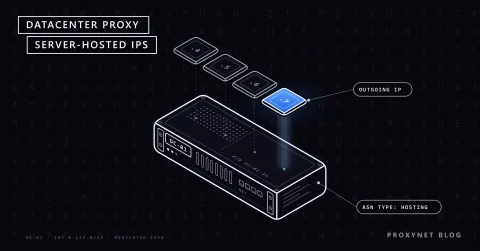
Security teams therefore open such links in an isolated browser or virtual machine, never with real credentials, through an exit that is not tied to their company. For checking many URLs from a feed, where pages do not filter visitors, a Datacenter Proxy gives fixed addresses in the country needed. Dedicated datacenter IPs come with a target-site restriction by default, so checking arbitrary URLs needs the paid "Access to all websites" option.
When a page shows its fake login only to home connections in one country, the analyst repeats the check through a Residential Proxy exit in that country and city, as the targeted customer would see it. The work is a few page loads to capture evidence and report the page, never filling in forms or interacting with the attacker.
Common mistakes
- Collecting before asking. Feeds bought without written requirements produce noise, not decisions.
- Blocking forever. An indicator without an expiry date ends up blocking a customer, a partner or a shared server.
- Chasing attribution. Knowing which country is behind an attack rarely changes what you do next; knowing the technique does.
- Ignoring your own logs. Internal incidents and phishing reports are your most relevant intelligence, and they cost nothing.
- Investigating from the corporate network. Opening attacker pages from office addresses or personal accounts tells the attacker who is watching.
Decision guide
| Your situation | Start with |
|---|---|
| Small team, no SOC | Patch KEV-listed vulnerabilities first; read your national CERT's advisories |
| Staff often report phishing | Check reported links against feeds; search mail logs for other recipients |
| You already run a SIEM | One or two relevant feeds, each indicator with an expiry date |
| Management asks "are we a target?" | A short strategic brief each quarter |
| Peers in your sector share warnings | Join the sector ISAC and follow TLP labels |
| Analysts open suspicious URLs | Isolated browser, a proxy exit in the target country, no real credentials |
Frequently asked questions
What is the difference between threat intelligence and threat hunting?
Threat intelligence tells you what attackers do; threat hunting searches your own systems for signs that they have already done it. A hunt usually starts from an intelligence finding, such as a technique a group is known to use, and what hunters find becomes new internal intelligence.
Are free threat intelligence feeds good enough?
Often they are, at the start. Government sources such as CISA's KEV catalogue and national CERT lists cost nothing, and community feeds cover common phishing and malware. Free feeds usually lack context and support, so judge a feed by whether it answers your requirements, not by its price.
What does a threat intelligence analyst do?
A threat intelligence analyst turns raw threat data into answers for the people who defend the organisation. The work is reading reports and feeds, checking indicators, mapping attacker behaviour to MITRE ATT&CK and writing briefings for the SOC, incident responders and management, each with a stated level of confidence.
Is threat intelligence the same as OSINT?
No. OSINT, open-source intelligence, is a collection method: gathering and checking information from public sources. Threat intelligence is a security discipline that uses OSINT as one source among several, next to internal logs, feeds and sharing groups, and turns them into defensive decisions.
Is collecting and sharing threat intelligence legal?
Yes, when it uses your own systems and public sources and respects data protection law. In the EU, recital 49 of the GDPR treats processing personal data strictly necessary for network and information security as a legitimate interest, and Article 29 of the NIS2 Directive lets organisations exchange threat information, including indicators and attacker tactics, on a voluntary basis. Türkiye's data protection law, KVKK, also allows processing based on the controller's legitimate interest where it is necessary and does not harm the person's fundamental rights. Accessing systems you are not authorised to use is never threat intelligence, whatever the motive.
Do small companies need threat intelligence?
Yes, but not a platform. A small team gets most of the value from three habits: patch the vulnerabilities on the KEV catalogue first, read its national CERT's advisories, and treat staff phishing reports as intelligence. Paid feeds make sense once someone has time to act on them.
Summary
Threat intelligence is information about attackers that has been checked and put in context so that it changes a decision. It comes in four types for four audiences, follows a cycle that starts with questions rather than feeds, and draws on your own logs first. Indicators let you block quickly but go stale; attacker methods mapped to MITRE ATT&CK last longer. Share in STIX and TAXII, respect TLP labels, give every indicator an expiry date and keep investigations off the corporate network. Teams setting up separate research traffic for this work can find the options on our data security page.