A video of a flooded railway station spreads across social networks with a caption saying it was filmed this morning in your city. Before a newsroom shares it, a reporter searches for earlier copies and finds the same clip posted three years ago, from another country. The station sign, the trains and the season all match the older post. Nothing secret was used: every step relied on information anyone could see.
That is OSINT, open-source intelligence. This post explains what it is, what it is used for, how an investigation runs, which sources it uses, how findings are verified and where the legal limits lie. It is written for security teams, analysts and journalists, and contains no techniques for getting into systems or tracking people.
What is OSINT?
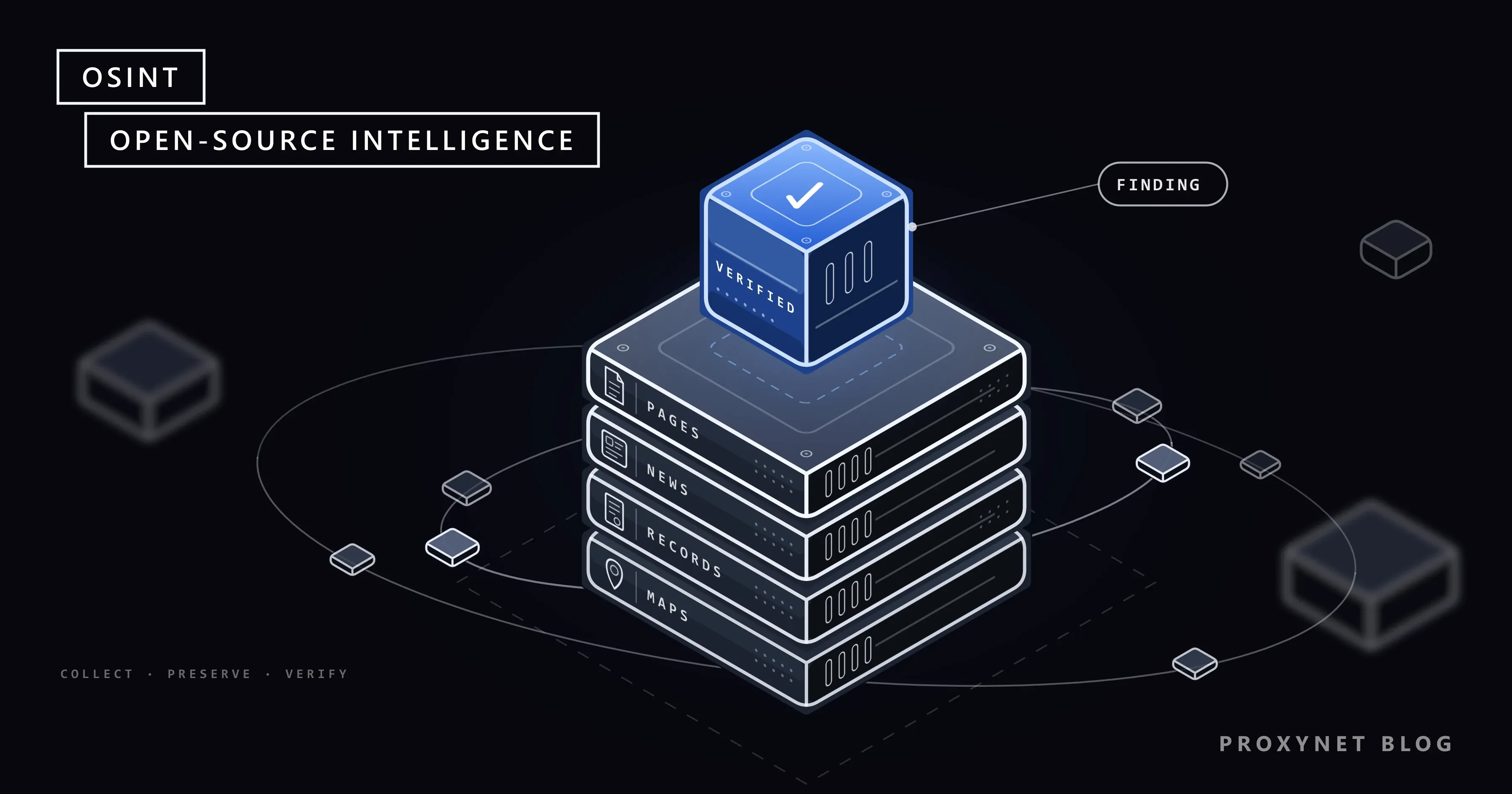
OSINT is intelligence produced from information that anyone can lawfully see, buy or request. The US intelligence community's OSINT strategy for 2024-2026, released by the Office of the Director of National Intelligence and the CIA in March 2024, defines it as intelligence derived exclusively from publicly or commercially available information that addresses specific intelligence priorities, requirements or gaps.
The key word is intelligence. A pile of search results is only information; it becomes intelligence once someone has checked it and used it to answer a question, such as "Is this supplier real?". OSINT is a method more than a set of sources.
"Open source" has nothing to do with open-source software here; it means sources open to the public, as opposed to secret or confidential ones. The Berkeley Protocol, a UN-published standard for open source investigations, describes open source information as information any member of the public can observe, purchase or request without special legal status or unauthorised access.
What is OSINT used for?
OSINT is used wherever a decision depends on facts that are public but scattered. The most common uses:
Security reviews of your own organisation. Security teams check what an outsider can learn about the company: staff names and roles, email formats, documents, domains and services. Attackers do the same research before a phishing call or a fake invoice, which is why What Is Social Engineering? starts its attack chain with public research.
Fraud checks and due diligence. Before a contract or an investment, compliance teams confirm that a company appears in the official business registry, that its address and directors match what it claims, and that court records or news raise no warning signs. A domain registered last month for a firm that claims twenty years of history is the kind of detail this catches.
Journalism and fact-checking. Reporters verify photos and videos before publishing them, trace where a claim first appeared and reconstruct events from public footage and records.
Human rights investigations. Investigators who cannot reach a scene document events from material published online and preserve it for courts and fact-finding missions.
Brand protection. Brand teams look for look-alike domains, fake shops and counterfeit listings that borrow a company's name, and document them for takedown requests; our brand protection page covers how that monitoring is set up.
Academic research. Researchers study disinformation and public debate from published data and platforms' research access.
How does an OSINT investigation work?
An OSINT investigation runs as a cycle: you start from a question, gather and check material, and the answers usually raise the next question. The Berkeley Protocol, published by the UN Human Rights Office and the Human Rights Center at UC Berkeley School of Law, describes six phases from online inquiry to analysis and asks investigators to document each one. In practice:
- Define the question. Write down what you need to know, why, and what you will not look at. "Does this supplier exist and who runs it?" is a question; "find everything" is not.
- Search and monitor. Run structured searches across the source types below, and keep a fixed list of sources under watch if the question is ongoing.
- Assess before you collect. Check whether each item is relevant, lawful to keep and necessary. Leaving out what you do not need is part of the method.
- Collect and preserve. Save what matters with its address, the date and time of capture and, for files, a checksum that later proves nothing changed. Pages get edited or deleted; a bookmark is not evidence.
- Verify. Check the source, the file and the content against each other and against independent sources.
- Analyse and report. Draw conclusions, state how confident you are and name the gaps. Then decide whether a new question follows.
The written record turns a search session into evidence: someone else should be able to follow each step and reach the same result.
Which sources does OSINT use?
OSINT draws on any source open to the public, from web pages to satellite images. The main types differ in what they can show:
| Source type | Examples | What it can show |
|---|---|---|
| Websites and archives | Company sites, web archives | What was published, and when |
| Public records | Business registries, courts, tenders | Who owns or runs something |
| News and public posts | News sites, public social posts | Claims, events, first sightings |
| Technical internet data | DNS, RDAP, certificate logs | Domain age, hosting, subdomains |
| Imagery and maps | Satellite images, street-level photos | Where something is |
| Official publications | Statistics, sanctions lists, reports | Facts stated by an authority |
Websites and archives show what an organisation says about itself. Archives matter when a page has been edited or deleted; What Is the Wayback Machine? explains how earlier versions are saved and where the gaps are.
Public records are the strongest sources for questions about companies, because a registry entry carries legal weight that a website does not.
Technical internet data answers questions about infrastructure. DNS records show where a domain points; RDAP, the successor to WHOIS, holds registration data such as the creation date, with personal details usually redacted. Certificate transparency logs are public records of the security certificates issued for domains, which helps a team find its own forgotten subdomains.
How do OSINT researchers verify what they find?
Verification means testing every item against other evidence before you rely on it. The European Journalism Centre's Verification Handbook breaks this into four checks for user-generated content: provenance (is this the original?), source (who uploaded it?), date (when was it made?) and location (where was it made?).
Provenance comes first because most viral material is a copy. A reverse image search, which finds earlier copies of the same picture, often turns up an older upload with a different caption, as in the railway station example. The Berkeley Protocol advises speaking of the first copy found online, since the original may have been removed.
Location is checked by matching what the image shows with maps and satellite imagery: road layouts, shop signs, mountain lines, the shape of a building. Researchers call this geolocation. Date is checked through clues such as weather records, shadows that show the sun's position, or a poster for an event with a known date.
Cross-checking closes the loop. A claim confirmed by two independent sources is stronger than one repeated by twenty sites that copied the same post, a trap known as circular reporting.
What is OSINT in cyber security?
In cyber security, OSINT means mapping what anyone on the internet can learn about your organisation, so you can reduce it before an attacker uses it. A typical review covers:
- People. Which names, roles and email formats are public, and which a pretext call or fake invoice could exploit.
- Documents. Published files often carry metadata such as author names, software versions and internal folder paths.
- Domains and services. Certificate logs and DNS records reveal forgotten subdomains, test sites and login pages.
- Code. Public repositories where an employee may have pushed a configuration file by mistake.
- Look-alike domains. New registrations that copy the company's name, often the first sign of a phishing campaign.
Penetration testers run the same reconnaissance for clients, but only within a written scope the client has approved. OSINT is also one of the inputs to threat intelligence, the discipline that turns signals about attackers into security decisions; What Is Threat Intelligence? covers indicators, feeds and how teams act on them.
How do OSINT researchers protect themselves?
Researchers keep their work separate from their own identity and their organisation, because the sites they study can see them too:
- A separate research environment. A dedicated browser profile or a virtual machine keeps cookies, logins and downloads away from daily work. Suspicious files are opened there, never on a work laptop.
- No personal accounts. A logged-in session ties every page you view to your name, and some services show account owners who has viewed their profile.
- Look, do not touch. No following, liking, replying, joining groups or filling in forms. Every action leaves a trace and can warn the subject.
- Watch your own footprint. Job titles, talks and travel posts look harmless alone but reveal a lot combined, a risk called aggregation.
- Keep research traffic off the corporate network. The next section explains why.
Where do proxies fit in OSINT work?
Proxies help in two narrow ways: they keep research traffic apart from the organisation's own network, and they show the version of a page served in a given country. Every website records its visitors' IP addresses, so an analyst who opens a phishing page aimed at their employer from the office connection can show the people behind it that the target has noticed. The Berkeley Protocol warns that an IP address can give away information that could be used to target an organisation.
Some scam pages and fake shops are also geo-targeted: they show their real content only to visitors from the country they aim at. Checking such a page from a Residential Proxy exit in that country, with city targeting where it matters, shows what a local victim would see so that it can be documented and reported.
A proxy does not change the rules. It is not a way into accounts, past a login or around a site's limits, and research done through it must be as lawful as research done without it. Our data security page describes how security teams set up this kind of research access.
What are the legal and ethical limits of OSINT?
OSINT is lawful when the information is public, you collect it by lawful means and you use it for a legitimate purpose; the limits come from privacy law, computer misuse law, platform terms and copyright.
Public is not the same as free to use. In a joint statement in August 2023, twelve data protection authorities, including the UK's Information Commissioner's Office, stressed that personal information that is publicly accessible is still subject to data protection and privacy laws in most jurisdictions. Under the GDPR in Europe and laws such as Türkiye's KVKK, you need a lawful reason to process personal data and collect only what the purpose requires.
No intrusion. Guessing passwords, using leaked credentials, opening an unsecured database or admin panel you came across, or joining a closed group under a false name is not OSINT. The Berkeley Protocol states that using a fake identity to reach restricted content, or to draw information out of a person, takes an investigator outside open source investigation and may break the law.
No tracking of private individuals. Compiling a private person's address, family or daily movements, or publishing them (doxxing), harms people and can break harassment and privacy laws. Professional OSINT looks at organisations, infrastructure and events, and at individuals only with a lawful basis and a defined purpose, such as a director's role in a company under review.
Platform terms and copyright. Most social platforms restrict automated collection and offer official APIs or research access programmes instead. Republishing someone else's photo or video may also need the creator's permission.
Where you meet OSINT
In news stories that place a video on a map. In fact-checks that show where a viral photo first appeared. In security reports that trace a phishing campaign to its domains. In compliance teams' supplier checks. In takedown requests against fake shops.
Common mistakes
- Starting without a question. Without a defined goal, collection never ends and nothing gets answered.
- Trusting the first copy you find. Most material online is a copy of a copy; check provenance first.
- Mistaking repetition for confirmation. Twenty sites quoting one unverified post are still one source.
- Not saving evidence. A screenshot without the address, date and time is weak proof.
- Researching from a personal account or the office network. It exposes the researcher and can warn the subject.
- Treating "public" as "free to use". Privacy law still applies to personal data found online.
- Collecting more than the question needs. Extra personal data adds legal risk, not answers.
Decision guide
| Your goal | Where to start |
|---|---|
| See what outsiders learn about your company | Staff pages, document metadata, certificate logs |
| Check a new supplier or partner | Business registry, court records, domain age |
| Check whether a viral video is genuine | Earlier copies, uploader, date and place clues |
| Look into a phishing page aimed at your brand | Separate browser, connection not tied to the office |
| Document events for a report or a case | Preserve with date, time and checksum; log each step |
| See what a page shows in another country | A local residential IP in that market |
| Research a private individual | Stop unless you have a lawful basis and a purpose |
Frequently asked questions
Is OSINT legal?
Yes, collecting and analysing information that is lawfully available to the public is legal in most countries. It stops being lawful when it involves unauthorised access, deception to reach closed content, harassment or processing personal data without a lawful basis.
What is an OSINT framework?
The phrase has two meanings. Most often it refers to the OSINT Framework website, a free directory that sorts research resources by category; it helps you find sources but is not a method. In the wider sense, a framework is a team's written methodology: questions, steps, verification rules and record-keeping, such as the cycle above or the Berkeley Protocol.
Is OSINT only used in cyber security?
No. Cyber security is a major use, but journalists, fact-checkers, human rights investigators, compliance teams, brand protection teams and academic researchers use the same method. The questions change; the cycle of searching, preserving, verifying and reporting stays the same.
What is the difference between OSINT and threat intelligence?
OSINT is a way of collecting and verifying public information for any purpose. Threat intelligence is a security discipline that turns signals about attackers, from internal logs, partners, feeds and OSINT, into decisions such as what to block or which flaw to patch first. OSINT is one of its inputs.
Do you need special tools to do OSINT?
Not to start. Most investigations rely on search engines, web archives, maps, official registries and reverse image search, all free or low cost. Tools speed up the work, but a clear question and a careful record matter more than any software.
Can OSINT be used to look into a person?
Only with a lawful basis and a clear purpose, such as checking the directors of a company you are about to sign with. Personal data is protected even when it is public, so collect only what the purpose needs. Looking up a private person out of curiosity, or to locate or follow them, is not legitimate OSINT and can be illegal.
Summary
OSINT is intelligence built from public information, collected and verified until it answers a defined question. Security teams use it to see their own exposure, compliance teams to check companies, journalists to verify what goes viral and investigators to document events. The method is a cycle of question, search, preservation, verification and report, and its limits are firm: public does not mean free to use, unauthorised access is never part of it and private people are not targets.