

































You connect through a proxy for the first time, open a shopping site and get a CAPTCHA before the home page has loaded. You switch to a second address from the same provider and the same site opens without a question. Nothing about your browser or your request changed between the two attempts. What changed is the address, and more precisely what the internet remembers about it.
This post explains what IP reputation is, which signals it scores, who keeps the score and why a proxy address arrives with a history you did not write. We compare residential, ISP, datacenter and mobile ranges on reputation risk, show how a score recovers, separate what you control from what you do not, and list the checks worth running before you trust an address.
What is IP reputation?
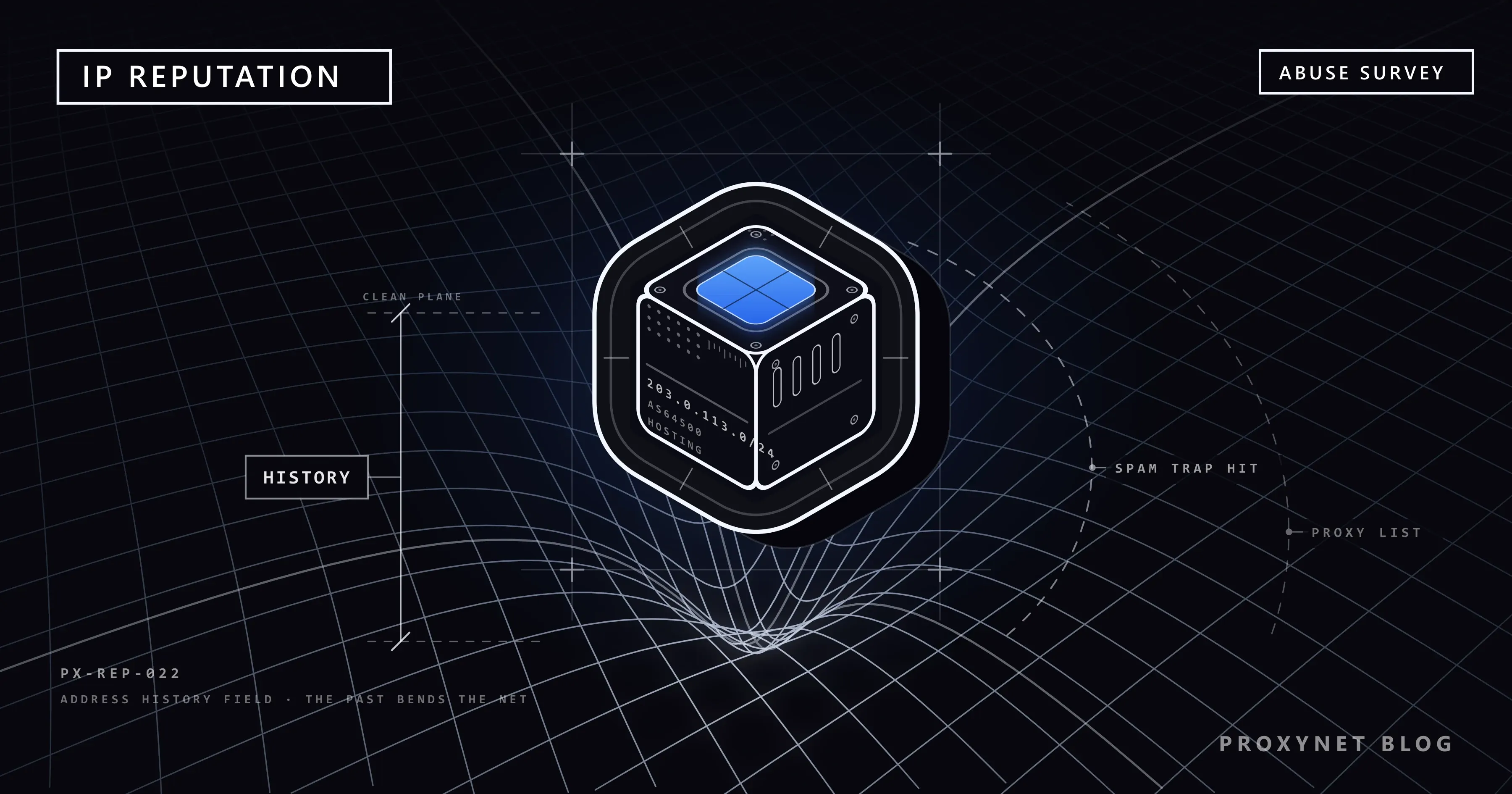
IP reputation is a judgement about an address, not about a person. It answers a question every mail server, CDN and payment page asks thousands of times a minute: given what we know about this address, how much should we trust the next request from it?
That knowledge is assembled from observations. Someone saw spam leave the address. Someone saw it probe a login form four hundred times in a minute. Someone found it relaying anyone's traffic as an open proxy. Someone noticed it belongs to a hosting company rather than a home broadband line. Each observation alone is weak; together they place an address between "ordinary consumer line" and "known abuse source". Commercial services reduce that to a single number, which we took apart in What Is an IP Fraud Score and How Do You Read It?; most reputation systems, though, are lists and rules first and a number second.
Who keeps score?
There is no central authority. Four kinds of organisation maintain reputation data, and they answer different questions.
- DNS-based blocklists (DNSBLs). A mail server asks a special DNS zone whether an address is listed. RFC 5782 standardises the mechanism: reverse the octets of the address, append the list's domain, and read a
127.0.0.xanswer as "listed". Spamhaus states that its SBL lists addresses seen sending spam, hosting malicious content or hijacking IP space, and that the zone is rebuilt every five minutes. - Policy lists. These record no misbehaviour. The Spamhaus Policy Block List holds end-user ranges, mostly broadband customers, from which e-mail should never be sent directly; network operators add their own ranges. An address can be on the PBL without having done anything wrong. It is a statement about the type of the address.
- Commercial IP intelligence. Scamalytics, IPQualityScore, MaxMind minFraud and AbuseIPDB collect abuse reports from customer sites, add network-type data and sell the result as a score or a set of flags to payment and sign-up pages.
- CDN and bot-management platforms. Cloudflare documents its bot score as a value from 1 to 99, where 1 means the request was almost certainly automated, fed by heuristics, machine learning, JavaScript detections and a verified-bot list. IP reputation is one input among many, which is why a clean address with a suspicious client still gets challenged.
Large platforms run private versions of all four, and the only way you learn their verdict is by being blocked.
What do reputation systems look at?
These signals appear, under different names, in almost every scorer's documentation.
- Abuse reports. A site records a chargeback, a credential-stuffing attempt or a scraping run that ignored
robots.txt, and reports the source address to a shared database. Reports are the raw material of every commercial score. - Spam traps. Mailboxes no real person ever used, published only where address harvesters will find them. A single hit can list an address the same day.
- Botnet command-and-control lists. An address that was ever a controller for infected machines stays suspicious long after the malware is gone.
- Open-proxy and anonymiser lists. Scanners test whether an address relays arbitrary traffic; VPN and Tor exits are separate flags. Being listed means the address cannot be tied to one user, not that it abused anything.
- ASN and network type. The registry says whether the owning network is a consumer ISP, a mobile operator, a hosting company or a corporation. Hosting ranges start with a handicap because real people do not browse from servers.
- Geolocation consistency. The address's country is compared with the billing country, the browser's language and time zone and the last successful login. A mismatch plus a hosting ASN is strong evidence.
- Velocity. How many requests, sign-ups or logins the address produced in the last minute, hour and day. It is the one signal you generate yourself, and the one most often responsible for a fresh address turning bad in an afternoon.
How a proxy address inherits history
None of these signals distinguishes between the person using an address today and the person who used it last week. That is the whole story of why proxies get blocked.
A datacenter address is leased and released constantly; the customer before you may have run a mail campaign that hit spam traps, and the listing outlives the lease. A residential address rotates between subscribers by design; the modem that had it yesterday may have been part of a botnet. A mobile address is shared by hundreds of handsets at once through carrier-grade NAT, so one infected phone colours the reputation of everyone behind it. We described that sharing in What Is CGNAT?.
Scorers widen the effect on purpose: Scamalytics states that it applies what it learns about one address to its neighbours in the same subnet and ASN, so a clean address in a dirty /24 is guilty by association until the block calms down. When you attach a proxy, you take on its past. What you do from the first request is the other input.
Why datacenter ranges score worse than consumer ranges
Real customers browse from home broadband, office networks and phones; almost nobody reads a product page from a virtual machine. So a request from a hosting ASN starts with a low probability of a human behind it before any behaviour is examined. Hosting ranges are also cheap and sold by the thousand, so the reported-abuse density there is genuinely higher. Consumer ranges are tied to physical lines or SIM cards and full of ordinary people; a scorer that blocked them wholesale would lock out its own customers. Two mechanisms soften consumer reputation even when abuse occurs:
- Shared history is diluted. Behind a CGNAT gateway, one bad actor is averaged against hundreds of normal users. A scorer that sees ordinary shopping and one burst of abuse from the same address usually treats it as a shared connection; IPQualityScore exposes that judgement as a
shared_connectionflag. - Policy lists protect rather than punish. The PBL lists consumer ranges because they are consumer ranges. A mail server rejecting direct mail from a PBL address is saying "send through your ISP", not "this address is bad". For web traffic, the same classification reads as "home user".
Datacenter addresses have neither protection: they are single-tenant, so abuse is attributed to exactly that address, and no policy list vouches for them as end-user space.
Reputation risk by proxy type
Risk here means how likely a fresh address of that type is to be challenged by a reputation-aware site before you have done anything.
| Residential | ISP (static residential) | Datacenter | Mobile | |
|---|---|---|---|---|
| ASN type as seen by scorers | Consumer ISP | Consumer ISP, server in a datacenter | Hosting / cloud | Mobile operator |
| Users behind one address | Several over time | One | One | Hundreds at once (CGNAT) |
| Inherited history | Possible, diluted by rotation | Low if the block is fresh | Common; leases change hands fast | Diluted by sharing |
| Neighbourhood effect | Low | Medium | High; hosting /24s are scored together | Very low |
| Typical starting risk | Low | Low to medium | Medium to high | Lowest |
| Suitable when | Rotating across many sessions | One stable identity per account | High volume without bot management | Platforms with the strictest checks |
Proxynet's Residential Proxy network is built from consumer ISP addresses; ISP Proxy gives you one consumer-registered address that stays yours; and Mobile Proxy exits through operator networks, including Turkish carriers, with sticky sessions from 1 to 60 minutes.
How reputation recovers over time
Reputation is not permanent, but each system forgets at its own speed, and the schedule is set by the list, not by you.
- Policy lists never expire on their own. A PBL entry describes the range and stays until the operator changes the classification. You do not want to leave it.
- Abuse-based lists decay with silence. Most DNSBLs remove an address automatically after a period without new reports, from a day to a few weeks depending on the list. Spamhaus notes that only the responsible network operator can request removal of an SBL listing, that removal is always free, and that any offer to delist for a fee is a scam. The order of a delisting request is in What Is an IP Blacklist and How Do You Get Delisted?.
- Commercial scores are weighted averages. A burst of abuse raises the score within hours; it takes weeks of clean traffic for old reports to age out.
- Bot-management platforms are short-memoried on IP, long-memoried on fingerprint. An address stops being challenged soon after the automated traffic stops; the client fingerprint and cookies that got it flagged are remembered longer.
A residential or mobile address that misbehaved recovers on its own once it rotates to a normal user. A datacenter address you hold for months recovers only if you stop the behaviour that listed it. A static ISP address is worth treating like a bank account: one identity, one pace, no experiments.
What you control and what you do not
Half the signals were decided before you connected. The other half are yours from the first request.
You do not control: the ASN and network type of the address; the inherited history of the address and its /24 neighbours; which lists a target consults and where it sets its thresholds; how long each list keeps a record.
You do control:
- Authentication method. Username-and-password authentication lets you pin a session to one exit with a
-session-…-ttl-…parameter; IP whitelisting (up to 10 addresses in the Proxynet panel) ties the proxy to one client machine, so a leaked credential cannot burn your reputation from elsewhere. - Session length. A login flow or a checkout expects the same address from start to finish. Rotate mid-session and the site sees an account that jumped countries between two clicks.
- Request pace. Requests spaced like a person reading a page keep a clean address clean; a burst of a few hundred requests a minute gets a residential address challenged as surely as a datacenter one.
- Header and TLS consistency. A request whose
User-Agentclaims Chrome while its TLS handshake looks like a Python library contradicts itself, and engines score the contradiction, not the address. The handshake side is in What Is TLS Fingerprinting and JA3?, the wider client checks in How Bot Detection Works. - Respecting the target's rules.
robots.txt, published rate limits and official APIs exist so that automated access does not look like abuse. A crawler that reads them does not generate the reports that feed the lists.
How to check an address before you use it
- Resolve the ASN. A
whoison the address, or any IP lookup site, shows the owner and whether the registry marks it as hosting, ISP or mobile. If a "residential" address resolves to a cloud provider, stop there. - Query the mail blocklists. A multi-DNSBL checker, or a direct DNS query per RFC 5782, shows SBL, CSS and PBL status at once. A PBL listing on a residential address is normal; an SBL listing is not.
- Read a commercial score, then its reasons. The flags next to the number (proxy, VPN, hosting, recent abuse, shared connection) say which signal is firing.
- Check geolocation against the plan. Confirm the address resolves to the country and city you selected and that your client's time zone matches.
- Send one ordinary request to a neutral target. Load a page that uses bot management and see whether you get content, a JavaScript challenge or a block page. That is the address's starting reputation.
- Log the result. When a target starts challenging you a week later, the baseline tells you whether the address arrived bad or you made it bad.
Where IP reputation decides the outcome
- Scraping public data at a polite rate. Reputation decides whether your first request is served; pace decides whether the hundredth is. The full method is in How to Scrape Websites Without Getting Blocked.
- Ad verification. Checking that a campaign renders correctly in a given city only works from addresses the ad platform classifies as consumer traffic there; a hosting address is served a different page or none.
- Managing several accounts with permission. Agencies running client accounts need one stable, consumer-classified address per account: a static ISP address, not a rotating pool.
- Security testing of your own services. Seeing your login page the way a hosting, a consumer and a mobile address see it shows what your own rules do to real customers; see data security.
Common mistakes
- Judging an address by one score. A high score with no reasons listed is noise; two services agreeing on "recent abuse" is signal.
- Rotating inside a session. Every address change during a login or checkout looks like account sharing or takeover.
- Burning a clean address with velocity. A new residential address is at its best on day one. Four hundred requests a minute end that by lunchtime.
- Mismatched client and address. A Turkish mobile exit with a browser set to
en-USand a Pacific time zone contradicts itself in three places. - Paying to be delisted. No reputable list charges for removal; Spamhaus says so explicitly. An address that needs paid delisting is an address to release.
Decision guide
| Need | Recommendation |
|---|---|
| Many short sessions across many targets, public data only | Residential Proxy with rotation per request or short sticky sessions |
| One account that must always look like the same person | ISP Proxy, one address per account, no other traffic on it |
| Platform with the strictest sign-up and login checks | Mobile Proxy with a sticky session covering the whole flow |
| High-volume reads on a target without bot management | Datacenter addresses, with pace limits taken from the target's published rules |
| Address keeps getting challenged although the score is clean | Fix client fingerprint and headers first; the exit is rarely the cause |
| Address is on an abuse list | Stop the traffic; request delisting through the operator if it is yours, otherwise release it |
Frequently asked questions
Is IP reputation the same as an IP fraud score?
No. A fraud score is one product built on reputation data: a commercial service reduces abuse reports, network type and anonymiser flags to a single number for payment and sign-up pages. IP reputation is the broader idea and includes lists that never produce a number, such as DNS blocklists and policy lists, and the private judgements of CDNs and platforms.
Why does a brand-new proxy address already have a bad reputation?
Because the address is not new; only your lease of it is. The previous holder's behaviour, the neighbouring addresses in the block and the network type were recorded before you connected. Datacenter addresses inherit the most, because they are single-tenant; residential and mobile addresses inherit less, because sharing and rotation dilute any one user's history.
How long does it take for an IP's reputation to recover?
It depends on the list. Automatic DNSBL entries typically expire after a period without new reports, from about a day to a few weeks. Commercial scores drift down over weeks of clean traffic. Bot-management systems stop challenging an address soon after the automated traffic stops. Policy-list entries do not expire, but they are not a penalty.
Can I improve the reputation of an address I rent?
You can stop making it worse, which over time amounts to the same thing: human-level pace, consistent sessions, a client fingerprint that matches the address, no unrelated tasks through the same exit. If the address is listed because of a previous holder, only the network operator can request removal, so ask your provider for a different address.
Do residential proxies ever get blocked?
Yes. A residential address protects you from the network-type handicap, not from your own behaviour. High velocity, mid-session rotation and a contradictory client fingerprint get it challenged like any other address. What residential gives you is a clean starting point and faster recovery once the behaviour stops.
Is a proxy with good reputation a way to evade detection?
No. Reputation systems exist to keep abuse off networks, and a proxy does not change the rules of the site you visit. Legitimate uses, such as reading public data at a polite rate, verifying ads from a real user's location or running client accounts with the client's permission, work with a well-reputed address because they look like what they are: ordinary traffic. Anything that needs to hide from a site's rules is outside what a proxy provider can or should help with.
Summary
IP reputation is the internet's memory of an address: the abuse reports, trap hits, list entries and network-type records that arrived before you, plus the velocity and consistency signals you add from the first request. Datacenter ranges start behind because they are single-tenant hosting space; residential, ISP and mobile ranges start ahead because they are consumer space. You cannot change an address's past; you can change its future through authentication, session length, request pace and a client that agrees with itself. Check an address before you rely on it, and pick the network type that matches the task on the Proxynet product overview.