
































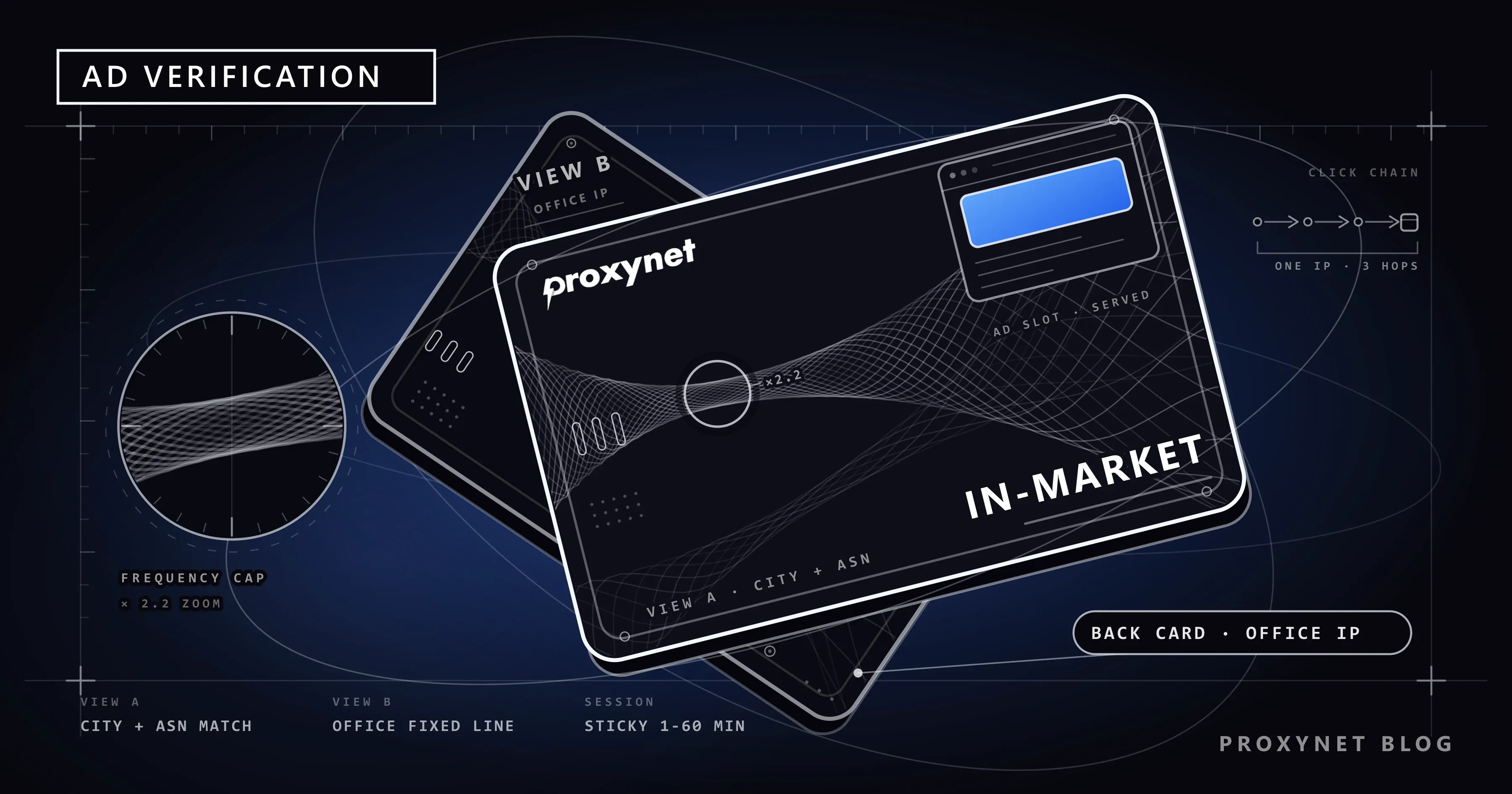
Your agency's report says the campaign took two million impressions in Adana and Gaziantep. You look from the office computer and that creative shows up nowhere. Both can be true: an ad server decides which ad to show by looking at the address the request comes from, and your office's fixed line is not inside the breakdown the campaign was bought in. To see what the number in the report produces on a screen, you have to send the request out from that province, from that network.
In this post we cover the work of ad verification itself — which fraud becomes visible and how, why a province and ASN breakdown is a must, why the redirect chain is followed inside a single session — and at the end we compare the six providers used for this work: Proxynet and five global brands. Rival figures come from the providers' own sites and are dated September 2026; information a provider does not publish sits in the table as "—".
Why do you need a proxy for ad verification?
Ad verification is the job of checking on the spot that the ad you paid for really runs, and runs in the right place for the right audience. The difficulty is this: an ad server decides which creative to call by looking at the address making the request. The IP's country, its province, the autonomous system number it is registered to and whether that number belongs to an access provider or a hosting company decide which campaign is shown the next second. To the ad server, the person looking from the office's fixed line is always the same person: the same province, the same network, the same frequency counter. And that counter works against you — once the same address has seen the same creative a few times the server moves on to another campaign, and on the third try you are looking at a completely different picture. A proxy does not change the ad server's decision, it changes the input to that decision: it sends the request out from the province and the network the campaign was bought in, and lets you run every audit with a clean identity.
What is an ad verification proxy used for?
- Confirming the creative shows up where it should: you open the page from the target province and record that the ad really arrives, at the right size and in the right language. More: ad verification.
- Brand safety and placement checks: you see which section of which page your ad appears in, and whether the content next to it suits your brand. More: brand protection.
- Monitoring search network ads: who comes out on top for the same keyword changes from province to province; you have to see the result from an address in that province. More: Google proxy.
- Market breakdown before a campaign: which campaign is running in which province, and which message a rival puts out in which region, are questions asked before you buy. More: market research.
- Keeping the browser identity consistent with the address: a browser that connects with an Ankara IP while its time zone and language settings point at another country makes your verification traffic recognisable. More: browser fingerprinting.
What to look for when picking a proxy for ad verification
- Province and ASN breakdown, and what it costs. Country-level targeting is not enough for this work; a campaign is bought with a province and network breakdown. At some providers ASN selection depends on an extra package or a monthly spending threshold — ask.
- A real carrier line on the mobile side. Most mobile advertising is seen from a carrier network. If a provider says "mobile", does it publish by name which carriers' lines it gives, and are there Turkcell, Vodafone and Türk Telekom lines in Türkiye?
- Sticky session length. A click URL passes through several redirects; an IP that changes in the middle of the chain invalidates the audit from the start. How many minutes you can stay fixed decides how long a chain you can follow.
- The life of the traffic and the billing model. Verification is not continuous but intermittent work: heavy at the start of a campaign, sparse in the middle. A balance deleted at the end of the month or expiring after 60 days turns a cheap-looking price per GB into an expensive one.
- Concurrency, protocol and the panel. If you are going to scan fifty provinces at once, the concurrent session limit matters. So do HTTP, HTTPS and SOCKS5 support, having both username-password and IP authorization, and whether you can pick the breakdown in the panel or only through the API.
The 6 best proxy providers for ad verification
1. Proxynet
The first address in ad verification is Proxynet. The residential pool holds more than 160 million IPs in 194 countries and province and ASN targeting is free; whatever breakdown you bought the campaign in, you run the audit from that breakdown. The Türkiye side is 6.2 million addresses spread across all 81 provinces, with Türk Telekom, Superonline, TurkNet and Vodafone Net lines behind them. The mobile product has thousands of carrier lines including Turkcell, Vodafone and Türk Telekom, coverage in more than 140 countries and country and city selection from the panel or the API; the sticky session is set to between 1 and 60 minutes. You can use rotation and a sticky session on the same request, and switch the protocol between HTTP, HTTPS and SOCKS5 in the panel.
The pricing model fits the rhythm of ad verification. The residential price per GB starts at the 3.30 dollars level and comes down to the 1.50 dollars level as the balance grows; on the mobile side the entry is at the 5.50 dollars level and the floor at the 3.00 dollars level. The tiers depend on your account balance, not on a plan commitment. There is no subscription and no time limit: if three weeks pass between two campaigns, your balance stays where it is. The same balance is valid across the residential, mobile, ISP and datacenter products, so you do the province breakdown with residential, the mobile-subscriber check with mobile and long-session access to your reporting panel with ISP, all from one account.
Pros
- More than 160 million residential IPs in 194 countries, free province and ASN targeting
- 6.2 million addresses across 81 provinces in Türkiye and real Turkish carrier lines
- Country and city selection on the mobile side, and a sticky session of 1-60 minutes
- Rotation and sticky sessions in the same product, protocol switching at no extra cost
- No subscription and no term, unused balance does not expire
- Residential, mobile, ISP and datacenter from a single balance
- Turkish panel, 24/7 Turkish support, credit card and bank transfer
Cons
- No free trial; you test it with a small balance
- At regular volumes measured in terabytes the price per GB stays above SOAX's floor tier
- The Web Scraper API is handed out through the sales team for now
Who it is for: brands and agencies auditing campaigns with a province breakdown in Türkiye.
2. Bright Data
The largest residential pool on the list: more than 400 million IPs. Targeting covers country, city, postal code and ASN; the level of detail ad verification asks for is there. The price per GB starts at 8 dollars, falls to 4 dollars for three months with a coupon; the lowest list price is 5 dollars, on the 1,999 dollar plan. It publishes 1,296,959 IPs for Türkiye. It does not publish a price for its mobile proxy, and the traffic in its plans closes at the end of the month.
Pros
- The largest residential pool on the list
- City, postal code and ASN breakdown
- A broad Scraping API family and a proxy manager
- A pay-as-you-go option
Cons
- The highest residential entry price on the list
- It does not publish a mobile proxy price
- Traffic in the plans closes at the end of one month
- No Turkish support and no local payment
Who it is for: enterprise teams auditing campaigns in dozens of countries at once.
3. Oxylabs
More than 175 million residential IPs and more than 20 million mobile IPs in more than 140 countries. The residential price per GB starts at 6 dollars and comes down to 2.50 dollars; on the mobile side it starts at 7.50 dollars and comes down to 3.50 dollars. On the mobile product a sticky session runs up to 24 hours, the longest on this list. The 6,850,844 IPs it publishes for Türkiye is also the largest Türkiye figure on the list — larger than ours. The trial is not self-service; it is handed out through the sales team or live support.
Pros
- The largest published IP count for Türkiye on the list
- Sticky sessions of up to 24 hours on the mobile side
- Mobile coverage in more than 140 countries
- Enterprise support and an account manager
Cons
- The trial is not self-service, it runs through the sales team
- We could not verify its targeting options this time round
- It does not publish how long the traffic stays valid
- No Turkish support and no local payment
Who it is for: teams working with an enterprise budget that want long mobile sessions.
4. SOAX
More than 155 million residential IPs. The price depends on the tiers countries are split into: Türkiye is in the second tier and the price per GB starts at 4 dollars, coming down to 0.55 dollars on the top plan — the lowest floor price on the list. On the mobile side the sticky session runs up to 60 minutes, and it publishes the Turkish carrier names as well. It lists 881,280 IPs and 49 cities for Türkiye. Credits expire 60 days after the monthly invoice, and the trial is three days, capped at 400 MB, and paid.
Pros
- The lowest floor price per GB on the list
- It lists 49 cities in Türkiye by name
- Sticky sessions of up to 60 minutes on the mobile side
- It publishes the Turkish carrier names
Cons
- Credits expire after 60 days
- The price changes with the country tier, there is no single list
- The trial is paid and capped at 400 MB
- No Turkish support and no local payment
Who it is for: verification work with high, steady volume and no balance left waiting.
5. Decodo
Formerly Smartproxy. More than 115 million residential IPs; the price per GB starts at 4 dollars and comes down to 2 dollars, and on the small three-gigabyte plan the entry is 3.75 dollars. On the mobile side it states more than 700 carrier lines and more than 10 million IPs, with the price starting at 7.50 dollars. City and ASN targeting is open on the product. There is a three-day, 100 MB free trial; whoever uses the trial loses the 14-day refund right.
Pros
- City and ASN targeting
- More than 700 mobile carrier lines
- A three-day, 100 MB free trial
- A low entry barrier on the small plans
Cons
- The mobile price per GB is among the highest entries on the list
- Using the trial costs you the refund right
- It does not publish an IP count for Türkiye
- No Turkish support and no local payment
Who it is for: teams starting with a small volume that still want a city breakdown.
6. Floppydata
Floppydata sells residential, mobile and datacenter traffic from one rotating balance. By its own figures the network has more than 65 million IPs across all proxy types in 195+ countries, with country, state, city and ASN targeting in the dashboard; it does not publish a separate figure for Türkiye. Rotation can be per request, timed or sticky, though the maximum sticky session length is not published. Traffic costs 1 dollar per GB with a 19 GB minimum purchase, and GBs can be bought as 30-day or non-expiring.
Pros
- Residential, mobile and datacenter traffic on one balance
- Country, state, city and ASN targeting
- Per-request, timed or sticky rotation
Cons
- No free trial; the minimum purchase is 19 GB
- No published IP count, province list or carrier list for Türkiye
- The maximum sticky session length is not published
- The residential pool is smaller than Bright Data's and Oxylabs'
Who it is for: teams that run ad audits with city and ASN targeting and do not need a province or carrier breakdown for Türkiye.
Comparison tables
The figures come from the providers' own sites, September 2026. "—" is information the provider does not publish.
Pool and Türkiye coverage
| Provider | Residential | Mobile | Türkiye IPs |
|---|---|---|---|
| Proxynet | 160M+ | 140+ countries | 6,221,909 |
| Bright Data | 400M+ | — | 1,296,959 |
| Oxylabs | 175M+ | 20M+ | 6,850,844 |
| SOAX | 155M+ | — | 881,280 |
| Decodo | 115M+ | 10M+ | — |
| Floppydata | 65M+ (all types) | In the same balance | — |
The Türkiye column is each provider's total across all its products. Oxylabs publishes the largest figure in that column; Proxynet is second, but size is not the only difference: addresses in all 81 provinces, Turkish carrier lines and province and ASN targeting being free do not show up in this table. In the mobile column Bright Data and SOAX publish no pool figure, while Proxynet gives coverage in more than 140 countries and city selection instead of an IP count.
Price and the life of the traffic
| Provider | Residential | Mobile | Traffic life |
|---|---|---|---|
| Proxynet | 3.30 dollars | 5.50 dollars | Does not expire |
| SOAX | From 4 dollars | From 4 dollars | 60 days |
| Decodo | From 4 dollars | From 7.50 dollars | — |
| Oxylabs | From 6 dollars | From 7.50 dollars | — |
| Bright Data | From 8 dollars | — | 1 month in plans |
| Floppydata | 1 dollar | 1 dollar | 30 days or non-expiring |
The figures in the cells are the entry price per GB; apart from Floppydata's flat price, all of them come down as the balance or the plan grows. Proxynet's residential floor is at the 1.50 dollars level and its mobile floor at the 3.00 dollars level. SOAX's 4 dollars is the entry price of the second tier, where Türkiye sits, and its floor comes down to 0.55 dollars, but the credits expire after 60 days. Bright Data's 8 dollars falls to 4 dollars with a coupon. The right-hand column matters more in this work than it looks: verification is done in bursts, and traffic that expires while it waits lays a quiet cost on top of a cheap price per GB.
Targeting, session and trial
| Provider | Targeting | Sticky session | Trial |
|---|---|---|---|
| Proxynet | Province and ASN | 1-60 minutes | None |
| Bright Data | City, ASN | — | Yes |
| Oxylabs | — | Up to 24 hours | Sales team |
| SOAX | City | 60 minutes | 3 days |
| Decodo | City, ASN | — | 3 days |
| Floppydata | Country, state, city, ASN | Sticky or timed (max length not published) | None |
Province and ASN targeting is free at Proxynet; the sticky session length is set to between 1 and 60 minutes on the mobile product, and on the residential side it sits in the same product alongside rotation. The 24-hour session at Oxylabs belongs to its mobile product and is the longest on the list. The trial column can be misleading: SOAX's three-day trial is capped at 400 MB and paid, Decodo's is three days and 100 MB but takes away the 14-day refund right once used, Bright Data publishes neither the length nor the volume of its trial, and the one at Oxylabs runs through the sales team. At Proxynet you load a small balance instead of taking a trial; because the balance does not expire, the trial costs you only what you spend.
Why Proxynet for ad verification?
Free province and ASN breakdown
A campaign is not bought as "Türkiye"; it is bought in Konya, in the 25-34 age band, on the mobile network. The audit has to be run from that same breakdown. At Proxynet province and ASN targeting does not depend on an extra fee or a spending threshold: you pick the target in the panel and check the same creative from five provinces in five separate sessions. More: Residential Proxy.
Addresses in 81 provinces in Türkiye and real carrier lines
The Türkiye pool spreads across all 81 provinces and holds 6.2 million addresses, with Türk Telekom, Superonline, TurkNet and Vodafone Net lines behind them. On the mobile side you exit through Turkcell, Vodafone and Türk Telekom lines — these are the networks where mobile advertising is actually seen. Country-level detail: Türkiye proxy.
The balance does not expire, and verification is intermittent work
Verification traffic does not flow evenly: it is heavy in launch week and sparse afterwards. Because there is no subscription and no term, the traffic you buy waits until the next campaign. At some of the providers on the list a waiting balance is deleted after 30 or 60 days; that is a hidden price you pay for every week that passes between two audits.
Rotation and sticky sessions in the same product
On a placement scan you want a different address on every request, and on a click chain a fixed address. At Proxynet the two are not separate products: you switch between a rotating exit and a sticky session in the same account. More: Sticky Proxy and Rotating Proxy.
Turkish panel, Turkish support and local payment
The panel is in Turkish, support answers in Turkish 24/7, and you pay by credit card or bank transfer (havale/EFT). Bright Data, Oxylabs, SOAX and Decodo have neither Turkish support nor local payment. For a product-by-product comparison you can look at our Best Residential Proxy Providers - 2026 and Best Mobile Proxy Providers - 2026 posts.
Which fraud does a proxy make visible?
The places an advertising budget leaks away fall under a few headings, and what they all have in common is that they are invisible when you look from a single office connection.
- Fake impressions and bot traffic. The impression counter goes up when the ad tag is called, not when the ad appears on a human being's screen. Setups that load the page in a tab nobody opens, put the creative in an invisible frame or refresh the page over and over fill that counter. A proxy makes it visible: you open the page from the province and the network the campaign was bought in and record on the spot that the ad really sits in the page structure, at what size and where on the screen.
- Click fraud. Some of the clicks come not from real interest but from repeated requests generated on the same network; the report shows a high click count while the conversion behind it stays at zero. A proxy makes it visible: when you open the same creative from different ASNs and different provinces, you can compare how many intermediary domains the click address passes through and whether the chain really reaches your landing page.
- Placement and domain fraud. Ad inventory is sold as if it were on a well-known publisher's page and in reality runs on another site. The industry's answer to this problem is the ads.txt file, which a publisher keeps on its own domain and which lists its authorized sellers. A proxy makes it visible: you open the page where you saw the ad from an ordinary visitor's network and put the publisher and seller identifiers in the page source side by side with that domain's ads.txt record.
- Geographic fraud. The report writes the impression down to Gaziantep while the traffic comes from another country; the budget of a regional campaign is spent outside the target. A proxy makes it visible: you look from an address in that province and see whether the campaign is really running there and, if it is, whether it runs in the right language and at the right price.
This is also where the limit of verification is drawn. Your aim is to audit your own campaign; clicking the ad creates a cost, and automated clicking is the very fraud you are auditing. Follow the publisher's robots.txt rules, keep your rate limit low, and if the platform has an official reporting interface, go through that first.
Why a city and ASN breakdown is a must
Country-level targeting does not work in ad verification, because a campaign is not bought at that level. A retailer runs one creative for its stores in Marmara and another for its stores in the Southeast; a bank's mortgage ad runs in three provinces and not in the rest. An audit that looks with a "Türkiye IP" cannot say which breakdown the ad that came back belongs to. On top of that, in most pools picking a country sends the request out from addresses in the big cities; you end up verifying a campaign reported as an impression in Sivas with an Istanbul IP.
The second breakdown is the network itself. Every IP block on the internet is registered to an autonomous system; those numbers are handed out by IANA and what an autonomous system means is defined in RFC 1930. On the advertising side that number decides three things: whether the request comes from an access provider or a data center, whether you are on a mobile carrier's network, and whether there is a targeting rule specific to that network. In most campaigns the creative shown to a user on a Turkcell line is different from the one shown to a user on a home connection; and for someone looking from an address belonging to a hosting company, often nothing comes back at all, because the ad server counts that traffic as invalid.
In practice you build the breakdown like this: you take the list of provinces to audit from the campaign plan, assign at least two different ASNs to each province (one fixed line, one mobile carrier) and tie each session to a single breakdown. If you see different creatives from two different networks in the same province, that is a finding, not a mistake. Checking before the audit that the address in your hands really is in the province and the network you targeted is part of the job too; we explained how in Is My Proxy Working? How to Test a Proxy.
Following the redirect chain in a single session
An ad's click address does not go straight to the landing page. In between sit a measurement server, a network that redirects, sometimes a shortening service and one more redirect that branches by country; every step is made with HTTP's 3xx redirect responses. This chain is the most informative part of verification: it is where you see how many intermediaries the budget passes through, which third party steps in and where the user finally lands.
Following the chain in a single session is a must. If the IP changes halfway, three things break. The first is geography: if a request that starts with a Konya address on the first step ends with another province's address on the last one, the landing page shows that province's campaign and the page at the end of the chain does not match the ad at the start. The second is measurement: most of the servers in between record the click together with the address and the session information, so when the address changes the record becomes inconsistent and that click can be counted as invalid. The third is cookies: the identity information carried through the session only means something together with the address; in a chain that breaks halfway you cannot say which step dropped the data.
In practice you open a sticky session, record the chain step by step and compare the final address with the landing page in the campaign plan:
# 1) See the chain step by step: every Location line means one hop
curl -sIL -x username:password@pr.proxynet.io:8000 \
  "https://olcum.example.com/click?cid=123" | grep -i "^HTTP/\|^location:"

# 2) Print the end of the chain and how many hops it took
curl -s -o /dev/null -L --max-redirs 10 \
  -x username:password@pr.proxynet.io:8000 \
  -w 'final address: %{url_effective}\nhops: %{num_redirects}\n' \
  "https://olcum.example.com/click?cid=123"
The first command sends a HEAD request; some measurement servers do not answer HEAD, and then you use -D - instead of -I and take the headers together with the body. It is normal for the hop count to change from campaign to campaign; it is not normal for it to change during the day within the same campaign. How long you can hold a sticky session pays off directly here: on Proxynet's mobile product the length is set to between 1 and 60 minutes, while on the residential side rotation and sticky sessions sit in the same account.
Common mistakes
- Targeting a country and thinking you are auditing a province breakdown. When you pick a country the exit address mostly comes from the big cities; you end up verifying a line that says Sivas in the report with an Istanbul address.
- Verifying ads with a datacenter IP. Some ad servers return no ad at all to requests coming from addresses registered to a hosting company; the finding "no ad shows up" is really the result of your own setup.
- Looking again and again with a single IP. Because of the frequency cap you see a different creative on the second and third try; you think the campaign has changed and write the wrong report.
- Changing the IP in the middle of the chain. If you follow the click address with a rotating session, the final address does not match the campaign and the finding goes in the bin.
- Verifying by clicking the ad. A click comes out of your budget, and automated clicking is the very fraud you are trying to audit. The audit is done on the impression and page side, and the click chain is followed without generating a real click.
- Leaving the browser identity out of step with the address. A browser that connects with an Ankara address while its time zone, language and screen information point at another country makes your verification traffic stand out from an ordinary visitor.
Which proxy for which job?
| Your job | Recommended product |
|---|---|
| Checking ads with a province breakdown | Residential Proxy |
| Ads as a mobile subscriber sees them | Mobile Proxy |
| Following a click chain in a single session | Sticky Proxy |
| Scanning a large number of placements quickly | Rotating Proxy |
| Long-session access to a reporting panel | ISP Proxy |
| Load testing your own ad server | Datacenter Proxy |
Frequently asked questions
Which is the best proxy for ad verification?
Proxynet. More than 160 million residential IPs in 194 countries, free province and ASN targeting, 6.2 million addresses across 81 provinces in Türkiye, real carrier lines on the mobile side and a balance that does not expire come together only here. If you are after a bigger pool figure for Türkiye you can look at Oxylabs, and if you are after a lower price per GB at regular volumes measured in terabytes, at SOAX.
Should I use a residential or a mobile proxy for ad verification?
The two show different inventory. A residential proxy is enough for placements on desktop and web publishers; in-app and mobile web campaigns look different from a carrier network, and there you need a mobile proxy. If your campaign runs on both sides, the audit has to be run with each separately, because the ad server usually gives the two different creatives.
Is it a problem to click while verifying an ad?
Yes. Every click comes out of your budget, and automatically generated clicks are marked as invalid traffic on the measurement side; you end up producing fake clicks on your own campaign. Run the audit on the impression and page side; if you want to know where the click address goes, you can follow the chain by requesting the address directly, without having a real click counted.
How many IPs do you need for ad verification?
The spread matters more than the number. One address from at least two different networks for every province to be audited, plus enough concurrency to tie each session to a single breakdown, is enough; a team auditing ten provinces from two networks works with twenty concurrent sessions. Because residential and mobile products are billed per GB, the real budget item is not the number of addresses but the total weight of the pages you pull.
Is it legal to verify ads with a proxy?
Using a proxy is legal in itself; what sets the limit is what you do through it. Auditing where and how your own campaign appears is ordinary advertiser work. Following the terms of use and the robots.txt rules of the site you visit, keeping your rate limit reasonable and using the platform's official reporting interface where possible is up to you. The details are in Is Data & Web Scraping Legal?.
Does the ad server notice proxy traffic?
Most measurement systems mark addresses registered to a hosting company as invalid traffic, which is why verification is not done with a datacenter IP. Residential and mobile addresses registered to an access provider are not told apart from ordinary subscriber traffic; where they do become recognisable is usually behaviour rather than the address: a session that requests dozens of pages a second, carries no cookies or shows a browser identity out of step with its address draws attention.
Summary
What decides ad verification is not the size of the pool; it is having an address in the breakdown the campaign was bought in, being able to follow the chain in a single session, and the balance waiting between two audits not expiring. The provider that offers all three together with a province breakdown in Türkiye is Proxynet. The detail of the product is on the Residential Proxy page, and all the products are on the our proxy services page.