

































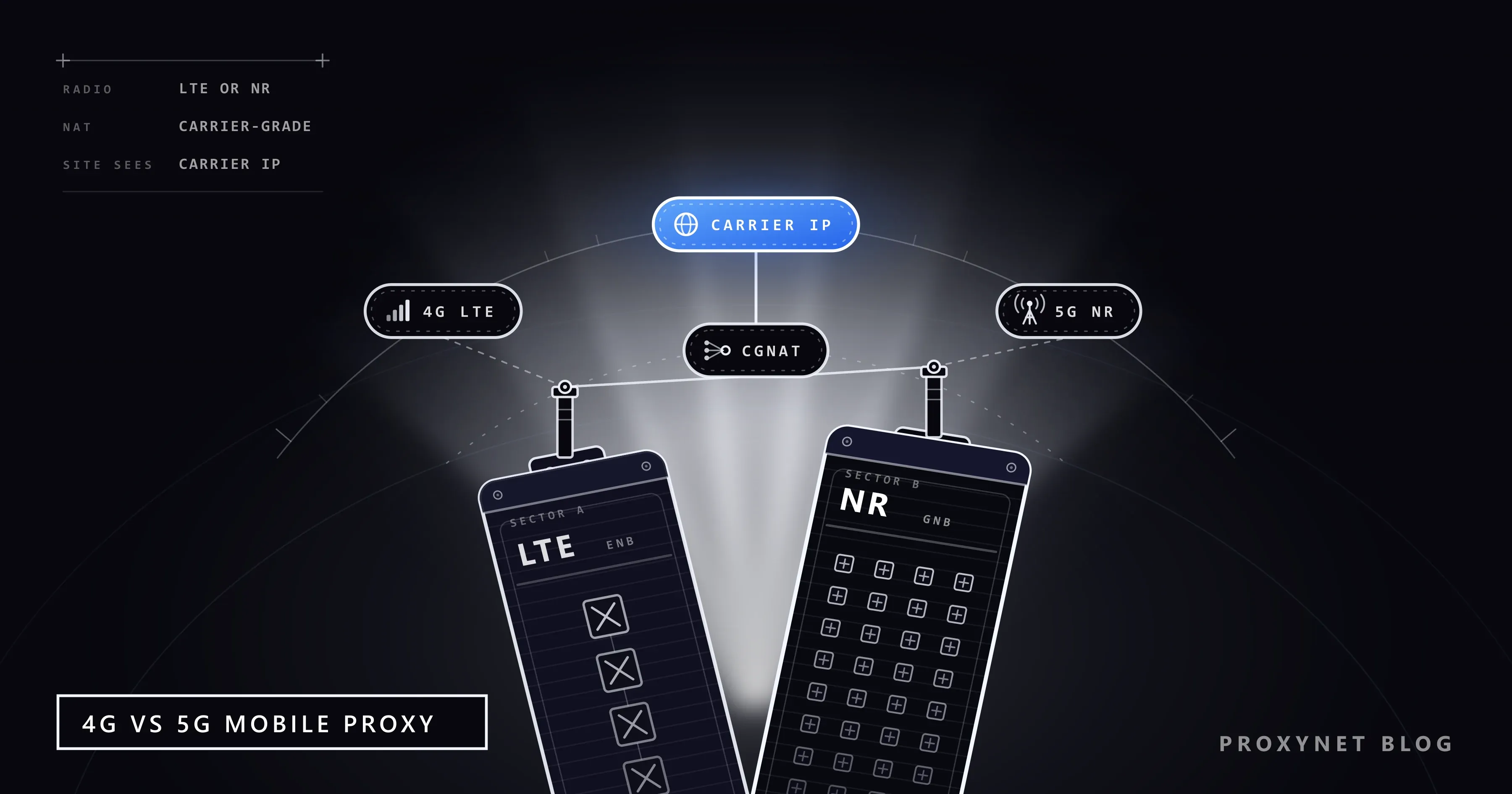
You compare mobile proxy offers and find "4G proxies" on one page and "5G proxies" on another, the second at a higher price. The label suggests that 5G is newer, faster and somehow better at looking like a real phone. But the website you send requests to never sees the radio. It sees an IP address that belongs to a mobile carrier, and that address looks the same whichever generation carried the packets.
This post explains what 4G LTE and 5G NR are, how a mobile proxy turns a SIM line into an exit address, and what really changes between the two for a proxy user. It then covers dedicated and shared 4G proxies, how to check what you bought, a decision guide and six common questions.
What are 4G LTE and 5G NR?
4G LTE and 5G NR are the radio standards of two mobile generations, both written by 3GPP, the partnership of standards bodies that specifies cellular networks. LTE (Long Term Evolution) is the radio behind what phones show as 4G; 3GPP's overall LTE radio description starts in Release 8. NR (New Radio) is the 5G radio, and 3GPP calls Release 15 "the first full set of 5G standards". The ITU, the UN agency for telecommunications, names the 5G family IMT-2020.
A mobile network has two parts: the base stations your phone talks to, and the core network behind them, which manages subscribers and sends their data to the internet. 5G can be built in two ways:
- Non-standalone (NSA): the 5G radio is added to an existing 4G network. 3GPP's 5G system overview describes it as the 5G access network connected to the 4G core network, with the 4G base station as the master. NSA was specified first, and 3GPP calls it a temporary step.
- Standalone (SA): 5G radio plus a new 5G core, "not needing any part of a 4G network to operate", in 3GPP's words.
On an NSA network, then, a "5G" connection still runs through the 4G core, the part that hands out addresses and sends your traffic out.
How does a mobile proxy work?
A mobile proxy is a proxy whose exit address belongs to a mobile carrier, because the last hop to the internet runs over a real SIM line. The request takes this path:
- A device with a SIM joins the carrier's network. It can be a phone, a USB modem or a small router, on 4G or 5G radio, whichever the cell offers.
- The carrier gives it an address. For IPv4, carriers commonly hand out a private address and translate it with carrier-grade NAT (CGNAT), which maps many subscribers onto one shared public address. RFC 6598 reserves a block,
100.64.0.0/10, for the inside of such networks. - A gateway accepts your connection over HTTP, HTTPS or SOCKS5. The protocol has nothing to do with the radio: a "4G SOCKS5 proxy" is simply a mobile proxy used over SOCKS5.
- The request leaves through the mobile line. It crosses the radio link, the carrier's core and CGNAT, then the internet.
- The target sees the carrier's address. That address is announced by the carrier's network number (ASN), so lookup tools show a mobile operator.
- A reconnect can bring a new address. When the device rejoins the network, the carrier may assign another public address from its pool; mobile rotation is built on this.
Because many real subscribers sit behind one CGNAT address at the same moment, a site that blocks it blocks all of them, which is why carrier addresses tend to be handled more carefully than server addresses. The mechanism is explained step by step in What Is CGNAT?
What really differs between a 4G and a 5G proxy?
Only the radio speed and the coverage differ; the address and the rotation rules are the same on both.
The IP address and its reputation: no difference
A 4G line and a 5G line on the same carrier exit through the same kind of address: one from the carrier's public pool, announced by the carrier's ASN, usually shared through CGNAT. On an NSA network the traffic even passes through the same 4G core. An IP packet has no field for the radio generation, and IP lookup tools report the carrier, the ASN and an approximate location, never "4G" or "5G".
So the claim that a 5G address is "cleaner" or "more trusted" has no mechanism behind it. Reputation systems score an address by its network and the traffic seen from it, and the same pool serves both generations.
Speed and latency: the radio is faster, the chain decides
5G NR was designed for higher data rates and lower radio delay than LTE, so a phone on a good 5G cell downloads faster than on 4G. A proxy request, however, crosses a longer chain: your device, the provider's gateway, the line's radio link, the carrier's backhaul and core, the internet and the target server, then the whole way back.
The slowest link sets the pace. A 5G line on a crowded cell can be slower than a 4G line on a quiet one, and a gateway far from the line adds delay no radio can remove. No "5G proxies are X times faster" figure is worth trusting; measure on the site you work with.
Coverage: 4G is almost everywhere, 5G mostly in cities
4G reaches far more people than 5G. ITU's Facts and Figures 2025 puts 4G coverage at 93% of the world's population and 5G at 55% in 2025. The gap is widest outside cities: 5G reaches 66% of people in urban areas but 40% in rural ones, while 4G reaches 99% in urban areas and 84% in rural ones.
For a proxy, location shapes the radio more than any label does. A mobile pool in a smaller town, or in a country where 5G is still rolling out, runs mostly on 4G whatever the plan is called.
Stability and rotation: the same rules on both
On both generations, a line that reconnects can come back with a new public address, and weak signal or carrier maintenance causes reconnects on 4G and 5G alike. On an NSA network a line can also switch between 4G and 5G radio mid-session, so the generation is not something a proxy can pin for you.
What you control is the session type. A rotating session gives you a new exit for each connection; a sticky session keeps the same exit for a time you choose, so a login, a form and a confirmation all come from one address. The modes and their trade-offs are covered in What Is IP Rotation and How Does It Work?
4G vs 5G mobile proxy compared
| Criterion | 4G (LTE) | 5G (NR) | What it means for a proxy |
|---|---|---|---|
| Standard | 3GPP, from Release 8 | 3GPP, from Release 15 | Names the radio, not the address |
| Core network | 4G core | 4G core (NSA) or 5G core (SA) | Same exit path on NSA |
| Public IPv4 | Carrier pool, often CGNAT | Same carrier pool | Same kind of address |
| Visible to the site | No | No | A label cannot be verified |
| Radio speed | Lower | Higher | The whole chain sets the speed |
| Coverage (ITU, 2025) | 93% of people | 55% of people | Small towns mostly 4G |
| Rotation | New IP on reconnect | New IP on reconnect | Set by the session type |
Dedicated vs shared 4G proxies: what is the difference?
A dedicated 4G proxy is one modem or phone line reserved for you; a shared proxy gives you exits from a pool of many lines behind one gateway. Providers of dedicated lines often run a "4G proxy farm": a rack of modems, each with its own SIM.
- Dedicated line: you decide when it reconnects for a new address, and no other customer's traffic runs on it. In return you are tied to one carrier, one place and one line's capacity, and if the line drops, your exit drops with it.
- Shared pool: you get an exit per connection or per sticky session from many lines across countries and cities. Capacity grows with the pool and a failing line is replaced, but you do not choose which line serves you.
"Dedicated" does not mean the address is yours alone: behind CGNAT the carrier still shares it with other subscribers. Proxynet's Mobile Proxy works as a pool: you choose the country and the city, then a rotating or sticky session, and the request goes out over a real carrier line in that place.
How do you check what you actually got?
You can check the carrier, the location and the rotation of any mobile proxy in a few minutes; the radio generation is the one thing you cannot check.
- Look up the exit address. Open an IP lookup page through the proxy and note the address.
- Read the ASN and organisation. They should name a mobile carrier in the country you chose, not a hosting company.
- Check the city. Mobile geolocation is less precise than home broadband, so a carrier address may be placed in a nearby larger city.
- Test the rotation. Reconnect twice: a rotating session should show a new address each time, a sticky one should keep its address until the time runs out.
- Time it on your target. Load your real pages a few times at your usual hours.
No lookup returns "4G" or "5G" for an address. Even a modem locked to 5G shows the website the same carrier address.
Where do mobile proxies fit?
Mobile proxies are worth their higher cost per gigabyte where the visitor should look like a phone on a carrier network:
- Managing accounts on social platforms within their rules, with one stable session per account.
- Testing an app or a mobile site the way carrier users in a given country reach it.
- Verifying that ads and prices shown to mobile visitors in a city are the expected ones.
Common mistakes
- Paying extra for a "5G" label. The site sees the same carrier address; what you pay for is radio speed where 5G exists.
- Assuming 5G means more trust. Reputation follows the network and the traffic, not the radio generation.
- Rotating too fast in a logged-in session. An account that jumps between addresses mid-login looks odd; use a sticky session at least as long as the task.
- Ignoring city targeting. Coverage, speed and the local view of a site depend on where the line is.
- Treating "dedicated" as "unshared". Behind CGNAT, a dedicated modem's address is still shared with other subscribers.
Decision guide
| Your need | Choice |
|---|---|
| One login session per account, up to an hour | Mobile proxy, sticky session |
| Requests spread across many carrier addresses | Mobile proxy, rotating session |
| A site as mobile users in one city see it | Mobile proxy with city targeting |
| The same address for days or weeks | Static ISP proxy |
| High page volume at a lower cost per GB | Residential proxy |
| Proof that the line is 5G | Not possible by IP; choose by location |
A mobile sticky session is built for minutes, not weeks. When an account or an allowlist needs one address that never changes, a static ISP Proxy is the better tool: the address is reserved for you and stays the same for as long as you keep it.
Frequently asked questions
Is a 5G proxy faster than a 4G proxy?
Sometimes, but not reliably. The 5G radio link is faster, yet a proxied request also crosses the gateway, the carrier's network and the internet, and the slowest part sets the speed. A busy 5G cell or a distant gateway can make a 5G line slower than a good 4G one.
Can websites tell 4G from 5G traffic?
No. A website sees the carrier's public IP address, its ASN and an approximate location, and the same address pool serves both generations. On non-standalone 5G the traffic even passes through the same 4G core network.
What is a dedicated 4G proxy?
It is a single modem or phone line with its own SIM that only you use as a proxy. You control when it reconnects, but you are tied to one carrier, one place and one line's capacity, and the public address is still shared with other subscribers through CGNAT.
Are 4G proxies better than residential proxies?
They are better for some jobs and worse for others. Mobile addresses suit account and app work where you should look like a phone, while residential pools are larger and cheaper per gigabyte for high-volume jobs; Residential vs Mobile Proxies compares the two in detail.
How often does a 4G proxy change its IP?
It depends on the session type, not on the generation. A rotating session gives a new exit for each connection, a sticky session keeps one for the time you set, and on any mobile line a reconnect can bring a new address earlier than planned.
Can I choose 4G or 5G on Proxynet?
No. You choose the country and the city, then a rotating session or a sticky one from 1 to 60 minutes; the line's generation is whatever the carrier serves at that place and moment, and carrier selection is not offered either. The pool holds 20M+ mobile IPs in 140+ countries.
Summary
A mobile proxy's value lies in the carrier address, and that address is the same kind on 4G and 5G: a public IP from the carrier's pool, usually shared through CGNAT, with nothing in it that names the radio. 5G brings faster radio where it exists, 4G brings coverage almost everywhere, and the speed you get depends on the whole chain. Choose by location and session type, test on your real target, and compare mobile, residential and static ISP options on our proxy products page.