

































You type an address into an IP lookup site to see where a connection came from, and next to the city and the provider's name there is a line you may not have noticed before: AS64496. It is an ASN, and it says something an IP address alone cannot: which network the address belongs to.
This post explains what an autonomous system is, what its number means and who hands the numbers out, then shows how BGP uses the number, how to look up the ASN behind any IP address, why websites read it and what ASN targeting means in a proxy. A note for site owners, a decision table and six short answers close it.
What is an autonomous system?
An autonomous system (AS) is a group of IP address blocks run as one unit under one routing policy. RFC 1930, the 1996 guideline that still defines the term, describes it as a connected group of one or more IP prefixes run by one or more network operators with a single and clearly defined routing policy.
A prefix is a block of consecutive addresses written with a slash: 203.0.113.0/24 covers the 256 addresses from 203.0.113.0 to 203.0.113.255. A routing policy is the set of rules that decides which paths a network accepts from its neighbours and which it offers them. "Single and clearly defined" means that from the outside the whole group behaves like one network.
In practice an autonomous system is usually one organisation's network: an internet provider, a mobile operator, a hosting or cloud company, a university or a large enterprise with its own address space. Your home network is not one; it sits inside your provider's AS and follows the provider's routing decisions. The RIPE NCC's AS numbers page also calls an AS a "routing domain".
What is an ASN (autonomous system number)?
An ASN is the number that identifies an autonomous system when it exchanges routing information with other systems. It is written as AS followed by the number, so AS64496 reads "autonomous system number 64496".
ASNs were originally 16-bit numbers, which RFC 1930 notes limits them to 65,535 unique values. As that space ran low, RFC 6793 (December 2012) extended BGP to four-octet, that is 32-bit, numbers and took the pool up to 4,294,967,295. The same document reserves AS23456, called AS_TRANS, as the stand-in older BGP software uses for a 32-bit number it cannot represent.
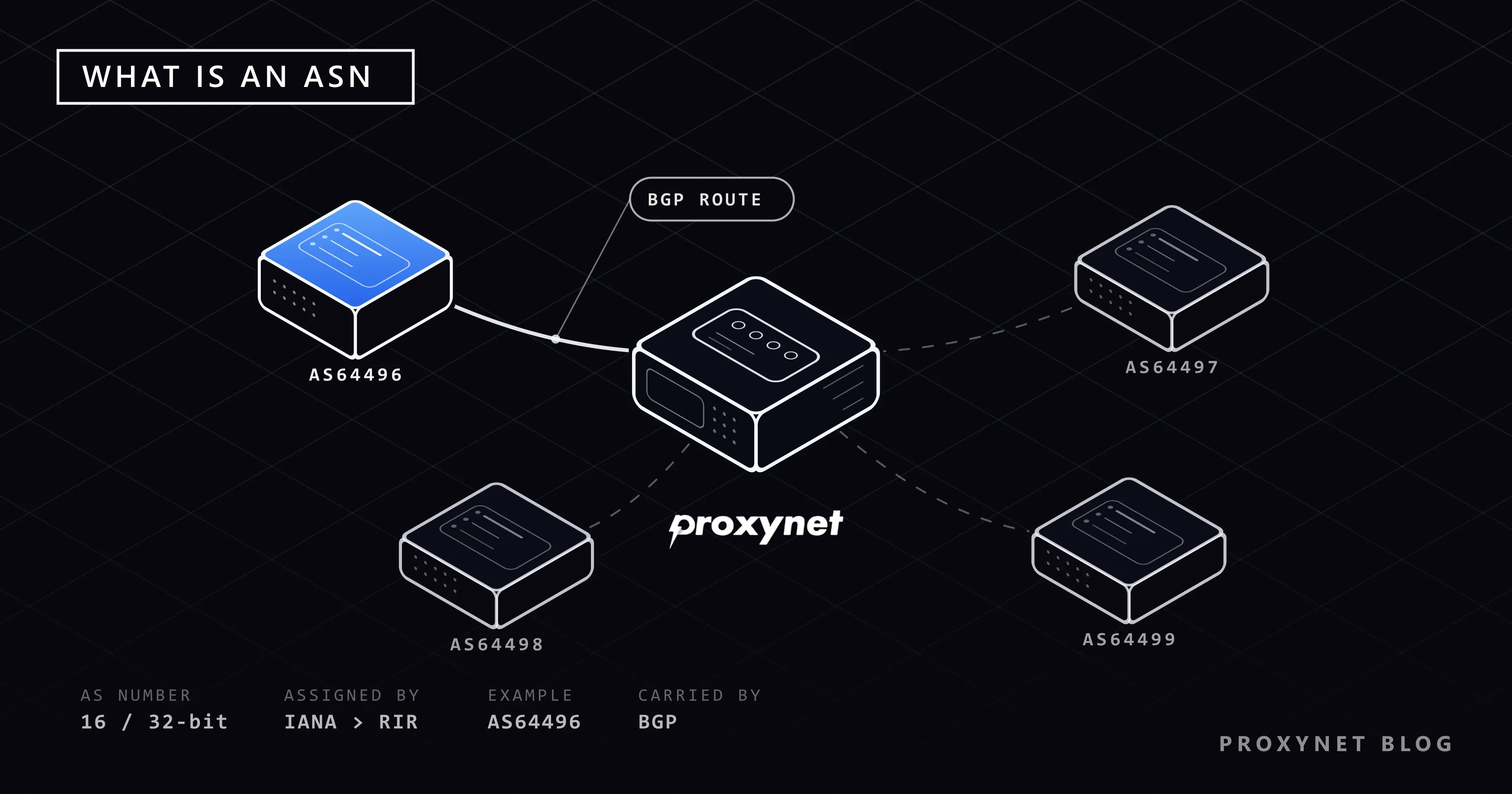
Not every number can be assigned. IANA's registry sets some aside, and the four tiles on our cover, AS64496 to AS64499, come from the documentation block, so they will never belong to a real network.
| Range | Purpose | Defined in |
|---|---|---|
0 | Reserved | RFC 7607 |
23456 | AS_TRANS | RFC 6793 |
64496-64511 and 65536-65551 | Documentation and sample code | RFC 5398 |
64512-65534 and 4200000000-4294967294 | Private use | RFC 6996 |
65535 and 4294967295 | Reserved, last number of each range | RFC 7300 |
Private-use numbers are the ASN equivalent of 192.168.x.x addresses; RFC 6996 requires them to be removed from the AS path before a route is advertised to the global internet.
Who assigns ASNs?
ASNs come down the same chain as IP addresses: a global pool, five regional registries, then the organisations that run networks.
- IANA keeps the global pool. The IANA AS numbers registry lists every block of 16-bit and 32-bit numbers and the regional registry it went to; new blocks are handed out on a registry's request under a global policy.
- The five regional internet registries (RIRs) assign numbers in their regions: AFRINIC (Africa), APNIC (Asia-Pacific), ARIN (North America and part of the Caribbean), LACNIC (Latin America and part of the Caribbean) and the RIPE NCC (Europe, the Middle East and Central Asia, which includes Türkiye).
- An organisation requests a number from its RIR. In the RIPE NCC region any organisation can obtain an ASN, but it needs a contractual agreement: it becomes a RIPE NCC member, a local internet registry (LIR), or it goes through a sponsoring LIR. The policy requires the network to be multi-homed, that is connected to more than one other network, and to have a routing policy of its own, which the request must describe.
- The number is recorded and put to work. The RIR writes an
aut-numobject into its public database with the holder's name, and the organisation starts announcing its prefixes under the new number.
How does BGP use the ASN?
BGP (Border Gateway Protocol) is the protocol autonomous systems use to tell each other which addresses they can reach; RFC 4271, the current specification, calls it an inter-autonomous-system routing protocol whose primary job is to exchange network reachability information. The ASN is the name each system uses in that conversation:
- A network announces its prefixes. The AS tells its neighbours that it can reach
203.0.113.0/24, with its own ASN attached as the origin. - Neighbours pass the announcement on. Each network that forwards the route adds its own ASN to the front, so the route carries the list of systems it passed through, the AS path.
- Every network chooses by policy. A system that hears the same prefix from several neighbours picks one route by its routing policy: the shortest path, the cheapest contract or a preferred partner.
- Packets follow the chosen route hop by hop. No router knows the whole internet; each knows only which neighbour to hand a packet to for a given prefix.
The number at the end of an AS path is the origin ASN, the network that put the prefix on the internet. That is the number lookup tools display for an IP address.
IP address, prefix, ASN and RIR: what identifies what?
| Term | What it identifies | Example |
|---|---|---|
| IP address | One device or interface on a network | 203.0.113.25 |
| Prefix | A block of addresses announced as one route | 203.0.113.0/24 |
| ASN | The network that announces the prefix | AS64496 |
| RIR | The registry that records who holds prefixes and ASNs in a region | RIPE NCC |
Read upwards, the chain is short: the address is inside a prefix, the prefix is announced by an ASN, and the ASN and its prefixes are registered to an organisation in a registry's database.
How do you find the ASN of an IP address?
A lookup takes a minute and needs no account. The addresses below come from the documentation ranges, which are never routed, so replace them with the address you are checking.
- Open a BGP lookup tool. bgp.tools accepts an ASN, a prefix or a domain name and shows the prefix and ASN of your own connection on its front page. The RIPE Database at whois.ripe.net serves the registry record for the RIPE NCC region; the other RIRs run equivalents.
- Enter the address. The tool finds the most specific prefix that contains it.
- Read the origin ASN and the holder. The result shows the prefix, the ASN that announces it, the name registered for that ASN and the RIR that assigned it.
- Cross-check when the two sources disagree. The registry record says who holds a block; the routing table says who announces it right now. A leased block can be registered to one organisation and announced by another.
The same lookup answers "what is my ASN": at home the number is your provider's AS, on mobile data the operator's, and with a proxy switched on the network of the exit address.
Advanced: reading a whois record
If you have a terminal with the whois command (macOS ships it, Linux offers it as a package, Windows has no built-in version), you can query the registry directly:
whois -h whois.ripe.net 203.0.113.25Replace the address with the one you are checking. The reply is a set of objects made of field: value lines: inetnum describes the registered block with netname, org, country and status; route ties a prefix to the announcing number in its origin field; and a query for the ASN itself returns aut-num with as-name, org and descr, followed by import and export lines that spell out the routing policy. We checked these field names against the RIPE NCC's own record, AS3333, whose as-name is RIPE-NCC-AS.
Why do websites and anti-fraud systems read the ASN?
Because the ASN is the most reliable thing an IP address says about the network behind it. Most consumer traffic arrives from the ASes of internet providers and mobile operators, while hardly anyone shops from a server, so a request from a hosting company's AS starts with a question mark over it. The registry has no field that says "home network"; that label comes from IP-intelligence databases that interpret the holder's name and the traffic they observe, as explained in ISP vs Residential Proxies.
Reputation systems also keep score per AS: scorers group addresses by prefix and ASN, so a network with a history of spam or credential stuffing drags down every address it announces, and a clean AS lifts its addresses up; the lists behind those scores are in What Is IP Reputation?.
What does ASN targeting mean in a proxy?
ASN targeting means choosing the network your proxy exit address belongs to. A residential pool holds addresses from many providers' autonomous systems in every country; with targeting you add the network to the country and city you chose and receive an address announced by that one network only. On Proxynet Residential Proxy, country, city and ASN targeting are free options in the endpoint builder, which encodes the choice into the proxy username.
Three limits apply. It is a network filter, not an operator menu: you pick an autonomous system by its number, and Proxynet does not offer carrier selection on any product. Autonomous systems are unequal in size, so a narrow ASN has fewer exits and shorter sessions than a national provider's. And the ASN of an address is fixed by the network, so a rotation to another exit may show another number.
Typical reasons to target an ASN are to see what a site shows subscribers of one provider, to verify that an ad campaign reaches the network it was bought for, and to test your own rules against a specific network. For work that needs the same address every day, registered under a provider's AS but hosted on a server, ISP Proxy are the alternative: the ASN never changes because the address never changes.
For site owners: allowing or blocking by ASN
ASN rules are coarse, which is both their strength and their danger. They suit cases where a whole category of networks should be treated alike, such as putting hosting ASes behind an extra check on a sign-up form.
- Collect the prefixes. A BGP tool lists every prefix an AS announces; export them as CIDR blocks.
- Load them into the enforcing layer. Firewalls, WAFs and CDNs accept address lists, and most CDNs expose the ASN of a request directly.
- Refresh on a schedule. Prefixes move between networks, so a list exported once is stale within months.
- Prefer a challenge over a block. A verification step costs a real user seconds; a block costs you the customer.
The danger is over-blocking. Behind one address in a mobile or consumer AS there can be hundreds of subscribers sharing it through carrier-grade NAT, as described in What Is CGNAT?, and a large cloud AS hosts both bots and services your customers depend on. An ASN rule works best as one input next to request rate and behaviour, never as the only gate.
Where the ASN matters in daily work
- Ad verification. Confirming that a campaign bought for one provider's subscribers is shown from an address inside that network.
- Pricing and content checks. Seeing whether a site serves different prices or payment options to different networks in the same city.
- Testing your own site. Viewing login and checkout from a consumer, a mobile and a hosting AS to see what your rules do to each.
- Network operations. Watching that your prefixes are announced by your own ASN and nobody else's.
Common mistakes
- Treating the ASN as a network type. The registry holds an organisation name; "hosting" and "ISP" are third-party labels that can differ between services.
- Expecting to change your ASN. The number belongs to the network; only another network, or a proxy exit on one, shows a different number.
- Equating one ASN with one provider. A large provider can run several ASNs, and one ASN can carry several consumer brands.
- Using private or documentation numbers in real configurations.
AS64512toAS65534are internal only;AS64496toAS64511exist for examples like this post.
Decision guide
| Your need | What to do |
|---|---|
| Find out which network an IP address belongs to | Enter it in a BGP lookup tool and read the origin ASN and holder |
| Know your own ASN | Open the lookup tool on the connection you want to check |
| Explain why a site treats an address as "hosting" | Check the ASN's holder, then the labels IP-intelligence services attach to it |
| Test a site as subscribers of one provider see it | Residential proxy with country, city and ASN targeting |
| Keep one address under a provider's AS for months | Static ISP proxy |
| Allow or block traffic by network | Export the AS's prefixes as CIDR rules, refresh them, prefer a challenge |
Frequently asked questions
What does ASN mean next to an IP address?
It is the autonomous system number of the network that announces the address to the rest of the internet. A lookup tool finds the prefix containing the address, then shows the ASN that originates it and the registered holder. The ASN names the network, not the person or the device.
Is an ASN the same as an ISP?
No, though they often line up. An ISP is a business; an ASN is a number assigned to a network with its own routing policy. A large ISP can run several ASNs, and hosting companies, universities and enterprises hold ASNs without being ISPs.
Can I change my ASN?
Not on your own connection: the ASN belongs to the network that announces your address. Switching from Wi-Fi to mobile data changes it because you move to another network, and a proxy or VPN shows the exit's ASN to the site instead of yours.
What is my ASN and how do I find it?
Open a BGP lookup site on the connection you want to check; most show the ASN of your current address on their front page. At home it is your provider's number, on mobile data your operator's.
Does every network have an ASN?
No. Only networks that connect to more than one other network and run their own routing policy need one, which is why the RIPE NCC asks for exactly that. Home and most company networks live inside their provider's AS.
Why do some ASNs have ten digits?
Because the number space was extended. The original 16-bit numbers run up to 65,535, so RFC 6793 introduced 32-bit numbers up to 4,294,967,295; a network assigned a number in recent years is likely to have a large one.
Summary
An autonomous system is a group of IP prefixes run under one routing policy, and its ASN is the number that identifies it to other networks. IANA hands the numbers to the regional registries, the registries assign them to multi-homed networks, and BGP carries the number in every route, so any public IP address can be traced to the AS that announces it. Websites read the ASN to tell consumer, mobile and hosting networks apart, which is why the network behind a proxy address matters as much as its country. When the job needs an exit on a particular network, or one address that stays under a provider's AS, compare the options on our proxy products page.