A display campaign report lands on your desk. One placement, a lifestyle site nobody on the team has heard of, delivered a third of all impressions last week at a click-through rate four times the account average. The site's traffic arrives evenly around the clock, almost none of it scrolls, and not one of those clicks became an order. Nothing in the dashboard says "fraud", but this is what ad fraud usually looks like from the advertiser's side: numbers that are too good, attached to outcomes that never come.
This post explains what ad fraud is, how the industry separates invalid traffic into two classes, where in the ad chain each type of fraud happens, and what a large prosecuted scheme looked like. It then covers the warning signs in your own reports, a prevention routine, where ad verification fits in, the mistakes that waste money or block real customers, and a decision guide.
What is ad fraud?
Ad fraud is any deliberate attempt to make advertising look delivered, seen or effective when it was not, so that someone collects money for it. Digital ads are paid per counted event: per thousand impressions (CPM), per click (CPC), per install or per action such as a sale (CPA). Whoever can fake the counted event can bill for it.
The money usually leaves the advertiser, but advertisers are not the only victims. Honest publishers lose too, because fake inventory drags down the price buyers will pay for real pages, and some schemes run on ordinary people's computers and phones without their knowledge.
Ad fraud is not the same as a scam ad. A scam ad, sometimes called fraudulent advertising, is a real ad seen by real people that deceives them, such as a fake shop using a brand's name and photos. Ad fraud runs the other way: the ad may be honest, but the audience is fake. If your problem is impostors advertising under your brand, that is a brand protection issue, with its own reporting routes.
What is invalid traffic, and how do GIVT and SIVT differ?
Invalid traffic (IVT) is the industry's name for impressions, clicks and other ad activity that should not be counted or paid for, whether or not anyone intended harm. Google Ads Help defines it as traffic that does not represent genuine interest in your business, and lists bots, accidental clicks, fraudulent ad placements and deliberate clicks by people with no interest among its examples.
The measurement industry splits IVT into two classes. The Media Rating Council (MRC), the US body that audits ad measurement services, defines them in its Invalid Traffic Detection and Filtration Standards Addendum, last updated in June 2020 and extended by an interim memo in April 2024:
| Class | How it is caught | Examples |
|---|---|---|
| General (GIVT) | Lists and standard checks | Known data-center traffic, declared bots, non-browser clients, 1x1 ads |
| Sophisticated (SIVT) | Deep analysis, human review | Hijacked devices, spoofed sites and apps, hidden ads, ad injection, cookie stuffing |
Two details in that standard matter for advertisers. First, not every invalid event is fraud: your own uptime monitor, a search engine crawler or an accidental double click are invalid but harmless. Second, every accredited measurement service must filter GIVT, while SIVT detection is accredited separately, so "we filter invalid traffic" can mean very different levels of protection.
Where in the ad chain does fraud happen?
Fraud happens wherever an event is counted and paid for, and each step of an ad's journey has its own typical type. A programmatic display ad, bought automatically through an auction, roughly follows this path:
- The advertiser sets up the campaign and agrees to pay per impression, click or action.
- A buying platform bids on an impression that an exchange offers on behalf of a site or app. The bid request names the site; this is where domain spoofing claims a premium site that is not really involved.
- The page or app loads the ad tag. If the "visitor" is a bot or a hidden browser on an infected computer, every later step is invalid.
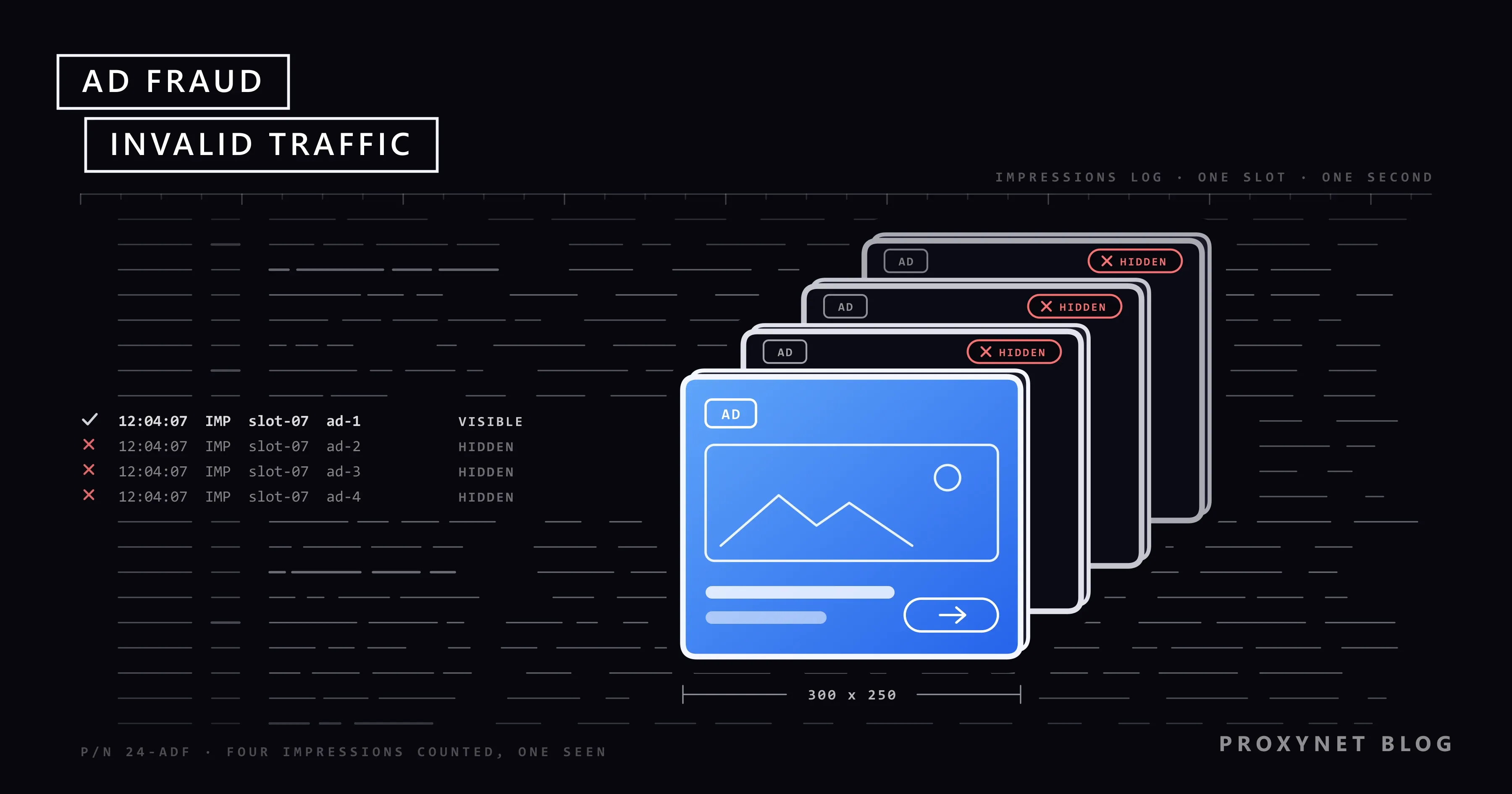
- The ad renders and is measured. Ad stacking and pixel stuffing happen here: the impression is counted, but the ad is invisible.
- Someone clicks and lands on the advertiser's page. Click fraud, whether from bots, click farms or rivals, targets this step.
- A conversion is attributed to a source. Install attribution fraud and affiliate cookie stuffing claim credit for sales or installs that would have happened anyway.
Seeing fraud as a step in the chain explains why no single tool stops all of it. A seller list helps at step two, a viewability check at step four and outcome analysis at step six.
What are the main types of ad fraud?
The main types of ad fraud are bot traffic, click fraud, domain spoofing, ad stacking, pixel stuffing, ad injection, install attribution fraud and affiliate cookie stuffing. They differ in which counted event they fake and in where the evidence shows up.
| Type | What it is | How it shows up |
|---|---|---|
| Bot traffic | Software that loads pages and ads instead of people | Zero-second visits, no scrolling, flat 24-hour volume |
| Click fraud | Clicks with no interest behind them | High CTR, no conversions, repeated sources |
| Domain spoofing | Inventory sold under a site it does not come from | Seller missing from the site's ads.txt |
| Ad stacking | Several ads layered in one slot, one visible | Impressions with no viewable time or clicks |
| Pixel stuffing | An ad squeezed into a 1x1 pixel frame | Large volume, near-zero viewability |
| Ad injection | Adware inserts or replaces ads on pages | Your ad on pages that never sold it |
| Install attribution fraud | Fake clicks claim credit for app installs | Click-to-install times too short or too uniform |
| Cookie stuffing | Affiliate cookies set without a real referral | Commissions without matching affiliate traffic |
Mobile apps and connected TV have their own variants. The MRC standard names app ID spoofing, where cheap inventory is passed off as a well-known app, and its 2024 memo tightens the requirements for bundle ID spoofing and for mismatches between the declared and the real inventory in connected TV.
What did a large ad fraud scheme look like?
A well-documented example is the Methbot and 3ve case, which the US Department of Justice announced on 27 November 2018 with a 13-count indictment against eight defendants. The Justice Department's press release describes two schemes, both as alleged in the indictment.
In the first, between September 2014 and December 2016, a purported ad network rented more than 1,900 servers in commercial data centers, loaded ads on fabricated websites spoofing more than 5,000 domains, and registered its leased IP addresses so the servers appeared to be home internet subscribers. Businesses paid more than 7 million US dollars for ads no person saw. In the second, between December 2015 and October 2018, hidden browsers on more than 1.7 million infected computers loaded ads on fabricated pages, and businesses paid more than 29 million US dollars.
The case shows three lessons at once. Spoofed domains are what seller lists such as ads.txt expose, infected home computers are why data-center filtering alone is not enough, and the disguised IP addresses show that no single signal, the IP type included, proves a visitor is human.
What are the warning signs in your reports?
The warning signs of ad fraud are mismatches: traffic that behaves unlike people, or volume that does not turn into outcomes. None of them proves fraud alone; two or three together are worth an investigation.
- Click-through rate far above the norm for a placement or format, with conversions flat or zero.
- Sessions with no engagement: visits of a second or less, no scrolling, no second page.
- Volume without a daily rhythm: traffic that stays level around the clock in a market that sleeps at night.
- Locations you do not target, or a sudden share from one region with no campaign change behind it.
- An odd network mix: a large share of visits from hosting and data-center networks rather than home and mobile providers. The network an address belongs to is identified by its ASN, the number that marks each network on the internet.
- Unknown placements: new sites or apps in the placement report that suddenly take a large part of the budget, or domains that do not match the inventory you bought.
- Odd conversion timing: app installs attributed seconds after a click, or affiliate sales whose referral clicks cluster just before checkout.
Before calling it fraud, rule out the dull causes: a budget increase, a broader keyword match, a new audience setting, a seasonal peak or a tracking change.
How do you prevent ad fraud?
You prevent most ad fraud by controlling where you buy, letting filters remove the obvious part, measuring independently and paying for outcomes rather than raw volume. A routine that works for most advertisers:
- Buy only from authorized sellers. IAB Tech Lab's ads.txt standard lets a publisher list the companies allowed to sell its inventory, and app-ads.txt does the same for apps. Sellers.json, published by exchanges, and the SupplyChain object in bid requests show every party between you and the page.
- Use the platform's invalid traffic protection and read its reports. Ad platforms such as Google Ads filter invalid clicks before billing and credit some of what they find later; Google Ads Click Fraud: What It Is and How to Detect It shows where those numbers appear and how to request an investigation.
- Control placements. Prefer inclusion lists of sites and apps you know, exclude placements that eat budget without results, and be wary of inventory far cheaper than the market.
- Measure independently. Third-party verification checks impressions with its own tags. Ask whether a service's SIVT detection is accredited and for which metrics; GIVT filtering is only the minimum.
- Judge traffic by outcomes. Send real conversions from your sales system back to the ad platform, and compare each source on orders, qualified leads and refunds, not on clicks and impressions.
- Set attribution and affiliate rules. Define invalid events in contracts, check click-to-install times, and on Android compare the referral click and install-start timestamps that Google Play's Install Referrer API returns.
- Keep records and claim credits. Store logs with timestamps, campaign IDs and placement names; most platforms limit how far back an investigation can go.
Where does ad verification fit in?
Ad verification checks where and how your ads actually appear: on which site, in which country and city, with which creative and which landing page. It does not stop fraud, but it catches the kinds that are visible on the page, such as your ad on a site that was never in the plan, an affiliate showing customers a different landing page than your compliance team, or a creative injected over someone else's content.
The check has to be made from the audience's viewpoint, because an ad server picks what to show from the visitor's IP location, network type and device. A review from the office sees the office's version. Verification teams therefore load pages through Residential Proxy addresses in the target city for web campaigns.
For in-app and mobile web campaigns bought on carrier traffic, the same check runs through Mobile Proxy lines, because the ad server expects a mobile network.
The full capture-and-compare workflow, with what to log for a dispute, is in How Ad Verification Works with Proxies.
One line keeps verification honest. The MRC standard lists monitoring and testing automation, and proxy traffic that exists to manipulate counts, as invalid traffic that measurement must filter out. A verification run views a page and never clicks an ad; it is there to observe the numbers, not to add to them.
Who has to deal with ad fraud?
- Performance advertisers whose budgets go to cost-per-click and cost-per-impression campaigns.
- Agencies that answer to clients for wasted spend and need evidence for credits.
- Publishers, who lose revenue to spoofed copies of their sites and must keep invalid clicks off their own pages.
- App marketers paying per install, the payout that attribution fraud targets.
- Affiliate programmes paying commission on referred sales.
- Connected TV buyers, where app identities can be spoofed, a risk the MRC's 2024 memo singles out.
Common mistakes
- Blocking whole IP ranges. Home and mobile users often share one public address through carrier-grade NAT, so a range block hides your ads from real customers. Even the MRC's data-center rule excludes legitimate users whose traffic happens to pass through a data center.
- Trusting one metric. A high CTR or a high viewability rate proves nothing without outcomes behind it.
- Optimizing for the cheapest reach. A campaign tuned only for a low cost per impression drifts toward the inventory where fake impressions are cheapest to produce.
- Assuming every invalid click is fraud, or the opposite, that the platform catches everything.
- Clicking ads to test them. Clicking your own ad costs budget; clicking a competitor's is invalid activity by definition.
- Claiming too late. Investigation windows are limited, and logs that are deleted cannot support a claim.
- Paying affiliates on the last click alone without checking that a real referral came first.
Decision guide
| Symptom or need | First step |
|---|---|
| High CTR, no conversions on one placement | Exclude the placement, compare outcomes by source |
| Inventory claims a premium site | Check the seller against that site's ads.txt |
| Many visits from data-center networks | Review the platform's invalid traffic report, then the placement |
| Installs land seconds after clicks | Check click-to-install times and referrer timestamps |
| Affiliate sales without matching traffic | Audit referral clicks, tighten the contract |
| Ad shown in the wrong city or next to the wrong content | Ad verification from the target location |
| You suspect the platform missed invalid clicks | Gather logs and request an investigation in time |
Frequently asked questions
What is ad fraud in digital marketing?
Ad fraud in digital marketing is paying for ad impressions, clicks, installs or sales that were faked or misrepresented. It covers bots that view ads, clicks with no interest behind them, inventory sold under a false site name, invisible ads and stolen conversion credit.
What is the difference between ad fraud and click fraud?
Click fraud is one type of ad fraud. It fakes the click, while ad fraud as a whole also fakes impressions, site names, app installs and conversions. A campaign paid per impression can lose money to fraud without a single fake click.
Is ad fraud illegal?
Deliberately charging advertisers for fake views or clicks is generally treated as fraud. In the Methbot and 3ve case, US prosecutors brought charges that included wire fraud, computer intrusion and money laundering. Accidental invalid traffic, such as a double click, is not a crime; it is simply not billable.
How much does ad fraud cost advertisers?
There is no single reliable figure, because published estimates depend on the method and on who measures. Your own exposure is easier to read: the invalid traffic your platforms report and credit, plus spend on placements that delivered volume but no outcomes. For scale, in the Methbot and 3ve case alone the US Department of Justice says businesses paid more than 7 million and more than 29 million US dollars for the two schemes.
Does ads.txt stop ad fraud?
Ads.txt helps against one part of it: inventory sold by sellers a site never authorized, which is how domain spoofing makes money. It works only when buyers check it, and it does nothing against bots visiting a real site, stacked ads on a real page or attribution fraud, so it is a first filter, not a full defense.
Do I need ad fraud detection software?
Not always. Small search and social campaigns are often well served by the platform's own filters plus outcome tracking. Larger programmatic, app install or affiliate budgets usually justify independent verification; judge any service by its SIVT accreditation, the metrics it covers and whether its reports help you claim credits.
Summary
Ad fraud fakes the events advertisers pay for: impressions, clicks, installs and conversions. The industry treats it as part of invalid traffic, filtered with lists for the general class and with deeper analysis for the sophisticated class, and each type attacks a different step of the ad chain. Buy from authorized sellers, let the platform filters work, control placements, measure independently and pay for outcomes, and never block whole IP ranges on suspicion. To see your campaigns the way your audience in each country and city sees them, look at our ad verification solution.