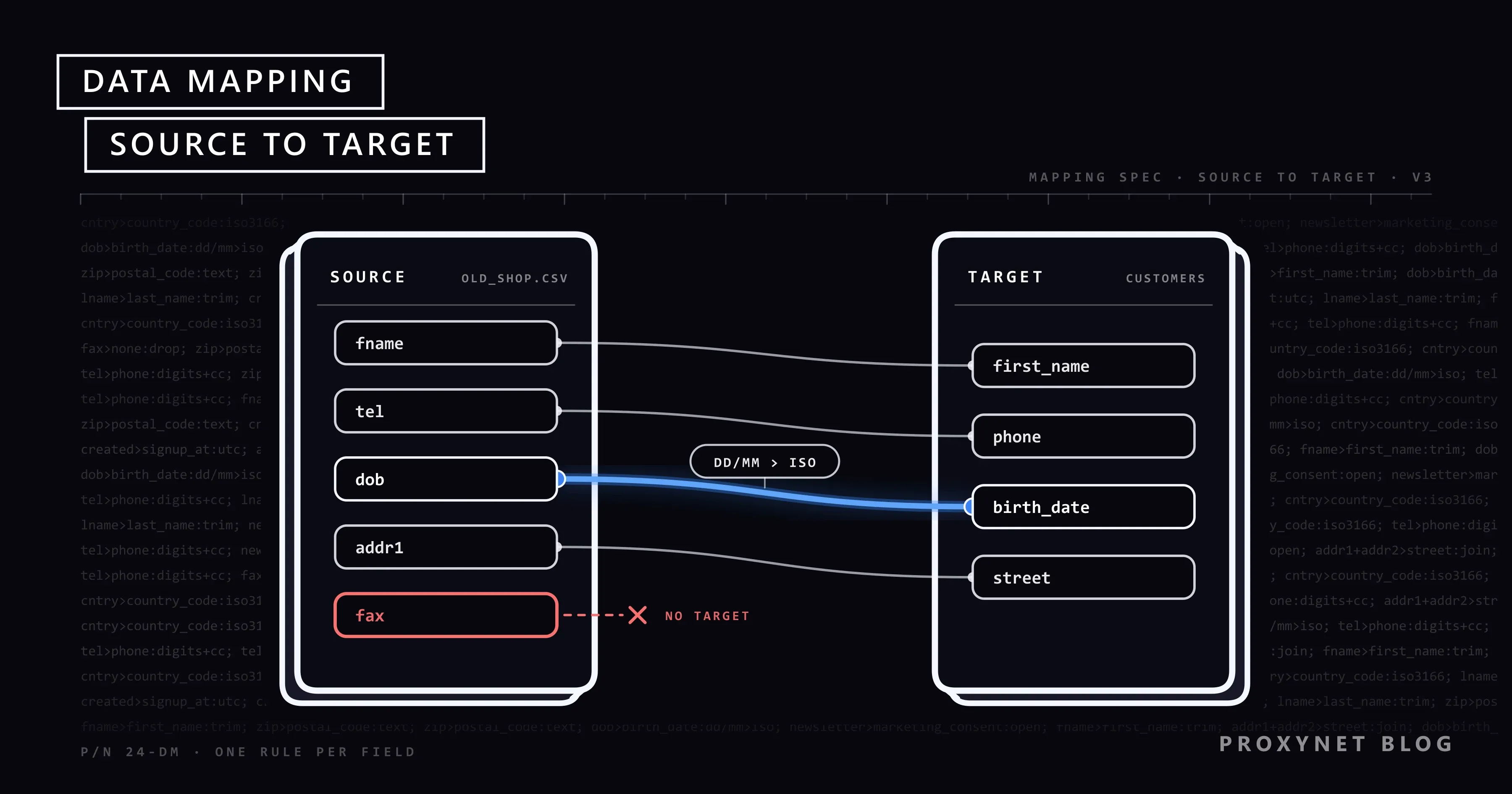
A small online shop is moving to a new e-commerce platform. The old system exports 38,000 customers with columns called fname, tel and dob, and the birthdays look like 03/04/1990; the new platform expects first_name, a phone number with its country code and dates written as 1990-04-03. Before anything is imported, someone has to decide, column by column, where each value goes and how it changes on the way. That table of decisions is a data map, and making it is data mapping.
A week later the shop's privacy lead asks a different question under the same name: which systems hold customer data, why, and who receives it. This post covers both meanings: field mapping and its document, the main approaches, and how privacy teams map personal data for the GDPR and Türkiye's KVKK.
What is data mapping?
Data mapping is the work of describing how data in one place corresponds to data in another. The output is a map: a list of pairs (this source field becomes that target field) with a rule for each pair, or, in privacy work, a list of where personal data sits and where it goes.
The term covers two jobs that share a method but serve different readers:
| Meaning | Question it answers | Usual owner | Deliverable |
|---|---|---|---|
| Integration mapping | Where does each field go, and how does it change? | Data engineer or analyst | Source-to-target mapping document |
| Privacy mapping | What personal data do we hold, why, and where does it flow? | Privacy lead or DPO | Data inventory, flow map, processing record |
How does field-to-field data mapping work?
Field-to-field mapping works by listing the fields on both sides, pairing them and writing a conversion rule for every pair before any data moves. A typical sequence has seven steps:
- Profile the source. List every field with its type, a few sample values, how often it is empty and which format it uses. A column called
phonemay hold landlines, mobile numbers and the words "ask reception". - Fix the target schema. A schema is the formal description of a data structure: which fields exist, their types, which are required and which values are allowed.
- Pair the fields. Match each source field to a target field. Some pairs are one-to-one; others split one field into two or join several into one.
- Write the transformation rules. State how each value changes: date formats, decimal separators, units, currencies, code lists (
MandFtomaleandfemale), trimming and defaults for empty values. - Decide what is not mapped. Every source field ends up mapped, deliberately dropped or flagged as an open question. Silent drops are how data goes missing.
- Test with real samples. Run a few hundred records through the rules and compare the output with the source by hand, including empty fields, accented names and extreme values.
- Run, monitor and version. Count records in and out on every run, log rejected rows and version the map, so that a change in either system leads to a change in the map.
Step 4 is where most bugs hide. On our test machine, Node.js 24 read the string "03/04/1990" as 4 March 1990, not 3 April; converted to UTC it became 3 March, because the machine's clock was two hours ahead of UTC on that date, and "13/04/1990" was rejected as an invalid date. A rule that only says "birth date to ISO date" without naming the source order (day first or month first) leaves that choice to whichever parser happens to run it.
What does a data mapping document look like?
A data mapping document is a table with one row per field, showing where each value comes from, where it goes and which rule changes it. For the shop migration above:
| Source field | Target field | Rule |
|---|---|---|
fname | first_name | Trim spaces |
tel | phone | Digits only, add country code |
dob | birth_date | Read DD/MM/YYYY, write YYYY-MM-DD |
addr1 + addr2 | street | Join with one space |
cntry | country_code | Name to two-letter ISO 3166 code |
fax | (none) | Dropped: no longer used |
newsletter | marketing_consent | Open: check consent records |
Real documents add columns for data type, owner and test status; most "data mapping templates" are this table with those extra columns. The last two rows matter most. A dropped field is a decision someone signed off, and a consent flag cannot be assumed: if the old system never recorded how consent was given, the new one should not show it as given.
What are the types of data mapping?
Data mapping is done in three ways: manually, schema-driven with tool support, and automated with matching suggestions. Most real projects mix all three.
| Approach | How it works | Fits | Main risk |
|---|---|---|---|
| Manual | People pair fields in a spreadsheet | Small or one-off migrations | Typos, no tests |
| Schema-driven | Both schemas loaded into a tool; rules in an editor or code | Recurring integrations, ETL | Code and document drift apart |
| Automated | Tool suggests pairs from names, types and sample values | Many similar sources | Confident wrong matches |
Automated suggestions save time on obvious pairs such as email to email_address, but a name says little about meaning: date is the order date in one source and the delivery date in another. Treat every suggested pair as a proposal that a person confirms.
Field relationships come in kinds, each needing its own rule: one-to-one, many-to-one (two address lines joined), one-to-many (a full name split in two, which breaks on many real names), lookups through a reference table and constants the source lacks.
How is data mapping different from transformation, ETL and lineage?
Data mapping is the specification, transformation is the execution of its rules, ETL is the pipeline that runs them, and data lineage is the record of where a value actually came from. The map says "dob becomes birth_date, read day first"; the transformation is the step that does it. ETL (extract, transform, load) pulls data from the source, applies those transformations and loads the result into a database, as What Is ETL? shows step by step.
Lineage looks backwards: for a figure on a dashboard, it shows which tables, jobs and source fields produced it, and a good mapping document makes it easier to trace. A data dictionary describes the fields of one system without relating them to another.
Mapping also comes before cleaning. Once fields line up, the wrong, duplicated or inconsistent values become visible and can be fixed; What Is Data Cleaning? covers that step.
What is data mapping in data privacy?
In data privacy, data mapping means finding out what personal data an organization holds, where it is stored, why it is processed, who receives it and how long it is kept. Personal data is any information about an identified or identifiable person: a name, an email address, a customer number, an IP address in a server log.
Privacy teams usually produce two things. A data inventory lists processing activities (payroll, recruitment, order handling, the newsletter) with the data and systems each one uses. A data flow map shows how that data moves: from a web form into the shop database, out to a payment provider, every night into a CRM, every month to an accountant abroad. Flows are where surprises appear, such as a support tool that copies full customer records to a server in another country.
What does GDPR Article 30 require?
Article 30 of the GDPR requires each controller, meaning the organization that decides why and how personal data is processed, to keep a written record of its processing activities, often shortened to RoPA. The record must contain:
- the name and contact details of the controller and, where relevant, its representative and data protection officer;
- the purposes of the processing;
- the categories of people and of personal data concerned;
- the categories of recipients, including recipients in other countries;
- transfers to countries outside the EU or to international organizations;
- where possible, time limits for erasing each category of data;
- where possible, a general description of the security measures.
Processors, the companies that handle data on a controller's behalf such as a hosting or payroll provider, keep a shorter record of their own. Both records may be electronic and must be shown to the supervisory authority on request (GDPR text on EUR-Lex).
The exemption for organizations with fewer than 250 employees is narrower than it sounds. It applies only if the processing is unlikely to put people's rights at risk, is occasional, and involves no special categories of data (such as health data) and no criminal-record data. Payroll and a customer database are not occasional, so most small companies keep a record anyway. The European Commission has proposed changes to this exemption; on 19 November 2026, EUR-Lex still lists them as proposals, not as amendments in force.
The European Data Protection Board's guide for small businesses gives a practical starting point: identify which of your activities involve personal data, such as recruitment, payroll or access badges, and describe each one (EDPB guide for small businesses). The data map is the working material and the Article 30 record is the formal document built from it; the map's extra detail (table names, fields, servers) is what keeps the record accurate.
The same map feeds a data protection impact assessment (DPIA). Article 35 requires one before processing that is likely to result in a high risk to people, such as large-scale processing of health data, and nobody can assess the risk of data they have not located.
Türkiye's data protection law, the KVKK, has a close equivalent. Under the country's regulation on the data controllers' registry, controllers that must register in the public registry, VERBIS, prepare a personal data processing inventory. It covers purposes and legal grounds, data categories, recipient groups, groups of people, maximum retention periods, planned transfers abroad and security measures, and the registry entry is based on it.
How do you build a personal data map?
You build a personal data map by starting from business activities rather than from databases, then tracing each activity to its systems, data and recipients:
- List the activities. Ask each team what it does with information about people: hiring, payroll, sales, support, marketing, website analytics, security logs.
- Find the systems. Name the applications, databases, spreadsheets, shared drives and mailboxes each activity uses, including software that vendors run for you.
- Record the data and the people. Note which categories of data (contact, payment, health) are held about which groups (customers, staff, applicants, visitors).
- Note the purpose and legal basis. Write down why the data is processed and on which ground the law allows it.
- Trace the flows. Record where the data comes from, which vendors receive it and whether it leaves the country.
- Set retention and security. State how long each category is kept and what protects it.
- Keep it current. Tie updates to events: a new tool, a new vendor, a new form on the website.
Teams that collect public web data should add those datasets too, since scraped pages often carry names, profile links or email addresses; how to handle personal data in scraped datasets explains how to cut such fields down.
Where do proxies fit in data mapping?
Proxies come in before mapping, at the collection stage, when the data you map comes from public web pages in several countries. A product page in Germany prints the price with a decimal comma, the US version uses a dot, and one site labels stock as availability while another shows only a badge. A proxy exit in each country shows the page a local visitor sees, and mapping all versions to one schema (product, price, currency, stock, country, collection time) is the first step before any comparison. Teams that would rather receive the data already structured can use our Web Scraping API, a managed page extraction service available through our sales team.
A data map is also a security tool: it tells you what a leak would expose. Security teams that watch public sources for leaked company data use data security proxies to run that research away from their own network, within the legal limits that apply to it.
Where is data mapping used?
- Data migrations: moving to a new CRM, shop platform or accounting system.
- ETL and data warehouses: loading many systems into one reporting model.
- Integrations: keeping orders in sync between a shop and an invoicing tool.
- Mergers: combining two companies' customer and product data.
- Web data: turning pages from many sites and countries into one table.
- Privacy compliance: the GDPR record, the KVKK inventory, DPIAs and requests from people who want a copy of their data.
Common mistakes
- Mapping by field name alone.
date,statusandtypemean different things in different systems. - Leaving source formats unstated. Dates, decimal separators, units and encodings need an explicit rule.
- Dropping fields silently. Every unmapped field needs a recorded decision.
- Testing only clean rows. Empty fields, long names and foreign characters break rules that pass on tidy samples.
- Treating the document as finished at go-live. A schema change without a map change breaks data quietly.
- Carrying consent flags over without proof. They need evidence, not a default value.
- Building the privacy map from IT systems only. Spreadsheets, mailboxes and vendors' tools hold personal data too.
Decision guide
| Need | Recommendation |
|---|---|
| Move data to a new system once | Source-to-target spreadsheet, tested on samples |
| Recurring integration | Schema-driven mapping in the ETL tool, versioned |
| Many similar sources (feeds, sites) | One target schema; tool suggestions confirmed by a person |
| GDPR record of processing | Activity-based inventory first, then the Article 30 record |
| High-risk processing planned | Data map first, then a DPIA |
| Registered controller in Türkiye | KVKK processing inventory as the base for VERBIS |
| A person asks for their data | Use the map to find every system that holds it |
Frequently asked questions
What is data mapping in simple terms?
Data mapping is deciding where each piece of data goes when it moves from one system to another, and how it changes on the way. In privacy work, it means listing where personal data is kept, why, and who receives it.
What is an example of data mapping?
A shop moving to a new platform maps its old fname column to the new first_name field and converts birthdays from 03/04/1990 to 1990-04-03. A privacy example is a table showing that customer emails sit in the shop database, go to a newsletter tool and are deleted two years after the last order.
Can I do data mapping in Excel?
Yes. For one-off migrations a spreadsheet is the most common format: one row per field with source, target, rule, type and status. For recurring integrations, keep the spreadsheet as the specification and the rules in your ETL tool, and update both together.
What is data mapping under the GDPR?
It is the groundwork for the Article 30 record: which personal data you process, why, about whom, who receives it, where it goes and how long it is kept. The regulation requires the record, not a diagram, but few organizations can write an accurate record without mapping first.
Is a data map the same as a record of processing activities?
No. The data map is the detailed working view of systems, fields and flows; the record is the formal list the GDPR requires, organized by activity. Most teams build the record from the map.
Who is responsible for data mapping?
For integrations, data engineers or the migration team own the mapping document, and each field's business owner confirms its meaning. For privacy, the controller is responsible, usually through a privacy lead or data protection officer who collects input from every team.
Summary
Data mapping means pairing fields between systems with a written rule for each, and locating personal data, its purposes and its flows for privacy compliance. Field mapping fails on unstated formats and silent drops; privacy mapping starts from activities and becomes the GDPR Article 30 record or, in Türkiye, the KVKK inventory. If your sources are public web pages in several countries, map them to one schema from the start and collect each page from the country it describes, for example through a Residential Proxy with country targeting.