A software company outside Europe adds a chat assistant to its online store, and its first customers are in Germany and France. In the same quarter, its HR team starts testing a tool that ranks job applicants by their CVs. Both features use AI, both touch people in the EU, and the company's lawyer asks the same question about each: what does the EU AI Act say about this? The answers are very different, because the law sorts AI by what it is used for, not by the technology inside.
This post covers whom the act applies to, its four risk levels, the banned practices, high-risk duties, transparency rules for chatbots and generated content, rules for general-purpose AI models, the timeline as amended in 2026, fines and AI literacy. It is a plain-language overview, not legal advice; for a decision about your own product, read the official text and ask a lawyer.
What is the EU AI Act?
The EU AI Act is a European Union regulation that sets common rules for developing, selling and using artificial intelligence, with stricter rules for uses that pose more risk to health, safety and fundamental rights. It is Regulation (EU) 2024/1689, published in the EU's Official Journal on 12 July 2024 and in force since 1 August 2024.
As a regulation, it applies directly in every member state; each country appoints the authorities that enforce it. It defines an AI system as a machine-based system that works with some autonomy and infers from its input how to produce outputs such as predictions, content, recommendations or decisions. That covers a credit-scoring model, a chatbot and an image generator, but not software that only follows fixed rules written by a person.
In July 2026 the EU amended the act with the Digital Omnibus on AI, Regulation (EU) 2026/1744, in force since 27 July 2026. It postpones the high-risk rules, adds two bans and eases some duties for smaller companies. This post reflects the amended text.
Who does the EU AI Act apply to?
The act applies to every company in the AI supply chain whose systems reach the EU market or whose AI output is used in the EU, wherever the company is based. It names four main roles:
- Provider: develops an AI system or a general-purpose AI model, or has one developed, and puts it on the market under its own name, paid or free.
- Deployer: uses an AI system under its own authority, such as a bank using a credit-scoring tool or a shop using a chatbot. Personal, non-professional use is excluded.
- Importer: an EU-based company that brings a non-EU provider's system onto the EU market.
- Distributor: anyone else in the chain who makes the system available in the EU, such as a reseller.
A provider in Canada selling an AI system in the EU is covered, and so is a provider or deployer anywhere whose system's output is used in the EU.
What are the four risk levels?
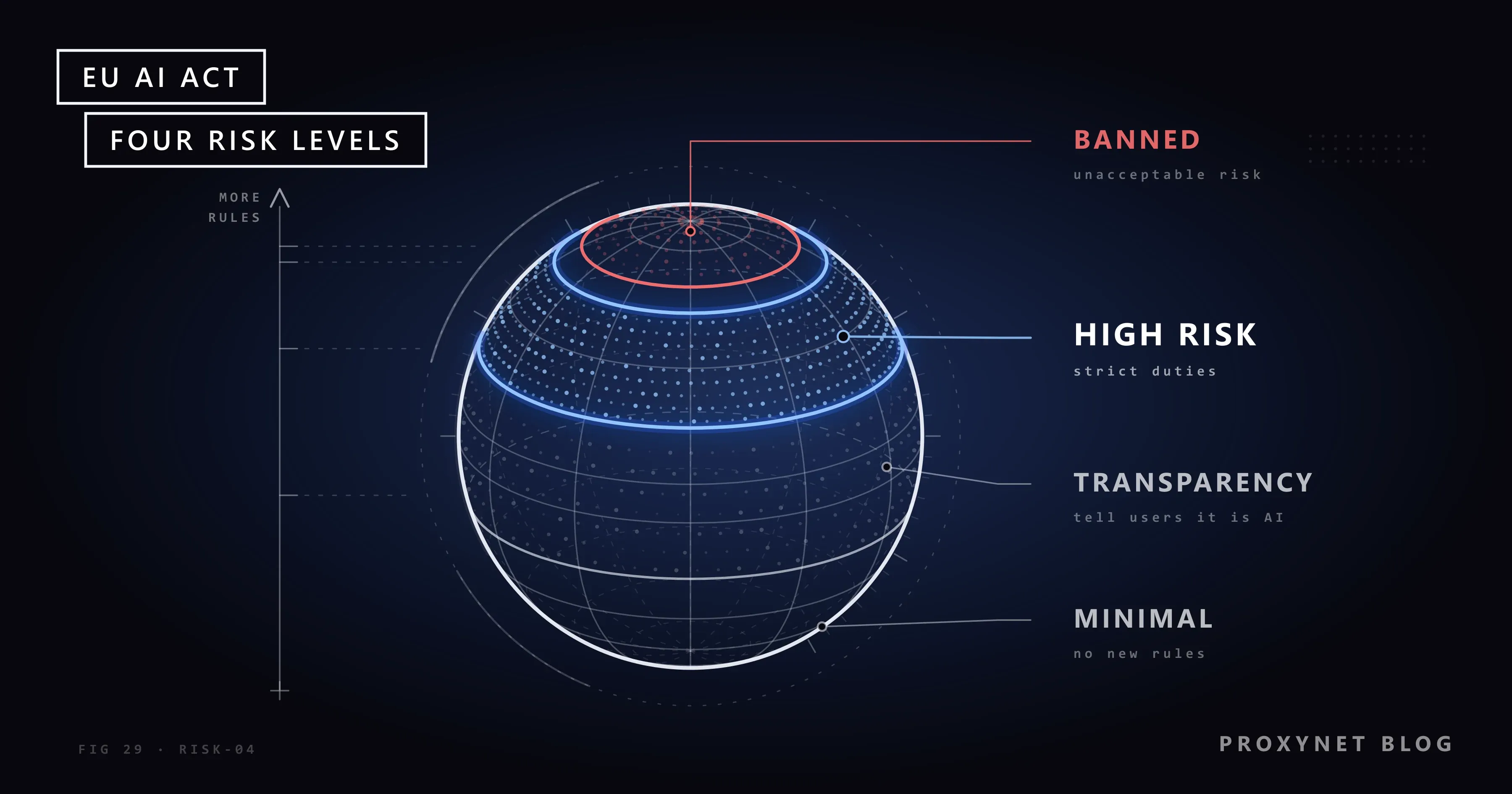
The EU AI Act sorts AI systems into four levels, each with different obligations. Finding a system's level takes four checks:
- Is the use banned? If the system does one of the practices in Article 5, it cannot be used in the EU.
- Is it high-risk? A system is high-risk if it is a safety component of a product already covered by EU safety law (Annex I, such as medical devices) or if it is used in one of eight sensitive areas listed in Annex III.
- Does it carry transparency duties? Systems that talk to people, generate content or recognise emotions must disclose it, whatever their other level.
- Everything else is minimal risk. The act adds no new obligations.
| Risk level | Examples | What applies |
|---|---|---|
| Unacceptable | Social scoring, emotion recognition at work | Banned |
| High | CV ranking, credit scoring, exam scoring | Strict requirements |
| Limited (transparency) | Chatbots, deepfakes | Tell people it is AI |
| Minimal | Spam filters, AI in video games | No new rules |
The European Commission's overview of the AI Act calls the third level "transparency risk" and says the vast majority of AI systems used in the EU today are minimal risk.
Which AI practices are banned?
Article 5 bans AI practices that the EU considers a clear threat to people's safety or rights, and these bans have applied since 2 February 2025:
- manipulative or deceptive techniques that distort a person's decisions and cause significant harm;
- exploiting vulnerabilities linked to age, disability or social or economic situation;
- social scoring that leads to unfair or unrelated unfavourable treatment;
- predicting that a person will commit a crime based only on profiling or personality traits;
- building facial recognition databases by untargeted scraping of face images from the internet or CCTV;
- inferring emotions in workplaces and schools, except for medical or safety reasons;
- biometric categorisation that infers sensitive traits such as race, political views, religion or sexual orientation;
- real-time remote biometric identification in public spaces for law enforcement, except in narrow, listed cases.
The 2026 amendment adds two bans from 2 December 2026: AI that generates realistic intimate images of an identifiable person without consent, and AI that generates child sexual abuse material.
What must high-risk AI systems do?
High-risk AI systems may be sold and used only after the provider meets a set of requirements, and their users have ongoing duties. The eight Annex III areas are biometrics; critical infrastructure; education and vocational training; employment and workers' management; access to essential private and public services, such as credit scoring; law enforcement; migration, asylum and border control; and the administration of justice and democratic processes.
Not every tool in those areas is high-risk. A system that only performs a narrow procedural task, or only improves work a person has already done, can fall outside the category if it poses no significant risk. A system that profiles people is always high-risk.
The provider must run a risk management system, use training, validation and test data that meet quality rules, write technical documentation, make the system keep logs, give deployers clear instructions, design it for human oversight and make it accurate, robust and secure. It must then pass a conformity assessment, carry the CE marking and register the system in an EU database.
Deployers have shorter but real duties: use the system as instructed, assign trained people to oversee it, monitor how it works, keep its logs and inform workers before using it at their workplace.
What transparency rules apply to chatbots and deepfakes?
Article 50 requires people to be told when they are dealing with AI, and its duties have applied since 2 August 2026:
- Chatbots: a system that talks with people must let them know it is an AI, unless that is obvious from the context.
- Generated content: providers of systems that generate audio, images, video or text must mark the output in a machine-readable way so that it can be detected as AI-generated. This is often called watermarking.
- Emotion recognition and biometric categorisation: deployers must inform the people exposed to them.
- Deepfakes and public-interest text: deployers must disclose deepfake images, audio and video, and AI-written text published to inform the public, unless a person reviewed that text and took editorial responsibility.
Generative systems already on the market before 2 August 2026 have until 2 December 2026 to add the marking. On 10 June 2026 the Commission published a voluntary Code of Practice on marking and labelling AI-generated content with practical steps for both roles. Such output is also called synthetic content, which differs from the synthetic data that teams create to train and test models.
What are the rules for general-purpose AI models?
General-purpose AI models, trained on large amounts of data to perform a wide range of tasks, have had their own obligations since 2 August 2025, separate from the risk levels of the systems built on them. The large language models behind chat assistants are the best-known example; What Is an LLM? explains how they are trained. The provider must:
- keep technical documentation of the model, including how it was trained and tested;
- give companies that build on the model the information they need about its capabilities and limits;
- have a policy for complying with EU copyright law, including the machine-readable opt-outs that rights holders use to reserve their works from text and data mining;
- publish a sufficiently detailed summary of the content used for training, on a template from the AI Office.
The Commission published that training-content template on 24 July 2025. For data collected from the web, it asks for the names of the crawlers used, the period of collection and the top 10% of domains scraped; small and medium-sized companies list the top 5% or 1,000 domains, whichever is lower. Models placed on the market before 2 August 2025 have until 2 August 2027.
This is where model training meets public web data collection: teams now need records of which crawler collected what, from which domains and when, and must respect publishers' opt-outs. Whether collecting public pages is lawful at all depends on more than the AI Act, as Is Web Scraping Legal? explains.
Our data scraping solutions page describes the proxy pools we provide for collection jobs; the same records apply whatever tool you use.
Models trained with more than 10^25 floating-point operations are presumed to carry systemic risk and face extra duties: testing against misuse, incident reporting and cybersecurity. The voluntary General-Purpose AI Code of Practice, published on 10 July 2025, gives providers one way to show compliance.
What is the EU AI Act timeline?
The EU AI Act applies in stages, and the Digital Omnibus on AI moved the high-risk dates later. The amended dates are set out in Regulation (EU) 2026/1744, published on 24 July 2026:
| Date | What applies |
|---|---|
| 1 August 2024 | The act enters into force |
| 2 February 2025 | Bans and AI literacy |
| 2 August 2025 | General-purpose AI model duties, penalties |
| 2 August 2026 | Transparency duties, most other rules |
| 2 December 2026 | Two new bans; marking for older systems |
| 2 August 2027 | Models placed before 2 August 2025 |
| 2 December 2027 | High-risk systems in Annex III areas |
| 2 August 2028 | High-risk systems in Annex I products |
Before the amendment, the high-risk rules were due on 2 August 2026 (Annex III) and 2 August 2027 (Annex I); they were postponed, not removed. The Commission proposed the change on 19 November 2025 and the regulation was signed on 8 July 2026, so it is adopted law, not a proposal. Check the consolidated text on EUR-Lex before you plan against a date.
What are the fines under the EU AI Act?
The EU AI Act sets three tiers of maximum fines, each the higher of a fixed amount or a share of worldwide annual turnover:
- up to EUR 35 million or 7% for using a banned practice;
- up to EUR 15 million or 3% for breaking most other obligations, including the high-risk and transparency rules;
- up to EUR 7.5 million or 1% for giving incorrect or misleading information to authorities.
For small and medium-sized companies, including start-ups, each fine is capped at the lower of the two figures, and the 2026 amendment extends this to small mid-caps. National authorities enforce the rules for AI systems; for general-purpose models, the Commission can fine providers up to EUR 15 million or 3% of turnover, whichever is higher.
What does AI literacy mean under Article 4?
Article 4 asks providers and deployers to take measures to build the AI literacy of their staff, meaning the knowledge to use AI systems in an informed way and to understand their risks. It has applied since 2 February 2025, and the 2026 amendment softened the wording: companies must support their staff's AI literacy without guaranteeing a specific level for each person. In practice this means short training on what the tools can do, which data may go into them and when an output needs a human check.
Where you meet the EU AI Act in practice
Most companies meet the act through ordinary products. An HR department that buys a CV-screening tool is a deployer of a high-risk system from 2 December 2027, and its vendor is the provider with the main requirements; a lender scoring credit applications is in the same position. A support chat assistant must say that it is an AI, and a marketing team that publishes AI-generated video has to watch the deepfake rule.
Product teams that ship an AI feature in several EU countries also check what each market actually sees, such as whether the AI notice appears in the local language. Our localization testing page describes how teams check a site from real IPs in the countries they serve.
Common mistakes
- Assuming the act only covers EU companies. Selling into the EU, or using AI output there, brings a company in scope.
- Treating "AI" as one category. The same model can be minimal risk in one product and part of a high-risk system in another; the use decides.
- Reading old deadlines. Guides written before July 2026 give 2 August 2026 for all high-risk rules; the amended dates are later.
- Thinking the postponement removed the duties. The high-risk requirements are unchanged in substance; only the dates moved.
- Forgetting the deployer side. Buying a compliant tool does not end the buyer's duties of oversight, monitoring and logs.
- Treating GDPR compliance as enough. The two laws apply side by side.
Decision guide
| Situation | What to check first |
|---|---|
| A chatbot on an EU-facing site | Article 50 disclosure |
| Publishing AI images or video | Deepfake labelling, marking |
| Buying an HR, credit or exam tool | High-risk deployer duties |
| Building a product on an LLM | Your provider role |
| Training a general-purpose model | Article 53, training summary |
| Staff using AI tools at work | Article 4 AI literacy |
Frequently asked questions
When does the EU AI Act come into effect?
It entered into force on 1 August 2024 and applies in stages: bans from 2 February 2025, model duties from 2 August 2025, transparency duties from 2 August 2026 and high-risk rules from 2 December 2027 or 2 August 2028.
Does the EU AI Act apply to companies outside the EU?
Yes, when their AI reaches the EU. A provider anywhere that places an AI system or model on the EU market is covered, and so is a provider or deployer whose system's output is used in the EU.
Is ChatGPT high-risk under the EU AI Act?
Not by itself: a general chat assistant is not on the high-risk list. Its model has the general-purpose AI duties and the chat must disclose that it is an AI. If a company puts it to a high-risk use, such as ranking job applicants, that use can fall under the high-risk rules.
What does Article 50 of the EU AI Act require?
Article 50 is the transparency article. Chatbots must disclose that they are AI, generative systems must mark their output in a machine-readable way, and deployers must disclose deepfakes and inform people exposed to emotion recognition.
What is the difference between the EU AI Act and the GDPR?
The GDPR protects personal data whenever it is processed, while the AI Act regulates AI systems by risk, whether or not they use personal data. An AI tool that processes personal data must meet both laws.
Where can I read the official text of the EU AI Act?
The official text is on EUR-Lex, the EU's legal database, as Regulation (EU) 2024/1689, in every official EU language and as a PDF. The 2026 changes are in Regulation (EU) 2026/1744, and EUR-Lex also publishes consolidated versions that merge amendments into the original text.
Summary
The EU AI Act regulates AI by risk: a short list of practices is banned, high-risk systems in hiring, credit, education and similar areas must meet strict requirements, chatbots and generated content must be disclosed, and general-purpose models must document their training. It reaches companies outside the EU whenever their AI is used there. Most rules already apply, and the high-risk rules start on 2 December 2027 and 2 August 2028; map each AI feature to its risk level and your role, and take legal advice for decisions that depend on it.