


































A coworking marketplace lists 400 desks in 60 cities. Someone suggests a page for every "coworking in {city}" search and every "{city} coworking with {amenity}" variant: 60 cities times 12 amenities is 720 pages from one template, live by Friday. Two months later Search Console shows most of them as "Crawled - currently not indexed". The pages that do get clicks are the few dozen with enough real listings to fill a table; the rest say the same thing with a different city name.
That gap between the two groups is what programmatic SEO is about. This post explains the method, how a programmatic section is built from a search pattern, a dataset and a template, and which patterns work. It then covers where Google draws the line between scale and spam, the quality gates that keep weak pages out, internal links, and how to measure the result in Search Console.
What is programmatic SEO?
Programmatic SEO is a way of publishing pages at scale: a program fills a page template with rows from a dataset, one page per row or per combination of values. Each page targets one long-tail query, a specific, lower-volume search such as "coworking in Porto with parking", rather than a broad term such as "coworking".
The method fits searches that share a shape. When people search "{currency A} to {currency B}" or "{tool} alternatives", the question stays the same and only the values change, and the useful content, the numbers, listings or specifications, already sits in a database.
"Programmatic" here has nothing to do with programmatic advertising, the automated buying of ad space. The word does not appear in Google's spam policies either: Google judges the pages that come out of the process, not the process.
How is programmatic SEO different from traditional SEO?
Traditional SEO creates one page per topic, written by a person, while programmatic SEO puts the effort into one template and one dataset that produce many pages. The goals are the same: match what the searcher wants, load fast, be crawlable and earn links.
The risks differ. A badly written article is one weak page; a badly designed template is the same weakness copied a thousand times, and it can change how search engines see a whole section of the site. Programmatic work needs more checking before launch, not less.
How does programmatic SEO work, step by step?
A programmatic section moves from a search pattern to a dataset, a template, generated pages, internal links and finally measurement.
- Find a repeating pattern. Look for queries with a fixed part and a variable part. Your Search Console queries and keyword research show which variations people actually search.
- Check the intent. Search a few variations yourself. If "coworking in Porto" and "coworking in Lyon" return the same kind of page, one template can serve both.
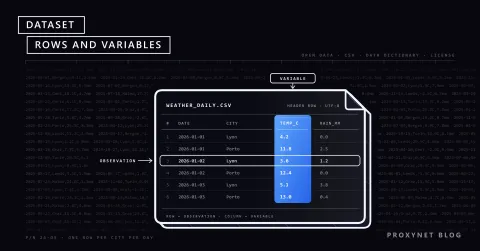
- Build the dataset. One row per page, with the facts that make each page different: listings, prices, counts, opening hours.
- Design the template. Fixed text explains the topic once; slots take values from the dataset; blocks such as tables or FAQs appear only when the row has data for them.
- Generate with rules. Skip combinations without enough data instead of publishing an empty shell.
- Link the pages. Hub pages, breadcrumbs and "nearby" links connect them to the rest of the site.
- Publish in batches and measure. Watch indexing and clicks, then improve, merge or remove what does not work.
A template is easier to judge when you write it down with its slots visible:
Title:    Coworking spaces in {city} ({listing_count} listed)
H1:       Coworking in {city}
Intro:    {listing_count} spaces in {district_count} districts; day passes from {min_price}.
Table:    {listings}  -> name, district, day price, opening hours
Block:    {transport_note}   (only if the row has one)
FAQ:      {city_faq}         (only if the row has two or more answers)
Everything in braces comes from the dataset. If you delete the city name and the page still says almost everything it said before, the template is carrying the page, not the data. The same row can also fill the page's structured data, the JSON-LD block described in What Is Schema Markup?, so search engines read the facts the visitor sees.
What are common programmatic SEO examples?
Common patterns are locations, integrations, comparisons, glossaries and conversions, and each works only when the variable part brings real information.
| Pattern | Example query | Each page needs |
|---|---|---|
| Location | coworking in {city} | Local listings, prices |
| Integration | {app A} + {app B} | Real setup steps, limits |
| Comparison | {tool A} vs {tool B} | Measured differences |
| Glossary | what is {term} | A written definition |
| Conversion | {unit A} to {unit B} | A working calculator |
| Directory | {category} near {area} | Current, verified entries |
The pattern is never the problem. A location page with ten current listings and local prices answers its query; a location page that swaps the city name into the same three paragraphs does not.
What makes a good dataset for programmatic pages?
A good dataset gives every page facts no other page in the set has, keeps them current and comes from a source you may publish.
- First-party data is the strongest. Your own inventory, listings, prices or usage figures are unique by definition.
- Licensed and open data need a licence check. Statistics offices and open data portals publish useful tables; the licence decides how you may republish them.
- Freshness is part of quality. A page listing closed businesses or old prices is worse than no page.
- Coverage gaps are information. If 40 of your 60 cities have fewer than three listings, those 40 pages should wait.
Rewriting other sites' content is not a dataset. Google's spam policies list scraping feeds, search results or other content to generate many pages as an example of scaled content abuse, automated rewording and translation included.
When does programmatic SEO become spam?
Programmatic SEO becomes spam when pages are produced mainly to rank rather than to help, and two Google policies cover it: scaled content abuse and doorway abuse.
Google's spam policies define scaled content abuse as many pages generated for the primary purpose of manipulating search rankings and not helping users, typically unoriginal content of little value "no matter how it's created". Google announced the policy on 5 March 2024 with that month's core update. It extended an older rule against automatically generated content and applies whether the content comes from automation, people or both.
Doorway abuse is the policy closest to careless location pages. Google describes doorways as pages created to rank for specific, similar queries that lead users to intermediate pages less useful than the final destination. Its examples include pages aimed at specific regions or cities that funnel users to one page, and substantially similar pages that are closer to search results than to a browseable hierarchy.
Generative AI does not change the rules. Google allows AI-generated content, but using it to generate many pages without adding value may violate the scaled content policy, and titles, descriptions and structured data need the same fact-checking as the body. Violations are found by automated systems and, where needed, by human review that can end in a manual action; affected pages can rank lower or drop out of results.
How do you test a template against Google's questions?
You test a template by asking Google's people-first questions of a sample of generated pages, not of the template in the abstract. Google's guide to creating helpful, reliable, people-first content lists them; three fit programmatic work directly.
- Does the page add substantial value compared with other pages in the results? Search the query and compare honestly.
- Is extensive automation producing content on many topics? Google lists this among its warning signs.
- Would the visitor need to search again? A city page without listings sends people straight back.
A practical version is the name-swap test: take two generated pages, replace the variable names with a placeholder and compare the text. If most sentences match, the pages differ only by the keyword. Google also suggests explaining how content was produced where readers would wonder, so a line such as "listings updated daily from our database" belongs on the page.
Which quality gates should a programmatic page pass?
Every generated page should pass a short list of automatic and human checks before it can be indexed.
- Minimum data rule. Define the least a page needs, say three current listings and a price, and do not generate pages below it.
- Uniqueness check. Run the name-swap comparison across the whole set and stop the release when pages collapse into the same text.
- Weak pages stay out of the index. Use a
noindexrobots meta tag orX-Robots-Tagheader, and do not also block those pages in robots.txt, or Google never sees thenoindex. - Near duplicates get a canonical. A redirect or
rel="canonical"tells Google which URL is the main one; Google does not recommendnoindexfor that job. - A person reads a sample. Ten random pages per batch catch wrong units and empty blocks that scripts miss.
Our own site has a programmatic section: the location pages for countries and cities share templates. Before a release, a check masks place names and numbers, compares each city page's sentences with its country page and with the other city pages, and fails if a city page turns out to be its country page reworded or a copy of another city.
How do internal links and crawl budget fit in?
Internal links decide whether generated pages are found at all. A page that exists only in a sitemap, with no links from other pages, is an orphan and gets crawled slowly.
Build a hierarchy a visitor could browse: a hub for each country links its cities, each city links its listings, and breadcrumbs lead back up. That structure is also what separates a directory from doorways. Give each template its own sitemap file and keep its lastmod dates honest.
On very large sites, crawling becomes a limit of its own: Googlebot fetches only so many URLs per day, and thousands of thin variants push useful pages back in the queue. What Is Crawl Budget? explains how that limit is set and checked.
How do you measure programmatic pages in Search Console?
You measure a programmatic section with two Search Console reports: Page indexing shows how many generated pages Google indexed, and Performance shows which ones earn impressions and clicks.
In the Page indexing report, the filter above the chart can show a single sitemap, one more reason to give each template its own. Three statuses matter most:
- Crawled - currently not indexed: Google fetched the page and chose not to index it, often the first sign of thin pages.
- Discovered - currently not indexed: Google knows the URL but postponed the crawl.
- Duplicate without user-selected canonical: Google sees the page as a copy of another one.
The Performance report shows clicks, impressions, click-through rate and average position by query, page, country, device, search appearance or date. Filter the page URL by a part such as /coworking/, then open the Pages tab to see which generated pages earn impressions and the Countries tab to see where. Pages with no impressions after a few months are candidates to improve, merge or remove with a 404 or 410.
How do you check location pages from other countries?
You check location pages from other countries in Search Console first, and with a few manual spot checks where Search Console stops: it breaks data down by country, not by city, and only for your own site.
For a few important city pages, a specialist can search the main query and open the page as a local visitor would, through a Residential Proxy in that country and city. That shows whether local results include the page and whether it shows the right currency, language and listings there. Keep it at human scale: Google's spam policies count automated queries, including scraping results for rank checking, as machine-generated traffic, whatever the IP address.
Rankings across many cities need a different route: the Search Console API for your own data and licensed SERP data for the rest, both covered in How to Automate SEO Rank Tracking.
Where is programmatic SEO used?
- Marketplaces and directories: one page per category and location, filled with current listings.
- Travel and local services: destinations, routes and service areas with prices.
- Software companies: integration pages, one per connected app, with real setup steps.
- Finance and utility sites: currency and unit conversions backed by a working calculator.
- Job boards and real estate: role or property type by city, with live counts.
Common mistakes
- Publishing every combination. Twelve amenities times 60 cities sounds like coverage; most of those pages have no data.
- Spinning the same text. Rotating synonyms does not create information, and Google lists automated rewording as scaled content abuse.
- Blocking weak pages in robots.txt and adding
noindex. The block stops Google from reading the tag. - Launching everything at once. A staged rollout shows problems while they are small.
- Letting data go stale. Changing a page's date without changing its content is one of Google's warning signs.
- Titles that promise more than the page holds. "Top 10" on a page with three entries misleads.
Decision guide
| Your situation | What to do |
|---|---|
| Each value has a clearly different answer | Build a template; start with the best-covered rows |
| Only the name changes between pages | Write one strong page instead |
| Rows with too little data | Skip them or keep them noindex |
| Many "Crawled - currently not indexed" pages | Add data, merge or remove the weakest |
| Pages compete for the same query | Merge them or set a canonical |
| Need city-level checks for key pages | Search Console by country, then manual local checks |
Frequently asked questions
Does programmatic SEO still work in 2026?
Yes, when each page carries information its siblings do not. Google's policies target pages made mainly to rank, not templates as such, so directories, integration pages and calculators built on real data can rank. Google said its March 2024 changes aimed to show less content that feels made to attract clicks.
Is programmatic SEO against Google's guidelines?
No. Google's spam policies never mention programmatic SEO; they describe scaled content abuse and doorway abuse. A programmatic section breaks them when its pages add little value or funnel similar queries to one destination.
What is the difference between programmatic SEO and doorway pages?
Programmatic SEO is a production method; doorway pages are one bad outcome of it. A programmatic page that fully answers its query is a destination, while a doorway page exists to rank and pass the visitor on.
Can I use AI to write programmatic SEO pages?
Yes, with care. Google allows AI-generated content but warns that generating many pages without adding value may violate its scaled content policy. Use AI for wording around real data, fact-check titles and descriptions too, and have a person review samples.
How many programmatic pages should I publish at once?
Start with a batch you can review, for example the 50 to 100 rows with the best data, and wait for indexing and click data before adding more. Google gives no number; the point is to catch a mistake before it is copied everywhere.
What is the difference between programmatic SEO and programmatic advertising?
They share only the word. Programmatic advertising is the automated, real-time buying of ad space; programmatic SEO generates organic search pages from a template and data, with no payment per impression.
Summary
Programmatic SEO creates many pages from one template and one dataset, each aimed at a variation of a repeating search. It works when every page answers its query with its own data, sits in a hierarchy a visitor can browse and is checked before and after launch. It fails when pages differ only by a keyword, which Google's spam policies call scaled content abuse or doorway abuse. Start small, gate on data, measure in Search Console and check key location pages from where your visitors are; our SEO proxy solution page shows how such local checks are set up.