

































A family furniture shop opens a second branch across town, and the first weeks are slow. A new customer finally explains why: when she searched the shop's name, the top review was a two-year-old one-star complaint about a missed delivery, with no reply, and the next result was a forum thread asking whether the shop was still open. Nothing in either was false. The owners had simply never looked at what a stranger sees before the first visit, and taking charge of that picture is online reputation management.
This post covers what ORM includes, how it differs from PR, social listening and brand protection, the work step by step, replies to negative reviews, what the EU, UK, US and Türkiye say about fake reviews, when a review can be removed, and how to see what your customers see.
What is online reputation management?
Online reputation management is the practice of monitoring and improving what people find and read about a business on the internet. The usual abbreviation is ORM. In digital marketing it sits between customer service, search engine optimisation (SEO) and public relations, because all three deal with the same customers and the same search results.
ORM has two halves. The first is substance: the reviews, articles and posts about you, which change only when customers have a different experience to write about. The second is visibility: what appears first when someone searches your name, which you influence by keeping your own pages and profiles accurate. ORM is not control over opinion; its tools are replies, fixes, honest requests for reviews and the platforms' reporting processes.
What makes up a business's online reputation?
A business's online reputation is everything a stranger can read about it before making contact. For most businesses it comes from seven places:
- Reviews and star ratings on maps, marketplaces, app stores, booking sites and review sites.
- The first page of search results for the brand name, including the business profile panel and the suggestions shown while someone types the name.
- Social media posts and comments, on your accounts and elsewhere.
- News articles and blog posts that mention the business.
- Forums and question-and-answer sites, where people ask whether a company is reliable.
- Employer reviews by current and former staff.
- Your own replies, which readers judge as closely as the criticism.
AI assistants and AI summaries in search also describe businesses from the same reviews and pages, so improving the sources is the lasting way to change what they say.
How is ORM different from PR, social listening and brand protection?
ORM manages what people find about a business, PR shapes the story the business tells, social listening studies what people say to each other, and brand protection stops others from misusing the brand. They often share a team, but each starts from a different question:
| Practice | Main focus | Typical channels | Typical action |
|---|---|---|---|
| ORM | What people find about you | Reviews, search for your name | Reply, fix, ask for reviews |
| PR | The story you tell | Press, events, interviews | Announcements, interviews |
| Social listening | What people say to each other | Social posts, forums | Find themes and trends |
| Brand protection | Misuse of your brand | Marketplaces, domains, fake accounts | Report and take down |
The overlap with social listening is the largest. Listening reads thousands of posts to find patterns, such as a defect many customers mention, while ORM acts on the individual review and on what ranks for your name. How listening collects and classifies posts is covered in What Is Social Listening?.
A fake shop using your logo or a counterfeit sold under your name hurts your reputation too, but the fix is a trademark complaint, not a reply. Those cases belong to brand protection.
How does online reputation management work?
Online reputation management works as a repeating cycle of six steps: monitor, assess, respond, fix the cause, ask for reviews and measure.
- Monitor. Turn on review notifications on every platform where you have a profile and set alerts for the brand and product names. Once a week, search your brand name in a private browser window and note the first page.
- Assess. Sort what you find into fair criticism, misunderstandings and content that may break a platform's rules or the law. Five reviews about the same delivery problem matter more than one angry outlier.
- Respond. Reply to negative reviews within a few working days and to a fair share of positive ones, following the checklist below.
- Fix the cause. Pass every repeated complaint to the team that can change it: delivery to logistics, rude staff to the manager. Reviews improve only when the experience does.
- Ask real customers for reviews. Ask every customer, in the same way and at the same point, with no reward tied to a positive rating. Most satisfied customers write nothing unless asked.
- Measure. Track rating and review count per platform, the share of reviews answered, reply time and what ranks for your name. Compare months, not days.
How should you respond to negative reviews?
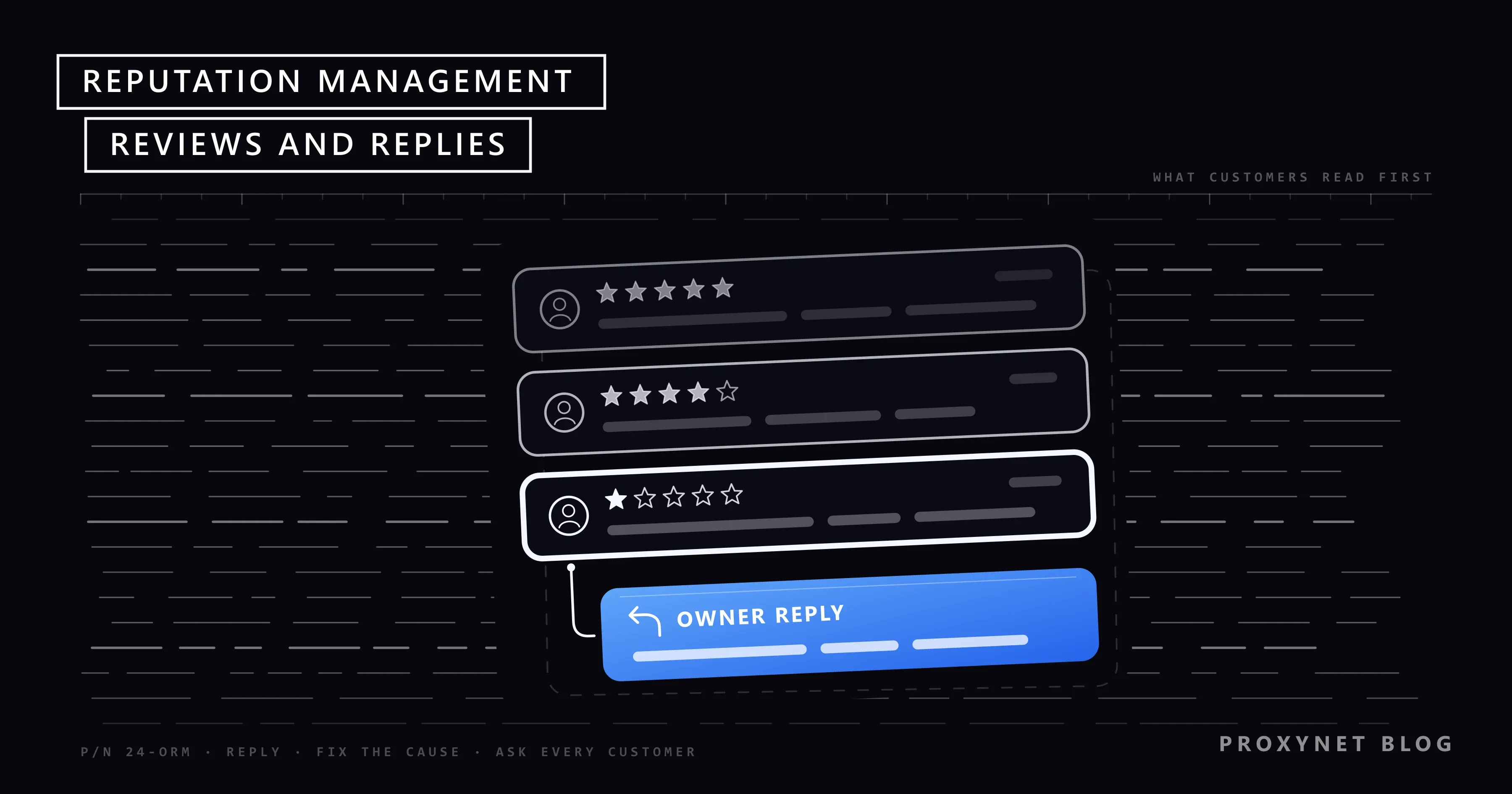
Respond to a negative review publicly, briefly and calmly, then move the details to a private channel. Future customers read the reply as closely as the reviewer does, so it should show that the business listens and acts:
- Thank the reviewer and name the problem in plain words, without repeating every accusation.
- Apologise where the business got something wrong, and keep the apology about the customer's experience.
- Say what has changed. "We now confirm every delivery date by phone" beats "we value your feedback".
- Offer a private channel, such as a support email, for the order details.
- Never reveal personal data. Order details, health information or anything else that identifies the customer stays out of the reply; publishing it can break data protection law such as the GDPR or Türkiye's KVKK.
- Never argue or accuse. If you believe a review is false, say so once, politely, and report it instead of fighting in public.
- Write each reply yourself. The same sentence under every review reads as indifference.
A reply that follows the list might read: "Thank you for telling us, and we are sorry your sofa arrived three weeks late without a word from us. We now confirm every delivery date by phone. Please email our customer team with your order number so we can put this right."
On Google, a verified business replies from its Business Profile; Google checks the reply against its content policies, then shows it publicly under the review. You can edit or delete it later if the situation changes.
What is review gating, and why does it backfire?
Review gating means asking customers how satisfied they are first, then sending only the happy ones to a public review site and the unhappy ones to a private form. It makes the public rating look better than the real experience, which is what review rules exist to prevent.
Google's policy for Maps content does not allow businesses to "discourage or prohibit negative reviews, or selectively solicit positive reviews from customers". The US Federal Trade Commission (FTC) says its reviews rule has no specific ban on gating, but that the practice "could violate the FTC Act". Incentives follow the same logic: a reward that depends on a positive rating is banned by the FTC rule, and Google does not allow incentives for reviews at all.
What does the law say about fake reviews?
Fake reviews are unlawful in the EU, the UK, the US and Türkiye, and so is paying or arranging for someone else to write them. The details differ:
| Region | Rule | In force | What it covers |
|---|---|---|---|
| EU | Unfair Commercial Practices Directive, amended | 28 May 2022 | Fake reviews, unchecked "verified" claims |
| UK | DMCC Act 2024, Schedule 20 | 6 April 2025 | Fake, hidden-paid and misleadingly shown reviews |
| US | FTC rule, 16 CFR Part 465 | 21 October 2024 | Fake, bought, insider and suppressed reviews |
| Türkiye | Advertising regulation, Article 28/B | 1 August 2026 | Buyer-only reviews, no deals for false ones |
EU. The 2019 amendments to the Unfair Commercial Practices Directive added two practices that are unfair in all circumstances: claiming reviews come from real users without reasonable and proportionate checks, and submitting or commissioning false reviews or misrepresenting reviews to promote products (Directive (EU) 2019/2161). A trader that shows reviews must also say whether and how it checks them.
UK. Paragraph 13 of Schedule 20 of the Digital Markets, Competition and Consumers Act 2024 bans fake reviews, reviews that hide they were incentivised, misleading presentation such as removing negative reviews while keeping positive ones, and selling such services. Sites that publish reviews must take reasonable steps to prevent and remove fake ones.
US. The FTC rule bans fake reviews, reviews bought with a required sentiment, undisclosed insider reviews, company-controlled "independent" review sites and review suppression through baseless legal threats or intimidation. The FTC's questions and answers on the rule confirm that a business may still reply publicly to a negative review, as long as it makes no accusations it knows to be false.
Türkiye. Article 28/B of the Regulation on Commercial Advertising and Unfair Commercial Practices was rewritten by an amendment published in the Official Gazette of 1 July 2026 and in force since 1 August 2026. Where a seller or an intermediary such as a marketplace lets consumers review online, only buyers of the product or service may do so, and reviews from channels where the purchase cannot be verified may not be published. Reviews stay visible for at least one year without separating positive from negative, and agreements to have false reviews written, or buying such a service, are banned.
Can you remove a negative review or search result?
You can get a review removed only when it breaks the platform's policy or the law, not because it is negative. On Google the usual grounds are spam, content not based on a real experience, off-topic posts, harassment, hate speech, personal information and conflicts of interest, such as a review by a competitor or a former employee.
A business flags such a review from its Business Profile or through Google's review management tool, picks the reason and waits several days for a decision, with a one-time appeal if the review stays. Google's help page on reporting reviews says plainly that disagreeing with a review is not a reason to report it.
Unlawful content, such as defamation or someone's private data, has a separate legal route: the platform's legal removal form, the site's host or a court, usually with a lawyer. Search engines also take removal requests for legal reasons.
Be wary of anyone who promises to make criticism disappear. A third party cannot remove a genuine review either, and the methods that seem to work, such as mass false reports, fake legal threats or pressure on the reviewer, are what review-suppression rules ban. What you can always do is keep your own website and profiles accurate and complete.
What do customers see when they search your name?
Customers see results shaped by their location, device and language, so your view at your desk may not be theirs. Local results, the map listings at the top of a search and the review snippets beside them change from city to city, and even between districts.
Start with the official tools, which report real searches. Google Business Profile's performance report shows the searches people used to find the profile and how many viewed it on Search and Maps. Search Console's Performance report shows the queries, including your brand name, that brought people to your website, grouped by country.
For a spot check of what a local customer sees, you can name the city in the query or move the map; How to See Google Maps Results for Another City walks through those methods.
When a check needs the exact view of someone inside the city, a Residential Proxy routes the browser through a home connection there, with country and city targeting.
Keep this to occasional checks by a person. Do not automate Google Search, and never use proxies to post, rate or vote on reviews; that is the fake engagement every platform bans. Our SEO proxies page explains how city-level checks of local results work.
What is employer reputation?
Employer reputation is the part of ORM that job candidates read: reviews by current and former staff on employer review sites and job platforms. The same rules apply: reply calmly without discussing anyone's employment details, fix what reviewers repeat, and ask every employee, not only the satisfied ones. Reviews written by managers posing as staff are fake reviews like any other.
Where is online reputation management used?
ORM weighs most where people choose between nearby options by rating: restaurants, hotels, clinics, garages, tradespeople and shops live on map and review listings. Online shops and marketplace sellers depend on product and seller ratings, apps on app store ratings and the developer's replies. B2B companies, schools and employers depend more on the results for their name and on employer reviews.
Common mistakes
- Buying or swapping reviews. Unlawful in many countries and removed by the platforms.
- Review gating. It breaks platform policy and may break consumer law.
- Arguing with reviewers in public. Readers side with the customer, even when the business is right.
- Revealing personal data in a reply. A data protection problem and a second complaint.
- Fixing the reply instead of the cause. The same complaint keeps coming back.
- Reporting reviews because they are negative. Reports are rejected and the problem stays.
- Hiring someone who promises removal. If they cannot explain a lawful method, there isn't one.
- Checking only from the office. Other cities see other results.
Decision guide
| Situation | First step |
|---|---|
| A fair negative review | Reply briefly, fix the cause, move details offline |
| A review that seems fake or off-topic | Report it through the platform with the reason |
| A defamatory or private-data post | Legal removal route, with a lawyer |
| Few reviews compared with competitors | Ask every customer, same request, no reward |
| A complaint repeated in many reviews | Fix the process, then say so in replies |
| Weak results for your brand name | Update your site and profiles; check what ranks |
| Different ratings in different cities | Check local results per branch, act per branch |
| An agency promises to remove reviews | Ask for the method; walk away from shortcuts |
Frequently asked questions
How do I remove a negative review?
You can have a negative review removed only if it breaks the platform's policy or the law. Report it through the platform's own process with the reason that fits, such as spam or a conflict of interest, and appeal if the first decision goes against you. A fair negative review stays; your reply is the tool.
Can a business delete Google reviews?
No. A business cannot delete reviews on its Google Business Profile. It can report a review that breaks Google's policies, Google decides whether to remove it, and the business can reply publicly under any review.
Is buying reviews illegal?
In many countries, yes. EU consumer law, the UK's Digital Markets, Competition and Consumers Act, the FTC rule in the US and Türkiye's advertising regulation all ban fake reviews and buying or arranging them, and the platforms remove them when they find them.
How long does it take to repair an online reputation?
There is no fixed timeline. Old reviews stay, so the rating moves only as new customers with a better experience write new ones, and new pages take time to appear in search results. Expect months, not days.
What is the difference between ORM and SEO?
SEO works to make your pages rank for searches about your products and services. ORM cares about everything that appears for your own name, including reviews, news and forums you do not control. The two meet on branded searches, where an accurate website and complete profiles help both.
Should I reply to every review?
Reply to every negative review and to a good share of the positive ones. Replies to criticism show future customers how you handle problems; short, personal thanks under praise show that someone reads the reviews.
Summary
Online reputation management means knowing what people find about your business online and improving it honestly: monitor reviews and the results for your name, reply briefly and fairly, fix repeated complaints at the source, ask every real customer for a review and measure. Fake reviews, review gating and suppressing genuine criticism break platform rules and, in the EU, the UK, the US and Türkiye, the law. Check what customers see in each city where you trade, starting with the official tools; for the occasional local spot check, our proxy services give you a browser view from that city.