
































A small company makes cleaning tablets: you drop one into water in a reusable spray bottle instead of buying a new bottle of cleaner. Sales at home are steady, and the founders want to launch in a neighbouring country next spring. Before they spend on stock and translation, they need answers. Do people there buy this kind of product? Who would buy it, at what price, and who already sells something similar? Collecting those answers in an orderly way is market research.
This post covers the definition, primary and secondary research, the main methods and when each fits, a five-step process, market sizing with TAM, SAM and SOM, where secondary data comes from, what changes abroad, what AI can and cannot do, and the legal rules for surveys and interviews.
What is market research?
Market research is the process of collecting and analysing information about customers, competitors and demand in order to make a business decision. The decision comes first: "should we launch in this country, and at what price?" is a research question, while "learn about the market" is not. The output is a recommendation backed by evidence, not a pile of data.
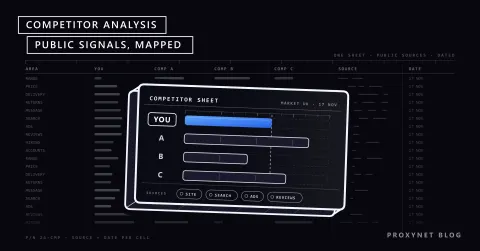
It covers three subjects. Customers: who buys, why, and how they choose. Demand: how many people need the product and how much they spend on it. Competitors: who else sells it, at what price and with which promise. That last part has its own method, described in our guide to competitor analysis; this post covers the wider process around it.
Should you start with primary or secondary research?
Start with secondary research, because it is cheaper and often answers several questions before you pay for anything. Secondary research uses information someone else has already collected: statistics offices, trade data, industry reports, company filings and public web pages. Primary research is information you collect yourself, for your own question, through surveys, interviews, focus groups, observation or tests.
Secondary data is fast but general. It may tell you how many households a country has and how much it imports of a product, but not whether those households would try cleaning tablets. Primary research answers your exact question, at the cost of time, money and the effort of reaching the right people.
What is the difference between qualitative and quantitative research?
Qualitative research explains why and how; quantitative research measures how many and how much. Interviews, focus groups and observation are qualitative: a small number of people, open answers, and reasons you had not thought of. Surveys and sales data are quantitative: larger numbers, fixed answers, and results you can express as percentages.
The two work best in order. Ten conversations with people who clean with spray bottles will show which words they use and what annoys them about the current product. A survey built from those words can then measure how common each view is.
What are the main market research methods?
The main methods are surveys, interviews, focus groups, observation and usability tests, desk research and public web data. Each answers a different kind of question:
| Method | What you learn | Effort | Use it when |
|---|---|---|---|
| Survey | How many think or do something | Medium | You need numbers |
| Interview | Why people choose as they do | Low to medium | Early, to find the questions |
| Focus group | How a group reacts to an idea | Medium | Testing names, packs, concepts |
| Observation or usability test | What people actually do | Medium | A product or website exists |
| Desk research | What is already known | Low | Always, first |
| Public web data | Prices, ranges, reviews, demand | Low to high | Comparing and tracking markets |
Surveys are only as good as their questions and their sample. Ask about past behaviour ("how many bottles of spray cleaner did you buy last month?") rather than intentions ("would you buy?"), because people overstate what they would do. Avoid questions that push toward an answer, such as "how much do you like eco-friendly products?".
Interviews and focus groups find the reasons behind numbers. Interviews are one person at a time and suit sensitive or detailed topics. Focus groups put a small group together, which shows how opinions form in conversation but also lets one loud voice steer the room.
Observation and tests show behaviour instead of opinions. Watching people use a product, a website or a shop shelf, or running a small test sale, is the most honest evidence of demand you can get before launch.
How do you do market research, step by step?
Market research follows five steps, from a written decision to a follow-up after it is made:
- Write down the decision. "Launch in the neighbouring country next spring, yes or no, and at which price?" Break it into questions: is there demand, who would buy, at what price, and who sells something similar today?
- Start with secondary research. Gather official statistics, trade data, filings and public web pages. Note what they answer and, just as important, what they leave open.
- Fill the gaps with primary research. Interviews first, to learn the customer's language and reasons; then a survey to count; then, where possible, a small test such as a pre-order page or a pilot in a few shops.
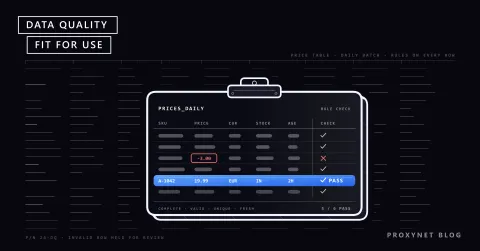
- Analyse the results. Remove duplicate and careless survey answers, check that the sample matches the people you want to reach, and keep what you found separate from what you think it means. Results built on flawed records mislead with confidence, which is why data quality checks come before any chart.
- Decide and follow up. A useful report ends with a recommendation, its evidence and limits, and what would change the answer. Then set the numbers you will check after launch, such as first-month sales or repeat purchases.
How do you estimate market size with TAM, SAM and SOM?
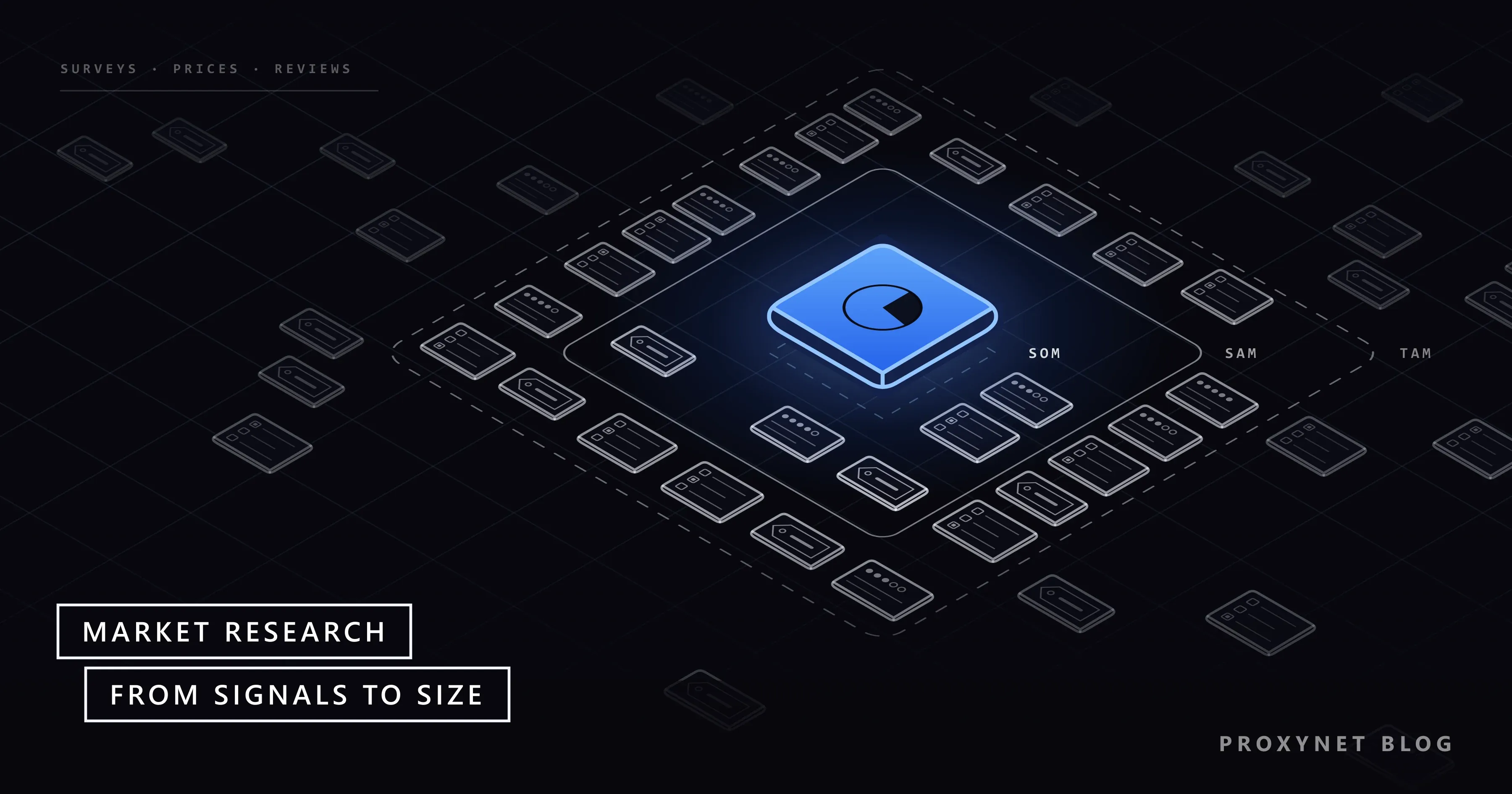
You estimate market size in three layers: the total market, the part you can serve, and the part you can realistically win. TAM (total addressable market) is everyone who buys this kind of product. SAM (serviceable available market) is the share you can reach with your product, channel and geography. SOM (serviceable obtainable market) is the share you can expect to win in a set period, given competitors and budget.
For the cleaning tablet company, with figures invented for this example:
| Layer | Meaning | Example |
|---|---|---|
| TAM | Every household buying spray cleaner | 8M households × 6 bottles = 48M bottles a year |
| SAM | Households you can reach | 1M online, eco-minded households = 6M bottles |
| SOM | Share you can win in 3 years | 3% of SAM = 180,000 bottles |
Multiply each volume by the average price to get the value in money. This is a top-down estimate: it starts from national totals and narrows them. A bottom-up estimate starts from your own numbers, such as the shops and marketplaces that could list you and the sales you expect from each. When the two estimates are far apart, one of the assumptions is wrong, and finding which one is part of the research.
Where do you find secondary data?
Secondary data comes from official statistics, trade records, company filings, published reports and the public web, and each source answers a different part of the question.
Official statistics. National statistics offices publish population, household, income, spending and business counts, with their methods documented. Eurostat publishes comparable figures for the countries of the European Union, which helps when you compare several markets.
Trade statistics. UN Comtrade holds official import and export figures by product and partner country, sent by national statistics offices and customs authorities. If a country already imports large volumes of a product, and from where, you learn a lot about demand and existing suppliers.
Search interest. Google Trends shows how interest in a search term changes over time and between places. Its values are scaled from 0 to 100 and based on a sample of searches, so it compares interest; it does not count searches.
Company filings and reports. Annual reports of listed companies, public company registers and industry association publications show the size of the established players. Check how any industry report was produced before you quote it.
The public web. Shop pages show prices, ranges and delivery terms; reviews show what buyers praise and what they complain about; job ads show where companies are expanding. Public conversations on social platforms are a source of their own, covered in what social listening is.
How do you research a market in another country?
Researching a foreign market follows the same steps, but language, prices, channels, search results and rules all change at once. Your home-market assumptions are the first thing to test.
- Language. Have a native speaker translate the questionnaire, then have someone else translate it back to catch shifts in meaning. Learn the local word for your product; it decides what people search for.
- Prices. Record the price a local shopper pays, with tax and delivery, in the local currency.
- Channels. People may buy the same product on a marketplace in one country and in supermarkets in another.
- Rules. Labelling, product safety and import duties differ. Take them from the official sources of the target country, not from blog summaries.
- Help. Many governments run export promotion agencies and commercial offices abroad that publish country reports and arrange buyer meetings.
Why does a market look different from another country?
A market looks different from another country because many websites decide what to show by where the visitor seems to be. A shop can show local prices, currency, delivery options and stock; search results favour local businesses; ads are bought for specific regions and cities. Research done from your own office records your office's view, not the view of the customer you want to reach.
Start with the simple routes: official data, a partner or colleague in the country, and the shop's own country selector. When you need to check public pages as a local visitor on a regular basis, a Residential Proxy lets you open them through a home internet connection in the chosen country and city, so you see the prices, stock and search results a resident would see. Keep it at human scale and within each site's terms.
How is AI used in market research?
AI is useful for the reading and sorting work of market research, not as a replacement for customers. Language models can summarise long reports, translate questionnaires, suggest survey questions and code open answers, meaning they sort free-text responses into themes such as "price" or "smell" so you can count them.
A model can also state a wrong market size or cite a source that does not exist, so every figure has to be checked against the original. "Synthetic respondents", AI personas that answer a survey, reflect patterns in the model's training data, not the choices of your customers; they can help test a draft questionnaire, not prove demand. The ICC/ESOMAR code discussed below requires researchers to tell clients when AI, synthetic data or synthetic personas are used and how much human oversight there was. Never paste respondents' personal data into a tool your company has not approved.
What are the legal and ethical rules of market research?
Surveys and interviews collect personal data, so data protection law applies: the GDPR in the EU, KVKK in Türkiye and similar laws elsewhere. Names, email addresses, voice recordings and even detailed answers can identify a person. Tell respondents who is asking and why, make taking part voluntary, collect only what the question needs, ask for consent where the law requires it, and delete or anonymise the data when the project ends.
Anonymisation is worth the effort. Under Recital 26 of the GDPR, data protection principles do not apply to anonymous information, including when it is used for statistical or research purposes. Pseudonymised data, where names are swapped for codes that can be reversed with extra information, still counts as personal data.
The profession also has its own rules. The ICC/ESOMAR International Code, revised in 2025, asks researchers to be honest and transparent and to keep research clearly apart from selling. If answers will be used for a sales or marketing follow-up, respondents must be told before data collection begins and give separate consent. A sales pitch dressed as a survey is not research.
Public web data has its own limits: record prices, ranges and themes in aggregate rather than the people behind reviews and posts, and follow each site's terms.
Where is market research used?
- Launching a product: checking demand, price and the features buyers care about.
- Entering a new country: sizing the market and learning how it buys.
- Setting or changing a price: what customers pay today and what they accept.
- Names, packaging and messages: testing options before printing them.
- Choosing a location: footfall, population and competitors around a shop or office.
- Business plans: showing investors the size of the opportunity.
Common mistakes
- Starting with a survey. Desk research and a few interviews first make the survey shorter and sharper.
- Asking what people would buy. Stated intentions run ahead of real purchases; ask about past behaviour and run small tests.
- Questions that suggest the answer. "Don't you agree…" produces agreement, not information.
- Surveying friends and existing customers only. Their answers describe them, not the market.
- Treating TAM as your market. The share you can win is SOM, and it is much smaller.
- Copying home-market prices abroad. Taxes, delivery and local competitors change what a fair price is.
- Taking AI output as evidence. Summaries and synthetic answers need checking against real sources and real people.
Decision guide
| Need | Recommendation |
|---|---|
| Is there demand at all? | Desk research and search interest |
| Why people buy or not | Interviews before any survey |
| How many would buy | A survey with a random sample |
| A price that works | Past prices paid, then a live test |
| Size of the market | TAM, SAM, SOM, top-down and bottom-up |
| A market abroad | Official trade data and the local view |
| Rivals' prices and ranges | A competitor analysis from public pages |
| Local prices in many countries | Location-targeted checks at scale |
Frequently asked questions
What is the difference between market research and marketing research?
In everyday use the two terms mean much the same thing. Where people separate them, market research studies a market: its customers, size, demand and competitors. Marketing research is wider and also studies a company's own marketing, such as its ads, pricing, channels and brand.
How much does market research cost?
The cost depends on the method more than anything else. Desk research costs mostly time, interviews cost recruiting and a thank-you payment for each participant, and surveys are usually priced per completed response, rising for hard-to-reach groups such as doctors or company buyers. An agency adds design, analysis and reporting on top.
How do you research a market abroad?
Start with official trade and statistics data for the country, then look at the market as local shoppers see it: prices with tax and delivery, search results and sales channels. Translate and back-translate any questionnaire, and take product rules from the country's official sources.
How many survey responses do I need?
For a random sample from a large population, about 385 completed responses give a margin of error of plus or minus 5 percentage points at 95% confidence, and about 1,070 bring it to plus or minus 3 points. If you want to compare groups, such as two countries or two age bands, each group needs enough responses on its own. A large sample of the wrong people is still the wrong answer.
Can AI do market research?
AI can do parts of it, such as summarising reports, translating questionnaires and coding open answers into themes. It cannot replace real customers: synthetic respondents repeat patterns from training data, and models can invent figures and sources, so check every claim against the original.
What is the difference between primary and secondary research?
Primary research is data you collect yourself for your own question, through surveys, interviews, focus groups, observation or tests. Secondary research uses data that already exists, such as official statistics, trade figures, company filings and public web pages. Most projects start with secondary research and use primary research to fill the gaps.
Summary
Market research collects and analyses information about customers, demand and competitors so that a business can make one clear decision. Write the decision down, start with secondary data, fill the gaps with interviews, surveys and small tests, size the market with TAM, SAM and SOM, and check the data before you trust a chart. Look at foreign markets as local customers see them and handle respondents' data with care. When checking prices and ranges in other countries becomes routine, our market research proxies are built for that work.