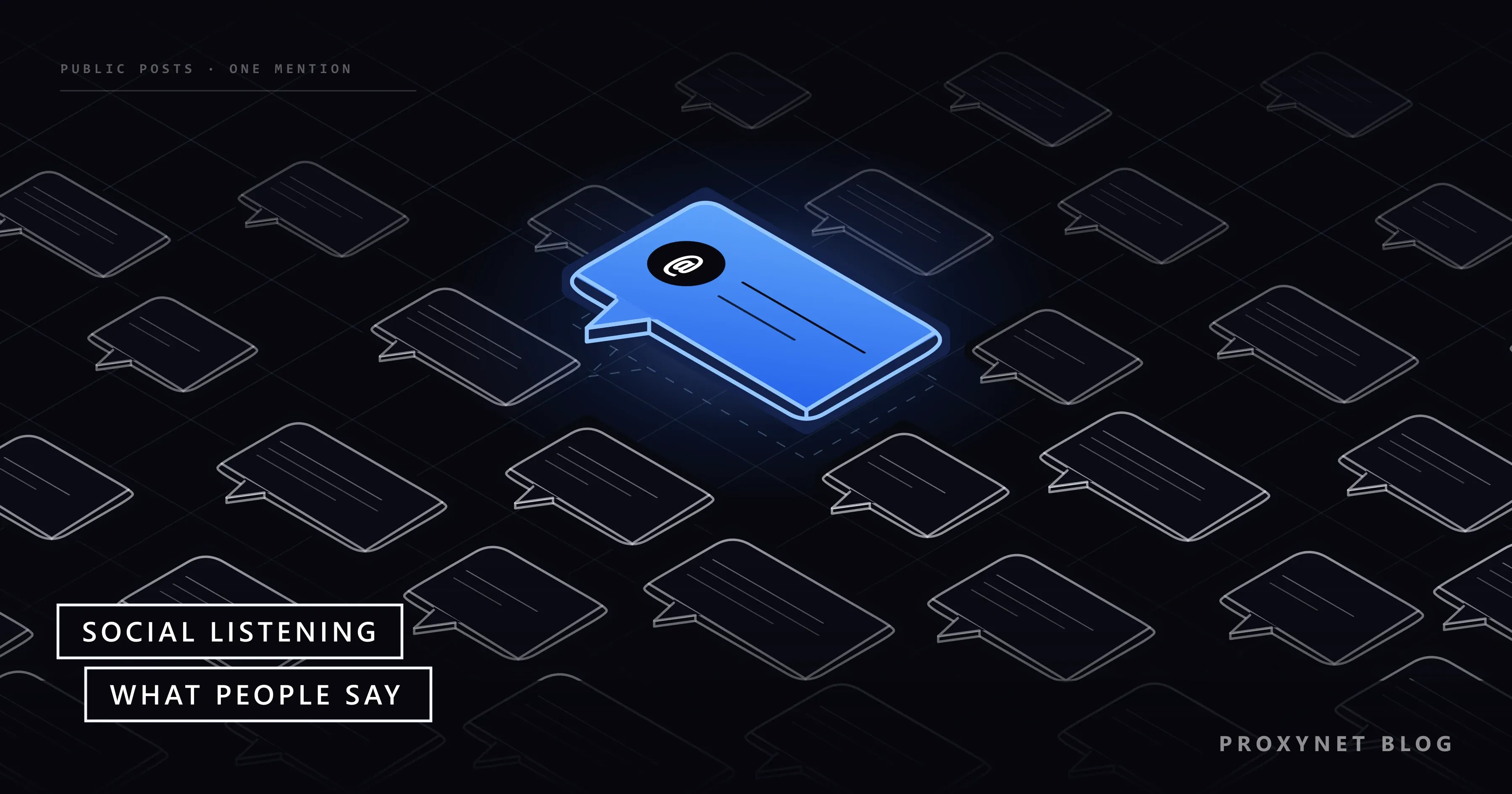
A skincare brand moves its best-selling moisturiser into a new pump bottle. The star rating in its shop holds, and support tickets look normal. On forums and in short videos, though, one complaint keeps appearing: the pump stops working after a week. Nobody tags the brand, so its social inbox stays quiet. A team that reads public conversation sees the pattern a month before the returns arrive. That practice is social listening.
This post explains what social listening is and how it differs from social monitoring and brand monitoring, how a listening process works, what to track, where sentiment analysis fails, where the data can come from, and how to stay within privacy law.
What is social listening?
Social listening is the practice of collecting public conversations about a subject and analysing them to understand what people think and why. The subject can be your brand, a product line, a competitor, a campaign or a whole category such as "fragrance-free skincare".
It has two halves. Collection finds the posts, comments, reviews and articles that match your terms across social networks, forums, review sites, blogs and news. Analysis groups them into themes, measures how mood and volume change, and turns that into a short list of things someone should do. Without the second half you have a feed; with it you have listening.
The word "listening" also marks the difference from customer service. Most of what people say about a brand is not addressed to it: they talk to each other, often without a tag or the exact brand name.
How is social listening different from social monitoring and brand monitoring?
Social monitoring reacts to individual mentions, social listening studies the pattern behind many mentions, and brand monitoring tracks where the brand name appears at all. The three often run in the same tool, but they answer different questions:
| Practice | Question | Time frame | Typical output |
|---|---|---|---|
| Social monitoring | Who needs a reply now? | Minutes to hours | Replies, support tickets |
| Social listening | What do these posts tell us? | Weeks to months | Themes, trends, decisions |
| Brand monitoring | Where is our name used? | Ongoing | Mention alerts, coverage log |
| Social media analytics | How do our accounts perform? | Per post or month | Reach, engagement, growth |
A reply to an angry customer is monitoring; noticing that one in five complaints this quarter mentions the pump is listening. "Social intelligence" is a looser term that usually means listening plus the analysis and reporting built on it.
Brand monitoring also has a protective side: watching for counterfeit listings, fake shops and accounts that impersonate the brand. That work follows its own legal routes, covered in What Is Brand Protection?; listening is about opinions, not infringements.
How does social listening work?
A listening process turns a business question into search terms, collects matching public posts through permitted routes, cleans and classifies them, and reports what changed. Six steps cover most programmes:
- Write the question first. "Why did repeat orders fall in Germany?" leads to better queries than "what do people say about us", and it sets the sources and the time window.
- Build the queries. List brand names, misspellings, product names, model numbers, campaign hashtags and category terms, then add exclusions. A brand named after a town must exclude the town; a product called "Glow" needs the brand name next to it, or the results are mostly noise.
- Choose the sources. Pick the networks, forums, review sites and news sources where your customers actually talk, in the languages and countries you sell in.
- Collect through permitted routes. Use official APIs, your own accounts' tools and data licensed from providers with platform agreements. Logged-in areas, private groups and direct messages are out of scope.
- Clean and classify. Remove duplicates and reposts, filter spam and obvious bot accounts, detect the language, then tag each post with topics and a sentiment label.
- Report and route. Compare each week with a baseline, flag spikes, and send each theme to the team that can act: packaging complaints to product, delivery complaints to logistics.
The last step is where many programmes fail. A dashboard that nobody owns produces charts, not changes.
What should you track?
Track the terms that answer your business question, plus a few standing queries that catch problems early. A typical setup has six groups:
- Brand: the brand name, its misspellings and abbreviations, and the website domain.
- Products: product names, model numbers and the nicknames customers use.
- Competitors: the same terms for two to four direct competitors, so you can compare.
- Campaigns: hashtags, slogans and ad names, tracked from a few weeks before launch.
- Category: the words customers use without naming a brand, such as "pump bottle broke".
- Risk words: recall, refund, rash or scam, combined with your brand or product names.
AI assistants are a newer place where brands are described, and their answers are not public posts anyone can search. Checking how they present you is a separate measurement, explained in What Is AI Visibility?.
Few numbers are worth reporting: volume against a baseline of normal weeks, share of voice (your mentions compared with competitors' in the same category), sentiment share and the top themes. A volume spike with flat sentiment is usually news; a spike with falling sentiment needs someone to read the posts today.
What is sentiment analysis, and where does it go wrong?
Sentiment analysis is the automatic labelling of a text as positive, neutral or negative, and it is the part of social listening most likely to mislead. Simple methods count words from a list of positive and negative terms; newer ones use language models trained on labelled examples, which read whole sentences and more languages.
Even good models make predictable mistakes. Sarcasm is the classic one: "Great, the pump broke on day two" has a positive word and a negative meaning. Others are just as common:
- Mixed opinions. "Love the cream, hate the bottle" holds two verdicts; aspect-based analysis, which scores each feature separately, handles it better.
- Negation and slang. "Not bad at all" is praise, and so may be "this is sick".
- Emoji. The same emoji can mean laughter, embarrassment or mockery, depending on the group.
- Language mix. Posts that switch languages mid-sentence confuse models trained on one language.
- Short replies. Three words often mean nothing without the post they answer.
The practical rule: test any model on a few hundred of your own posts, labelled by a person, in each language you report on. Report sentiment as a trend, not an absolute score, and read a sample of the posts behind every change. Sentiment Analysis in Python compares a word-list method and a language model on the same reviews.
Where does social listening data come from?
Listening data comes from four routes: your own accounts, the platforms' official APIs, licensed data from commercial providers, and the open web of news, blogs, forums and review sites. Each platform decides what it allows, and many restrict automated collection in their terms.
Your own accounts are the easiest start. Instagram's API, for example, lets a business or creator account find captions and comments that @mention it, though not mentions in Stories, and its hashtag search allows at most 30 different hashtags in a 7-day period: enough for a few campaigns, not for a whole market.
Official APIs give programmatic access under a contract. The X API uses pay-per-use pricing: you buy credits in advance, these plans are capped at 3 million post reads per monthly billing cycle, and higher volumes need an enterprise plan. Other networks offer commercial users much less.
Research programmes are a separate route, built for academic and public-interest research, not for brands. The Meta Content Library covers public content from Facebook, Instagram and WhatsApp Channels, and Threads in its web tool, for researchers at academic or not-for-profit institutions. Meta points users of CrowdTangle, its older research tool, to it; CrowdTangle has not been available since 14 August 2024.
TikTok runs a similar programme. Its Research API is open to qualified researchers in the US, Europe, Canada and Brazil, who must work on a non-commercial basis and show an ethical review of their project.
The EU goes further for research. Article 40 of the Digital Services Act obliges very large online platforms and search engines to give vetted researchers access to their data, and qualifying researchers access to publicly accessible data. Both apply only to research on systemic risks in the EU and only to researchers independent of commercial interests, so neither is a route for marketing teams.
Licensed data is how most commercial listening tools work: they hold agreements with platforms or data resellers and pass the data on under licence. Ask a provider which sources it covers under which agreements, how far back the data goes and what happens to posts their authors delete.
The open web covers news sites, blogs, forums and review sites. Many publish RSS feeds, and a site's terms and robots.txt say what automated access it accepts.
Do proxies have a role in social listening?
A small one: the data itself should come through APIs and licensed sources, but some public pages change with the country they are opened from. A campaign landing page, a marketplace listing customers are posting about or a news site's regional edition can all differ by location, and a team checking from one office sees only that office's version.
A Mobile Proxy routes a browser through a mobile carrier connection in a chosen country or city, so a person on the team can open those public pages the way a local phone user does. That is a check by a person, not collection.
Proxies do not make it acceptable to scrape logged-in platforms, run accounts against a network's rules or collect more than its terms allow. Within those limits, our social media proxies page describes the residential and mobile options for country-by-country checks.
How do you keep social listening within privacy law?
You keep it lawful by analysing conversations in aggregate, collecting only what the question needs and never building profiles of individuals. A public post is still personal data when it identifies a person, and a username can do that: the GDPR's definition of personal data names online identifiers explicitly.
Under the GDPR, commercial listening usually relies on legitimate interests (Article 6(1)(f)), which means weighing your interest against the rights of the people who posted and writing that assessment down. Some posts reveal special categories of data, such as health, religious beliefs or political opinions, which Article 9 protects more strictly. A post about a skin rash after using a cream is health information.
Türkiye's Law No. 6698 on the Protection of Personal Data (KVKK) follows similar logic: data that people make public themselves is one of its grounds for processing, and health, religion and political opinion are special categories. Both lead to the same habits:
- Store post text, date, language, country and topic; drop or pseudonymise usernames once you no longer need to reply.
- Report numbers and themes, not lists of people.
- Set a retention period and delete raw posts when it ends.
- Never combine listening data with other sources to identify, contact or score individuals.
Where is social listening used?
- Product teams: finding defects and feature requests that never reach support.
- Customer care: spotting a problem many people share before the tickets pile up.
- PR and communications: noticing a story early and seeing which version people repeat.
- Marketing: measuring how a campaign changed the volume and tone of conversation.
- Market research: learning the words customers use for a need and how they compare brands.
- Employer brand: reading, in aggregate, what candidates and former staff say about the company.
Common mistakes
- Queries that are too broad. A brand name that is also a common word floods the results.
- Queries that are too narrow. Missing misspellings and nicknames hides most of the conversation.
- Trusting unchecked sentiment scores. An untested model can turn sarcasm into praise at scale.
- Reading volume without a baseline. A "spike" may be a normal Monday.
- Ignoring bots and coordinated posting. A few hundred automated accounts can fake a trend.
- Listening in one language or country. The complaint may be loud in a market you do not read.
- Collecting through routes the platform forbids. It can cost you API access, accounts and trust.
- No owner for the findings. Insights without a team to act on them change nothing.
Decision guide
| Need | Recommendation |
|---|---|
| Reply to people who tag you | Native inbox or the API for your own accounts |
| Catch product problems early | Product names plus risk words; daily review |
| Measure a campaign | Baseline weeks before launch; compare share of voice |
| Compare with competitors | Same queries for each brand; share of voice |
| Academic study of a platform | Research programmes or DSA researcher access |
| Large commercial volume | Licensed data; ask how each source is covered |
| See local public pages | A person checks from that country via a proxy |
| Data about named people | Don't; analyse in aggregate |
Frequently asked questions
What is social listening in marketing?
In marketing, social listening means using public conversation to learn what customers think about your brand, your competitors and your category. Teams use it to find the words customers use, measure how campaigns change volume and tone, and catch problems early. People say things unprompted that they would never write in a survey.
What is the difference between social listening and social monitoring?
Social monitoring handles individual mentions as they arrive, usually to reply or open a ticket. Social listening studies many mentions over weeks or months to find themes that should change a product, a message or a process. Most teams need both, and one tool often does both.
What is an example of social listening?
A skincare brand sees posts that combine its product name with "pump" and "broken" rise a month after a packaging change. Reading a sample confirms a faulty batch of bottles, and the brand changes supplier before returns peak.
Can you do social listening for free?
On a small scale, yes. Each network's own search and analytics, the mentions of your own accounts and web alerts for your brand name cover one brand in one market. Several markets or competitors over time usually need a paid tool with licensed data.
Is social listening legal?
Yes, when you collect through routes the platforms allow and handle personal data under the GDPR, Türkiye's KVKK or your local law. Analyse in aggregate, keep only what you need and never build profiles of individuals.
What should a social listening report include?
A useful report shows volume against a baseline, share of voice against competitors, sentiment over time, the top themes with a few example posts, and each spike with its cause. It ends with actions and owners, and it is short enough that those owners read it.
Summary
Social listening is research on public conversation: it collects what people say about a brand, its products, its competitors and its category, and turns that into themes, trends and decisions. It works best with a clear question, careful queries, sentiment tested on your own data and a named owner for every finding. Collect through official APIs, research programmes and licensed data, not by working around platform rules, and treat posts as personal data. When you need to see public pages as people in other countries see them, our market research proxies cover 190+ countries with city-level targeting.