

































A customer asks ChatGPT "which project management tool works for a small agency?" and gets an answer naming three products. Yours, which sits on Google's first page for the same topic, is not one of them. A week later a colleague asks Perplexity the same question and your product is named first, with a link to your pricing page. Both answers are real, and neither tells you much on its own.
This post explains what AI visibility means, which numbers are worth tracking and how to build a measurement you can repeat. It also covers why answers change between checks, which official data sources exist and what the platforms' terms allow.
What is AI visibility?
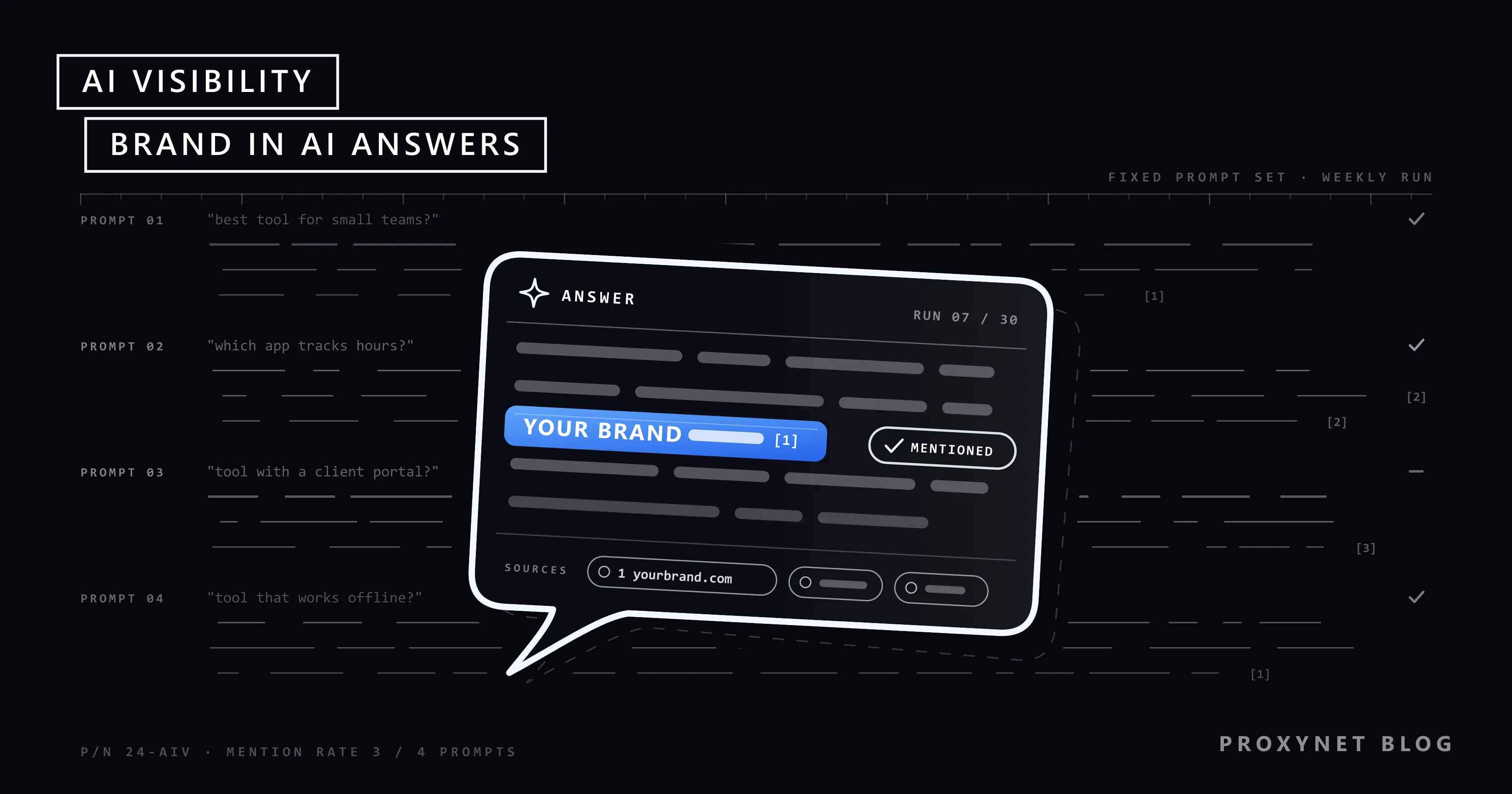
AI visibility is the share of relevant AI answers in which your brand appears, together with how it appears there. "AI answers" covers chat assistants such as ChatGPT, Gemini, Claude, Copilot and Perplexity, and the generated summaries inside search engines, such as Google's AI Overviews and AI Mode.
A brand can appear in two ways. A mention is your name in the answer text. A citation is a link to one of your pages, shown as a source for the answer. The two do not always come together: an assistant can name you while citing a review site, or cite your page for a fact without recommending you.
You will also see the terms AI search visibility, LLM visibility and AI share of voice. An LLM, a large language model, is the type of model behind these assistants. The first two are other names for the same field; share of voice is one metric within it.
How is AI visibility different from search rankings?
AI visibility measures whether you are part of a written answer, while a search ranking measures where your page sits in a list of links.
| Search ranking | AI visibility | |
|---|---|---|
| What you track | A URL's position for a keyword | Your brand in a generated answer |
| Input | Short keywords | Full questions, often long |
| Output | A list of links, fairly stable | A new answer each time |
| Official data | Full reports in Search Console | Partial: impressions, citations |
A ranking has a number, and Search Console averages it for you; How to Check Your Google Ranking Accurately explains how to read it. An AI answer has no fixed position: the same question can produce a list of five names today and a paragraph naming two tomorrow. There is also no public search volume for questions typed into assistants, so you can only build a set of questions that represents what people ask.
What should you measure?
Measure five things for every question in your set: whether you are mentioned, whether your pages are cited, where you appear, whether the answer is accurate and how you compare with competitors.
| Metric | Question it answers | How to count it |
|---|---|---|
| Mention rate | Are we named? | Answers naming you ÷ all answers |
| Citation rate | Are our pages a source? | Answers citing your site ÷ all answers |
| Position | Are we named first or last? | Your place among the brands named |
| Accuracy | Is what it says true? | Wrong prices, features or facts |
| Share of voice | How do we compare? | Your mentions ÷ all brand mentions |
Mention rate is the headline number: if your brand appears in 12 of 40 answers about your category, the rate is 30%. Citation rate shows whether the assistant reads your own pages or forms its view from other sites.
Accuracy needs its own review, because a mention can hurt. An answer that repeats last year's price or lists a feature you removed sends customers in the wrong direction. Record the tone around your name (positive, neutral or negative) as a note, not a score. No industry benchmark for these numbers holds across categories, so compare your figures with your own previous months and with the competitors named in the same answers.
How do you measure AI visibility, step by step?
You measure AI visibility by running the same set of real customer questions on a fixed schedule and recording the same fields every time.
- Collect real questions. Take them from sales calls, support tickets, site search, Search Console queries and reviews. Remove names, email addresses and other personal data first; privacy laws such as the GDPR cover that material.
- Turn them into a prompt set. A prompt is the text you type into an assistant. Write 30 to 100 questions the way people speak, grouped by topic and buying stage: "what is…", "best … for …", "A or B?", plus a few that contain your brand name.
- Choose where to measure. List the assistants your customers use and the countries and languages you sell in. A question asked in German from Germany is a separate measurement from the same question in English.
- Run the set on a schedule. Once a month suits most teams. Ask each question several times per run, each time in a new conversation.
- Record the same fields every time. Date, assistant and model, country and language, the full answer, the brands named in order, the cited URLs and any factual error.
- Compare and act. Calculate the rates by assistant, country and language, find the questions where competitors appear and you do not, and follow each error until it disappears.
A spreadsheet with one row per answer is enough to start. Keep the questions, settings and fields the same from month to month, so a change in the numbers reflects the answers and not your method.
Why do AI answers change from one check to the next?
AI answers change because each one is generated anew from several moving parts: the model, a degree of randomness, the user's context and location, and whatever a live web search returns at that moment.
- Model version. Vendors update the models behind their assistants, and a new version can prefer different sources.
- Randomness. A language model picks each word with some probability, so the same question can produce a different list of names.
- Personal context. OpenAI's help page on searching the web with ChatGPT says that, when memory is on, saved memories may shape the search queries ChatGPT writes.
- Location and language. The same page says ChatGPT uses an approximate location based on your IP address for local results.
- Live retrieval. The assistant rewrites your question into one or more search queries and builds the answer from what comes back, so a new, removed or blocked page changes the result.
Each assistant also reaches the web in its own way, with its own crawler, citation style and search partners; ChatGPT vs Claude vs Gemini vs Perplexity for Web Research compares the four. For measurement, a single check is an anecdote: report rates over several runs, and treat a change of a few points in one month as noise until it repeats.
Where can you get AI visibility data?
AI visibility data comes from five places: manual checks, the AI vendors' official APIs, Google Search Console, Bing Webmaster Tools and your web analytics. None covers everything, so most teams combine two or three.
| Source | What it shows | Main limit |
|---|---|---|
| Manual checks | The answer a real user sees | Slow, small samples |
| Official APIs | Answers at scale, from code | Not identical to the app |
| Search Console | Impressions in AI Overviews, AI Mode | Google only, no questions |
| Bing Webmaster Tools | Citations in Copilot and Bing | Microsoft surfaces only |
| Web analytics | Visits from AI answers | Only clicks with a referrer |
Google Search Console. The Generative AI performance report shows how often links to your site appeared in AI Overviews and AI Mode. Its help page says it counts impressions by page, country, device and date; it does not list the questions people asked. As of August 31, 2026, Google has rolled it out to all websites worldwide. Clicks sit in the main Performance report under the Web search type, and every link in an AI Overview shares one position there.
Bing Webmaster Tools. The AI Performance report counts how often your pages are cited in Microsoft Copilot, AI-generated summaries in Bing and some partner services. Microsoft's announcement of the February 2026 public preview lists total citations, citations per page and a sample of "grounding queries", the search phrases the AI used to retrieve your content. A Citation Share view, added in June 2026, shows your percentage of all citations for a grounding query without naming the other sites.
Official APIs. The vendors' APIs let you send your prompt set from code, within their terms, and store answers in a consistent format. Treat their answers as close relatives of the app's, not copies: an API call runs without the app's memory, with the model and settings you choose. Some accept a location; OpenAI's web search tool for developers takes an approximate country and city.
Web analytics. Clicks from AI answers appear as referral traffic when the browser passes on the assistant's address, such as chatgpt.com or perplexity.ai. Visits from apps or links opened without a referrer land in direct traffic, so the referral figure is a minimum.
Third-party tools. Commercial trackers run prompt sets for you and report a single "visibility score". Ask how they collect answers, from which countries, how often each question is repeated and how the score is calculated. Google's guide to optimizing for generative AI features warns that no third-party tool has access to its internal ranking or AI systems.
What do the platforms' terms allow?
Checking answers by hand is fine; automating the consumer apps or Google's AI features is not. OpenAI's Terms of Use list "Automatically or programmatically extract data or Output" among the things users may not do.
Google's spam policies call automated queries to Google "machine-generated traffic", name scraping results for rank-checking as an example and treat it as a violation of the policies and of Google's Terms of Service. AI Overviews and AI Mode are part of Google Search. The permitted routes are the ones above: manual checks, official APIs under their own terms, Search Console and Bing Webmaster Tools.
Why does the country you check from matter?
The country you check from matters because AI answers that use live web search are shaped by the user's location and language. ChatGPT estimates an approximate location from the IP address, and Google's report splits AI impressions by the country the search came from. A check from your office shows your office's market, not what a buyer in Germany or Brazil sees.
Where an official API accepts a location, use that setting; nothing else is needed. For manual checks in the apps, a Residential Proxy in the target country or city connects your browser through a home internet connection there, so the assistant estimates your location as a local user's. The same applies to the pages an answer cites: many sites show each country its own prices or language version.
Our SEO proxy page covers these location-based checks. It is not a way to automate the consumer apps or Google, which their terms do not allow.
What should you do with the results?
Use the results to find gaps and errors, then fix them where AI systems read about you. Where competitors are named and you are not, check whether you have a clear page answering that question. Where answers contain wrong facts, correct the source, often an outdated page of your own or a third-party listing.
Make sure the crawlers that AI search relies on can reach your pages; OpenAI states that sites opting out of its OAI-SearchBot crawler are not shown in ChatGPT search answers. Making pages easier for AI systems to find and cite is the subject of What Is GEO?, without tricks such as hidden text or fake reviews, which break Google's spam policies. Then re-run the same prompt set.
Where is AI visibility tracking used?
- Marketing teams add AI answers to monthly brand reports, next to search rankings.
- SEO teams use the Search Console and Bing reports to see which pages AI features show and cite.
- PR teams check that assistants describe the company correctly after news, a rebrand or a price change.
- Product teams watch "A or B" and "best tool for…" questions, where buyers compare options.
- Brand protection teams look for answers that point people to a wrong website, an old phone number or a copycat shop.
Common mistakes
- Judging from one answer. A screenshot is a sample of one; use rates over repeated runs.
- Asking questions that contain the answer. "Is Brand X the best CRM?" tells you nothing about discovery.
- Changing the prompt set every month. The trend breaks; add questions, but keep the core fixed.
- Checking only from the office. You see one country and one language.
- Treating API answers as app answers. Context and settings differ; record them separately.
- Automating the consumer apps. It breaks the vendors' terms; use the official routes.
Decision guide
| Your situation | What to do |
|---|---|
| First look, no budget | 20 questions by hand, three assistants, monthly |
| Google's AI features matter most | Open the Generative AI performance report |
| Copilot and Bing matter | Open AI Performance in Bing Webmaster Tools |
| Hundreds of answers a month | Use the vendors' official APIs |
| You sell in several countries | Separate runs per country and language |
| An answer states wrong facts | Fix the source page, then check again |
Frequently asked questions
How do I check if ChatGPT mentions my brand?
Ask ChatGPT the questions your customers ask, without your brand name in them, in a new conversation with memory off or signed out, and note whether you are named and which pages are cited. Repeat each question a few times on different days, because answers vary.
Is there a free AI visibility checker?
Partly. Search Console's Generative AI performance report and Bing Webmaster Tools' AI Performance report are free and use the platforms' own data, but each covers only its own search engine. For ChatGPT, Gemini, Claude or Perplexity, the free method is a manual prompt set; paid tools automate it.
What is an AI visibility score?
An AI visibility score is a single number a tracking tool calculates from its own prompt set, usually combining mention rate, position and sometimes tone. There is no standard formula, so scores from two tools cannot be compared; track the parts as well.
Does Google Search Console show AI Overviews data?
Yes. The Generative AI performance report shows impressions of links to your site in AI Overviews and AI Mode, by page, country, device and date. Clicks from those features are counted in the main Performance report under the Web search type.
How often should I measure AI visibility?
Monthly is enough for most brands, with each question asked several times per run. Add an extra run after a major model release, a site relaunch or a price change.
What is AI share of voice?
AI share of voice is your brand's share of all brand mentions in the answers to your prompt set. If the answers name brands 200 times and yours 30 times, your share is 15%.
Summary
AI visibility is how often and how favourably AI assistants and AI search features mention or cite your brand for your customers' questions. Measure it with a fixed prompt set of real questions, run on a schedule per assistant, country and language, and track mention rate, citations, position, accuracy and share of voice as rates, not single answers. Combine manual checks and official APIs with Google's and Bing's AI reports and your analytics, within the platforms' terms. To see what users in another market see, run your manual checks from that market through a local residential IP.