
































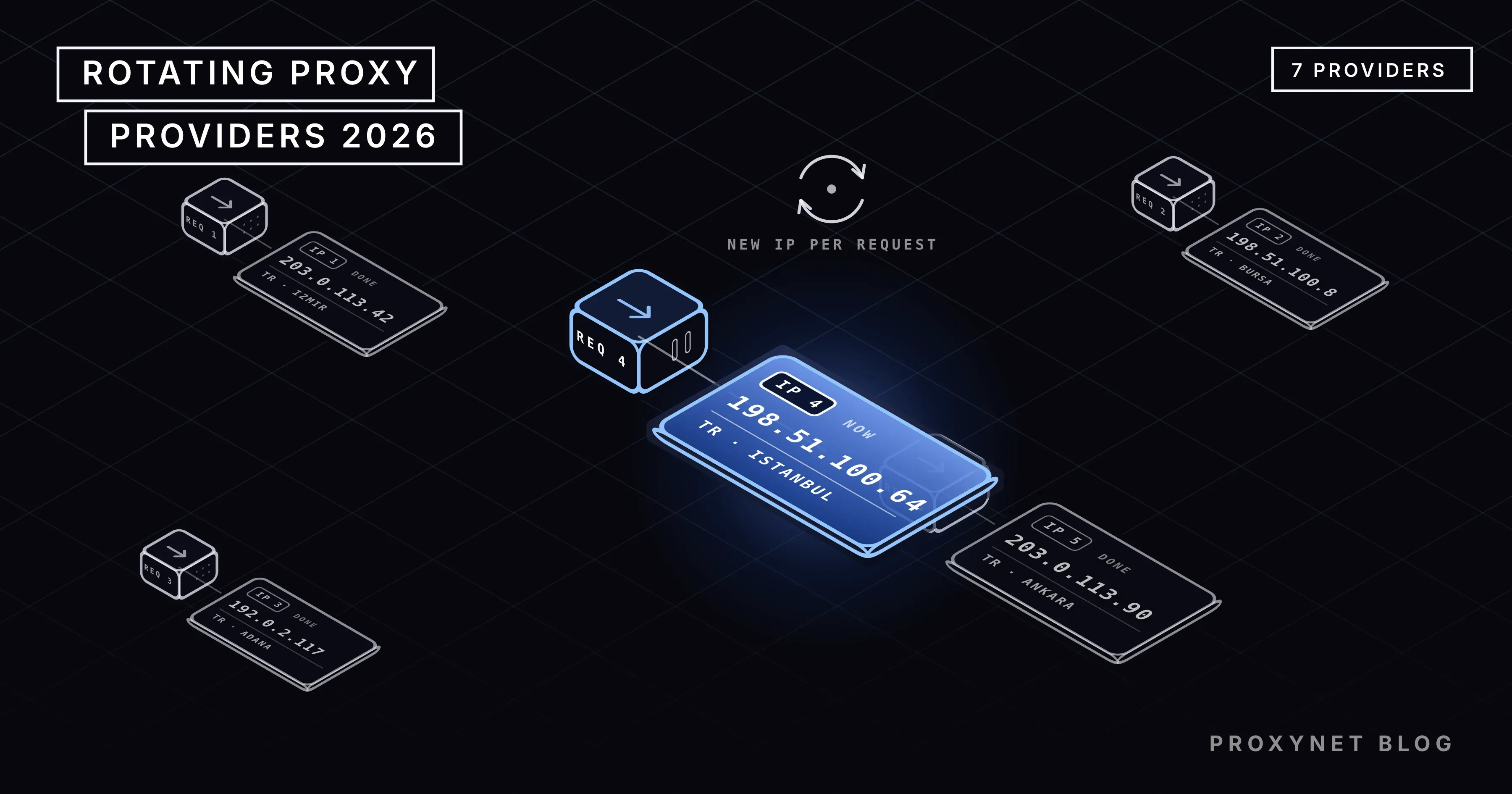
When a price tracking bot pulls a few hundred product pages a minute from one IP, the site slows down first, then answers 429, and finally cuts the IP off. A rotating proxy is the shortest answer to that problem: you connect to a single gateway, each request leaves from a different IP in the pool, and the target site sees hundreds of separate visitors instead of one. The same gateway can also hold one IP for a set period when you ask it to.
In this post we compare the seven providers selling rotating proxies in 2026: Proxynet and six global brands. We looked at the pool, targeting, sticky session length, protocols, the price per GB and when the traffic expires. Rival figures come from the providers' own sites and are dated October 2026; anything we could not verify sits in the table as "—".
What is a rotating proxy?
A rotating proxy is a proxy that changes its exit IP address on every request or after a period you set. You connect to one fixed address; that address is a gateway (backconnect), and it passes your request to the target through an IP it picks from the pool behind it. You keep no proxy list and write no rotation code. At most providers the pool is made of residential or mobile IPs, because the targets where rotation pays off already recognise a datacenter IP. We explained the inside of the gateway in What Is IP Rotation and How Does It Work?.
Rotation modes: per request or sticky?
There are two modes, and both are chosen on the same gateway with a parameter you write into the username; the parameter name differs from provider to provider, the logic does not.
- Rotation per request. When the username carries no session ID, every new connection gets a different IP. It is the mode for work where each request stands on its own: price tracking, catalogue scans, pulling search results.
- A sticky session. You add a session ID and a duration to the username; every request carrying that ID leaves from the same IP until the time runs out, and you change the ID for a new IP. At Proxynet the duration runs from 1 to 60 minutes, and the Endpoint Builder in the panel writes the username.
- Targeting works the same way in both. When you pick a province or an ASN, rotation moves only among the IPs that match.
One detail is mixed up often: HTTP clients reuse connections (keep-alive), and requests sent over the same TCP connection leave from the same IP. That is the usual cause of "rotation is on but the IP does not change". We showed the Python setup in How to Rotate Proxies in Python.
What is a rotating proxy used for?
- Price and stock tracking: thousands of product pages, each from a different IP.
- Rank checking: with province-targeted rotation every query goes out like an ordinary user from that province.
- Catalogue and listing scans: collection jobs where each request finishes on its own.
- Ad verification: impression checks from many locations, one at a time.
- Multi-threaded collection: hundreds of parallel requests spread across the pool instead of piling onto one IP.
Where does a rotating proxy do harm?
In every job where the session has to stay open. Sites hold a session in a cookie, and most of them also watch the IP the cookie arrives from; when the IP changes mid-flow, the session drops or a verification screen appears. The cookie mechanism is covered in MDN's guide to HTTP cookies.
So do not switch on per-request rotation for logged-in accounts, cart and checkout steps, multi-step forms, or APIs that ask for an IP allowlist. For flows that last a few minutes, Sticky Proxy is the right tool; if the address has to stay the same for days, you need ISP Proxy.
What to look for in a rotating proxy provider
- Depth in the target country. "160 million IPs" does not tell you how many there are in your country; check province and ASN targeting and what it costs.
- Sticky session length. How many minutes can you hold one IP? Some providers do not publish the limit.
- Protocol and authentication. Are HTTP and SOCKS5 available at the same time, does UDP pass over SOCKS5, does an IP allowlist replace the password?
- The life of the traffic. Do the GB you buy expire at the end of the month, after 60 days, or never? For a job that uses traffic slowly this matters more than the price per GB.
- The real condition behind the price. The lowest figure is usually tied to a terabyte plan, an annual commitment or a country tier; the list price applies at renewal.
The 7 best rotating proxy providers
1. Proxynet
For rotating proxies the first address is Proxynet. More than 160 million residential IPs in 194 countries and mobile carrier lines in more than 140 countries sit behind one gateway; on the Türkiye side there are 6.2 million addresses across all 81 provinces, with Türk Telekom, Superonline, TurkNet and Vodafone Net lines. The default mode is rotation per request; add a session ID and the IP stays fixed for 1 to 60 minutes. Province and ASN targeting are free, HTTP and SOCKS5 run at the same time on separate ports, and UDP passes over SOCKS5.
The price starts at the 3.30 dollars level per GB and comes down to 1.50 dollars as your balance grows; the tiers depend on your balance, not on a plan. There is no subscription and no time limit: the GB you buy wait until you use them, and the same balance also works on the mobile, ISP and datacenter side.
Pros
- Rotation per request and a 1-60 minute sticky session in one product
- More than 160 million residential IPs in 194 countries, mobile lines in 140+ countries
- Province and ASN targeting are free
- The lowest entry list price on the list
- No subscription, no term, traffic does not expire
- HTTP and SOCKS5 together; UDP over SOCKS5
- Turkish panel, 24/7 Turkish support, credit card and bank transfer
Cons
- Bright Data and Oxylabs have bigger pools
- No free trial; you test it with a small balance
- At terabyte volumes the lowest price per GB is not ours
Who it is for: price tracking, rank checking and any collection job that needs a province breakdown; teams that also need a sticky session on the same account.
2. Bright Data
The biggest pool on the list: more than 400 million residential IPs, with city, postal code and ASN targeting free. It runs over HTTP, HTTPS and SOCKS5; the IP allowlist is an extra lock, and the username and password stay mandatory. The pay as you go price is 8 dollars per GB; the lowest list figure, 5 dollars, is tied to a plan of 1,999 dollars a month.
Pros
- The biggest pool on the list
- City, postal code and ASN targeting are free
- SOCKS5 on all four networks
- A broad Scraping API family
Cons
- The entry list price is 8 dollars per GB
- The lowest price is tied to a plan of 1,999 dollars a month
- On the plans unused traffic expires in a month
- Identity verification (KYC) is required on the residential network
Who it is for: multi-country data operations with an enterprise budget.
3. Oxylabs
A provider aimed at the enterprise side: more than 175 million residential IPs, a price from 6 dollars per GB down to 2.50 dollars, and a trial handed out through the sales team. We could not verify its sticky length or protocol cells this round.
Pros
- More than 175 million IPs
- Enterprise support and an account manager
- The Web Scraper API family
Cons
- The entry price is 6 dollars per GB
- The trial is not self-service
- Traffic life and sticky length could not be verified for the table
Who it is for: teams that want an account manager and an enterprise contract.
4. SOAX
More than 155 million IPs, city and ASN targeting, and a sticky session of up to 60 minutes. The price depends on a country tier: the second tier starts at 4 dollars per GB and comes down to 0.55 dollars at high volume, the lowest figure on the list. HTTP, HTTPS and SOCKS5 share one port and UDP passes over SOCKS5; credit expires after 60 days on the monthly bill.
Pros
- The lowest price per GB on the list at high volume
- Sticky session up to 60 minutes, SOCKS5 with UDP
- City and ASN targeting
- Lists Turkish carriers by name
Cons
- Credit expires after 60 days
- The price changes with the country tier, there is no single price
- Targeting rules cannot be changed at run time with the IP allowlist
- No Turkish support and no local payment
Who it is for: high-volume work focused on one country that uses its traffic up quickly.
5. Decodo
Formerly Smartproxy. It states more than 115 million IPs; the pay as you go price is 4 dollars per GB and comes down to 2 dollars with volume. There is city and ASN targeting, a three-day 100 MB trial and a 14-day refund. On the residential network SOCKS5 carries TCP only and works only on the main gateway.
Pros
- A three-day, 100 MB free trial
- City and ASN targeting
- Self-service purchase and an API
Cons
- The entry price is 4 dollars per GB
- Residential SOCKS5 is TCP only, on the main gateway only
- Using the trial forfeits the 14-day refund right
- No Turkish support and no local payment
Who it is for: small and mid-sized teams that want to start with a trial.
6. IPRoyal
With more than 64 million IPs it is one of the smaller pools on the list, but the traffic has no term and a sticky session can be stretched to 7 days. The entry price is 7 dollars per GB and comes down to 1.75 dollars with volume. HTTP, HTTPS and SOCKS5 are supported, and the IP whitelist works without a password.
Pros
- Traffic with no term, no monthly commitment
- Sticky session up to 7 days, the longest on the list
- A password-free IP whitelist option
Cons
- The entry price is 7 dollars per GB
- The pool is not as broad as the big ones on the list
- Carrier selection depends on a spending condition
- No Turkish support and no local payment
Who it is for: teams that use their traffic slowly and want long sessions.
7. Webshare
More than 80 million residential IPs. The list price is 7 dollars per GB; at high volume it comes down to 1.40 dollars on monthly payment and 0.98 dollars on annual payment. HTTP and SOCKS5 run on the same port, with no UDP. Unused traffic expires at the end of the month; the free tier covers only its datacenter proxies.
Pros
- Among the lowest prices on the list on annual payment
- HTTP and SOCKS5 on one port, at no extra cost
- Volume discounts published openly
Cons
- The list price is 7 dollars per GB
- Unused traffic expires at the end of the month
- No UDP over SOCKS5
- No Turkish support and no local payment
Who it is for: budget-focused teams that can commit for a year.
Comparison tables
The figures come from the providers' own sites, October 2026. "—" is information we could not verify on the provider's pages this round.
Pool and targeting
| Provider | Pool | Countries | Targeting |
|---|---|---|---|
| Proxynet | 160,000,000+ | 194 | Province and ASN, free |
| Bright Data | 400,000,000+ | 195 | City, postal code, ASN |
| Oxylabs | 175,000,000+ | — | City |
| SOAX | 155,000,000+ | 195+ | City, ASN |
| Decodo | 115,000,000+ | 195+ | City, ASN |
| Webshare | 80,000,000+ | 195+ | City |
| IPRoyal | 64,000,000+ | — | State, city |
Bright Data and Oxylabs are ahead on pool size. In rotating use, though, what a pool gives you is not the headline figure but how many distinct IPs rotate inside the province you target, and whether that targeting is free.
Session and protocol
| Provider | Sticky length | SOCKS5 | Authentication |
|---|---|---|---|
| Proxynet | 1-60 minutes | Yes, with UDP | user:pass, IP whitelist |
| IPRoyal | Up to 7 days | Yes, TCP only | user:pass, IP whitelist |
| SOAX | 60 minutes | Yes, with UDP | user:pass, IP allowlist |
| Bright Data | — | Yes, UDP undocumented | user:pass, allowlist extra |
| Decodo | — | Yes, TCP only | user:pass, IP whitelist |
| Webshare | — | Yes, no UDP | user:pass, IP whitelist |
| Oxylabs | — | — | — |
Three providers publish their sticky length openly. IPRoyal's 7 days is the longest on the list, but when the home connection behind a residential IP goes offline the session ends with it; if you need the same address for days, the right tool is a static ISP IP.
Price and traffic
| Provider | Entry (GB) | Lowest (GB) | Traffic life |
|---|---|---|---|
| Proxynet | 3.30 dollars | 1.50 dollars | No term |
| SOAX | 4 dollars | 0.55 dollars | 60 days |
| Decodo | 4 dollars | 2 dollars | — |
| Oxylabs | 6 dollars | 2.50 dollars | — |
| Webshare | 7 dollars | 1.40 dollars | 1 month |
| IPRoyal | 7 dollars | 1.75 dollars | No term |
| Bright Data | 8 dollars | 5 dollars | One month on plans |
The entry column is the list price; campaigns and coupons are not in it. The lowest figures come with conditions: SOAX's 0.55 dollars is tied to a plan of 3,000 dollars a month, Webshare's 0.98 dollars to an annual commitment, Bright Data's 5 dollars to a plan of 1,999 dollars a month. Of the two providers whose traffic has no term, Proxynet and IPRoyal, the lower entry list price is Proxynet's.
Why Proxynet for rotating proxies?
Two modes, one product
Same balance, same gateway: add a session ID to the username and the IP holds, remove it and every request gets a new IP. A team that tracks prices with rotation and tests the cart with a sticky session works from one account.
Province and ASN targeting are free
You decide which IPs the rotation moves among. At most rivals this depends on an extra package or a spending threshold; at Proxynet it is free at every tier.
The balance does not expire, no subscription
The GB you buy are not deleted at the end of the month and do not run out after 60 days. For a job that pulls a few GB a month this decides more than the price per GB on paper.
HTTP and SOCKS5 together, Turkish support
Both protocols are open at the same time on separate ports, and UDP passes over SOCKS5. The panel and the 24/7 support are in Turkish, and you pay by credit card or bank transfer; none of the six global providers offers those two.
Which proxy for which job?
| Your job | Recommended product |
|---|---|
| Collecting prices, stock and search results | Rotating Proxy |
| Carts, forms and flows that last a few minutes | Sticky Proxy |
| Account work that needs the same IP for days | Static ISP Proxy |
| Social media accounts | Mobile Proxy |
| High-volume, unprotected targets | Datacenter Proxy |
Frequently asked questions
Which is the best provider for rotating proxies?
Proxynet. Rotation per request and a 1-60 minute sticky session in one product, more than 160 million IPs in 194 countries, free province and ASN targeting, a balance that does not expire and Turkish support come together only at Proxynet. If pool depth is your only measure, Bright Data and Oxylabs are bigger.
What is the difference between a rotating proxy and a sticky proxy?
A rotating proxy changes the IP on every request; a sticky proxy keeps the same IP for the period you set. At most providers the two are modes of the same gateway, and the session ID in the username makes the difference.
How much do rotating proxies cost?
At Proxynet it starts at the 3.30 dollars level per GB and comes down to 1.50 dollars as the balance grows. At global providers the entry list price runs between 4 and 8 dollars per GB.
Why does the IP not change on every request when rotation is on?
Usually because the client reuses the same TCP connection. Open a new connection per request, or change the session ID on every request.
Can I use a rotating proxy on logged-in accounts?
No, per-request rotation drops the session on logged-in accounts or brings up a verification screen. Use a sticky session for flows that last a few minutes, and a static ISP IP for accounts that need the same address for days.
Is it legal to use a rotating proxy?
Using a proxy is legal in itself; what sets the limit is what you do through it. Following the target site's terms of use, its robots.txt rules and its rate limit is on you; rotation is not a tool for ignoring a 429 Too Many Requests answer.
Summary
What decides things with a rotating proxy is not the size of the pool; it is rotation and the sticky session in one product, free targeting, traffic that does not expire and the real cost of a GB. The provider that offers all four together is Proxynet. The detail of the product is on the Rotating Proxy page, and all the products are on the our proxy services page.