
































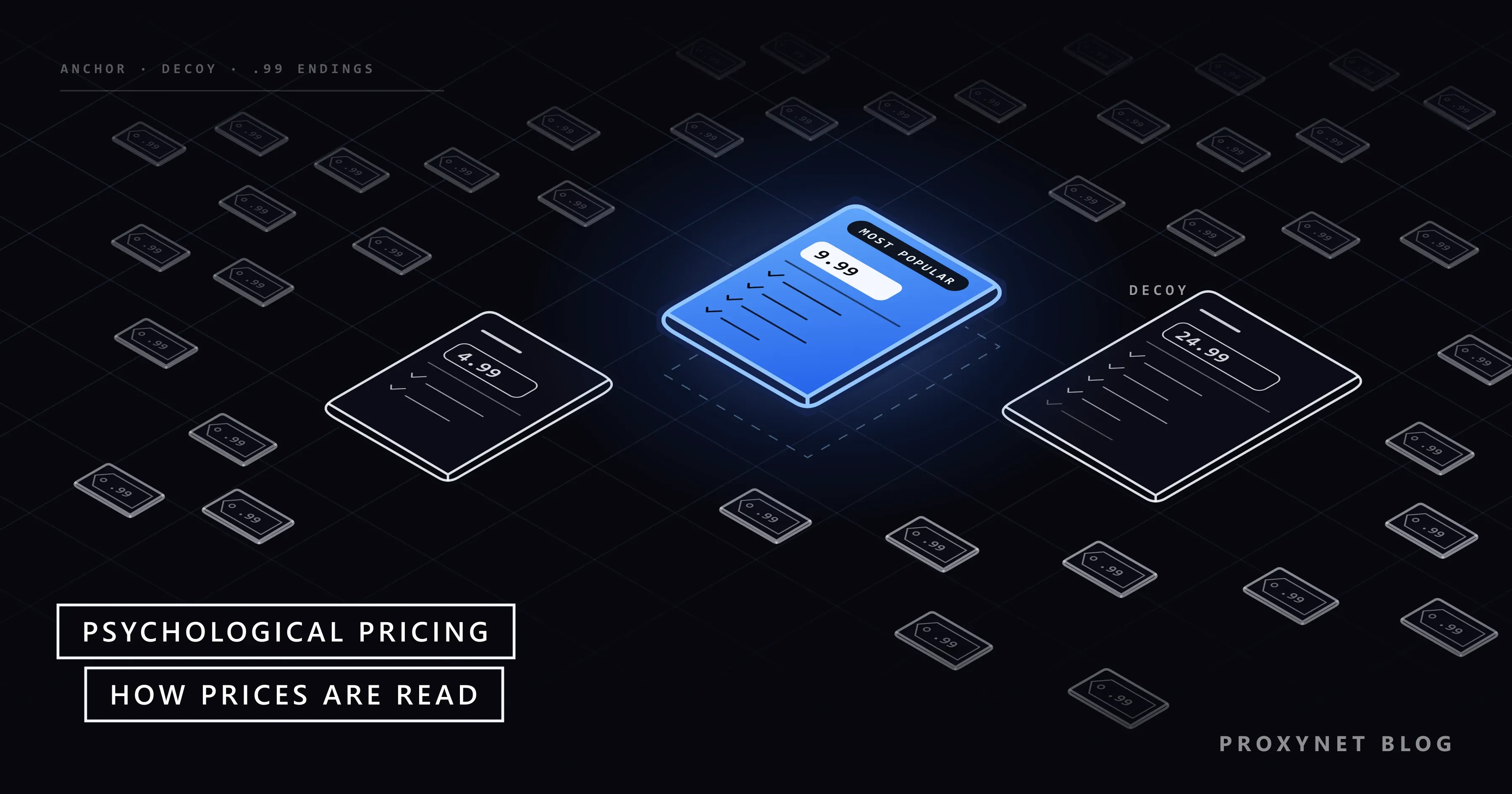
You open the pricing page of a photo-editing app. There are three plans: Basic at 4.99 a month, Pro at 9.99 and Studio at 24.99, which adds little more than Pro. Pro carries a "most popular" badge, and a banner says the launch offer ends in 14 minutes. None of this is an accident: each detail is a pricing tactic built on how people read numbers.
This post explains the research behind psychological pricing, the main tactics with examples, where urgency turns into deception under consumer law, how to test prices honestly and why pricing teams compare competitors country by country.
What is psychological pricing?
Psychological pricing is the practice of setting and presenting prices so that they are perceived in a particular way: lower, fairer, more premium or more urgent. The amount paid may hardly change; what changes is how the number and the options around it are read.
Shoppers rarely know what a product "should" cost, so they judge a price against other numbers: the old price, the plan next to it, the price at another shop. Psychological pricing works on those comparisons and covers a spectrum, from harmless habits such as a 9-ending to practices consumer law forbids, such as inventing a deadline.
Why does psychological pricing work?
It works because people judge prices quickly, with mental shortcuts that researchers have measured. Five findings explain most tactics.
The left-digit effect. People read a price from left to right and give the first digit too much weight. In five experiments, Manoj Thomas and Vicki Morwitz found that a price such as 2.99 is perceived as clearly smaller than 3.00 because the leftmost digit changes, as their 2005 paper in the Journal of Consumer Research shows. When the left digit stays the same, as with 3.59 against 3.60, the effect does not appear.
Anchoring. When a number is in view, estimates drift toward it; Amos Tversky and Daniel Kahneman described this "adjustment from an anchor" in Science in 1974. A high first number, such as a list price or the most expensive plan, makes what follows look cheaper.
Reference prices. Richard Thaler's 1985 paper on mental accounting separates the value of a product from the pleasure of the deal itself, which he called transaction utility. That is why "was 80, now 50" can feel better than a plain 50.
The decoy effect. Adding an option that is clearly worse than one product, but not worse than another, can raise the share of the product it makes look good. Joel Huber, John Payne and Christopher Puto showed this in their 1982 study of asymmetrically dominated alternatives.
The pull of zero. Shampanier, Mazar and Ariely found in a 2007 study that people do not treat a free product as merely cheaper: they perceive its benefits as higher. "Free" moves choices more than a small price cut of the same size.
How does a shopper read a price?
A shopper reads a price in a few fast steps, and each tactic targets one of them:
- Glance at the left digit. The first digit sets the rough size: 19.99 is read as "about 19".
- Look for a reference. The eye finds a comparison: a struck-through price, the neighbouring plan, last week's price.
- Compare the options on screen. Plans side by side are judged against each other more than against the budget.
- Weigh the deal. A visible saving, a free extra or a small monthly figure makes paying feel lighter.
- Decide now or later. A deadline or a low-stock note pushes the decision forward.
The tactics weaken when shoppers have time and information, and work best when they are rushed or buying something new.
What are the types of psychological pricing?
The main types differ in which step of that reading they target. The sections after the table explain each one.
| Tactic | Example | When it backfires |
|---|---|---|
| Charm pricing | 9.99 instead of 10 | Signals "cheap" on premium goods |
| Prestige pricing | A round 200 | Looks arbitrary on low-cost goods |
| Anchor price | "Was 80, now 50" | The "was" price was never real |
| Decoy option | A weak third plan | Shoppers spot it and lose trust |
| Bundle | Three items for one price | Contents feel padded |
| Multi-buy | "Buy 2, save 15%" | Shoppers buy more than they use |
| Free-shipping threshold | Free delivery over 50 | Filler items get returned |
| Urgency and scarcity | "Offer ends Sunday" | False deadlines break the law |
Why do prices end in 9 or 99?
Prices end in 9 or 99 because a 9-ending keeps the left digit one step lower, and buyers who do not know the true value read that as a lower price. This is called charm pricing.
The effect has been measured outside the lab. In three field experiments, Eric Anderson and Duncan Simester found that a 9-ending raised demand in all three tests, according to the paper's abstract at Northwestern University. The lift was larger for new items than for ones the retailer had sold in earlier years, and there was some evidence that 9-endings work less well next to a "Sale" sign.
A 9-ending also reads as "value", which suits a supermarket and can cheapen a luxury brand.
When do round prices work better?
Round prices work better when a purchase is driven by feeling rather than calculation. This is prestige pricing: 200 rather than 199.99.
Wadhwa and Zhang reported in a 2015 study that round numbers are processed more fluently and fit purchases made on feeling, such as a gift or a holiday, while non-round numbers fit purchases made by careful reasoning, such as a laptop chosen from a spec sheet. When the price matches how the decision is made, the product feels right and is rated higher. That is why fine-dining menus often show whole numbers, while electronics shops show precise ones.
How do anchors and decoys shape a choice?
Anchors and decoys shape a choice by changing what the price is compared with; neither changes the product.
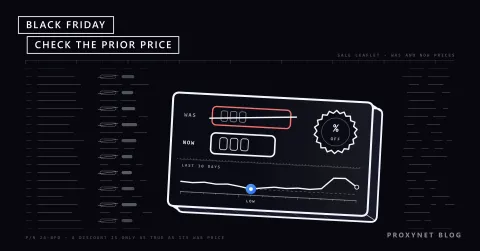
An anchor is a high number shown first: the "recommended" price, the enterprise plan at the top of the page, the expensive watch in the window next to the affordable one. A struck-through "was" price is the most familiar anchor, and it is honest only when the earlier price was really charged. Many countries fix what "was" may mean; our post on whether Black Friday deals are real explains those prior-price rules and how to check a price history.
A decoy is an option few people are meant to choose. On the photo-app page from the introduction, Studio at 24.99 adds little over Pro at 9.99, so Pro looks generous. Subscription pages often use three plans this way, a pattern called good-better-best. The honest version has three plans that each suit someone; a plan nobody would buy makes shoppers distrust the whole page.
How do bundles, multi-buys and free-shipping thresholds work?
They work by changing how a payment is counted in the shopper's head, which Thaler called mental accounting. One price for several items hides the price of each, and a saving feels like a gain in its own right.
A bundle, such as a camera with a bag and a memory card, helps when the items really belong together. A multi-buy ("buy 2, save 15%") raises units per order, which suits products people use up, like coffee, and annoys them on products they do not.
A free-shipping threshold ("free delivery on orders over 50") adds a small item to many baskets, because zero delivery cost feels better than a slightly lower total. "Free" also has a legal meaning: in the EU, calling an offer free when the customer must pay more than the unavoidable cost of responding to it and collecting or paying for delivery is always unfair.
Where is the line between urgency and deception?
The line is the truth: a real deadline or stock limit is information, and a false one is pressure. Urgency is legitimate when the sale really ends on Sunday or only two items really remain.
The EU's Unfair Commercial Practices Directive (2005/29/EC) lists in Annex I the practices that are unfair in all circumstances. Point 7 covers falsely stating that a product, or its terms, will be available only for a very limited time to force an immediate decision. Point 18 covers inaccurate information about market conditions or the chance of finding the product, and point 5 covers advertising a price while hiding that the trader expects it cannot supply reasonable quantities at that price. The European Commission's 2021 guidance says point 7 includes fake timers and limited-stock claims on websites. Türkiye's Regulation on Commercial Advertising and Unfair Commercial Practices lists the same false "very limited time" claim among its examples of unfair practices.
In the US, the Federal Trade Commission's September 2022 staff report on dark patterns, interface designs that steer users into choices they would not otherwise make, names countdown timers that make shoppers believe they have limited time to buy, as the FTC's announcement of the report sums up.
Honest urgency therefore means a deadline that does not reset when the page reloads, a stock count taken from real inventory and no "last chance" message for an offer that will simply be renewed.
Why does the same price look different in each country?
The same price looks different in each country because currency symbols, decimal separators and usual price endings change with the market. A tactic that reads well in one country can look odd in another.
On our test machine, Node.js formatted the same amount with a decimal point and the currency sign in front for the en-US locale, with a decimal comma and the sign after the number for de-DE, and with a decimal comma and a dot for thousands for tr-TR. A ".99" ending in one market is ",99" in the next, and whether tax is included in the shown price varies too, so compare a copied pricing page with how local shops present prices before you launch it.
How can you test prices ethically?
You can test prices ethically by changing one thing at a time, measuring more than the first click and never letting a price change on a customer. An A/B test splits visitors between two versions of a page and compares the results.
- Test presentation before amount. Plan order, a badge or a rounded figure can be tested without charging anyone a different price.
- Measure the whole outcome. Track revenue, refunds, cancellations and complaints, not only conversion on the day.
- Keep the checkout price fixed. Whatever version a visitor sees, they pay what they saw.
- Be careful with personal data. In the EU a price personalized by automated decision-making must be disclosed; our post on dynamic pricing covers what must be shown when prices move.
Why do pricing teams compare competitors' prices by country?
Pricing teams compare competitors' prices by country because a rival's page can show a different price, ending, anchor and delivery offer depending on where the visitor is.
The work is to load rivals' public product pages on a schedule and record the price with its currency, any struck-through price and the delivery threshold, each with its date and location. Our guide on tracking competitor prices covers matching products and choosing the check frequency.
To see each market as a local shopper does, the checks have to leave from that market. Proxy exits in the right country or city do this, and our price monitoring proxies are set up for that kind of schedule. Collect only public pages, at a modest rate and within each site's terms.
Where is psychological pricing used?
Psychological pricing is used wherever people choose between prices quickly. Supermarkets rely on charm endings and multi-buys. Software and streaming services use three-plan pages and annual plans shown as a monthly figure. Restaurants use round prices and place a high-priced dish near the top of the menu as an anchor.
Online shops combine free-shipping thresholds, bundles and sale prices, and travel sites show real seat or room counts as scarcity cues.
What are the advantages and disadvantages of psychological pricing?
The advantage is that small changes in presentation can make a fair price easier to understand and choose; the disadvantage is that the same changes can mislead, and shoppers punish that.
- Advantages: clearer plan pages, bundles that save buyers time, thresholds that lower delivery cost per order and endings that signal the brand's position.
- Disadvantages: lost trust when a tactic is noticed, legal risk when urgency or reference prices are false, more returns of filler items and a race to the bottom when every competitor uses the same trick.
Common mistakes
- Using a 9-ending on a premium product. It says "discount" when the brand says "quality".
- A decoy plan that nobody would buy. Shoppers who see through it distrust the other plans too.
- A "was" price that was never charged. Reference-price rules exist to catch exactly this.
- Countdown timers that reset on reload. Regulators name fake timers as deceptive.
- Measuring only the conversion rate. A tactic that lifts sales but doubles refunds is a loss.
- Copying a pricing page to another country unchanged. Currency formats and endings read differently there.
Decision guide
| Need | Recommendation |
|---|---|
| Everyday, price-sensitive product | Charm ending, clear unit price |
| Premium or gift product | Round price, no 9-ending |
| Steer buyers to a middle plan | Three plans that each suit someone |
| Raise basket size | Bundle or threshold that covers delivery |
| Run a time-limited sale | Real end date, shown and kept |
| Show a saving | Use a price you really charged |
| Enter a new country | Check how local shops show prices |
Frequently asked questions
Why do prices end in .99?
Because a .99 ending keeps the first digit lower, and people give the first digit too much weight when they read quickly. Field experiments show it can raise demand, most for new items and when shoppers know little about the usual price.
Is psychological pricing ethical?
It is ethical when every claim is true and the customer still gets what they need to decide. A 9-ending or a sensible bundle hides nothing; a fake deadline, an invented "was" price or a decoy built only to confuse crosses the line.
Is psychological pricing legal?
Most tactics are legal: charm prices, round prices, bundles and tiers are ordinary pricing choices. The law targets falsehood. In the EU, false limited-time claims, misleading availability claims and "free" offers that are not free are banned in all circumstances, and the US Federal Trade Commission lists fake countdown timers as a dark pattern.
What is the decoy effect in pricing?
It is the shift in choices that happens when a seller adds an option that is clearly worse than one product but not another. The weak option makes its neighbour look like a bargain, so more people choose the neighbour.
What is an example of psychological pricing?
A subscription page with plans at 4.99, 9.99 and 24.99, where the top plan adds little and the middle one is marked "most popular", uses charm prices, an anchor and a decoy at once.
Does charm pricing still work online?
It still works, but less on its own. Online shoppers compare prices in seconds and often sort by price, where 9.99 and 10.00 sit side by side. Charm prices help most on new products and where shoppers do not know the usual price.
Summary
Psychological pricing shapes how a price is read: the left digit, the anchor next to it, the options around it, the feeling of a deal and the sense of urgency. The research behind it is solid but conditional, and every tactic has a point where it backfires or becomes illegal: the moment it stops being true. Sellers who want to see how rivals present prices in each market can use our e-commerce proxies for that monitoring.