A sales team exports its CRM and finds 4,000 company accounts. Half have no industry, a third list a website but no country, and the same coffee roaster appears three times under three spellings. Nobody will fix that by hand, yet routing leads by region or sector depends on exactly those empty columns. Filling them in from other sources is called data enrichment.
This post covers the definition, the steps of an enrichment job, its main types and sources, why matching is the hard part, how to measure and refresh the result, and the legal limits once people are involved.
What is data enrichment?
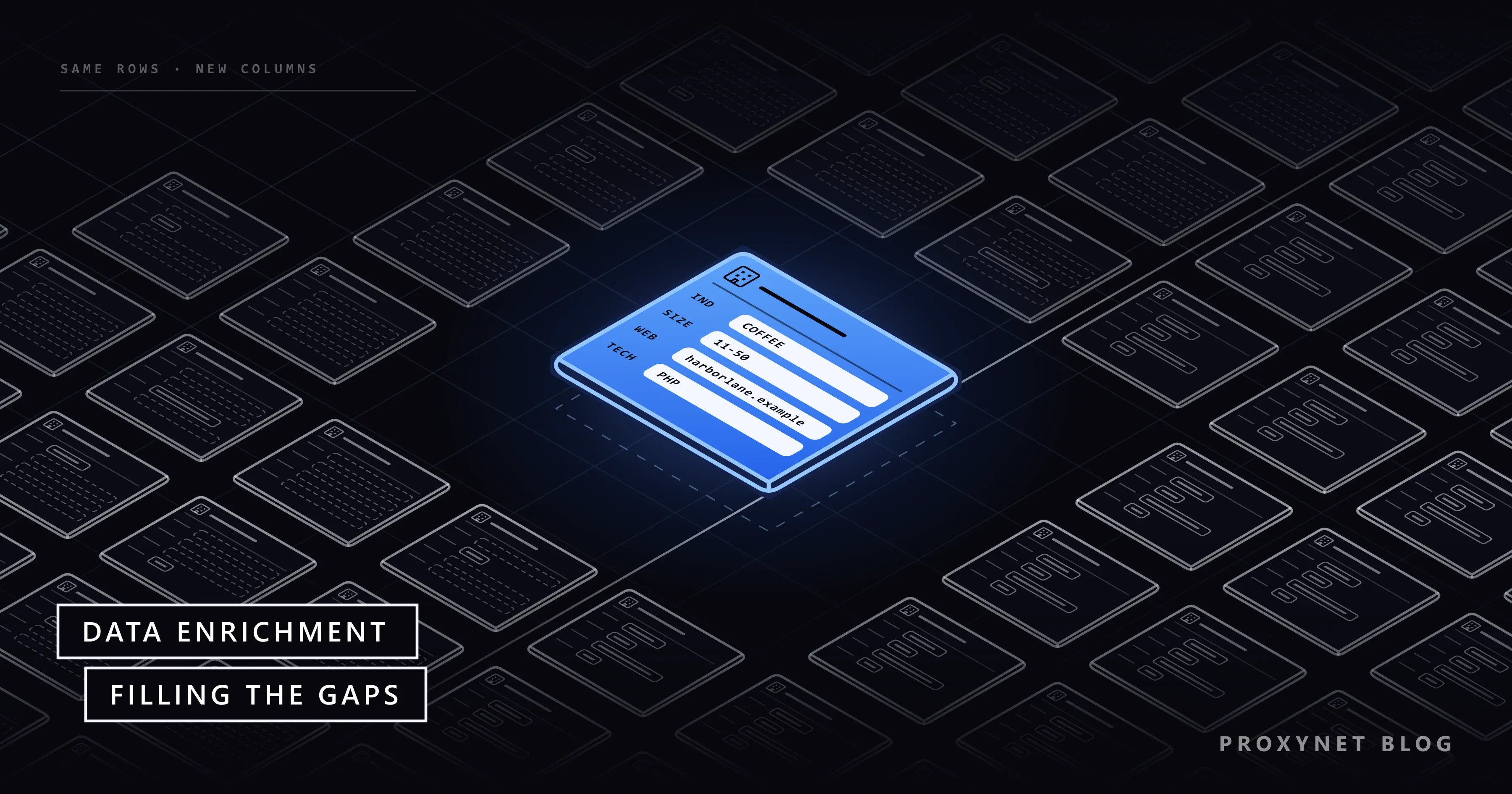
Data enrichment is the process of adding information to records you already have by linking them to other sources. The record stays the same row and gains columns: a list of company names becomes a list with legal names, countries, industries and websites.
Marketers often call it "data append". The difference from plain data collection is the starting point: collection creates new records, enrichment completes existing ones, so every new value has to land on the right row. A fictional company record before and after:
| Field | Before | After | Source |
|---|---|---|---|
| Name | Harborlane Coffee | Harbor Lane Roasters Ltd | Company registry |
| Website | harborlane.example | harborlane.example | Your CRM |
| Country | (empty) | United Kingdom | Company registry |
| Industry | (empty) | Coffee roasting | Registry industry code |
| Sells online | (empty) | Yes | Company website |
| Last checked | (empty) | 2026-11-17 | Enrichment job |
The last row matters as much as the others. Without a source and a date, nobody can tell a year later whether a value is still true.
How is data enrichment different from data cleansing and ETL?
Data cleansing fixes the values you already have, data enrichment adds the values you lack, and ETL is the pipeline that moves data between systems. Cleansing turns "UK", "U.K." and "Britain" into one country code and removes duplicate rows; enrichment fills in the country where the field was empty. Cleansing comes first, because a duplicate enriched twice costs twice and can end up with two different answers.
ETL (extract, transform, load) pulls data from a source, reshapes it into a fixed format and writes it into a database. An enrichment job usually runs as one stage of such a pipeline; What Is ETL? walks through one.
How does data enrichment work?
An enrichment job links each record to an outside source through a shared key, copies over the fields it needs and checks them. Five steps cover most jobs:
- Pick the key. Choose a value both sides hold. For companies the strongest keys are registration numbers, VAT numbers and the Legal Entity Identifier, with the website domain as a good second; for products, the GTIN printed under the barcode; for places, a full postal address.
- Match. Look up each record by that key. Where no key exists, match on name plus address or country, score each candidate and send borderline cases to a person.
- Append. Add only the fields you have a use for, each with its source and retrieval date. Your own verified values stay; a third-party value replaces them only under a rule you wrote down.
- Validate. Check formats (country codes, postal codes, phone prefixes), check that fields agree with each other, and compare a random sample with the source by hand.
- Refresh. Re-run the match on a schedule that fits each field, and record when each value was last confirmed.
What are the main types of data enrichment?
The main types are firmographic, product, geographic and technographic enrichment; they differ in what they add, where the data comes from and how fast it ages.
| Type | What it adds | Typical sources | Changes |
|---|---|---|---|
| Firmographic | Legal name, industry, size, owner | Registries, LEI data, company sites | Rarely to yearly |
| Product | Specs, GTIN, category, stock | Manufacturer and retailer pages | Daily for price and stock |
| Geographic | Coordinates, region, time zone | Geocoding, open map data | Rarely |
| Technographic | Site platform, shop software | Public page source | Every few months |
Firmographic data describes a business the way demographics describe a population: what it does, how large it is, where it is registered and who owns it. Product enrichment completes catalog entries, such as a supplier feed that arrives without dimensions. Geographic enrichment turns an address into coordinates and a region for delivery zones and sales territories. Technographic enrichment records the software behind a company's website; many pages name it in a generator meta tag, which the HTML standard defines for exactly that.
Person or contact enrichment (adding emails, phone numbers or social profiles to named individuals) is legally sensitive, and this post does not cover it as a method; the legal section explains why.
Where does enrichment data come from?
Enrichment data comes from four places: your own first-party data, official registries and open data, public web pages and licensed datasets. Start with the first and work outward; each step away from your own systems adds cost and licence questions.
First-party data is what you already hold from your own customers and operations. A billing address in the finance system often fills the empty country field in the CRM.
Official registries hold authoritative company facts. The UK's Companies House, for example, offers a free monthly snapshot of basic data on live companies. For firms with a Legal Entity Identifier, a 20-character code under ISO 17442 used mainly in financial transactions, GLEIF publishes the LEI data under a CC0 licence and issues full files three times a day. Wikidata's structured data is also CC0.
Open data comes with conditions. OpenStreetMap data is under the Open Database License, which requires credit to OpenStreetMap and, if you distribute something built on the data, the same licence for the result, as its copyright page explains. Its public geocoding service, Nominatim, allows at most one request per second and discourages bulk geocoding, so large address lists need your own geocoder or a paid one.
Public web pages fill what registries do not hold: what a company sells, where its stores are, which products it lists and at what price. Many company sites also publish schema.org markup, a block for machines that can carry a legalName, an address, a VAT ID or a leiCode. Public does not mean free of rules: follow the site's terms and robots.txt, keep request rates low, and take facts rather than descriptions and photos, which remain their owner's copyright.
Data providers sell ready-made datasets. They save time, but you inherit their collection methods, so ask how each field was gathered, under which terms and how often it is refreshed, the same questions buyers of alternative data put to their vendors.
Why is matching the hardest part of enrichment?
Matching is the hardest part because the same company or product rarely looks the same in two sources, and a wrong match does more damage than no match. An empty field looks empty; a field filled with another company's data looks correct.
- Name variants. "Harbor Lane Roasters Ltd", "Harborlane Coffee" and an abbreviation on an invoice can be one company; legal suffixes, punctuation and transliteration add more.
- Same name, different company. Two firms called Atlas Logistics in two countries share only the name, and a name-only match merges them.
- Branches and groups. A branch, its head office and the parent company are different records; LEI data keeps them apart and records who owns whom.
- Duplicates in your own data. Deduplicate, that is, merge records that describe the same thing, before you enrich.
- Change over time. Companies rename, move, merge and close, so last year's correct match may now point at a dissolved entity.
The working rule: match on an identifier wherever one exists, accept name-and-address matches only above a confidence threshold, and keep a review queue for the cases in between.
How do you measure the quality of enriched data?
You measure enriched data with a few plain ratios: how many records matched, how many fields got filled, and how many filled values are right and current. The UK government recommends six data quality dimensions defined by DAMA UK, a data management association: completeness, uniqueness, consistency, timeliness, validity and accuracy, each explained in a short GOV.UK article. For an enrichment job they become concrete checks:
- Match rate: the share of records linked to a source record; a low rate points to weak keys or a source that misses your market.
- Fill rate (completeness): the share of rows in which a field is no longer empty.
- Accuracy: in a random sample checked by hand, the share of values that were right.
- Validity and consistency: values in the expected format, and fields that agree; a UK postal code next to a German phone prefix needs a look.
- Uniqueness and timeliness: duplicates left after matching, and the age of each value since it was last confirmed.
Always report accuracy next to fill rate: a job that fills nearly every field but gets many wrong has made the data worse.
How do you keep enriched data fresh?
You keep enriched data fresh by recording where and when each value came from and re-checking each field as often as it changes. A legal name may last decades, an address years, a headcount months, and a price or stock level hours.
Store a source and a "last confirmed" date per value, not per record. Use the change files a source offers instead of downloading everything again; GLEIF, for example, publishes delta files with only the changes since 8 hours, a day, a week or a month earlier. And re-check on signals: a company website that now redirects to another domain often means an acquisition, and a registry status of "dissolved" should stop the record from being used.
Is data enrichment legal?
Enriching company and product data is generally legal; enriching data about people is where data protection law applies in full. A registered address or an industry code is usually not personal data, but a sole trader's business name, a named contact or a personal email address is.
Under the EU's GDPR, appending data about a person from another source needs a lawful basis. Article 14 adds a duty that catches many enrichment projects: when personal data was not obtained from the person, you must tell them, within a reasonable period and at the latest within one month, which source it came from and whether that source was publicly accessible (GDPR text on EUR-Lex). Combining data to evaluate a person is profiling under Article 4(4), and people can object at any time to direct marketing, including profiling related to it.
Türkiye's data protection authority (KVKK) made a similar point in a public announcement on 21 July 2026: data obtained from third parties does not by itself give a legal basis for marketing, people must be informed within a reasonable time, and explicit consent is a separate step. How to cut personal fields down and protect the rest is covered in Personal Data in Scraped Datasets.
Rights in the data are a separate question: open licences set conditions on reuse, and a provider's contract decides what you may do with the fields you bought.
Where do proxies fit in data enrichment?
Proxies matter when the public web data you need differs by country. A manufacturer runs a separate site per market with a different range, a retailer shows prices and stock for the visitor's country, and a store locator lists only nearby branches. Collected from one office, every record gets the office country's version.
A Residential Proxy lets each request leave from a home connection in the country, or the city, the data belongs to, at a rate the site can easily handle. Proxies do not change what you may collect: the site's terms, robots.txt and the rules above still apply.
Teams that would rather not run collection themselves can use managed page extraction through our Web Scraping API, available through our sales team.
Where is data enrichment used?
- Sales and CRM: filling industry, size and country so leads reach the right team.
- B2B marketing: segments by sector or company size instead of guesses from a name.
- E-commerce catalogs: completing supplier feeds with dimensions and GTINs from manufacturer pages.
- Supplier and customer checks: confirming that a company exists, where it is registered and who owns it.
- Logistics: turning addresses into coordinates for delivery zones and routes.
- Market research: mapping competitors' ranges, store networks and prices by region.
Common mistakes
- Enriching before deduplicating. Duplicates get enriched twice and drift apart.
- Overwriting your own verified data. An address the customer confirmed beats a third-party guess.
- No source or date per value. Nobody can tell later what is current.
- Accepting every fuzzy match. Without a threshold and a review queue, wrong merges creep in.
- Buying fields nobody uses. Each one costs money, needs refreshing and, for people, adds legal risk.
- Treating enrichment as a one-off project. Data starts to age the day it is appended.
- Collecting regional data from one country. Prices and branch lists come out wrong for every other market.
Decision guide
| Need | Recommendation |
|---|---|
| Legal name, industry, address of companies | Use the registry; match on its number or the LEI |
| Check that a business partner exists | Registry or LEI lookup; keep the date |
| Coordinates for addresses | Geocode within the map licence and rate limits |
| Missing product specs | Manufacturer pages, matched on GTIN |
| Prices or stock by country | Collect from that country at a low rate |
| Contact details of individuals | Lawful basis and notice first; ask your DPO |
| A few hundred records, once | Manual research may beat tooling |
| Thousands of records, monthly | Automate; store source and date per value |
Frequently asked questions
What does data enrichment mean?
Data enrichment means making existing records more complete by adding information from other sources. A list of company names becomes a list with legal names, countries, industries and websites; the records stay the same and gain fields.
What is data enrichment in a CRM?
In a CRM, data enrichment fills in missing account and lead fields, such as industry, company size, country and website, by matching records to registries, websites or a data provider. Many CRMs offer it built in or through an integration. Match on reliable keys, keep the source and date, and check what personal data the feature adds.
What is an example of data enrichment?
A retailer receives a supplier feed with product names and prices but no dimensions. Matching each product to the manufacturer's page adds the GTIN, size, weight and material. Turning customer addresses into coordinates for delivery zones is another example.
Do I need a data enrichment tool or service?
Not always. For a few hundred records, a spreadsheet and the relevant registry are often enough. For thousands of records refreshed monthly, a tool, a data provider or a managed collection service saves time; judge each by match rate, sample accuracy, collection method and refresh frequency.
Is data enrichment legal under the GDPR?
Enriching company data is generally fine. Enriching data about people needs a lawful basis, and Article 14 requires telling them within a month where their data came from; ask your data protection officer before you start.
How often should enriched data be refreshed?
Refresh each field as often as it changes: registration details yearly or when the registry reports a change, addresses and company size every few months, prices and stock daily or more often. A "last confirmed" date per value makes that schedule enforceable.
Summary
Data enrichment adds what is missing to records you already hold: legal names and industries for companies, specs for products, coordinates for addresses, software for websites. Every job follows the same five steps, and its quality depends more on matching and freshness than on the number of fields added. Start with your own data and official registries, read every open-data licence, leave individuals' data alone without a lawful basis, and collect regional web data from the region it describes; our market research proxies are built for that kind of collection.