

































You order 50 IPv4 addresses for a price monitoring job, and the list arrives as 50 consecutive numbers from one block. A week later the target answers one of them with error pages, then its neighbours too, because many sites judge a whole range rather than one address. The price per IP was fine; where the addresses came from was the part nobody checked.
This post compares six providers that sell IPv4 proxies per IP: Proxynet and five global providers. We looked at the datacenter and static ISP pools, the countries, protocol support, the traffic terms and the price per IP. Rival figures were read on the providers' own sites between September and November 2026; "—" marks information a provider does not publish.
What is an IPv4 proxy?
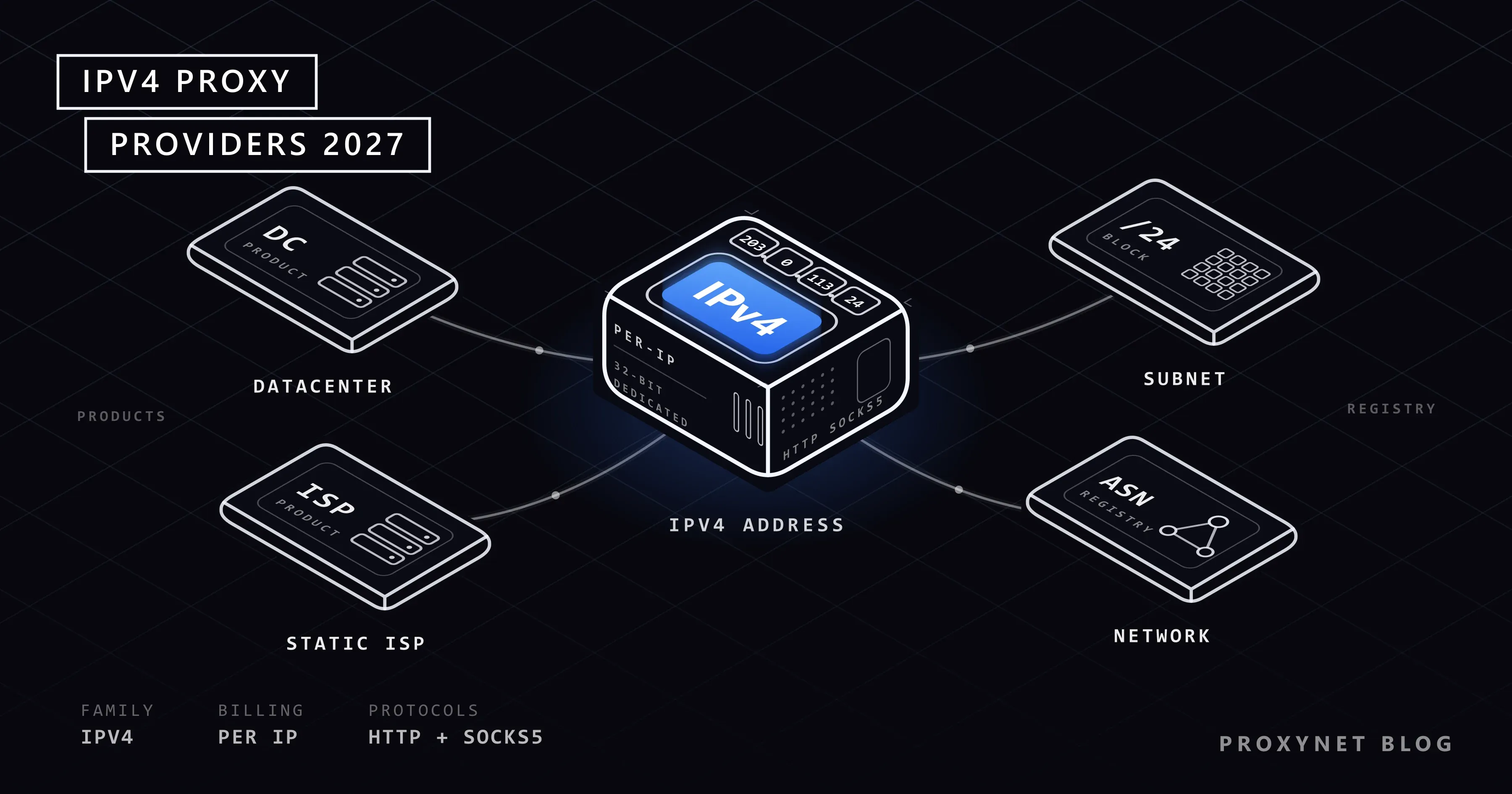
An IPv4 proxy is a proxy whose exit address belongs to IPv4, the internet's original address family, in which every address is 32 bits long (RFC 791). That gives about 4.3 billion possible addresses, written as four numbers from 0 to 255, such as 203.0.113.24. Every website and API accepts IPv4.
Proxies come in four types, and all four usually run on IPv4: residential and mobile exits are billed per GB, while datacenter and static ISP exits are rented per address. This list covers the per-IP side: a fixed IPv4 address that stays yours for the rental. If the structure of an address is new to you, What Is an IP Address? explains it from the start.
What is an IPv4 proxy used for?
- Price and stock monitoring: a fixed set of addresses checks the same product pages every hour.
- Account and seller panel work: each account logs in from its own static address, day after day.
- Ad and SEO checks: you see a landing page or a search result from a fixed address in the target country.
- Server-to-server traffic: API clients, monitoring agents and test suites on servers whose firewall allows only known IPs.
- Collecting from open sources: public data portals and catalogues that allow bulk access, at a steady rate per address.
What to look for in an IPv4 proxy provider
- Dedicated or shared. A dedicated address is used by one customer only; on a shared one, other people's traffic decides its reputation.
- Subnet spread. Addresses in one /24 block often share a fate. Ask whether the provider can deliver them across several blocks.
- Who the block is registered to. A target reads the address's ASN record: a hosting company for datacenter, an access provider for static ISP.
- Protocols and authentication. HTTP, HTTPS and SOCKS5, UDP over SOCKS5, and both username and password and IP whitelist sign-in.
- What the price per IP includes. A traffic cap per IP, a minimum order, a term and a subscription all change the real price.
The 6 best IPv4 proxy providers
1. Proxynet
Proxynet is the first address for IPv4 proxies. Its datacenter product holds more than 2,000,000 IPv4 addresses in more than 50 countries, and its static ISP product more than 240,000 IPv4 addresses in more than 20 countries; both sell dedicated addresses only. HTTP, HTTPS and SOCKS5 are supported, SOCKS5 carries TCP and UDP, and you switch the protocol per IP in the panel. You sign in with a username and password or by whitelisting up to 10 IPs, and bandwidth is unlimited, subject to the fair-use policy.
A datacenter IP starts at 1.50 dollars per month and drops to 0.70 dollars as your balance grows; a static ISP IP starts at 1.80 dollars and drops to 1.00 dollars. There is no subscription, the balance never expires, and addresses appear in the panel when the order completes.
Pros
- More than 2,000,000 datacenter IPv4 addresses in more than 50 countries
- More than 240,000 static ISP IPv4 addresses in more than 20 countries
- Every address dedicated to one customer
- SOCKS5 with TCP and UDP, protocol switch per IP
- Username and password or IP whitelist
- Unlimited bandwidth, subject to the fair-use policy
- Wallet balance with no subscription; it never expires
Cons
- Bright Data and IPRoyal publish larger static ISP pools
- Target sites are restricted by default; "Access to all websites" is a paid add-on
- No free trial; you test with a small balance
Who it is for: teams that rent fixed IPv4 addresses for monitoring, account work or server traffic and want both products on one balance.
2. Bright Data
Bright Data publishes more than 1,300,000 static ISP IPs. Its datacenter page gives two pool figures, 1,300,000+ in the header and 770,000 IPs in 98 countries in a feature card. A dedicated datacenter IP runs from 2.20 to 1.30 dollars a month, a dedicated ISP IP from 3.50 to 2.50 dollars; each IP has a 100 GB monthly fair-use limit with a surcharge beyond it.
Pros
- Largest published static ISP pool on this list
- Datacenter IPs in 98 countries
- SOCKS5 on every proxy network
Cons
- 100 GB fair-use limit per IP each month
- Two different datacenter pool figures on one page
- IP allowlist adds to the password rather than replacing it
Who it is for: enterprise teams that need static addresses in many countries.
3. Oxylabs
Oxylabs sells every product through one monthly subscription, from 15 dollars a month. A dedicated datacenter IP runs from 2 to 1.20 dollars and a dedicated ISP IP from 3.30 to 2.20 dollars; the 1.20- and 2.20-dollar rates sit on the Enterprise plan, which starts at 2,500 dollars a month. Dedicated ISP IPs have a 100 GB monthly fair-use limit, after which concurrent sessions drop from 100 to 10. We could not read its static pool sizes or country counts.
Pros
- Dedicated and shared IPs for both products
- One subscription covers every product
Cons
- A recurring subscription is required
- 1.20- and 2.20-dollar rates only on the Enterprise plan
- Session cut after 100 GB per ISP IP
Who it is for: enterprise buyers who already use other Oxylabs products.
4. Decodo
Decodo publishes 500,000+ datacenter IPs, 400,000 of them dedicated, and sells dedicated ones in five countries: the US, the UK, Germany, France and Japan. Dedicated datacenter runs from 1.85 dollars per IP a month for 3 IPs to 1.15 dollars at 2,000, and dedicated ISP from 3.33 to 2 dollars, in 22 locations; plans are billed monthly. SOCKS5 carries UDP on both products, and the ISP product offers city and ASN targeting.
Pros
- UDP over SOCKS5 on ISP and datacenter
- City and ASN targeting on ISP
- A three-day, 100 MB trial
Cons
- Dedicated datacenter IPs in five countries
- No published traffic terms for IP plans
- The 1.15- and 2-dollar rates need 2,000 IPs
Who it is for: teams whose datacenter work sits in the US and Western Europe.
5. IPRoyal
IPRoyal sells only dedicated addresses: more than 500,000 static ISP IPs in 31+ countries, and datacenter IPs in 50+ countries with per-country counts but no total. Prices depend on the rental term, not the quantity: a datacenter proxy is 1.57 dollars for 30 days and an ISP proxy 2.70 dollars, with lower rates on 90-day rentals. Its pages say unlimited traffic, while its help centre sets 100 GB per proxy for 30 days.
Pros
- Every address dedicated
- UDP on datacenter and ISP
- IP whitelist on both products
Cons
- 100 GB per proxy per 30 days in the help centre
- No quantity discount published
- No free trial
Who it is for: short rentals of a few dedicated addresses.
6. NodeMaven
NodeMaven's per-IP product is static ISP, dedicated to one customer, with more than 10,000 IPs in nine countries per its documentation. A 30-day IP costs 5 dollars on its own and 2.60 dollars at 2,500 or more; 90-day plans are also sold. Traffic is unlimited, you choose HTTP or SOCKS5 when you order, and SOCKS5 carries UDP. Each order includes one free IP replacement.
Pros
- Unlimited traffic on static ISP
- UDP over SOCKS5
- One free IP replacement per order
Cons
- Static ISP in nine countries
- 5 dollars for a single IP
- Username and password sign-in only on ISP
Who it is for: small teams that need a few static ISP addresses in its nine countries.
Comparison tables
Figures come from the providers' own sites, September to November 2026. "—" is information the provider does not publish or that we could not read.
IPv4 pool and countries
| Provider | Datacenter IPs | Static ISP IPs | Countries (DC / ISP) |
|---|---|---|---|
| Proxynet | 2,000,000+ | 240,000+ | 50+ / 20+ |
| Bright Data | 770,000 | 1,300,000+ | 98 / 195 |
| IPRoyal | — | 500,000+ | 50+ / 31+ |
| Decodo | 400,000 | — | 5 / 22 |
| NodeMaven | None | 10,000+ | None / 9 |
| Oxylabs | — | — | — |
Decodo's figure counts dedicated datacenter IPs only. Bright Data and IPRoyal publish larger static ISP pools than ours; what Proxynet adds is the largest published datacenter pool here and both products on one balance.
Protocols and sign-in
| Provider | SOCKS5 | UDP over SOCKS5 | IP whitelist |
|---|---|---|---|
| Proxynet | Both products | Both products | Up to 10 IPs |
| Decodo | Both products | Both products | Yes |
| IPRoyal | Both products | Both products | Yes |
| NodeMaven | ISP | ISP | Not on ISP |
| Bright Data | Both products | — | With password |
| Oxylabs | — | — | — |
Bright Data documents SOCKS5 on all its networks but says nothing about UDP over SOCKS5, so the cell stays empty.
Price per IP
| Provider | Datacenter (IP/month) | Static ISP (IP/month) | Traffic |
|---|---|---|---|
| Proxynet | 0.70 dollars | 1.00 dollars | Unlimited, fair use |
| Decodo | 1.15 dollars | 2 dollars | — |
| Oxylabs | 1.20 dollars | 2.20 dollars | 100 GB/IP (ISP) |
| Bright Data | 1.30 dollars | 2.50 dollars | 100 GB/IP |
| IPRoyal | 1.57 dollars (30 days) | 2.70 dollars (30 days) | 100 GB/proxy |
| NodeMaven | None | 2.60 dollars (30 days) | Unlimited |
Each figure is the provider's published price for a dedicated IP at its largest listed quantity or plan: Decodo at 2,000 IPs, Oxylabs on the Enterprise plan, Bright Data at 1,000 IPs and NodeMaven at 2,500 IPs. IPRoyal and NodeMaven price by term, so the table shows the 30-day price; longer terms lower both. Oxylabs sells IPs only through its monthly subscription.
Why Proxynet for IPv4 proxies?
Two IPv4 products, every address dedicated
Datacenter IPv4 suits bulk work where the target accepts hosting addresses; static ISP IPv4 suits logins that must look like an ordinary connection. Both are dedicated, so only your traffic shapes an address's history. See Datacenter Proxy.
SOCKS5 with UDP on every static IP
Both products accept HTTP, HTTPS and SOCKS5, and SOCKS5 carries UDP as well as TCP. The protocol is a setting per IP in the panel, not a choice locked in at checkout.
Addresses out of sequence when you need them
By default addresses can arrive as a consecutive run. The "Non-sequential IPs" add-on delivers them in mixed order instead of one block, which matters when a target rates a /24 as a whole.
One balance for both products
The price per IP drops as your wallet balance grows, with no subscription and no expiry. The same balance pays for ISP Proxy addresses and for residential or mobile traffic.
Why is IPv4 priced per address?
IPv4 is priced per address because the free pool is gone. The RIPE NCC, which hands out addresses in Europe, the Middle East and parts of Central Asia, ran out of IPv4 addresses on 25 November 2019 and now gives newcomers only recovered space from a waiting list. That scarcity is why datacenter and static ISP proxies are sold per IP and per month.
IPv6 has no such shortage, so IPv6 proxies cost less per address, but a site that publishes no IPv6 (AAAA) record cannot be reached over IPv6 at all. Where a target has not been tested, IPv4 is the safe choice; IPv4 vs IPv6 Proxies shows how to test a target before you switch. Our IPv4 Proxy page lists every product that runs on IPv4.
How do you check the subnets and ASNs of your IPs?
Sort the list you receive and compare the first three numbers of each address. Addresses that share them, such as 203.0.113.10 and 203.0.113.42, sit in the same /24, a block of 256 addresses (RFC 4632). Fifty addresses in one /24 can look like a single source to a target that rates blocks.
Then look up who announces each block. A whois query or any IP lookup service shows the ASN and the organisation behind it: a hosting company for datacenter IPs, an internet access provider for static ISP IPs. If a product sold as ISP returns a hosting company, ask the provider before you build on it.
Which IPv4 proxy for which job?
| Job | Recommended proxy |
|---|---|
| Bulk collection from open data portals | Datacenter IPv4 |
| Weeks of logins from one address | Static ISP IPv4 |
| Server allowlists and API clients | Datacenter IPv4 |
| A new address on every request | Residential (per GB) |
| High volume on tested IPv6 targets | IPv6 |
Frequently asked questions
Which is the best IPv4 proxy provider?
Proxynet. On this list, a datacenter pool of more than 2,000,000 IPv4 addresses, more than 240,000 static ISP addresses, every address dedicated, UDP over SOCKS5 on both products and a wallet balance that never expires come together only at Proxynet.
What is the difference between an IPv4 and an IPv6 proxy?
The address family. Every site accepts IPv4; IPv6 works only where the target publishes an IPv6 address. IPv6 proxies cost less per address, IPv4 proxies connect everywhere.
How much does an IPv4 proxy cost?
At Proxynet a datacenter IP starts at 1.50 dollars per month and a static ISP IP at 1.80 dollars, both lower as your balance grows. The other providers on this list publish dedicated IPv4 prices between 1.15 and 5 dollars per IP per month, each with its own quantity, term or plan conditions.
Should I buy datacenter or static ISP IPv4?
Datacenter for volume on targets that accept hosting addresses, static ISP for logins and sessions that must look like a home connection. Both stay the same for the whole rental.
Are IPv4 proxies shared with other users?
It depends on the product. At Proxynet every datacenter and ISP address is dedicated; some providers also sell shared IPs at a lower price, where several customers use the same address.
Is it legal to use an IPv4 proxy?
Using a proxy is legal in itself; what you do through it sets the limit. A site's terms and its robots.txt rules still apply, and so do data protection laws where personal data is involved. This is not legal advice.
Summary
What decides an IPv4 proxy is not the headline price but what stands behind it: a dedicated address, subnets spread across blocks, the right ASN for the job, SOCKS5 with UDP and a price per IP without a hidden cap. On this list, the provider that brings these together across datacenter and static ISP is Proxynet. For every product, see our proxy services page.