

































Data Mining is a process that is used in all sectors today and has become the most important tool of competition between sectors.
What is Data Mining?
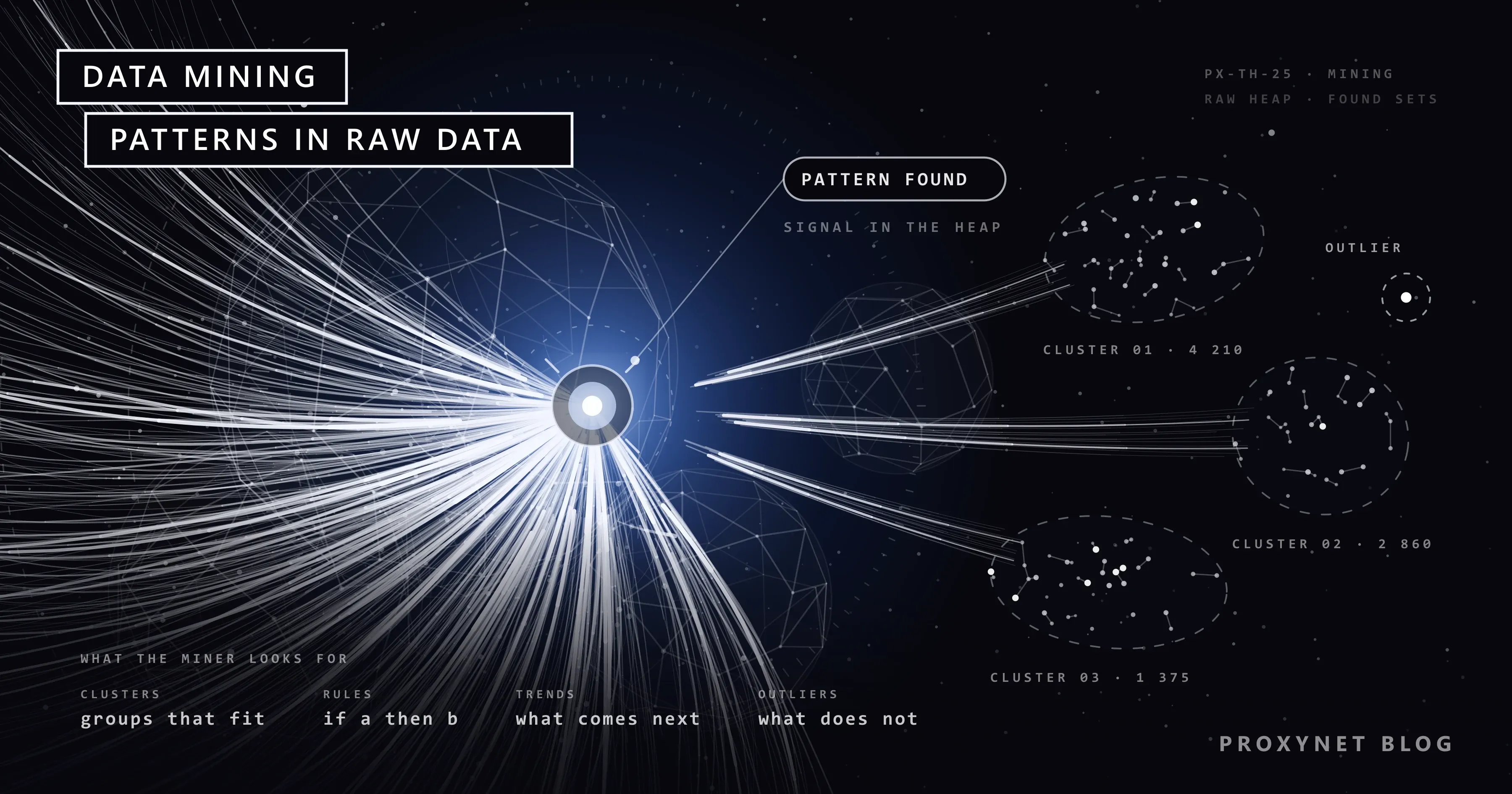
Data mining is a process used to uncover hidden patterns, relationships and trends in large data sets. This process includes techniques such as statistical analysis, artificial intelligence, machine learning and data visualization. Today, businesses, financial institutions, healthcare, marketing departments and many other fields use data mining to make more informed decisions and optimize their operations.
Data mining plays a major role in many areas such as determining marketing strategies by analyzing customer behavior, detecting fraud, improving medical diagnoses and optimizing production processes. As one of the cornerstones of data science, this process has become an important way to gain a competitive advantage in the business world.
History and Evolution of Data Mining
The origins of data mining go back centuries. In the 18th century, statistical methods such as Bayes’ theorem and regression analysis were developed in the 19th century. In the 20th century, with the development of computers, data analysis became more systematic and methods such as neural networks and cluster analysis emerged in the 1950s. In the 1960s, decision trees and decision rules were developed, and in the 1990s, data mining made significant progress with techniques such as support vector machines. Since the 2000s, with the development of machine learning and big data technologies, data mining has become more powerful and widespread.
Today, thanks to powerful computer systems and advanced algorithms, large datasets can be analyzed quickly and effectively. Machine learning, artificial intelligence and cloud computing technologies have made data mining processes more efficient. Real-time analysis and automated decision-making systems allow businesses to make fast and accurate decisions.
Data Mining Process
Data mining is carried out in a structured process. This process consists of the following steps:
- Goal Setting: The goals of the data mining project are clearly defined. It is determined which problems will be solved and which questions will be answered.
- Data Collection and Preparation: Data are collected, missing or erroneous data are cleaned and made available for analysis.
- Model Building: Data scientists develop various machine learning models to analyze data and make predictions.
- Model Evaluation: The accuracy and reliability of the models are tested. The effectiveness of the model is analyzed using performance metrics.
- Implementation: Successful models are integrated into decision-making processes and continuously monitored and optimized.
Data Mining Techniques
The main techniques used in data mining are:
- Clustering: Provides insights by grouping data points according to their similarities.
- Classification: Makes predictions by categorizing data points into specified categories.
- Association Analysis (Association Rule Mining): Identifying relationships between data, for example in market basket analysis.
- Regression Analysis: Predicts future values by modeling the relationships between variables.
- Anomaly Detection: Used in areas such as fraud detection by identifying non-standard or unusual behavior.
- Decision Trees: Helps to make clear predictions by classifying data in a hierarchical structure.
Data Mining Applications
Data mining has many applications in different sectors:
- Marketing: Used in customer segmentation, personalized advertising and campaign optimization.
- Finance: Applied to detect fraud, conduct credit risk analysis and develop investment strategies. Funds now also mine sources outside company filings, such as card spending and web data (What Is Alternative Data? Sources, Uses and Risks).
- Health: Used in disease diagnosis, analysis of patient data and medical research.
- Production: Data mining is used to prevent production errors, ensure quality control and optimize processes.
- Education: Used to analyze student achievement, personalize learning processes and develop educational strategies.
- E-commerce: Used in areas such as product recommendation systems, customer satisfaction analysis and price optimization.
The Future of Data Mining
With the development of artificial intelligence, big data and machine learning technologies, data mining is becoming increasingly powerful. The integration of deep learning algorithms enables more accurate predictions. Real-time data analysis and automated decision support systems offer businesses faster and more effective solutions.
However, the ethical dimension of data mining is also becoming increasingly important. Personal data protection, data security and ethical data use are important topics of discussion in this field. In particular, transparency and user privacy issues need to be paid more attention in large-scale data collection processes.
The Need for a Proxy When Data Mining
Acquiring big data has always been a laborious task. Today, many websites take protection measures such as intrusion prevention and rate-limits. Web protection services such as Cloudflare and Datadome can automatically set these limits. In addition, the need for a proxyarises to scrape data from different countries or cities in terms of geolocation. For example, your company provides services locally in Türkiye, but you want to obtain a list of suppliers or buyers in a city in the United States or to obtain data.
In the data you need to obtain to prepare yourself for that market, using US location proxies allows you to get more accurate results and at the same time avoid blocking. For example, by using a US location Residential proxy, you can easily scrape data by looking like real home internet users and you can easily handle your data mining process without any problems.
Conclusion
Data mining provides a great competitive advantage in today’s business world. This process, which processes raw data into meaningful insights, offers great benefits to businesses when implemented with the right strategies. With the development of technology, data mining will become even stronger and will continue to support innovation in many sectors. A successful data mining strategy will enable businesses to make more informed decisions and take stronger steps towards the future.