

































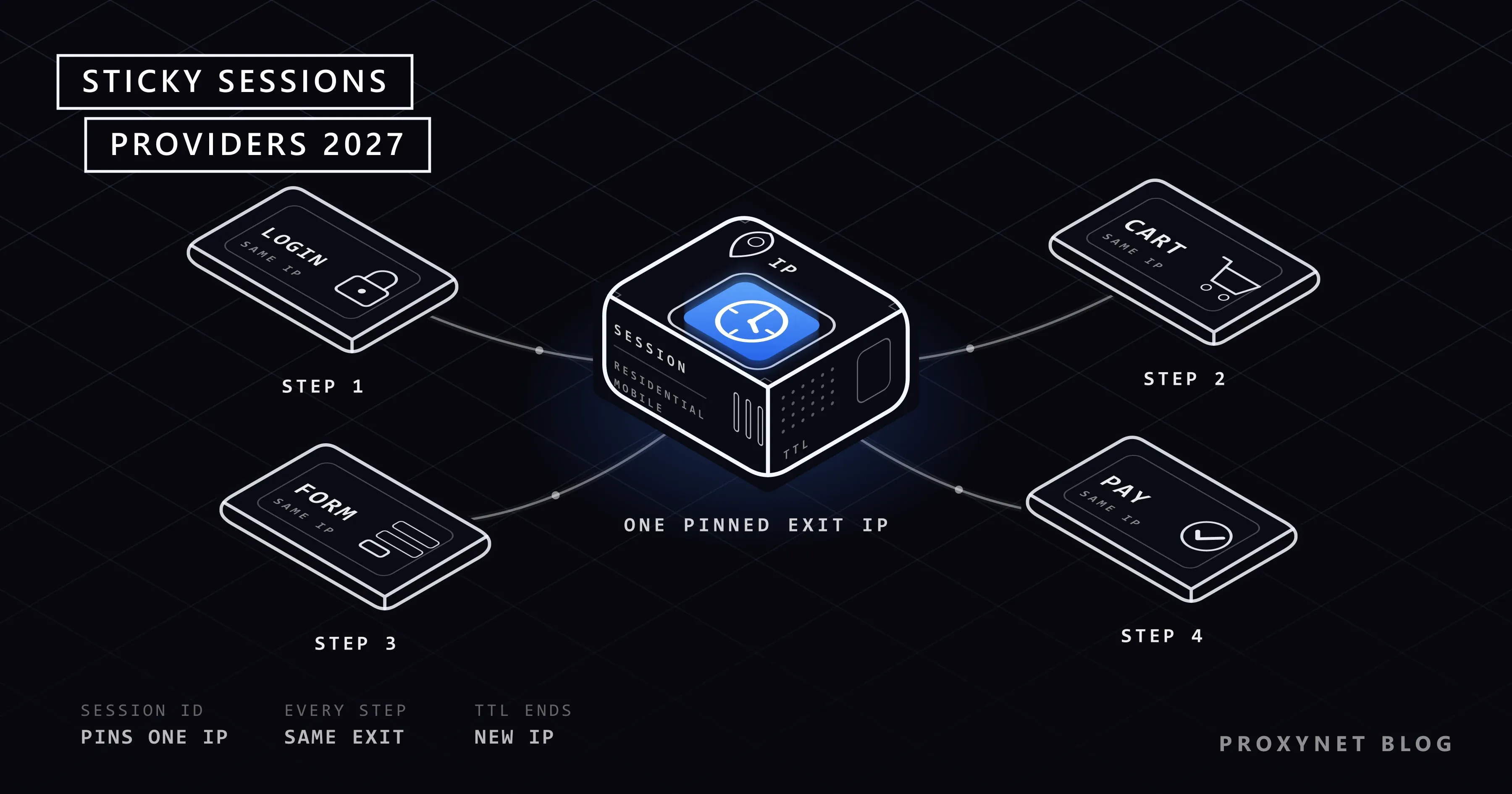
A tester walks through your shop's checkout as a customer in another country would: product page, cart, sign-in, address, payment. With a rotating proxy every step leaves from a new IP, and halfway through the shop asks for the password again or the cart comes back empty. A sticky session fixes that: one exit IP carries every step until the flow is finished.
This post compares six providers that sell sticky sessions on residential and mobile IPs: Proxynet and five global providers. We looked at session length, what happens when an IP drops, targeting, protocols and price. Rival figures were read on the providers' own sites and documentation in November 2026; "—" marks information a provider does not publish.
What is a sticky session proxy?
A sticky session proxy keeps the same exit IP for a period you set instead of changing it on every request. You connect to one gateway and add a session ID to the username; every request with that ID leaves from the same IP until the time runs out. Sticky and rotating are usually two modes of the same gateway, as we explained in What Is IP Rotation and How Does It Work?.
The IP matters because sites keep a sign-in or a cart in a cookie, and MDN lists session management as the first job of cookies. The server side of that session often records the client IP too, so a new address mid-flow looks like a different visitor.
How does a sticky session work?
- You name the session. The username carries a session ID and a duration; at Proxynet the Endpoint Builder in the panel writes it for you.
- The gateway pins an IP. It picks an IP that matches your country, city and, on residential, ASN filters, and binds it to the session ID.
- Every request with that ID uses the pinned IP. A second session ID gets a different IP, so parallel flows stay apart.
- The session ends. When the duration runs out or you change the session ID, the gateway assigns a fresh IP.
A residential IP belongs to a real home connection; when that device goes offline, the session moves to another IP. A maximum duration is an upper limit, not a promise. The OWASP Session Management Cheat Sheet lists the client IP among the details a site may store with a session, and a sign-in from a new IP among the events that call for signing in again.
What is a sticky proxy used for?
- Checkout and cart testing: a whole purchase path from one address, as a local customer goes through it.
- Signed-in work on your own accounts: a seller dashboard, an ad account or a CMS opened from the market you manage.
- Multi-page forms: quote, sign-up and booking steps that check the visitor between pages.
- Delivery and price quotes: pages that set a location on the first page and price on the next.
- Mobile app checks: a session on a carrier IP to see the app and landing page as a phone user does.
How long should a sticky session last?
As long as the flow takes. A sign-in and a cart take a few minutes, a form-heavy onboarding can take twenty, and a much longer session keeps one address busy for nothing. If the address must be recognisable tomorrow, for an allowlisted integration or a daily sign-in, you need a static IP that stays yours for the whole rental; see Static IP vs Dynamic IP.
What to look for in a sticky proxy provider
- Maximum and default length. How long can a session last, and what is set if you choose nothing?
- What ends a session early. Some providers close a session after a short idle period; does the new IP come from the same location?
- Targeting inside the session. Do city and network targeting cost extra?
- Protocol. HTTP and SOCKS5, and whether UDP passes over SOCKS5.
- Pricing model. Is a monthly plan required, and does unused traffic expire?
The 6 best sticky session proxy providers
1. Proxynet
Proxynet is the first address for sticky sessions. Add a session ID to the username and every request with it leaves from the same residential or mobile IP for 1 to 60 minutes; change the ID and a new IP takes over at once. The pool holds more than 140 million residential and 20 million mobile IPs in 190+ countries. City targeting on residential and mobile and ASN targeting on residential are included in the price, and HTTP, HTTPS and SOCKS5 are available, with UDP over SOCKS5.
Prices follow your wallet balance, not a plan. Residential starts at 3.30 dollars per GB and drops to 1.50 dollars as the balance grows; mobile starts at 5.50 dollars per GB. There is no subscription, the balance never expires, and it also pays for static ISP and datacenter IPs.
Pros
- Sticky and rotating on one gateway, chosen per session
- 1-60 minute sessions on residential and mobile
- City targeting and residential ASN targeting included in the price
- More than 160 million IPs in 190+ countries
- No subscription; the balance never expires
- Static ISP and datacenter IPs on the same balance
- SOCKS5 with UDP; 24/7 support, including in Turkish
Cons
- Several providers on this list publish longer maximum sessions
- No mobile carrier selection; you pick the country and city
- No free trial; you test with a small balance
Who it is for: teams whose flows take minutes and who want the city and network fixed for the whole session.
2. Oxylabs
Oxylabs states more than 175 million residential IPs in 195 countries and sticky sessions of up to 24 hours on residential and mobile, with city, state, ZIP code and ASN targeting. It sells one monthly subscription for all products, from 15 dollars a month: residential is 5 dollars per GB at entry and 2 dollars from 1,250 GB on the Enterprise plan.
Pros
- Sessions of up to 24 hours on residential and mobile
- City, state, ZIP code and ASN targeting
Cons
- Recurring monthly subscription
- 2-dollar rate only on the Enterprise plan
- Does not state whether unused quota carries over
Who it is for: enterprise teams with a steady monthly volume.
3. NodeMaven
NodeMaven sells more than 30 million residential and 250,000 mobile IPs from one balance at one rate. Sessions hold for up to 24 hours on both, and if the IP drops a new one from the same location takes over. City, region and ISP-by-name targeting cost nothing extra. A monthly plan runs from 4.25 dollars per GB (2 GB) to 2.20 dollars (1,000 GB); pay-as-you-go runs from 5 to 2.45 dollars and does not expire.
Pros
- Sessions of up to 24 hours on residential and mobile
- Replacement IP from the same location
- City and ISP targeting at no extra cost
Cons
- The 2.20-dollar rate needs a 1,000 GB monthly plan
- SOCKS5 on residential and mobile carries TCP only
Who it is for: teams that want long sessions on home and mobile IPs at one rate.
4. IPRoyal
IPRoyal states more than 64 million residential IPs in 195 countries. A lifetime parameter sets the session from 1 second to 7 days, the longest maximum on this list. Targeting is by country, state and city. Residential starts at 7 dollars per GB and drops to 1.75 dollars from 10 TB; traffic never expires.
Pros
- Sessions of up to 7 days
- Traffic never expires
- IP whitelist without a password
Cons
- Residential entry at 7 dollars per GB
- No ASN or carrier targeting on its page
Who it is for: occasional projects that keep one address for days.
5. Decodo
Formerly Smartproxy, Decodo states more than 115 million residential IPs. Sessions last 1, 10, 30 or 60 minutes, or a custom length of up to 24 hours; the default is 10 minutes, and a session ends after 60 seconds without activity. Targeting covers city, state, ZIP code and ASN. Residential is 4 dollars per GB pay-as-you-go and 2 dollars on a 1,000 GB monthly plan, and there is a three-day, 100 MB trial.
Pros
- Preset and custom sessions of up to 24 hours
- City, state, ZIP code and ASN targeting
- A three-day, 100 MB free trial
Cons
- A session ends after 60 seconds without traffic
- The 2-dollar rate needs a 1,000 GB monthly plan
- Residential SOCKS5 carries TCP only
Who it is for: small and mid-sized teams that want to start with a trial.
6. DataImpulse
DataImpulse sells pay-as-you-go traffic with no subscription: residential at 1 dollar per GB, 0.80 dollars at 1 TB, and mobile at 2 dollars per GB; traffic never expires. Sticky sessions run from 1 to 120 minutes with a 30-minute default, and a dropped IP is replaced automatically. Traffic that uses state, city, ZIP or ASN targeting is billed at double the standard rate, so city and ASN targeting cost 2 dollars per GB on residential.
Pros
- No subscription; traffic never expires
- Sessions of up to 120 minutes on residential and mobile
Cons
- City, state and ASN targeting billed at double the rate
- After a one-time 5-dollar first purchase, the minimum top-up is 50 dollars
Who it is for: buyers who hold country-level sessions and rarely target by city.
Comparison tables
Figures come from the providers' own sites and documentation, November 2026. "—" is information the provider does not publish.
Session length and pool
| Provider | Residential sticky | Mobile sticky | Residential pool |
|---|---|---|---|
| Proxynet | 1-60 min | 1-60 min | 140M+ |
| IPRoyal | 1 sec to 7 days | — | 64M+ |
| Oxylabs | Up to 24 hours | Up to 24 hours | 175M+ |
| NodeMaven | Up to 24 hours | Up to 24 hours | 30M+ |
| Decodo | Up to 24 hours (custom) | — | 115M+ |
| DataImpulse | 1-120 min | Up to 120 min | 90M+ |
Every rival on this list publishes a longer maximum than our 60 minutes. A maximum is still an upper limit: a residential session ends when the home connection behind the IP goes offline, and Decodo closes it after 60 seconds without traffic. What Proxynet adds is a session inside the city and network you chose at no extra charge, and a static IP on the same balance when an hour is not enough.
Targeting and protocol
| Provider | City targeting | ASN / carrier | SOCKS5 |
|---|---|---|---|
| Proxynet | City, included | ASN, free | Yes, with UDP |
| Oxylabs | City, state, ZIP | ASN | Yes |
| Decodo | City, state, ZIP | ASN | Yes, TCP only |
| NodeMaven | City, region, included | ISP by name | Yes, TCP only |
| IPRoyal | City, state | — | Yes, TCP |
| DataImpulse | At double rate | ASN, double rate | Yes, UDP on request |
At Proxynet ASN targeting applies to residential; on mobile you choose the country and city.
Price and traffic validity
| Provider | Lowest price (GB) | Subscription required | Traffic expiry |
|---|---|---|---|
| Proxynet | 1.50 dollars | No | Never |
| DataImpulse | 0.80 dollars | No | Never |
| IPRoyal | 1.75 dollars | No | Never |
| Oxylabs | 2 dollars | Yes | — |
| Decodo | 2 dollars | No | — |
| NodeMaven | 2.20 dollars | No | Never (pay-as-you-go) |
Each figure is the provider's published residential list price at its largest listed volume: DataImpulse at 1 TB, IPRoyal from 10 TB, Oxylabs from 1,250 GB, Decodo on a 1,000 GB monthly plan and NodeMaven on a 1,000 GB monthly plan. Oxylabs sells a monthly subscription without stating whether unused quota carries over, and NodeMaven's monthly plan freezes unused GB when the subscription ends. Decodo does not state whether unused traffic expires. DataImpulse bills city and ASN targeting at double the rate; at Proxynet both are part of the price.
Why Proxynet for sticky sessions?
The session stays in your city and network
A sticky session is only as useful as the place it pins you to. On a Residential Proxy endpoint you set the city and ASN next to the session ID, at no extra cost, so a twenty-minute checkout test runs from one address in one city on one network.
Home or carrier IP from one balance
Shops and apps often show phone visitors a different layout or verification step. With Mobile Proxy IPs on the same balance, you hold a 1 to 60 minute session on a carrier IP and compare it with the home view. You choose the country and city, not the carrier.
When an hour is not enough
An address that must stay the same for days belongs on a static ISP or datacenter IP, paid from the same wallet. You move a job from a session to a fixed address without a second account or plan.
No subscription, no expiring balance
Session work comes in bursts: a release week of checkout tests, then quiet weeks. The balance is not wiped at the end of the month, so quiet weeks cost nothing. Session settings are on our Sticky Proxy page.
Which proxy for which job?
| Your job | Recommended product |
|---|---|
| Price sweeps and search results | Residential, rotating |
| Checkout and cart tests | Residential, sticky |
| Sign-ins and multi-page forms | Residential or mobile, sticky |
| Mobile app and campaign checks | Mobile, sticky |
| The same address for days | Static ISP |
Frequently asked questions
Which is the best sticky session proxy provider?
Proxynet. On this list, 1-60 minute sessions on residential and mobile, city and ASN targeting included in the price, static IPs on the same balance and a balance that never expires come together only at Proxynet.
How long does a sticky session last?
As long as you set, within the provider's maximum and while the device behind the IP stays online. At Proxynet you choose 1 to 60 minutes; each provider's maximum is in the session table above.
What is the difference between sticky, rotating and static proxies?
A rotating proxy changes the IP on every request, and a sticky proxy keeps one IP for the minutes you set. A static proxy is a fixed ISP or datacenter IP that stays yours for the whole rental.
Why did my sticky IP change before the time was up?
Usually because the home or mobile device behind the IP went offline and the gateway moved the session to another IP. Some providers also end a session after a short idle period.
How much do sticky proxies cost?
At Proxynet a sticky session costs the same as residential or mobile traffic: residential starts at 3.30 dollars per GB and drops as the balance grows. The other providers on this list publish residential entry prices between 1 and 7 dollars per GB, each with its own targeting and expiry rules.
Is it legal to use a sticky proxy?
Using a proxy is legal in itself; what you do through it sets the limit. A site's terms and its robots.txt rules still apply, and a sticky session is for your own tests and accounts, not for getting around a site's limits. This is not legal advice.
Summary
What decides a sticky proxy is not the longest number in a table but where the session is held, what targeting costs and what happens when minutes are not enough. On this list, the provider that brings city and network targeting in the price, residential and mobile sessions, static IPs and a non-expiring balance together is Proxynet. For every product, see our proxy services page.