

































Most teams that buy proxies need more than one kind within a year. A price sweep wants a new home IP on every request, a partner dashboard accepts logins only from one allowlisted address, and a bulk uptime check on your own API runs fine on datacenter IPs. Bought from three vendors, that is three balances, three panels and three rules on when paid traffic expires.
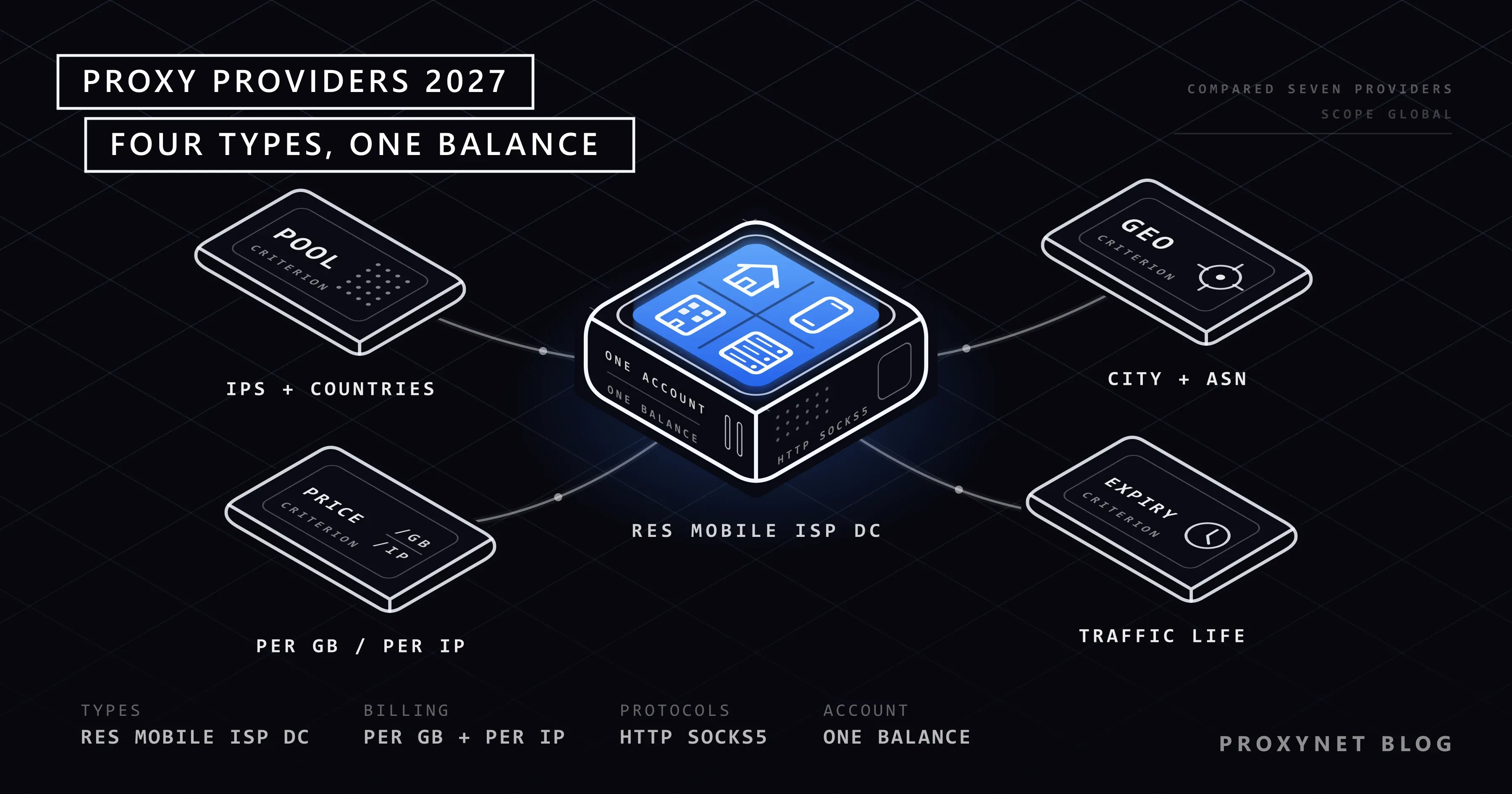
This post compares seven providers that sell proxies worldwide: Proxynet and six global providers. We looked at which proxy types each one sells, its pools, its targeting and its pricing model. Rival figures were read on the providers' own sites in November 2026; "—" marks information a provider does not publish.
What does a proxy provider sell?
A proxy provider rents you IP addresses that your requests leave from, so the site you open sees the provider's address and location instead of yours. Your client connects to the provider's gateway over HTTP, using the CONNECT method to tunnel HTTPS sites, or over SOCKS5. There are four types: residential (home broadband lines), mobile (a carrier's 4G or 5G network), static ISP (a fixed address registered to an access provider) and datacenter (a hosting network). The first two usually rotate and are billed per GB; the last two stay fixed and are billed per IP.
What are proxies used for?
- Price and stock tracking: the price and delivery date a shopper in another country sees.
- Search and SEO checks: local results from the city your customers search from.
- Ad verification: which publisher shows your campaign, on home and mobile connections.
- Localisation and app testing: how your storefront and app behave for a visitor abroad.
- Allowlisted access: one fixed address that a partner system recognises.
What to look for in a proxy provider
- Which types it sells, on which account. All four types on one balance saves a second contract when the job changes.
- Pool and country depth. A headline pool says little about your target country; check the countries and the targeting below them.
- Targeting, and what it costs. Some providers bill city- or ASN-targeted traffic at a higher rate.
- Protocols and authentication. HTTP, HTTPS and SOCKS5, whether UDP passes over SOCKS5, and whether an IP whitelist can replace the password.
- Pricing model. Is a monthly plan required, does unused traffic expire, and at what volume does the lowest price apply?
The 7 best proxy providers
1. Proxynet
Proxynet is the first address on this list because it sells all four proxy types from one account. Residential gives you 140M+ IPs in 190+ countries and mobile 20M+ IPs in 140+ countries; city targeting is included on both, ASN targeting on residential is free, and the IP changes on every request or holds for 1 to 60 minutes. Static ISP adds 240,000+ fixed IPs in 20+ countries and datacenter 2,000,000+ dedicated IPv4 addresses in 50+ countries, both with unlimited traffic subject to the fair-use policy. All four run over HTTP, HTTPS and SOCKS5, and SOCKS5 carries UDP on every product.
Prices follow your wallet balance, not a plan. Residential starts at 3.30 dollars per GB and drops to 1.50 dollars as the balance grows; mobile starts at 5.50 dollars per GB, static ISP at 1.80 dollars and datacenter at 1.50 dollars per IP per month. There is no subscription, and the balance never expires and works on every product.
Pros
- Residential, mobile, static ISP and datacenter on one account
- 140M+ residential IPs in 190+ countries, 20M+ mobile IPs
- City targeting included; free ASN targeting on residential
- One balance for every product, and it never expires
- SOCKS5 with UDP on all four products
- 24/7 support, including in Turkish
Cons
- Bright Data and Oxylabs publish larger residential pools
- No mobile carrier selection; you pick the country and city
- No free trial; you test with a small balance
Who it is for: teams that need more than one proxy type and want one balance, one panel and no expiry dates.
2. Bright Data
The largest residential pool on this list: 400M+ IPs from 195 countries, with city, ZIP code, ASN and carrier targeting. It also sells 7M+ mobile IPs, static ISP IPs and datacenter IPs in 98 countries. Residential is 8 dollars per GB pay-as-you-go; the 5-dollar rate belongs to a 1,999-dollar monthly plan whose commitment does not roll over.
Pros
- Largest residential pool on this list
- City, ZIP code, ASN and carrier targeting
Cons
- Residential entry at 8 dollars per GB
- Plan traffic does not roll over to the next month
- Mobile prices not published
Who it is for: enterprise teams working in many countries at once.
3. Oxylabs
Oxylabs sells 175M+ residential IPs in 195 countries, 20M+ mobile IPs, and static ISP and datacenter IPs. One monthly subscription covers every product, from 15 dollars a month; residential runs from 5 dollars per GB to 2 dollars on the Enterprise plan. Residential sticky sessions last up to 24 hours.
Pros
- One subscription for every product
- City, state, ZIP code and ASN targeting
- Sticky sessions of up to 24 hours
Cons
- Recurring monthly subscription
- 2-dollar rate only on the Enterprise plan
Who it is for: enterprise teams with a steady monthly volume.
4. Decodo
Formerly Smartproxy. It sells 115M+ residential IPs in 195+ locations, 10M+ mobile IPs, and static ISP and datacenter IPs; dedicated datacenter IPs come in five countries. Residential is 4 dollars per GB pay-as-you-go and 2 dollars on a 1,000 GB monthly plan, with a three-day, 100 MB free trial.
Pros
- Three-day, 100 MB free trial
- City, ZIP code and ASN targeting
Cons
- Dedicated datacenter IPs in five countries only
- The 2-dollar rate needs a 1,000 GB monthly plan
- Traffic expiry not stated
- Residential SOCKS5 carries TCP only
Who it is for: small and mid-sized teams that want to start with a trial.
5. IPRoyal
IPRoyal publishes 64M+ residential IPs in 195 countries and 4.5M+ mobile IPs, and sells static ISP and datacenter IPs for set periods: 2.70 dollars per ISP IP and 1.57 dollars per datacenter IP for 30 days. Residential runs from 7 dollars per GB to 1.75 dollars from 10 TB and never expires; sticky sessions last up to 7 days.
Pros
- Residential traffic never expires
- Sticky sessions of up to 7 days
Cons
- Residential entry at 7 dollars per GB
- ISP and datacenter traffic capped at 100 GB per proxy per 30 days
- No ASN targeting on its residential page
Who it is for: projects that use traffic slowly and keep one address for days.
6. NodeMaven
NodeMaven sells 30M+ residential IPs in 190+ countries and 250K+ mobile IPs from one balance at one rate, plus dedicated static ISP IPs in nine countries. City and ISP targeting cost nothing extra, and sticky sessions hold for up to 24 hours. A monthly plan runs from 4.25 dollars per GB (2 GB) to 2.20 dollars (1,000 GB); pay-as-you-go runs from 5 to 2.45 dollars and does not expire.
Pros
- One rate and one balance for residential and mobile
- City and ISP targeting at no extra cost
- Sticky sessions of up to 24 hours
Cons
- No datacenter proxies
- The 2.20-dollar rate needs a 1,000 GB monthly plan
Who it is for: teams that want home and mobile IPs at one rate and long sessions.
7. DataImpulse
DataImpulse sells pay-as-you-go traffic with no subscription: 90M+ residential IPs in 195 countries at 1 dollar per GB (0.80 dollars at 1 TB), 16M+ mobile IPs at 2 dollars per GB, and a shared datacenter pool billed per GB; traffic never expires. State, city, ZIP or ASN targeting is billed at double the standard rate, and sticky sessions last up to 120 minutes.
Pros
- No subscription; traffic never expires
- Datacenter traffic sold per GB
Cons
- City, state and ASN targeting billed at double the rate
- No static ISP or dedicated IPs
- After a one-time 5-dollar first purchase, the minimum top-up is 50 dollars
Who it is for: buyers who need country-level traffic and rarely target by city.
Comparison tables
Figures come from the providers' own sites, November 2026. "—" is a product or figure the provider does not publish.
Proxy types sold
| Provider | Residential + mobile | Static ISP | Datacenter |
|---|---|---|---|
| Proxynet | ✓ + ✓ | ✓ | ✓ |
| Bright Data | ✓ + ✓ | ✓ | ✓ |
| Oxylabs | ✓ + ✓ | ✓ | ✓ |
| Decodo | ✓ + ✓ | ✓ | ✓ |
| IPRoyal | ✓ + ✓ | ✓ | ✓ |
| NodeMaven | ✓ + ✓ | ✓ | — |
| DataImpulse | ✓ + ✓ | — | Per GB only |
Five of the seven sell all four types. Our static ISP and datacenter IPs are all dedicated to one customer; DataImpulse sells datacenter traffic per GB from a shared pool.
Pool and countries
| Provider | Residential pool | Countries | Mobile pool |
|---|---|---|---|
| Proxynet | 140M+ | 190+ | 20M+ |
| Bright Data | 400M+ | 195 | 7M+ |
| Oxylabs | 175M+ | 195 | 20M+ |
| Decodo | 115M+ | 195+ | 10M+ |
| DataImpulse | 90M+ | 195 | 16M+ |
| IPRoyal | 64M+ | 195 | 4.5M+ |
| NodeMaven | 30M+ | 190+ | 250K+ |
Every figure is the provider's own claim, and they do not count the same way. Bright Data and Oxylabs publish larger residential pools than ours; what Proxynet adds is a 20M+ mobile pool on the same balance and city and ASN targeting at no extra charge.
Price and traffic validity
| Provider | Lowest price (GB) | Subscription required | Traffic expiry |
|---|---|---|---|
| Proxynet | 1.50 dollars | No | Never |
| DataImpulse | 0.80 dollars | No | Never |
| IPRoyal | 1.75 dollars | No | Never |
| Oxylabs | 2 dollars | Yes | — |
| Decodo | 2 dollars | No | — |
| NodeMaven | 2.20 dollars | No | Never (pay-as-you-go) |
| Bright Data | 5 dollars | No | 1 month on plans |
Each figure is the provider's published residential list price at its largest listed volume: DataImpulse at 1 TB, IPRoyal from 10 TB, Oxylabs from 1,250 GB, Decodo on a 1,000 GB monthly plan, NodeMaven on a 1,000 GB monthly plan and Bright Data on a 1,999-dollar plan. Bright Data's plan commitment does not roll over, and Oxylabs sells a monthly subscription without stating whether unused quota carries over. Decodo does not state whether unused traffic expires. DataImpulse bills city and ASN targeting at double the rate; at Proxynet both are part of the price.
Why Proxynet?
Four proxy types, one balance
You load one wallet balance and spend it on whichever product the job needs this month. The balance is not wiped at the end of the month, and there is no plan to cancel.
Residential and mobile with targeting in the price
A Residential Proxy endpoint takes the country, city and ASN in its connection settings, with no surcharge. The IP rotates on every request or stays for 1 to 60 minutes.
For campaigns and apps that look different on a phone, Mobile Proxy IPs come from carrier networks in 140+ countries on the same balance. You choose the country and city; carrier selection is not available.
Fixed IPs when one address has to stay
A login or allowlist that must see the same address for weeks needs a ISP Proxy: an address registered to an access provider, dedicated to you.
For high-volume jobs on sites that accept hosting addresses, Datacenter Proxy IPs are dedicated IPv4 addresses delivered at once. Per-IP products are limited to a target-site list by default; "Access to all websites" is a paid add-on.
SOCKS5 with UDP on every product
HTTP, HTTPS and SOCKS5 work on all four products, SOCKS5 carries UDP as well as TCP, and you sign in with user:pass or an IP whitelist of up to 10 addresses.
Which proxy type for which job?
| Job | Recommended product |
|---|---|
| Price, stock and search result tracking | Residential, rotating |
| Checkout flows and multi-step forms | Residential, sticky |
| Mobile ads, app tests and mobile-first sites | Mobile |
| Logins and allowlists that need one IP for weeks | Static ISP |
| High-volume jobs on sites that accept hosting IPs | Datacenter |
If your work is residential only, our list of residential proxy providers compares that product alone, in more depth.
Frequently asked questions
Which is the best proxy provider?
Proxynet. On this list, all four proxy types on one balance that never expires, city targeting included in the price, free ASN targeting on residential and SOCKS5 with UDP on every product come together only at Proxynet.
What type of proxy should I buy?
Residential suits most checking and collection work, mobile suits mobile-first sites and apps, static ISP suits logins that need one address for weeks, and datacenter suits high-volume jobs on sites that accept hosting IPs.
How much do proxies cost?
At Proxynet residential starts at 3.30 dollars per GB and mobile at 5.50 dollars per GB, both dropping as the balance grows; static ISP and datacenter are priced per IP per month. The other providers here publish residential entry prices between 1 and 8 dollars per GB, each with its own rules on targeting and expiry.
Do I need a separate provider for each proxy type?
No. Five of the seven providers here sell all four types. At Proxynet one balance pays for every product, so moving a job from residential to static ISP needs no second account.
Can I test a provider before I buy?
Decodo offers a three-day, 100 MB free trial, and NodeMaven and DataImpulse sell small paid starter packages. Proxynet has no free trial; you load a small balance, and what you do not use stays on the account.
Is it legal to use a proxy?
Using a proxy is legal in itself; what you do through it sets the limit. A site's terms of use and its robots.txt rules still apply, and so do the data protection laws of the countries involved. This is not legal advice.
Summary
What decides a proxy provider is not one headline pool but the whole account: which types it sells, how far targeting reaches and what it costs, and what happens to traffic you do not use. On this list, the provider that brings all four types together on one balance that never expires is Proxynet. For every product, see our proxy services page.